
Bareboat catamaran charters typically start around $4,000 to $7,000 per week for a modest 35 to 40 foot boat, while a skippered version of that same vessel runs higher once you add a professional at the helm. Fully crewed catamarans for remote or dive-focused itineraries often begin near $15,000 a week and climb well past $50,000 for larger, luxury-class vessels. Add the Advanced Provisioning Allowance, fuel, and marina fees, and your final bill can land 20 to 40% above the quoted base rate.
TL;DR:
- The total cost of a catamaran charter can increase by 20 to 40 percent once additional expenses like fuel, provisioning, marina fees, and taxes are included.
- Larger vessels and luxury yachts can cost significantly more, with prices reaching over $50,000 weekly for luxury models with full crew and high-end amenities.
- Booking during high season or in destination-specific peak times can substantially raise prices and limit availability, especially for popular or large vessels.
- Smaller and shoulder-season charters tend to offer better per-day value, especially when anchoring instead of marina dockings and pre-arranged provisioning are used to cut costs.
- Calculating the real per-person price involves adding all line items such as APA, gratuity, and taxes to the base rate and dividing by the guest count, with larger groups typically reducing individual costs.
Table of Contents
- Catamaran Charter Cost by Charter Type and Boat Size
- What's Included in the Base Rate, and What Costs Extra?
- How Do You Calculate Your Real Per-Person Cost?
- Does Season and Destination Change the Price?
- Smart Ways to Trim Your Charter Budget
- What Should You Verify Before You Pay?
- Are Luxury Catamarans Worth the Price Jump?
- How Long Should Your Charter Be?
- Planning for the Unexpected
- When Does Hiring a Charter Specialist Make Sense?
- Get a Personalized Catamaran Charter Estimate
- Sources
Catamaran Charter Cost by Charter Type and Boat Size
The base weekly rate is only the entry point, and it shifts dramatically depending on who's sailing your boat and how big it is. Understanding the three charter models is the first real step toward an honest catamaran charter cost estimate, because each one redistributes labor, risk, and price in a different way.
Bareboat charters put you at the helm with no crew aboard. You need a sailing résumé and often a certification to qualify, but you pay the least for the privilege. Skippered charters add a single professional captain to run the boat while you and your group handle the rest, including your own cooking and provisioning. Crewed charters include a full team, typically a captain and a chef or mate, who handle navigation, meals, and logistics from the moment you step aboard.
Vessel size moves the price almost as much as the charter model does. Here's roughly how the market breaks down by size band:
- Small catamarans (35 to 40 feet): Comfortably sleep 4 to 6 guests; bareboat rates commonly fall between $4,000 and $8,000 per week depending on region and season.
- Mid-size catamarans (42 to 50 feet): Handle 6 to 10 guests across three or four cabins; skippered and crewed rates in this band often run $10,000 to $25,000 weekly.
- Large and luxury catamarans (55 feet and up): Built for 8 to 12 guests with multiple crew, these vessels can command $30,000 to $80,000 or more per week, particularly in remote or expedition-style destinations.
One detail trips up a lot of first-time charterers: nearly every price you'll see quoted is a weekly figure built around a Saturday-to-Saturday turnover, the standard cycle most charter bases use worldwide. Ask about a shorter trip, say four or five days, and you'll usually pay a disproportionately higher day rate rather than a clean fraction of the week, since operators still have to cover the same cleaning, provisioning, and crew logistics on either end. If your schedule is flexible, a full week almost always delivers better value per day than a truncated one. For a closer look at how these figures shift across specific boats and builders, Exoticacharters' catamaran yacht charter listings show current base rates by model.
What's Included in the Base Rate, and What Costs Extra?
Charter pricing follows one of two structures, and knowing which one you're looking at changes how you should read a quote. All-inclusive pricing bundles most operating costs into a single number, common on some bareboat fleets in popular sailing regions. Plus-expenses pricing, the norm for crewed and many skippered charters, quotes only the vessel and base crew, with everything else billed separately through the Advanced Provisioning Allowance, or APA.
The APA exists because fuel, food, and port costs fluctuate constantly and vary by itinerary, so operators would otherwise have to guess at a fixed markup and pad every quote to cover themselves. Any unspent balance is refunded after the charter, and any shortfall gets settled before you disembark.
Beyond the APA, expect these recurring line items on most crewed and skippered quotes:
- Skipper and crew fees — sometimes built into the base rate, sometimes billed separately depending on the operator.
- Provisioning — food and beverage costs, drawn from APA unless you've arranged a pre-paid package.
- Fuel — variable by engine hours and itinerary, settled through APA.
- Marina and berth fees — charged when the boat overnights in a paid slip rather than at anchor.
- Taxes and government fees — VAT or local cruising taxes, depending on the charter region.
- Damage deposit or damage waiver — a refundable security deposit, or a one-time fee to waive it, typically settled by card or wire before boarding, as detailed in regional charter listings.
- Crew gratuity — customarily 10 to 15% of the base charter fee, usually paid in cash at the end of the week.
Some listings also tack on smaller extras, like starter provisioning packs or booking handling fees, the kind of line items you'll spot on detailed catamaran rental listings if you read past the headline price.
Pro Tip: Ask for an itemized APA settlement statement before you pay any balance due at the end of the trip. Reputable operators track every fuel purchase and provisioning receipt, and a clear accounting protects you from disputed charges after you've already left the boat.
How Do You Calculate Your Real Per-Person Cost?
Take the base rate, add every line item from the previous section, then divide by your headcount. That's the whole formula, but the devil is in remembering all the pieces before you commit to a number that sounds affordable on the surface.
Start with the base weekly charter fee, then stack on APA, crew gratuity, any damage waiver fee, and taxes. Divide the grand total by the number of guests, not the number of cabins, since most groups don't fill every berth. Here's how that plays out for a mid-size crewed catamaran with 7 guests aboard:
Copy this template for your own group:
- Base weekly rate ÷ nothing yet, just note it
- Add APA (usually 25 to 40% of base)
- Add gratuity (10 to 15% of base)
- Add damage waiver or deposit insurance
- Add taxes and any local fees
- Divide the sum by total guest count
Group size is the single biggest lever you control. A family of four splitting a $20,000 week pays roughly double per head what a full 8 guest booking on the same boat would pay, which is why larger vessels like those featured among Exoticacharters' 8 cabin power catamaran charters often deliver a lower per-person rate despite a higher sticker price.
Does Season and Destination Change the Price?
Yes, and often by a wider margin than most first-time charterers expect. Charter operators run tiered pricing calendars, and the same catamaran can cost noticeably more in peak weeks than it does just a few weeks earlier or later, a pattern visible on any detailed weekly price calendar from a working charter fleet.
High season, generally the school-holiday and best-weather windows in any given region, pushes rates up and shrinks availability months in advance. Shoulder season, the weeks bracketing peak demand, often delivers the same boat and crew for noticeably less, with the trade-off being slightly less predictable weather in some regions.
Destination adds its own cost layers on top of seasonality:
- Marina fees vary enormously by region, and catamarans specifically face a beam surcharge in many harbors, since berths are priced by width rather than length alone, making a wide-beam cat cost more to dock than a monohull of similar length.
- Fuel prices swing by country and directly affect your APA drawdown on longer, more mobile itineraries.
- Local taxes, including VAT in some regions and cruising permits in others, get layered onto the final settlement.
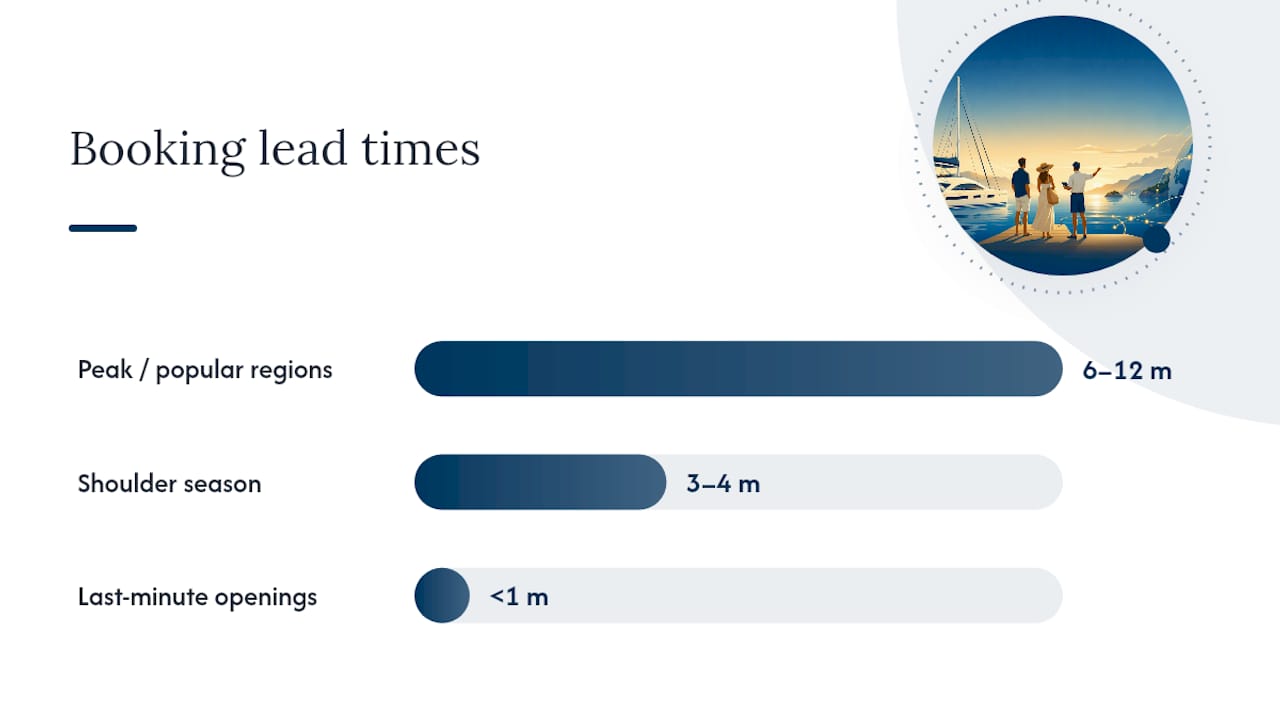
For booking timing, six to twelve months ahead is the safe window for popular regions and peak weeks, especially for larger or specialized vessels. Booking three to four months out in shoulder season can still land a strong rate, and last-minute openings occasionally surface at a discount when an operator needs to fill a gap in the calendar.
Smart Ways to Trim Your Charter Budget
Cost control on a catamaran charter isn't about cutting corners on the experience, it's about being deliberate with the variables that actually move the number. A few tactics consistently make the biggest difference:
- Shift toward shoulder season rather than peak weeks to capture lower base rates and easier availability.
- Limit marina nights in favor of anchoring out, since berth fees add up fast, particularly for wide-beam catamarans.
- Pre-arrange provisioning with the crew ahead of time to avoid last-minute markups on food and beverage.
- Fill the boat with a full guest count to lower the per-person split.
- Consider deposit insurance instead of a larger cash damage deposit if your operator offers it.
- Weigh skippered against crewed honestly: a skipper alone costs less but leaves you cooking and cleaning; a full crew costs more but frees up the entire week.
Pro Tip: Former captains often say the biggest APA overruns come from unplanned fuel use, extra engine hours spent chasing better anchorages or weather. Ask your captain to flag fuel-heavy days in advance so you can decide together whether the detour is worth the spend.
What Should You Verify Before You Pay?
A seasoned charter team catches the details that cost first-timers money later. Before signing anything, confirm the vessel's name, specs, and cabin configuration match the contract exactly, along with the APA policy, payment method, and settlement timeline. Ask about crew qualifications, the damage deposit amount, and whether deposit insurance is available as an alternative to a large cash hold. Clarify the fuel policy and who handles customs or permit paperwork in multi-island itineraries.
Former captains with charter experience offer a few habits worth adopting: track your APA spend daily rather than waiting until the last night, keep every receipt the crew hands you, and ask to anchor rather than dock when the itinerary allows it. Small habits like these routinely save several hundred dollars over a week-long trip without changing anything about the experience itself.
Are Luxury Catamarans Worth the Price Jump?
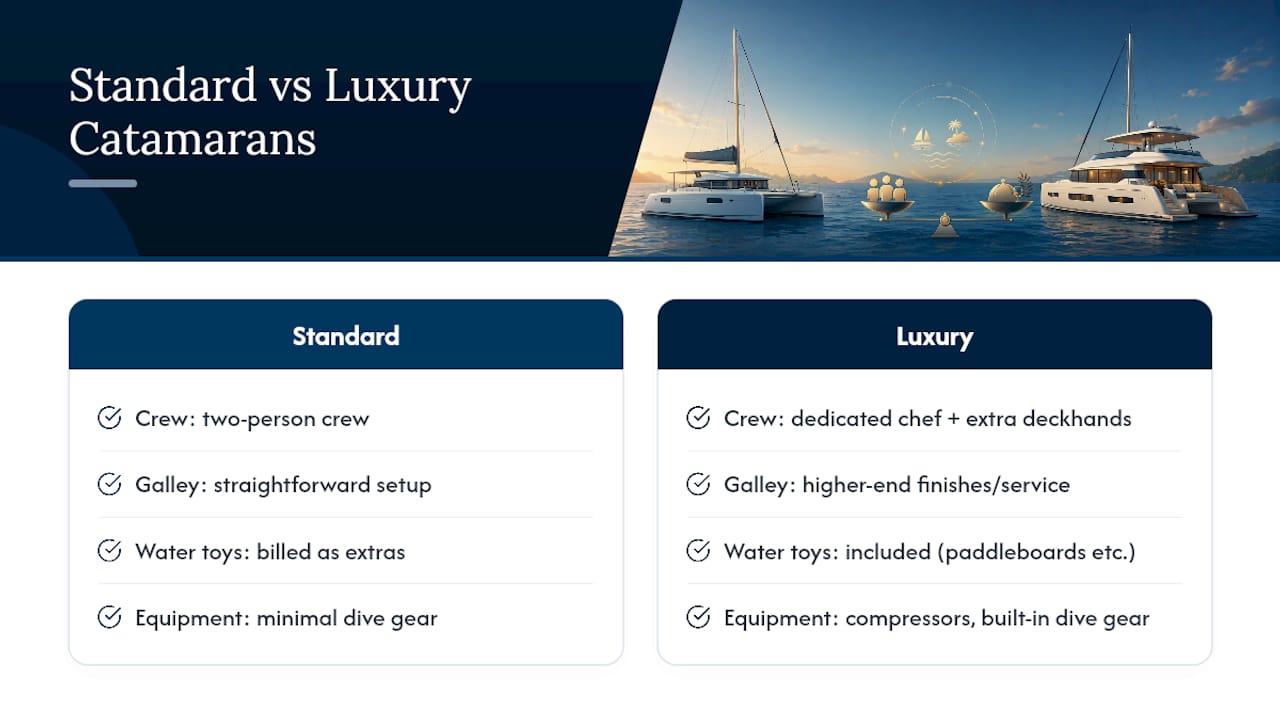
The gap between a standard charter catamaran and a luxury one isn't just cosmetic, and the price difference reflects real operational costs. Luxury vessels carry larger crews, higher-end finishes, more sophisticated water toys and dive equipment, and often newer engines that burn fuel more efficiently despite higher horsepower.
A standard mid-size catamaran might run with a two-person crew and a straightforward galley setup. A luxury equivalent for dive and expedition itineraries often carries a dedicated chef, additional deckhands for water sports, and gear like compressors or paddleboards built into the charter fee rather than billed as extras. This crew depth shows up directly in the weekly rate, but it also shows up in what you get: faster response to weather changes, more ambitious itineraries, and less of your week spent on logistics you'd otherwise handle yourself.
For groups prioritizing diving or wildlife encounters in remote regions, the luxury tier often pays for itself in access alone, since these vessels can reach anchorages and dive sites a standard charter boat simply isn't equipped or crewed to handle safely. Builder-specific pages, like those covering Fountaine Pajot models, illustrate how much variation exists even within a single manufacturer's catamaran lineup.
How Long Should Your Charter Be?
A full week remains the industry standard, and for good reason: it's the block most operators build their crew schedules, provisioning runs, and cleaning turnovers around. Shorter charters exist, typically three to five days, but they rarely offer proportional savings.
Longer charters, two weeks or more, sometimes unlock a modest per-week discount, since the crew avoids a turnover cycle mid-trip and provisioning runs get more efficient at scale.
For most leisure groups, a single week strikes the right balance between cost efficiency and enough time to actually settle into remote anchorages without feeling rushed. If you're weighing a shorter getaway, ask your broker directly whether a partial week reflects real savings or just a smaller number on a proportionally higher day rate.
Planning for the Unexpected
Even a carefully budgeted charter runs into surprises, usually weather-driven detours, unplanned fuel use, or a provisioning run that costs more than estimated. The smart move is building a cushion into your budget rather than treating the quoted total as a hard ceiling.
This covers scenarios like an extra night in a marina due to weather, a last-minute provisioning top-up, or minor incidentals the crew fronts and expects reimbursed. Ask your operator or broker what happens if the APA runs short mid-week. Reputable crews will flag a shortfall early and ask for a top-up rather than springing it on you at settlement.
It's also worth setting aside a small personal contingency separate from the group APA, for things like shore excursions, dive gear rental, or souvenirs that fall outside the charter's scope entirely. Groups that build in this cushion tend to enjoy the trip more, simply because nobody's mentally tallying every dollar against a number that had no room to breathe.
When Does Hiring a Charter Specialist Make Sense?
Self-booking works reasonably well for a straightforward bareboat week in a familiar sailing region. It gets riskier fast once your itinerary involves remote anchorages, dive logistics, multi-country permits, or a vessel and crew that need to be matched carefully to your group's experience level.
That's where a broker earns its keep. A good specialist vets the vessel and crew directly, builds an itinerary around your priorities rather than a generic template, coordinates provisioning suited to dietary needs or dive schedules, and stays reachable if something changes mid-trip. For expedition-style destinations like the Galápagos or Alaska, where permits and seasonal access windows genuinely complicate planning, that hands-on coordination often prevents costly mistakes rather than just adding convenience.
If your itinerary is anything but simple, the value of that guidance tends to show up well before you ever step aboard.
— Mo
Get a Personalized Catamaran Charter Estimate
Working out a realistic catamaran charter cost on your own takes real research time, and it's easy to miss a fee that surfaces later at settlement. Some brokers build personalized budget estimates around your group size, destination, and priorities, whether that's a dive-focused itinerary or a wildlife-heavy route through remote waters, so the number you see upfront reflects what you'll actually pay.
Teams staffed by experienced charter professionals handle vessel vetting, provisioning planning, and crew selection so you're not guessing at APA math from a spreadsheet. Browse current sailboat and catamaran charter options, or reach out directly for a quote tailored to your dates and destination. Request a personalized estimate today and get a clear, itemized picture of your total trip cost before you commit to anything.
Sources
- Privatejets
- Catamaran Fountaine Pajot Aura 51 6C for rent in Naples - Italy, South West Coast
- Fountaine Pajot Elba 45 - 4 + 1 cab. Limin' for rent in BVI / British Virgin Islands (38008)