A dive-focused yacht itinerary is defined as a crewed charter trip built entirely around underwater exploration, placing divers directly above the best reefs, wrecks, and walls the ocean holds. The industry term for this format is a "liveaboard yacht charter," and the benefits of dive-focused yacht itineraries go far beyond convenience. You get private access to remote reefs, a personalized instructor on board, and the freedom to dive on your schedule rather than a tour operator's. Destinations like Raja Ampat, the Maldives, and the Red Sea become genuinely immersive when your vessel is anchored above the site at dawn, not racing a day boat back to port by 3:00 PM.
1. What are the core benefits of dive-focused yacht itineraries?
Yacht-based diving gives you access to sites that shore-based tours simply cannot reach. Secluded reefs and remote anchorages are the defining advantage of a liveaboard charter. Day boats work from fixed marinas and fixed schedules. A private yacht moves with you, repositioning overnight so you wake up at a new site every morning.
The second core advantage is privacy. You share the water with your group, not with forty strangers from a resort dive center. That changes the quality of every dive. You move at your own pace, linger on a coral bommie as long as you like, and surface when you are ready.
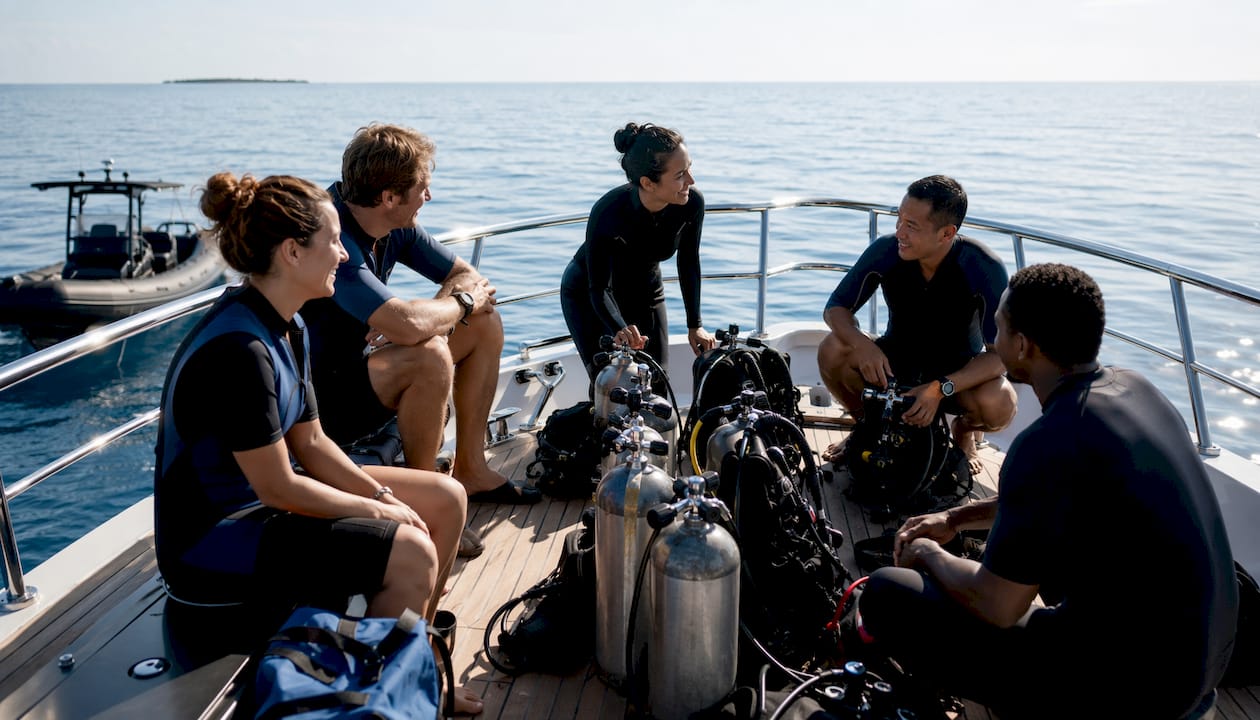
The third advantage is comfort between dives. Proper surface intervals spent in a well-appointed salon, eating a real meal and resting in a cabin, produce better dives than intervals spent on a crowded dive boat deck. Luxury and aquatic access combine on a modern dive yacht in a way that no land-based operation can replicate.
2. Direct access to remote dive sites
The most dramatic dive sites on the planet are not accessible by road or resort shuttle. They sit in open ocean, inside protected marine parks, or along coastlines with no infrastructure. A yacht is the only practical platform for reaching them.
Exoticacharters plans itineraries to destinations like the Galápagos, French Polynesia, and Alaska precisely because those locations reward the effort of getting there. The Galápagos, for example, offers hammerhead aggregations, whale sharks, and marine iguanas feeding underwater. None of those encounters happen reliably from shore.
Pro Tip: When reviewing a dive itinerary, check whether the anchorages are inside the marine protected area boundary. Sites inside the boundary consistently show higher fish biomass and coral cover than sites just outside it.
3. Flexible scheduling around dive conditions
Tides, currents, and visibility windows determine the quality of a dive far more than the site itself. A fixed-schedule shore excursion cannot adapt to those variables. A private yacht can.
Flexible itineraries that adapt to conditions are a structural advantage of yacht charter diving. If the current at a particular pass runs hard in the morning, the captain repositions to a sheltered wall and returns to the pass at slack tide. That kind of real-time adjustment is impossible on a resort dive schedule.
This flexibility also means you can fit in more dives per day. Three dives is standard on a liveaboard charter. Four is achievable on good days. Shore-based operations rarely offer more than two.
4. Personalized instruction and skill development
Private instruction on a yacht produces faster, more confident divers than group classes at a resort. Private instructor-to-student ratios on a liveaboard create a learning environment that a crowded resort pool cannot match. The instructor watches your buoyancy on every dive, corrects your trim in real time, and adjusts the lesson plan based on what they actually observe.
The pace is slower and more deliberate. That matters enormously for skill retention. A beginner who completes their open-water certification on a yacht charter typically exits the trip with more logged dives, better buoyancy control, and greater confidence than a beginner who completes the same certification in a resort pool followed by two check-out dives.
"Private yacht diving enhances skill acquisition by enabling slower, safer learning under expert supervision, leading to greater diver confidence."
Advanced divers benefit equally. A dive master on board can introduce you to drift diving, night diving, or deep wall techniques in conditions calibrated to your current skill level, not the lowest common denominator of a mixed group.
5. Multiple dive sites within a single trip
A well-planned scuba sailing itinerary covers more distinct ecosystems in one week than most divers visit in a year of resort trips. The yacht moves while you sleep. You wake up at a new site with fresh gear, a full tank, and a briefing from the dive master.
This multi-site structure is one of the clearest dive itinerary benefits. In the Coral Triangle, for example, a single week-long charter can take you from a black-sand muck diving site to an open-ocean seamount to a shallow coral garden, all within the same archipelago. Each environment hosts entirely different species assemblages.
Visiting multiple reefs and islands within one itinerary maximizes underwater exploration in a way that no fixed-base operation can. You are not commuting to the dive site. You are living on top of it.
6. Top global destinations for yacht charter diving
The world's premier dive destinations share one characteristic: they are best accessed by water. The table below outlines four regions that consistently deliver extraordinary underwater experiences on a yacht-based itinerary.
| Destination | Key Feature | Best Season |
|---|---|---|
| Maldives | Exceptional visibility, manta rays, whale sharks | november through april |
| Raja Ampat, Indonesia | Highest marine biodiversity on Earth | october through april |
| Red Sea, Egypt | Historic wrecks, dramatic walls, year-round warmth | march through may, september through november |
| British Virgin Islands | Calm, clear water, accessible reefs, the RMS Rhone wreck | december through april |
Calm, clear waters and rare marine life in these regions are only fully accessible by yacht. A resort in the Maldives places you on one atoll. A yacht itinerary places you on six.
Sustainable diving practices matter in all four regions. Careful buoyancy control and non-contact with coral are standard expectations on reputable liveaboard charters. Touching reef structures or chasing marine life causes measurable damage to ecosystems that took centuries to build.
7. Yacht features designed for serious divers
A dive-purpose yacht is a different vessel from a standard charter boat. The design choices reflect the demands of multiple daily dives by multiple guests.
Key features that distinguish a proper dive yacht include:
- Large swim platforms and dive tenders for easy water entry and exit, even in a light swell
- Dedicated gear storage with individual rinse tanks, wetsuit hangers, and labeled equipment bins
- Onboard air fills via a built-in compressor, eliminating the need to return to shore for tank refills
- Nitrox availability on higher-specification vessels, extending bottom time and reducing fatigue
- Decompression chambers on expedition-grade yachts operating in remote locations far from medical facilities
Swim platforms, gear storage, and dive tenders improve ease of water access and gear management on every dive. These are not luxury extras. They are operational necessities for a serious dive program.
Pro Tip: Before booking, confirm whether the yacht carries a built-in compressor or relies on pre-filled tanks. A compressor means unlimited fills and the freedom to add a fourth dive on exceptional days.
8. Accommodating all diver skill levels
A well-crewed dive yacht serves beginners and experienced divers simultaneously. Onboard gear provisions and professional guidance accommodate a broad range of skill levels within the same charter group. The dive master can take a certified diver to 30 meters on a wall while a beginner completes a shallow reef orientation with the second instructor.
This flexibility makes yacht charter diving ideal for mixed-ability groups, whether that means a family where the parents are certified and the teenagers are not, or a group of friends at different certification levels. The itinerary does not have to be designed for the least experienced person in the group.
Luxury charters customize dive programs and provide equipment for every guest. That customization extends to the briefing, the site selection, and the post-dive debrief. Every diver gets a program that matches their actual ability.
9. Environmental responsibility built into the itinerary
Responsible yacht operators integrate conservation practices directly into the dive program. This is not incidental. It reflects the reality that the sites these itineraries depend on are fragile and finite.
Reputable liveaboard charters enforce no-touch protocols, maintain safe distances from large pelagic species, and brief guests on the specific sensitivities of each site before entering the water. Some operators contribute to reef monitoring programs, recording coral health data on every dive. That kind of structured environmental stewardship is rare on shore-based excursions, where high guest turnover makes consistent briefings difficult.
The divers who benefit most from these protocols are the divers themselves. Healthy reefs produce the encounters that make a dive trip extraordinary. Protecting the ecosystem is the same as protecting the experience.
Key Takeaways
Dive-focused yacht itineraries deliver access, flexibility, and personalized instruction that shore-based diving cannot match, making them the most effective format for serious underwater exploration.
| Point | Details |
|---|---|
| Remote site access | Yachts reach protected reefs and open-ocean sites unreachable by shore-based day boats. |
| Flexible scheduling | Itineraries adapt to tides, currents, and visibility windows in real time. |
| Personalized instruction | Private instructor ratios produce faster skill development and greater diver confidence. |
| Multi-site coverage | Overnight repositioning allows divers to explore multiple distinct ecosystems in one trip. |
| Built-in sustainability | Reputable charters enforce no-touch protocols and brief guests on site-specific conservation. |
Why I think most divers underestimate the yacht format
Most divers I speak with have done their diving from resorts or day boats. They know the format: wake up, take a shuttle to the marina, wait for the group, do two dives, come back. It works. But it sets a ceiling on what the experience can be.
The first time I watched a group of mixed-ability divers complete a week-long liveaboard charter in a remote archipelago, the transformation was obvious. The beginner in the group entered the water nervous on day one. By day five, she was doing drift dives with the rest of the group. That progression happens because the environment is consistent, the instruction is continuous, and the dives accumulate quickly. You cannot replicate that on a two-dives-per-day resort schedule.
What surprises people most is how the luxury and the adventure reinforce each other rather than conflict. Resting well between dives, eating properly, and sleeping in a real cabin means you arrive at each site physically ready. The quality of the diving goes up because the quality of the recovery goes up. That connection is obvious in retrospect, but most divers do not think about it until they experience it.
The locations are the other revelation. Some of the most dramatic marine environments I have seen are places with no resort, no marina, and no infrastructure at all. The only way to reach them is by boat. That is not an inconvenience. That is the point.
— Mo
Exoticacharters and your next dive charter
Exoticacharters plans fully crewed dive-focused yacht charters to some of the world's most extraordinary marine environments, including the Red Sea, the Galápagos, and French Polynesia. Every vessel in the fleet is selected for its suitability to serious diving, with onboard compressors, dedicated gear storage, and professional dive staff who know the sites firsthand.
The team at Exoticacharters includes former captains and water sports professionals who plan each itinerary around actual dive conditions, not a generic template. Whether you are a certified diver looking for your first liveaboard experience or an advanced diver targeting a specific pelagic encounter, Exoticacharters matches you with the right vessel and the right route. Browse the full fleet of luxury dive yachts and speak with a charter specialist to build your itinerary.
FAQ
What is a dive-focused yacht itinerary?
A dive-focused yacht itinerary is a crewed liveaboard charter built around daily scuba diving, with the vessel repositioning overnight to place guests above new sites each morning. The format combines onboard instruction, gear provisions, and flexible scheduling to maximize underwater time.
How many dives per day can you do on a liveaboard charter?
Most liveaboard charters schedule three dives per day, with a fourth possible on favorable days. That pace is significantly higher than the one or two dives typical of shore-based resort excursions.
Are dive yacht charters suitable for beginners?
Yes. Onboard professional guidance accommodates beginners and experienced divers simultaneously, with customized programs and equipment provided for every guest. Beginners benefit from the slower, more deliberate pace that private instruction allows.
Which destinations work best for yacht-based diving?
The Maldives, Raja Ampat, the Red Sea, and the British Virgin Islands are among the world's top destinations for yacht charter diving, offering exceptional visibility, biodiversity, and sites only fully accessible by vessel.
What onboard features should a dive yacht have?
A proper dive yacht carries a built-in compressor, large swim platform, dedicated gear storage with rinse tanks, and professional dive staff. Expedition-grade vessels also carry decompression chambers for remote itineraries far from medical facilities.