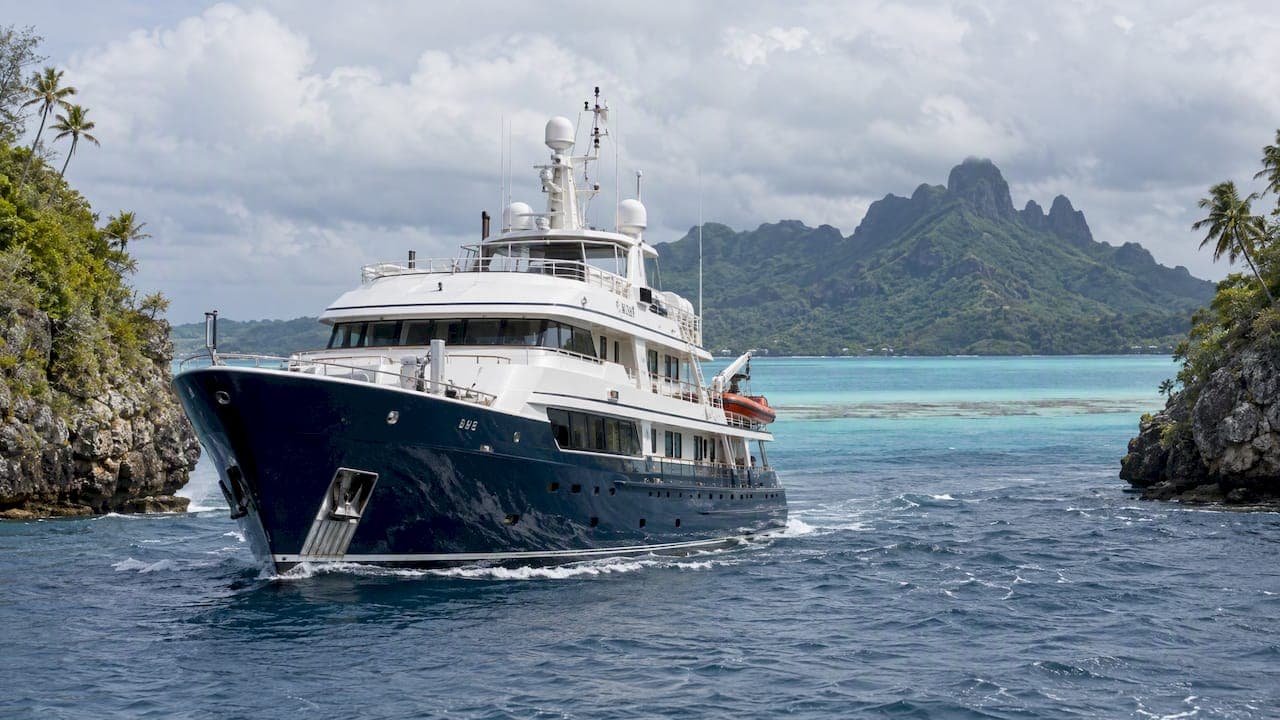
An expedition cruise is built around the place: small ships, landings by Zodiac, naturalist guides and an itinerary that bends to weather and wildlife. A luxury cruise is built around the ship: spacious suites, fine dining, spas and polished service, usually on a published port-to-port route. Neither is better in the abstract. The right one depends on whether you want to arrive somewhere extraordinary or to enjoy a beautiful floating resort along the way, and this guide helps you decide, with real figures and an honest look at a third option: a private crewed yacht.
TL;DR
- Expedition cruises put wildlife, scenery and exploration first; luxury cruises put onboard comfort, dining and service first.
- Most expedition ships carry 200 to 300 guests, while mainstream ships average around 3,000. Luxury ships sit in between, and newer hybrid ships blur the line.
- Expect expedition voyages to Antarctica or the Arctic to run around $1,000 per person per day or more, and luxury Galápagos cruises to run $900 to $1,500.
- Divers, wildlife enthusiasts and anyone chasing remote anchorages lean expedition; couples who value dining, spa time and calm lean luxury; families should weigh age limits and activity levels carefully.
- A private crewed yacht can combine expedition access with luxury service on your own schedule.
Table of Contents
- What actually separates the two
- Ship size and passenger numbers
- A day on board
- Destinations and access
- What each costs
- The hybrid: expedition with luxury touches
- Which suits you: divers, families, wildlife lovers and couples
- A third option: the private crewed yacht
- Plan a remote charter with us
- Our perspective
- FAQ
- Sources
What actually separates the two
The Cruise Lines International Association (CLIA) describes expedition cruising as centered on scenery, wildlife, nature, culture and the environment, with education and adventure at its heart. Classic cruises, by contrast, offer restaurants, bars and leisure facilities as the main event. Newer expedition ships can add luxurious touches, which is where the confusion begins.
A simple way to think about it: on a luxury cruise, the destination is the backdrop to your holiday. On an expedition, the destination is the holiday, and the ship is the vehicle that gets you into it.
The Los Angeles Times framed the trade-off as scale versus access: larger ships provide more entertainment and facilities, while smaller ships provide intimacy and entry to wilder places. That tension runs through every other comparison below.

Ship size and passenger numbers
Size shapes everything: how quickly you get ashore, how crowded the deck feels, how many restaurants there are, and which harbors and inlets the ship can enter.
CLIA's guide notes that mainstream ships average around 3,000 passengers, with the largest carrying nearly 7,000, while most expedition ships carry 200 to 300 and the largest about 500. Cruise Industry News's 2024 market report agrees: the vast majority of expedition vessels are in the 200-guest range.
Luxury ships are smaller than mainstream giants but are still resort-scale in what they offer. One 2024 CLIA report on a new luxury ship describes a 1:1.3 crew-to-guest ratio, butler service for every suite, several restaurants and lounges, pools and wellness facilities. Another describes a vessel with 461 oceanfront suites, six restaurants, 12 bars and lounges and four pools.
| Mainstream cruise | Luxury cruise | Expedition cruise | Private crewed yacht | |
|---|---|---|---|---|
| Typical guests | Around 3,000 on average | Several hundred | 200 to 300, up to about 500 | Your own party |
| Main draw | Entertainment and amenities | Service, dining, suites | Wildlife, landscapes, learning | Privacy and a custom route |
| Route | Fixed ports | Published ports, some scenic | Flexible, set by weather and wildlife | Designed around you |
| Evenings | Shows and nightlife | Fine dining, lounges | Briefings, low-key | Yours to shape |
The first three columns for guest numbers rest on the CLIA and Cruise Industry News figures above; the luxury range varies widely by ship.
A day on board
On an expedition, CLIA describes days as early and active: hikes, Zodiac wildlife viewing, kayaking or snorkeling, followed by evening briefings and generally low-key nights. You will not be dressing for a production show. You will be checking tide tables, layering up, and comparing notes on what the guides spotted.

On a luxury cruise, the rhythm is gentler and more discretionary. You might spend a morning ashore in a historic port, return for a long lunch, and book the spa in the afternoon. Nothing is demanded of you, and that is precisely the appeal for many couples.
The learning experience differs too. A review of a 378-passenger Antarctic expedition ship in Travel + Leisure describes scientists and naturalists on board, wildlife-focused talks, IAATO briefings and chances for guests to help with research. That is expedition cruising at its most developed: expertise turned into something you take part in, not just watch.
Destinations and access
CLIA explains that expedition ships are equipped for places larger vessels cannot reach, using Zodiacs, kayaks and sometimes helicopters or submarines. Routes, especially in polar regions, are adjusted to weather, sea conditions and wildlife sightings rather than a fixed port schedule.
That flexibility is both the magic and the caveat. If a pod of whales appears, the plan changes. If ice blocks a channel, the plan also changes. Travelers who need a guaranteed itinerary down to the hour will be happier on a luxury cruise with set ports; those who relish the unscripted will not mind.
Luxury cruising, meanwhile, covers the great sea routes: Mediterranean harbors, Caribbean islands, Alaska's scenic corridors. These are wonderful places, reached comfortably, but you will generally share them with more people and see them from a different angle.
What each costs
Expedition cruising is not cheap, and neither is luxury. The figures below give a realistic range, with the publication year so you can judge how current they are.
- Polar expeditions: The Points Guy reported in February 2026 that Antarctic and Arctic expedition cruises commonly reach $1,000 per person per day or more, and total trips can exceed $15,000 per person once flights and hotel stays are added.
- Galápagos: Travel + Leisure reported in 2025 that luxury cruises there generally cost $900 to $1,500 per person per day, first-class cruises $700 to $900, and tourist-superior cruises $500 to $700.
- Small versus large ships: The Los Angeles Times reported in 2019 that small-ship cruises commonly cost double or triple large-ship fares, while offering fewer large-ship attractions but more snorkeling, hiking and kayaking.
When you compare fares, check what is bundled. Expedition fares often include guided landings, expedition gear and lectures; luxury fares often include dining, drinks and gratuities. Flights, pre-cruise hotels and insurance are frequently extra on both. Planning the whole budget, not just the fare, is easier with the help of a concierge-style tours and adventures service that can handle surrounding logistics.
The hybrid: expedition with luxury touches
The market has moved toward the middle. Cruise Industry News reports that newer expedition ships increasingly offer multiple restaurants, bars, pool decks, full-service spas and entertainment venues, along with extensive floor-to-ceiling viewing areas.
A review of a 132-suite ship in Travel + Leisure shows the hybrid at work: Zodiac birdwatching, waterfalls and rock-art excursions paired with comfortable service and low-key evenings.
When comparing hybrid itineraries, check these points:
- Guest count. Fewer guests means faster, more frequent landings.
- Guide-to-guest ratio. Ask how many guides lead each landing group.
- Landing craft and activities. Zodiacs, kayaks, snorkeling gear and whether activities cost extra.
- Itinerary flexibility. Does the operator build in days to adapt to weather?
- What is included. Excursions, drinks, gear, transfers and flights.
Which suits you: divers, families, wildlife lovers and couples
Beyond the fares and ship statistics, the better question is what you want from the trip. Here is how we would steer different travelers.
Divers and snorkelers
Go expedition, or go private. Dive and snorkel access depends on the vessel's equipment, the number of guests sharing the water, and how freely the captain can reposition. Large luxury ships rarely stop where the underwater scenery is best. Ask any operator about compressors, tenders, guides and how often the schedule allows water time.
Wildlife enthusiasts
Expedition, almost without exception. Naturalist guides, small landing groups and routes that follow animal activity are what make the difference between seeing a penguin colony and understanding one. Where regulations cap landing numbers, smaller ships also spend more time ashore.
Couples seeking a remote getaway
It depends on temperament. If a romantic escape means spa treatments and a candlelit dinner, a luxury or hybrid ship is lovely. If it means a quiet anchorage, a sundowner on deck and a kayak at dawn, a small expedition vessel or a private yacht fits better.
Families
Families need to be selective. Expedition itineraries are active, early and sometimes demanding, and some polar voyages have age requirements, so confirm them with the operator before booking. Luxury ships offer kids' programs and variety, but little of the hands-on nature that many families want. For Galápagos in particular, our comparison of a crewed catamaran versus an expedition ship for families goes into detail.
A third option: the private crewed yacht
There is a choice that sits between the two and avoids the trade-off: chartering a yacht with its own captain and crew. You keep the remote access of an expedition and the service of a luxury cruise, but you share it only with the people you choose.
What changes is control. You set the pace, the anchorages and the activities, and the itinerary flexes around your group instead of 200 strangers. If you are choosing between specific regions, these comparisons may help:
- Antarctica by private crewed yacht versus expedition cruise
- What changes on a private yacht in Antarctica
- Galápagos cruise versus private yacht
To understand what sets a polar-capable vessel apart, see what makes a yacht suitable for polar or expedition waters. For budgeting, our page on how much an expedition charter costs explains the factors involved, and there is no published fixed price because each charter is built around the vessel, region and season.
Plan a remote charter with us
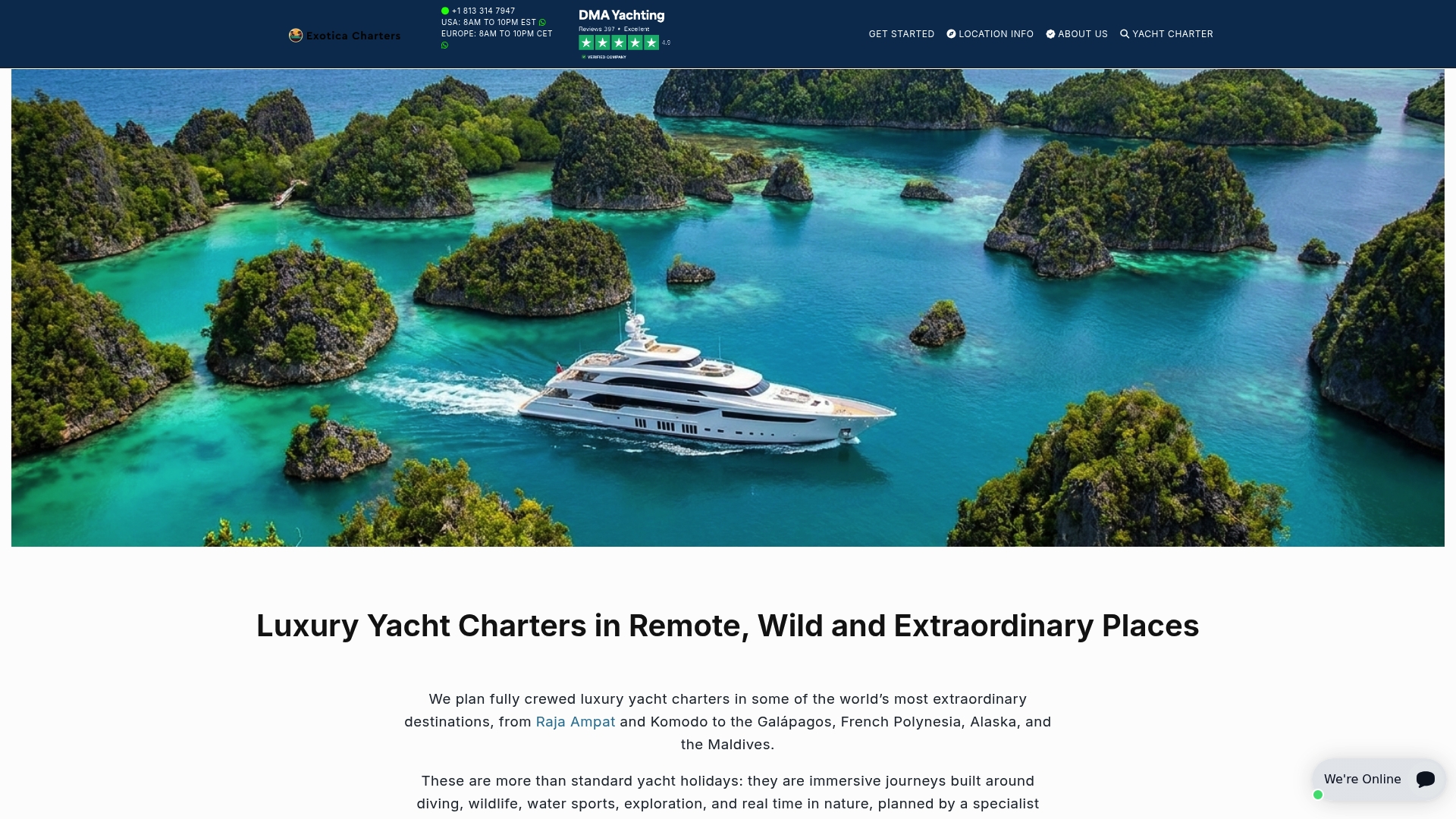
Exotica Charters plans fully crewed yacht charters to remote destinations such as the Galápagos, French Polynesia and Alaska, with itineraries shaped around diving, wildlife and adventure on the water. Our team is made up of former captains and water sports professionals, and we are rated highly on Trustpilot. Tell us what you want from the trip and we will propose vessels that fit, whether that is a sailing yacht, motor yacht, catamaran or expedition vessel.
Browse our luxury yachts or speak to a yacht charter specialist to start planning.
Our perspective
We have spent our careers on boats, and we have watched travelers choose a cruise for the wrong reason. They book a large luxury ship hoping for solitude among glaciers or coral, and find that the ship's scale keeps them a step removed. Others book a rugged expedition when what they wanted was a long, easy week with good food and a book.
Our advice is to decide first what you want to feel. If it is the thrill of being somewhere few people go, with a guide who can name every bird, choose expedition. If it is polished ease, choose luxury. If you want both, and want the freedom to change the plan when a pod of dolphins turns up alongside, a crewed yacht deserves a serious look.
We would also say this: ask any operator, including us, what happens on a bad-weather day, how many people share each landing, and what is truly included. Good answers are specific.
— Mo
FAQ
Is an expedition cruise more expensive than a luxury cruise?
Not always, but it often is per day. Polar expedition cruises commonly reach about $1,000 per person per day or more, and luxury Galápagos cruises run roughly $900 to $1,500 per person per day, according to the sources above. Compare what each fare includes before judging the headline number.
Can an expedition cruise be luxurious?
Yes. Newer expedition ships increasingly add multiple restaurants, spas, pool decks and large viewing lounges, according to Cruise Industry News. The core difference remains the itinerary: landings, guides and flexible routes rather than a fixed port schedule.
Are expedition cruises suitable for children?
Sometimes. Days are active and begin early, and some voyages set minimum ages, so check with the operator first. For families wanting a flexible pace, a private crewed charter lets you adapt activities to the children in your group.
What should I ask before booking an expedition cruise?
Ask how many guests share each landing, how many guides there are, what the weather contingency plan is, and which excursions, gear and transfers are included. Also ask how far the fare goes once flights and hotels are added.
Sources
- CLIA New to Cruise Guide: Expedition (2024)
- Cruise Industry News 2024 Expedition Market Report
- CLIA: luxury ship delivery report (2024)
- CLIA: new luxury ship celebration report (2024)
- Los Angeles Times: small ships versus big ships (2019)
- Travel + Leisure: Antarctic expedition ship review (2024)
- Travel + Leisure: hybrid expedition ship review (2024)
- The Points Guy: expedition cruising guide (2026)
- Travel + Leisure: choosing a Galápagos cruise (2025)
- Tours and adventures concierge service