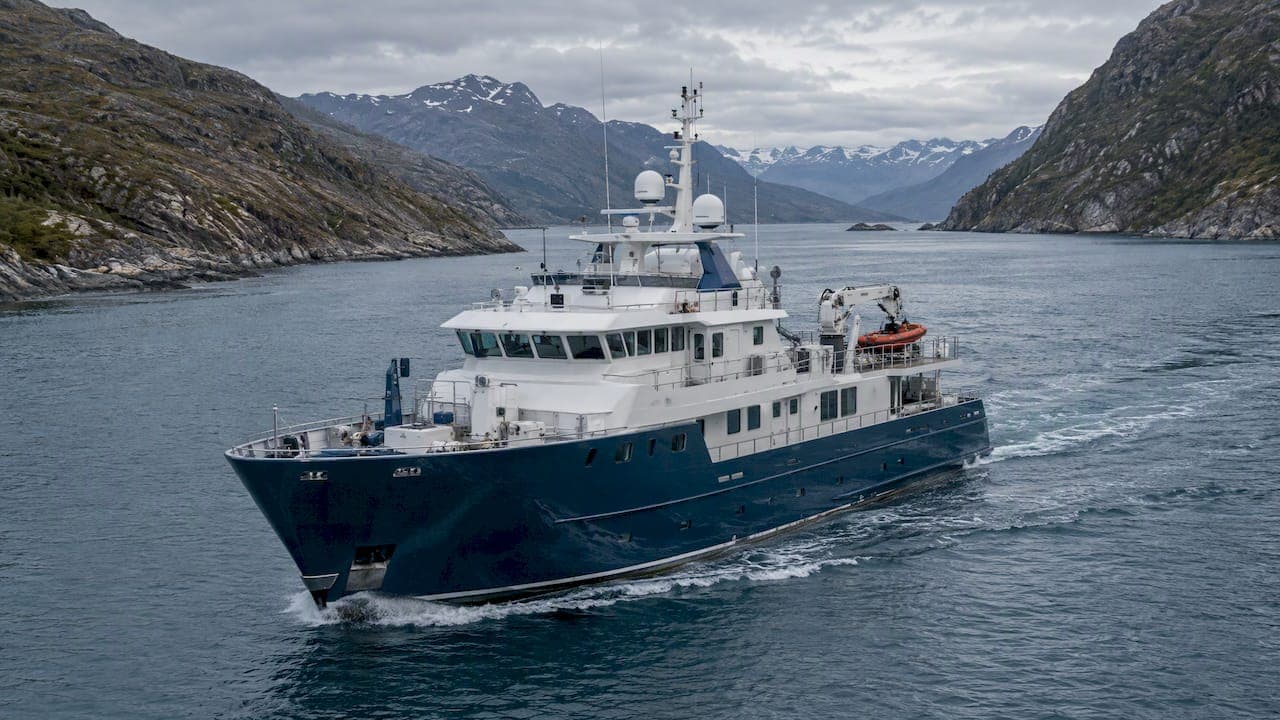
An expedition yacht is a vessel built, or converted, to cruise for long periods in remote places without relying on ports, fuel docks or repair yards. What separates it from a conventional motor yacht is not a rugged look but autonomy: the range, redundancy, storage and tenders that let you reach an anchorage few boats ever see, and stay there in comfort.
This guide walks through the features that matter, what each one means once you are aboard on a crewed charter, and how to judge whether a given yacht is truly built for the destination you have in mind.
TL;DR
- An expedition yacht is defined by self-sufficiency in remote areas: long range, deep storage for provisions and waste, and backup for critical systems.
- Strong hulls, redundant generators, steering and navigation, and satellite communications are the safety core.
- Tenders, dive gear, kayaks and observation space turn the yacht into a base camp for diving and wildlife.
- The terms "explorer" and "expedition" have no universal definition, so judge the yacht against your destination, not its label.
- On a charter, a specialist who has worked these waters can match vessel to itinerary before you commit.
Table of Contents
- What is an expedition yacht?
- Autonomy first: the idea behind every feature
- Hull strength and construction
- Range, fuel and speed
- Redundancy, navigation and safety systems
- Storage, provisioning and waste management
- Tenders and toys: how you actually reach the wild
- Comfort: the expedition yacht is still a yacht
- How these features serve different travelers
- Our perspective on choosing an expedition yacht
- Plan an expedition charter with specialists
- A short checklist before you book
- FAQ
- Sources
What is an expedition yacht?
Picture a yacht that can leave the last fuel dock behind, spend a month among islands with no marina and no chandlery, and still serve a hot dinner on deck at sunset. That is the idea. YachtBuyer describes an expedition yacht as a purpose-built or converted vessel designed for long-range, self-sufficient cruising in remote and challenging environments, with the endurance to remain off-grid for 30 days or more.
You will also hear the word "explorer." The two are used interchangeably, though some designers draw a line. BOAT International's 2022 explanation puts it this way: an explorer yacht can cross an ocean unsupported, while an expedition yacht must operate self-sufficiently in remote areas without shore-side support or infrastructure. Rob McCallum of EYOS Expeditions adds that all expedition yachts are explorers, but not every explorer has the autonomy that true expeditions demand.
The practical point for a charter guest is simple. SuperyachtNews notes that there is no universal definition, and that expedition design depends on the mission and the destination. A yacht suited to the Galápagos is not automatically the right vessel for Svalbard. The features below are the yardsticks.

Autonomy first: the idea behind every feature
McCallum's argument is worth remembering when you read a yacht brochure: autonomy, not a rugged appearance, is the defining expedition characteristic. A boat with a chunky profile and a painted-on explorer look may carry little fuel, little storage and one of everything. A plainer-looking vessel with deep tanks and doubled systems may be far more capable.
Autonomy shows up in four places:
- Range and fuel: how far the yacht goes between refuelings.
- Stores: how much food, water, spares and waste capacity it carries.
- Redundancy: what happens when a generator, pump or navigation unit fails far from help.
- Access: the tenders and equipment that get guests from the yacht to the reef, the beach or the glacier edge.
Everything else, from stabilizers to the spa pool, is either supporting these four or a comfort layer on top of them.
Hull strength and construction
A hull built for remote water is built to take knocks: floating debris, uncharted rocks, a poorly defined anchorage, or ice. Designers talk about heavier plating, double bottoms, watertight subdivision and protected running gear, the propellers and rudders that suffer first when you work close to shore. Seattle Yachts' owner FAQ notes that full-displacement hulls are common on expedition yachts because they can carry the tanks and stores that self-sufficiency requires, and that such boats often include protected running gear.

Ice class: only if your itinerary needs it
Ice-strengthened hulls matter in polar waters and are written into many explorer designs. They are not a requirement for tropical diving. If your plans point toward the Arctic, ask the specialist exactly which ice notation a yacht holds and what it permits in practice. We cover this in more depth in our guide to what makes a yacht suitable for polar or expedition waters, and our Arctic charter area page shows where those vessels cruise.
Motion at sea
Remote crossings are rarely short. Stabilizers, whether fin or at-anchor systems, and a hull shaped for a gentle motion make the difference between a trip people remember for the wildlife and one they remember for seasickness. When you compare yachts, ask about stabilization underway and at anchor; both matter, and they are different systems.
Range, fuel and speed
Range is the most quoted figure and the most misunderstood. According to YachtBuyer, expedition yachts typically have fuel capacity for 5,000 nautical miles or more, and a common benchmark for an explorer is a minimum of 5,000 nautical miles at 10 knots. Seattle Yachts gives an example of 3,000 to 8,000 or more gallons of fuel for long-range cruising at 9 knots, with larger vessels carrying considerably more.
Notice the speeds: nine or ten knots. Long range comes from slow, efficient cruising, not from the top speed on the spec sheet. A yacht that hits 18 knots for an hour but cannot cross the Pacific has a very different purpose from one that ambles at 10 knots and arrives with fuel to spare.
What this means on a charter:
- Fewer fuel stops mean more time at anchor and less in port.
- Reach into remote regions such as the South Pacific or the Galápagos without a support vessel.
- Flexibility: the captain can change the plan when weather or wildlife sightings suggest a better route.
Getting to the starting point is its own question; our notes on how we get to remote expedition regions explain the logistics.
Redundancy, navigation and safety systems
Far from a service port, a single point of failure becomes a trip-ending problem. That is why expedition yachts double up. Seattle Yachts' FAQ describes common equipment as redundant generators, steering, autopilots and navigation electronics, commercial-grade thrusters, davits and windlasses, and enhanced firefighting systems, alongside workspaces and tools so the engineer can repair rather than wait for parts.
Communications and distress alerting are the other half of the safety picture:
- Satellite communications. Services such as Starlink and Iridium Certus are used aboard expedition yachts and are especially valuable at high latitudes. They keep the crew in touch with weather routing and shore support, and guests in touch with home.
- Distress beacons. In United States waters, the Coast Guard's boaters' guide to federal requirements covers the visual and electronic distress signaling that vessels must carry; expedition yachts typically add 406 MHz EPIRBs and personal locator beacons as standard.
- Advanced sensing. Thermal imaging and dynamic positioning appear on some vessels, helping crews pick through unfamiliar anchorages at night or hold station over a reef without dropping an anchor.
The requirements differ by flag state and vessel size, so ask the specialist how a particular yacht is certified, and treat the Coast Guard guide as a U.S. baseline rather than a universal rule.
Storage, provisioning and waste management
This is the least glamorous feature and arguably the most important one. SuperyachtNews explains that autonomy means spending long periods at sea without nearby facilities to refuel, provision or discharge waste. BOAT International lists deep storage, emissions control and maneuverability among the key explorer considerations.
What to look for:
- Large cold and freezer rooms, so the chef can cook fresh menus for weeks.
- Water-making capacity, so showers and dive rinse tanks never become a rationing exercise.
- Waste systems that match the length of the trip: wastewater treatment, recycling and refrigerated or frozen garbage storage. Many ordinary yachts hold only a week to ten days of garbage; a remote itinerary needs far more.
- Space for spare parts, tools and the toys themselves: dive compressors, kayaks, paddleboards.
These are the features guests never photograph and always benefit from. In a protected marine park, taking your waste with you rather than discharging it is part of being a good visitor.
Tenders and toys: how you actually reach the wild
The yacht gets you to the anchorage; the tenders get you ashore. BOAT International's 2022 piece points to robust tenders as part of an expedition design, and the best vessels carry several types for different jobs: a sturdy landing craft for beach access, a fast RIB for dive sites, and quieter craft for wildlife.
| Feature | What it does | Who benefits most |
|---|---|---|
| Rigid inflatable or landing tender | Beach landings, shore excursions, dive-site shuttles | Everyone |
| Dive compressor and nitrox | On-board tank filling and enriched-air diving | Certified divers |
| Kayaks and paddleboards | Quiet access to mangroves, coves and wildlife | Couples, families, nature lovers |
| Glass-bottom boat, ROV or snorkel gear | Seeing the reef without diving | Non-divers, children |
| Observation deck and spotting gear | Whale, bird and shoreline watching | Wildlife enthusiasts |
| Helicopter or snowmobile capacity | Access in polar or very remote terrain | Adventure travelers in high latitudes |
Expedition brochures from operators in the field describe the same approach for diving, wildlife and family travel: snorkeling equipment and undersea specialists for the water, Zodiacs, kayaks and spotters for the shoreline, and communal spaces with educational programs and flexible activities for families. BOAT International also says remote-area capability may rest on dive centers, helicopters and snowmobiles.
For a closer look at what guests do day to day, see our page on activities on an expedition charter.
Comfort: the expedition yacht is still a yacht
An expedition yacht earns its name through capability, but you are on a luxury charter, and comfort should not be an afterthought. Explorer yachts have a reputation for generous amenities: pools, gyms, cinemas and even helipads are mentioned in discussions of the biggest vessels, though you should treat these as features of specific yachts rather than a given. A 30-meter boat will not have a hangar; a large explorer may have a beach club that opens from the stern.
What matters more than the list is how the interior works for a long voyage:
- Social spaces with a view, so the crossing becomes part of the trip.
- Cabin layout that gives families and couples privacy; extra berths are often reserved for guides and technical staff.
- A wet area where dive gear and wet suits can dry without invading the salon.
- Sound and vibration low enough to sleep well on night passages.
Compare options by category on our pages for motor yachts and luxury yachts, and by cabin count if you are traveling with a larger group, for example 10+ cabin motor yachts.
How these features serve different travelers
Divers
Look for a dedicated dive tender, a compressor, nitrox, a rinse area and a crew with dive-guide experience. A vessel that can anchor in open ocean near a seamount or a wall dive site changes the whole trip. Our Galápagos and Red Sea itineraries are built around this kind of access.
Families
The feature list that matters is different: calm anchorages, kayaks and snorkel gear, a spotter on deck, and cabins arranged so children and parents can each have their space. Lindblad-style family voyages treat the ship as a mobile base camp, with educational staff and flexible shared areas, and a private charter can borrow the idea and tailor it to your own pace.
Couples and wildlife enthusiasts
Quiet tenders, observation decks and a flexible schedule let you wait for the whale, rather than keep to a timetable. The New Zealand and Australia coasts reward exactly that patience.
If you are also arranging what happens before and after the yacht, from private transfers to restaurant bookings, a local lifestyle service can help; Veil Concierge's tours and adventures page shows what that kind of planning can include around a luxury trip.
Our perspective on choosing an expedition yacht
We come at this from the deck, not the showroom. Our team is made up of former captains and water sports professionals, and the question we hear most is whether a yacht "looks" expedition-ready. We suggest asking something else: what will this boat do for your itinerary on the worst day of the trip?
That means asking about the second generator, the fuel reserve at the farthest point, the tender that will carry you to the dive site in a swell, and the crew who have worked this coast before. A well-equipped yacht with the right crew will beat a more dramatic one with a thin bench. We also advise against over-buying: not every remote charter needs an ice-class hull, and not every guest wants a 60-meter vessel. Matching the vessel to the water, the season and the group is where most of the value lies.
For guests, the best expedition yachts are the ones where the engineering disappears: the water is made, the waste is handled, the tender is ready, and your attention goes to the reef, the glacier or the lemur-eyed face of a sea lion pup.
— Mo
Plan an expedition charter with specialists
Choosing between a sailing catamaran, a motor yacht and a full expedition vessel is easier when you describe the trip, not the boat. Tell us where you want to go, who is traveling and what you hope to see or dive, and we will match the vessel and crew to the itinerary. Our team covers motor yachts, sailboats, catamarans and larger vessels in remote destinations worldwide.
Start on our remote luxury yacht charters page and speak to a yacht charter specialist. If budget is the first question, our note on how much an expedition charter costs explains what shapes the price, and our guide to the crew on board shows who looks after you.
A short checklist before you book
- Destination fit: does the yacht's range and hull suit the region and season?
- Redundancy: are generators, steering and navigation duplicated?
- Stores and waste: can it stay out as long as your itinerary demands?
- Tenders and gear: are there enough boats and equipment for your group's activities?
- Communications: is satellite connectivity onboard, and who monitors weather?
- Crew experience: has the captain worked this coast, and are dive or wildlife guides aboard?
- Comfort: do cabins, social spaces and dry areas suit how your group travels?
FAQ
What is an expedition yacht?
It is a purpose-built or converted vessel designed for long-range, self-sufficient cruising in remote areas. It carries enough fuel, provisions and waste capacity to stay away from ports for weeks, often 30 days or more.
What is the difference between an explorer yacht and an expedition yacht?
The terms are often used interchangeably, and there is no universal definition. Some designers say an explorer can cross oceans unsupported, while an expedition yacht must also operate without shore support in remote regions.
Does an expedition yacht need an ice-class hull?
Only if you plan to cruise polar waters or ice-affected areas. For tropical diving and wildlife itineraries, range, redundancy, stabilization and tenders matter more. Ask your charter specialist which hull notation a yacht holds and what it allows.
Are expedition yachts comfortable for families?
Many are. Look for good communal spaces, kayaks and snorkel gear, calm anchorage planning and cabin layouts that give everyone privacy. Crew with guiding experience make remote destinations approachable for children.
Sources
- What is an Expedition or Explorer Yacht? (YachtBuyer)
- What design features are needed to make an explorer yacht? (BOAT International)
- Explorer yacht vs motor yacht (BOAT International)
- Building for Pacific cruising (SuperyachtNews)
- A Boater's Guide to the Federal Requirements (U.S. Coast Guard)
- Owning an expedition yacht FAQ (Seattle Yachts)
- Expedition brochure on diving, wildlife and families