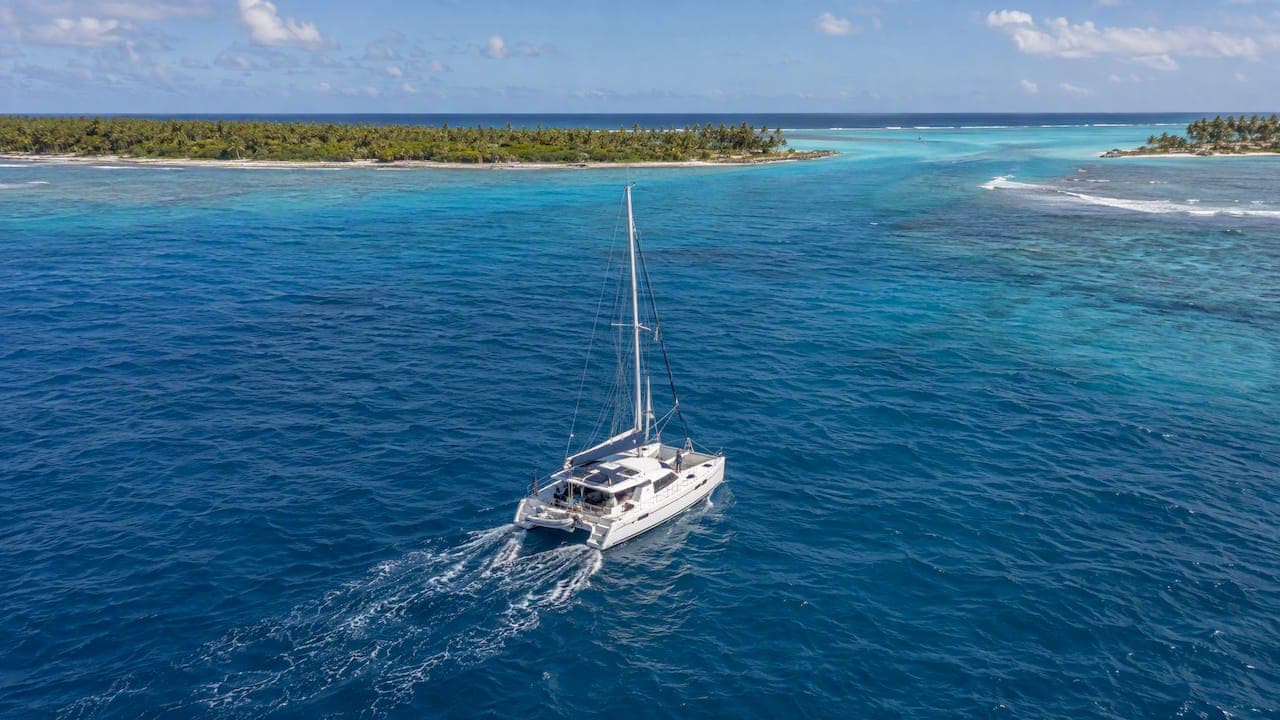
Choose Fakarava for epic pass dives and quieter, more remote islands; choose Rangiroa for more amenities, easier land-based diving, and frequent dolphin encounters. Both atolls sit a short Air Tahiti hop from Papeete, and Fakarava's reef system carries UNESCO biosphere status. A crewed charter can combine both into one seamless itinerary rather than forcing a choice.
TL;DR:
- Pass dives at Tiputa and South Pass favor incoming tides, but strong currents often require advanced certification and prior drift diving experience.
- Plan at least four days in Fakarava to reach its signature sites; five to seven days at either atoll leaves room for favorable tide windows.
- Direct flights from Papeete take about one hour to Rangiroa and just over an hour to Fakarava, but transfers between atolls route through Papeete.
- Divers Alert Network recommends buffer days in Papeete before and after Tuamotus travel because schedules and luggage limits leave little room to recover.
Table of Contents
- Comparing diving, snorkeling, and travel logistics
- Signature dive sites and what you'll actually see underwater
- Flights, transfers, and building in buffer days
- Where you sleep changes how you dive
- Timing your trip around tides and seasons
- Matching the right atoll to your travel style
- How a crewed itinerary handles both atolls at once
- A personal take on Fakarava's pull
- Visit both atolls on one crewed charter
- FAQ
- Sources
Comparing diving, snorkeling, and travel logistics
The two atolls reward different priorities, and the gap shows up clearly once you line up diving style, access, and pace of life.
| Factor | Rangiroa | Fakarava |
|---|---|---|
| Diving style | Pass drift dives, land-based day trips | Pass drift dives, often liveaboard-based |
| Signature wildlife | Dolphins, sharks, barracudas | Dense shark aggregations, large groupers, mantas |
| Snorkeling | Shallow lagoon spots, pass-edge dolphin sightings | Sandbars, shallow reef flats near villages |
| Accessibility | Direct Air Tahiti flight from Papeete | Direct Air Tahiti flight from Papeete |
| Accommodations | More resorts, higher operator density | Smaller pensions, fewer operators |
| Recommended stay | 3 to 4 days | At least four days (Tahiti Tourisme) |
A few distinctions matter most when you are narrowing the decision:
- Rangiroa suits divers who want to stay in one resort and dive Tiputa Pass repeatedly without changing lodging.
- Fakarava suits divers chasing a specific, high-density wildlife spectacle worth the extra remoteness.
- Snorkelers and mixed groups generally find Rangiroa's infrastructure easier to work around.
- Families often lean toward Rangiroa for its wider range of non-diving activities and services, which tend to be more numerous.
Neither atoll beats the other outright; if you are weighing different ocean destinations, consider the detailed comparison of Gulf Coast vs. Caribbean vacations to understand which fits your style better (Gulf Coast vs. Caribbean Vacation: Which Fits Your Style?). The choice comes down to whether you want range of services or depth of a single, dramatic dive experience.
Signature dive sites and what you'll actually see underwater
Rangiroa's diving centers on Tiputa Pass and Avatoru Pass, where incoming tides pull pelagic life through narrow channels. Divers regularly encounter dolphins riding the current, gray reef sharks, and barracuda schools stacking in the blue, according to Scuba Diving. Most Rangiroa diving runs as day trips from land-based resorts, which keeps logistics simple.

Fakarava's reputation rests on South Pass, often described as a wall of sharks, along with North Pass and Tumakohua. Tahiti Tourisme notes that South Pass delivers some of the most reliable large-shark aggregations in French Polynesia, alongside big groupers and passing mantas. Many visitors reach these sites by liveaboard, since the pass sits a boat ride from the main village.
A few practical notes shape how each dive unfolds:
- Both passes favor incoming tide dives, when clearer water and stronger pelagic activity align, per Scuba Diving.
- Current strength at both Tiputa Pass and Fakarava's South Pass often calls for advanced certification and prior drift-dive experience.
- Visibility swings with tide and season, so flexible scheduling matters more than a fixed dive calendar.
Snorkelers have options too. Rangiroa's pass edges let strong swimmers watch dolphins from the surface, while Fakarava's shallow lagoon flats near the villages offer calmer, family-friendly water.
Pro Tip: Book your pass dives for the first incoming tide of the morning, when currents are most predictable and the water is clearest.
Flights, transfers, and building in buffer days
Both atolls connect to Papeete by direct Air Tahiti flights, and the flight times run close enough that neither destination holds a real time advantage.
- Papeete to Rangiroa takes about one hour, covering roughly 356 kilometers, according to FlightConnections.
- Papeete to Fakarava takes slightly longer, just over an hour, covering approximately 375 kilometers.
- No scheduled passenger ferry links the two atolls directly, so most transfers route back through Papeete.
One hour versus one hour ten minutes is the entire flight-time difference between the atolls, which means the real planning challenge is connections, not distance. Divers Alert Network recommends building a buffer day in Papeete before and after Tuamotus travel, since domestic schedules and luggage allowances leave little room for a missed connection to self-correct.
Where you sleep changes how you dive
Lodging choice shapes the whole trip more than most travelers expect, since it dictates how far you travel to reach the passes each morning.
- Rangiroa carries a higher density of resorts and dive operators, which means more flexibility if a boat or guide is booked.
- Fakarava relies on smaller pensions, and many visitors reach its best sites through a liveaboard rather than a single shore base, per Tahiti Tourisme.
- A land-based stay in Rangiroa simplifies non-diving days, with easy access to restaurants, excursions, and rental gear.
- A liveaboard around Fakarava trades that convenience for access to multiple passes without repeated transfers.
If your days off the tank matter as much as your dives, Rangiroa's resort density makes idle time easier to fill.
Timing your trip around tides and seasons
Dive quality in both atolls tracks the tide more closely than the calendar, though season still shapes visibility and comfort.
- Incoming tides consistently produce the clearest water and strongest pelagic activity at both Tiputa Pass and Fakarava's South Pass.
- Many pass dives call for advanced skills given the current strength, so build in a check-out dive if your experience is more recreational.
- Plan at least four days at Fakarava to reliably reach its signature sites, as Tahiti Tourisme recommends, and a similar window at Rangiroa gives you enough tide cycles to catch a strong dolphin day.
A five to seven day stay at either atoll, rather than a rushed overnight stop, gives you enough incoming tides to avoid leaving disappointed.
Matching the right atoll to your travel style
Once you know your priorities, the decision tends to sort itself quickly.
- Advanced divers chasing shark aggregations and pass drama should head to Fakarava.
- Snorkelers, families, and mixed-interest groups generally get more out of Rangiroa's amenities and easier excursions.
- If you want both, a liveaboard or crewed itinerary sequences the atolls without the backtrack through Papeete that independent travel requires.
- Travelers with limited days should pick one atoll and dive it thoroughly rather than splitting a short trip between two.
How a crewed itinerary handles both atolls at once
A crewed Tuamotu itinerary lets us sequence Rangiroa and Fakarava around tide windows rather than fixed domestic flight times, cutting the number of connections a land-based trip usually demands. Our captains track weather and current patterns daily, coordinating with local dive operators so pass dives land on the best incoming tide rather than whatever slot a resort schedule allows.
Align your atoll-to-atoll crossing with a settled weather window and the next morning's incoming tide, and you arrive ready to dive rather than recovering from a rough passage.
Pro Tip: Ask your captain to hold a flexible day in the schedule for Fakarava's South Pass, since the best shark activity doesn't always fall on the day you'd plan for on paper.
A personal take on Fakarava's pull
If I had to pick a repeat destination, it would be Fakarava. The first time a wall of gray reef sharks held formation in the current at South Pass, the scale of it stayed with me longer than any single Rangiroa dive has. That said, Rangiroa remains the easier, friendlier introduction for anyone traveling with snorkelers or a mixed group, and both recommendations hold regardless of which one stays with you longest.
— Mo
Visit both atolls on one crewed charter
Crewed yacht charters can be arranged through the Tuamotus, building dive-focused itineraries around Rangiroa and Fakarava so travelers reach both without repeated domestic flights.

- Fewer flight connections, since we sequence the route by water instead of by Papeete transfers.
- Tide-based scheduling that puts you on the passes at their clearest window.
- Captains with expertise in maritime conditions and water sports on board to read conditions and coordinate with local dive operators.
Explore our South Pacific charter options and let us build a Tuamotus itinerary around your diving priorities.
FAQ
Which island in French Polynesia is the best?
There is no single best island; it depends on whether you prioritize dramatic pass diving, resort amenities, or a quieter, more remote setting. Fakarava suits divers chasing shark aggregations, while Rangiroa suits travelers who want more services alongside strong diving.
Is Rangiroa worth visiting?
Yes. Rangiroa offers some of French Polynesia's most accessible pass diving at Tiputa Pass, with frequent dolphin encounters, strong infrastructure, and direct flights from Papeete in about one hour, according to FlightConnections.
Which destination is better for a trip: Bora Bora, Tahiti, or Fiji?
Each fits a different style of trip: Tahiti works as a gateway with its own beaches and culture, Bora Bora suits overwater bungalow luxury, and Fiji spans a wider range of island types and budgets. For divers specifically focused on pass diving and shark encounters, the Tuamotus atolls of Rangiroa and Fakarava offer a more specialized experience than any of these three.
Is Tahiti nicer than Bora Bora?
They offer different experiences rather than one being objectively nicer: Tahiti has more urban infrastructure and easy access as the main gateway island, while Bora Bora is known for its lagoon and overwater bungalow resorts. Neither compares directly to the remote, dive-focused character of Rangiroa or Fakarava.
How many days should I plan for Fakarava or Rangiroa?
Plan at least four days for Fakarava to reliably reach its signature passes, as Tahiti Tourisme recommends, and a similar window for Rangiroa to catch multiple incoming tides. A crewed charter can extend or compress this depending on how you want to split time between the two atolls.
Sources
- Flights from PPT to RGI — FlightConnections
- Diving French Polynesia’s Tuamotus — Scuba Diving
- Fakarava | Tahiti Tourisme
- French Polynesia’s Tuamotus — Divers Alert Network (Alert Diver)
- Rangiroa — Air Tahiti