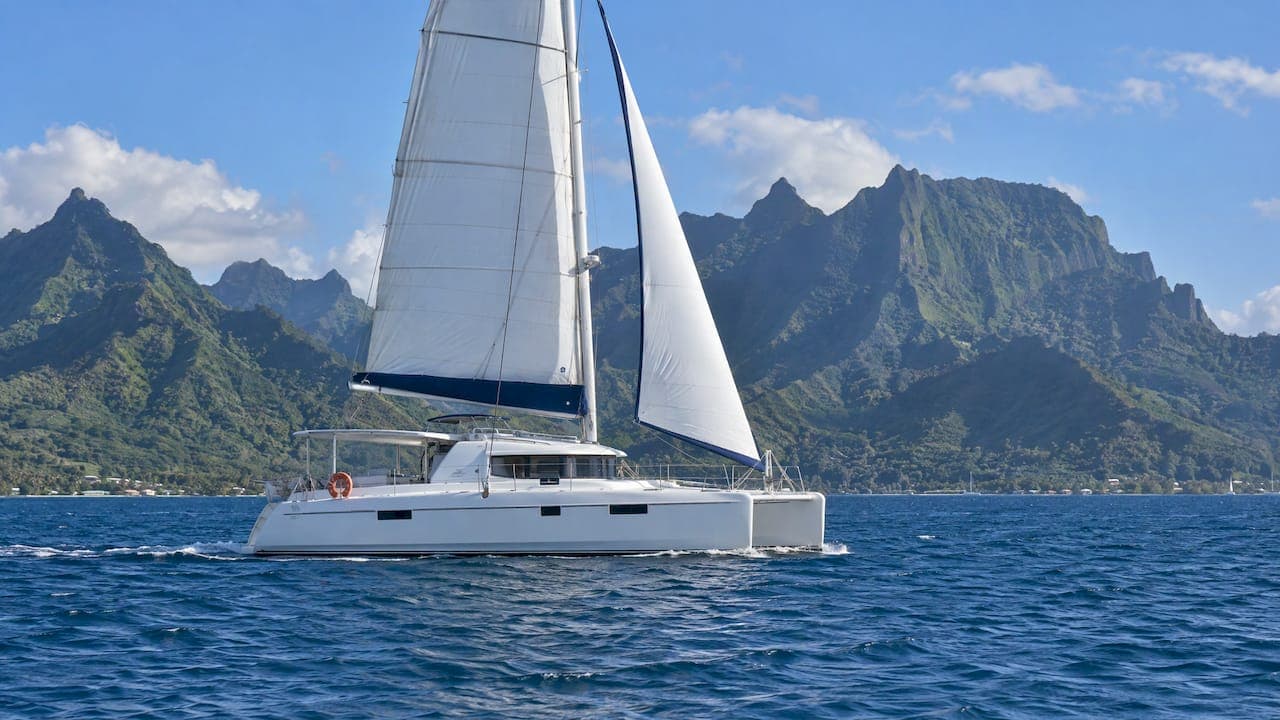
French Polynesia is one of the great charter grounds of the world: warm, sheltered lagoons in the Society Islands, wild atoll passes in the Tuamotus, and a sailing rhythm built around steady trade winds. For most American travelers, the best way to see it is a crewed yacht on a 7 to 14 day route through the Society Islands, with the Tuamotus added if you have time and want to dive. This guide covers where to go, when, how long to allow, and how to plan it so the trip feels effortless.
TL;DR
- The Society Islands (Tahiti, Moorea, Huahine, Raiatea, Taha'a, Bora Bora) are the heart of the charter scene; the Tuamotus add remote atolls, sharks and rays.
- Trade winds blow mainly from the east to southeast from May through November, which is also the drier part of the year.
- Allow 7 days for a taste, 10 days for a comfortable loop, and 14 days if you want Maupiti or the Tuamotus without rushing.
- A crewed charter takes navigation, reef passes, provisioning and water sports off your hands; we recommend it for families, divers and first-time visitors.
- Peak months fill early, so start planning many months ahead and speak to a specialist before you settle on a yacht.
Table of Contents
- What a French Polynesia charter actually is
- The islands, one by one
- Choosing your season
- How long do you need?
- Crewed, skippered or bareboat?
- Choosing the right yacht
- What to do on the water
- Planning for families and couples
- When to book
- Start planning your charter
- FAQ
- Sources
What a French Polynesia charter actually is
French Polynesia is a scattering of 118 islands and atolls across a stretch of the South Pacific about the size of western Europe, grouped into five archipelagos. Charter traffic concentrates in two of them. The Society Islands are mountainous, green and close together, so a day's sail rarely exceeds a few hours. The Tuamotus are the opposite: low coral rings enclosing enormous lagoons, reached through narrow passes where the tide runs hard.
That contrast shapes everything about how you plan. In the Societies you can hop between anchorages for lunch swims and sunset moorings. In the Tuamotus you plan around slack water, visibility and the behavior of the marine life that gathers at the passes.
A charter here usually takes one of two forms. A bareboat or skippered sailboat suits experienced sailors who want to run their own show in the sheltered Leeward Islands. A fully crewed yacht, whether a sailing yacht, catamaran, motor yacht or superyacht, adds a captain, chef and deckhands, and it is the format we focus on at Exotica Charters. Our team is made up of former captains and water sports professionals, so we think about a route the way a skipper does: weather first, then anchorages, then the experiences you came for.
The islands, one by one
Tahiti is the capital and gateway to the territory, and supplies arrive there before being distributed throughout the archipelago, as Tide Magazine's Society Islands itinerary notes. For a yacht, that means Tahiti is where you join the boat, stock the galley and, if you like, spend an evening in Papeete's markets before heading out.
Moorea
A short crossing from Tahiti, Moorea is the natural first night. Its two deep bays, Cook's Bay and Opunohu Bay, are framed by jagged volcanic peaks, and the lagoon is ideal for a first snorkel, paddleboard or kayak session while the crew settles you in. It is a gentle start, which matters after a long flight from the US.
Huahine
Quieter and more traditional, Huahine is where many guests slow down. Think small villages, vanilla and pearl farms, and lagoons with few other boats. It suits families and couples who want a sense of everyday island life rather than resort scenery.
Raiatea and Taha'a
These two islands share one lagoon, which makes them an easy pairing. Raiatea holds ancient Polynesian ceremonial sites, while Taha'a is known for vanilla and for motus (small reef islets) ringed with shallow, clear water. The sheltered lagoon gives good sailing even when the open ocean is lively.
Bora Bora
The postcard: a volcanic summit rising above a turquoise lagoon and a barrier of motus. It is busy by Polynesian standards, but a yacht lets you anchor away from the overwater-bungalow resorts, swim with rays and sharks in the lagoon, and watch the light change on Mount Otemanu from your own deck.
Maupiti
A small, unspoiled island west of Bora Bora, Maupiti is reached through a pass that needs calm sea conditions, so it is a stop we add when the weather agrees rather than one we promise in advance. A longer itinerary gives you the margin to do it.
The Tuamotus
Rangiroa and Fakarava are the best-known atolls for diving, with pass drifts, reef sharks and schools of fish in a clear-water setting that feels entirely different from the Societies. This is expedition-style cruising: fewer anchorages, more planning around currents, and a sense of real remoteness. If diving is the reason you are looking at French Polynesia, the Tuamotus deserve a few days of your itinerary. Our guide to which islands are worth it on a Tahiti superyacht charter goes deeper on the choices, and our page on crewed Tuamotu charters explains what the atolls involve.

Choosing your season
The broad pattern is simple. May through October is the drier stretch, with comfortable temperatures and reliable trade winds. November to April is warmer, more humid and wetter, with afternoon showers and a higher chance of tropical weather. Cruising World reports that winds are predominantly east to southeast from May through November, which gives the Societies dependable sailing breezes.
The same source adds a useful detail for anyone eyeing the atolls: in the Tuamotus, strong trades in July and August can bring higher waves and swell, faster currents in the passes, less enjoyable snorkeling and fewer usable anchorages. So the peak of the dry season is not automatically the best month for an atoll-focused trip. If diving the passes is your priority, we often look at the shoulder months on either side of the busiest weeks.
| Priority | What we would look at |
|---|---|
| Easy sailing in the Society Islands | The trade-wind months, May to October |
| Atoll diving and snorkeling | Shoulder months around the windiest weeks, depending on pass conditions |
| Fewer crowds | The edges of the dry season |
| Lush scenery and warm water | The wetter months, with flexibility for weather |
For a month-by-month view, read our best time to charter a yacht in French Polynesia, and our note on when to book a Tahiti crewed charter for crowds and costs by season.
How long do you need?
Distances between the Society Islands are short, so the real constraint is not sailing time but how much you want to enjoy each stop. A good rule: plan for at least two nights in the places you care about most, and treat the shortest hops as part of the pleasure rather than as travel days.
Seven days
A week works as an introduction. A typical shape is Tahiti, Moorea, then a flight or longer passage to the Leewards for Huahine and Raiatea or Taha'a, or a shorter loop that stays on one side. You will see the highlights, though Bora Bora and the Tuamotus will not both fit comfortably.
Ten days
Ten days is the length we find most guests are happiest with. You can sail Moorea, Huahine, Raiatea, Taha'a and Bora Bora with a full day or two of water sports, a diving day, and a slow morning or two on deck.
Fourteen days
Two weeks allows more expansive coverage. One charter company's itinerary suggests adding remote stops like Maupiti or moving into the Tuamotus for a distinct change in marine environment. We agree on the principle: the second week is where the trip stops being a holiday and becomes an expedition. Our own French Polynesia itineraries show how we would structure each length.
Crewed, skippered or bareboat?
Sailing on your own in French Polynesia asks for real experience: reef-strewn lagoons, coral heads, pass currents and changing light all demand attentive piloting, and charter bases generally expect proof of sailing experience or a hired skipper. If you have that background and want to sail the sheltered Leewards yourself, it can be a rewarding trip.
Most of our guests want something different: time to be on the trip rather than running it. A crewed charter gives you:
- A captain who knows the lagoons, the passes and which anchorages are calm on a given day.
- A chef who provisions in Papeete and cooks around your preferences.
- Deckhands and dive or water sports staff who set up paddleboards, snorkeling, tenders and, on suitable yachts, diving.
- The flexibility to change plans when weather or wildlife sightings suggest a better day.
We explain the details in what a crewed superyacht charter in Tahiti includes. Because a crewed charter is quoted on the specific yacht, season and itinerary, we give pricing individually, and our overview of what a crewed yacht charter in Tahiti costs explains how the pieces fit together, including the extras on top of the base rate such as fuel, food and gratuities.
Choosing the right yacht
The vessel shapes the experience as much as the route does.
- Catamarans are the favorite for Society Islands cruising: stable, shallow-draft, and with wide deck space for families. Browse our catamarans and power catamarans.
- Sailing yachts suit couples and sailors who love being under canvas. See our sailboats.
- Motor yachts cover distance more quickly, which helps when you want both the Societies and the Tuamotus in a single trip. See our motor yachts.
- Superyachts and expedition vessels bring toys, dive equipment, multiple tenders and a larger crew for groups who want a floating resort that can still reach remote anchorages.
What to do on the water
Much of the draw is in the water itself. Expect calm-lagoon snorkeling over coral gardens, paddleboarding and kayaking at dawn, and the chance to swim with rays and sharks in the shallows around Bora Bora and Moorea. Divers can look to the Tuamotu passes, where sharks and large schools of fish are the signature. Wildlife timing varies by species and season, so we ask what matters most to you, such as whales, mantas or reef sharks, and build the route around it rather than guessing.
Some conditions deserve respect. The Pacific Tsunami Warning System documentation notes that the Centre Polynésien de Prévention des Tsunamis monitors the region and that, while atolls are protected by reefs, volcanic islands with narrow bays such as the Marquesas can see amplified wave impacts during tsunamis. A professional captain keeps alerts in view and chooses overnight anchorages with that in mind, which is one more reason families often prefer a crewed yacht.
Planning for families and couples
Families tend to do best with a catamaran or a larger yacht with separate cabins, shallow lagoon stops for children, and a crew who can set up snorkeling and water toys safely. Keep the early days short and sheltered, then add longer passages once everyone has found their sea legs. Couples often prefer fewer, longer stays: two nights in Taha'a, a quiet anchorage off Huahine, a sunset in Bora Bora.
Flights from the US usually arrive in Papeete, so we recommend a night ashore or an unhurried first afternoon aboard before the first sail. Check current entry and health requirements for your passport on official government pages before travel.
When to book
The most popular yachts and the best weeks are taken first, especially during the busy mid-year months. We suggest starting your enquiry many months ahead of July and August, and earlier still for a larger yacht or a specific week. For another angle on how peak-season availability and booking lead times work on remote island expeditions, it helps to see how far in advance destination trips of this kind are typically organized. If your dates are flexible, a specialist can often find a stronger yacht in the shoulder weeks.
Our perspective
We have captained and guided in remote waters, and the mistake we see most often with French Polynesia is planning it like a Caribbean trip. The Society Islands are close together and forgiving, but the real magic comes from pacing: fewer stops, longer swims, and a crew who reads the weather each morning and moves the plan accordingly.
That is why we argue for a crewed charter here. Reef passes, atoll currents and changing conditions are exactly where local judgment turns a good week into an extraordinary one. Our team of former captains and water sports professionals builds itineraries around what you want to see underwater and on the horizon, then matches them to a yacht that can do it comfortably.
If you are torn between the Societies and the Tuamotus, we would suggest doing both, with the Societies first as a gentle introduction and the atolls as the adventure that follows.
Mo
Start planning your charter
If you are ready to turn ideas into a route, our specialists can match a yacht, season and itinerary to your group, whether that is a family on a catamaran, divers on an expedition-style vessel or a couple on a private sailing yacht. Browse our French Polynesia yacht charters, see the full range at Exotica Charters, and speak to a yacht charter specialist about your dates.
If you want a closer look at the destination first, our French Polynesia yacht charter page covers Tahiti, Bora Bora and the Tuamotus in one place.
FAQ
How many days do I need for a French Polynesia yacht charter?
Seven days gives you a good introduction to the Society Islands. Ten days is more comfortable and lets you include Bora Bora and a diving day. With fourteen days you can add Maupiti or the Tuamotus without rushing.
What is the best time of year to charter in French Polynesia?
The drier months from May to October bring dependable trade winds and comfortable conditions, which suit most Society Islands itineraries. In the Tuamotus, very strong winds in July and August can make passes and snorkeling more challenging. A specialist can match your priorities to the right weeks.
Do I need sailing experience to charter?
Not on a crewed charter, where a professional captain and crew handle navigation and the yacht. Bareboat charters are different and generally require proven experience or a hired skipper, so confirm the exact requirement with the operator.
Is a crewed charter suitable for children?
Yes, many families choose a crewed catamaran or larger yacht for the space, shallow lagoon stops and a crew who help with water activities. Tell us your children's ages and swimming ability so we can choose the yacht and route accordingly.
Sources
- Sailing the Society Islands, Tide Magazine
- How to Use Weather Patterns and Seasons in French Polynesia, Cruising World
- Pacific Tsunami Warning System book, NOAA
- Peak-season availability and booking lead times
- 14-Day French Polynesia Yacht Itinerary