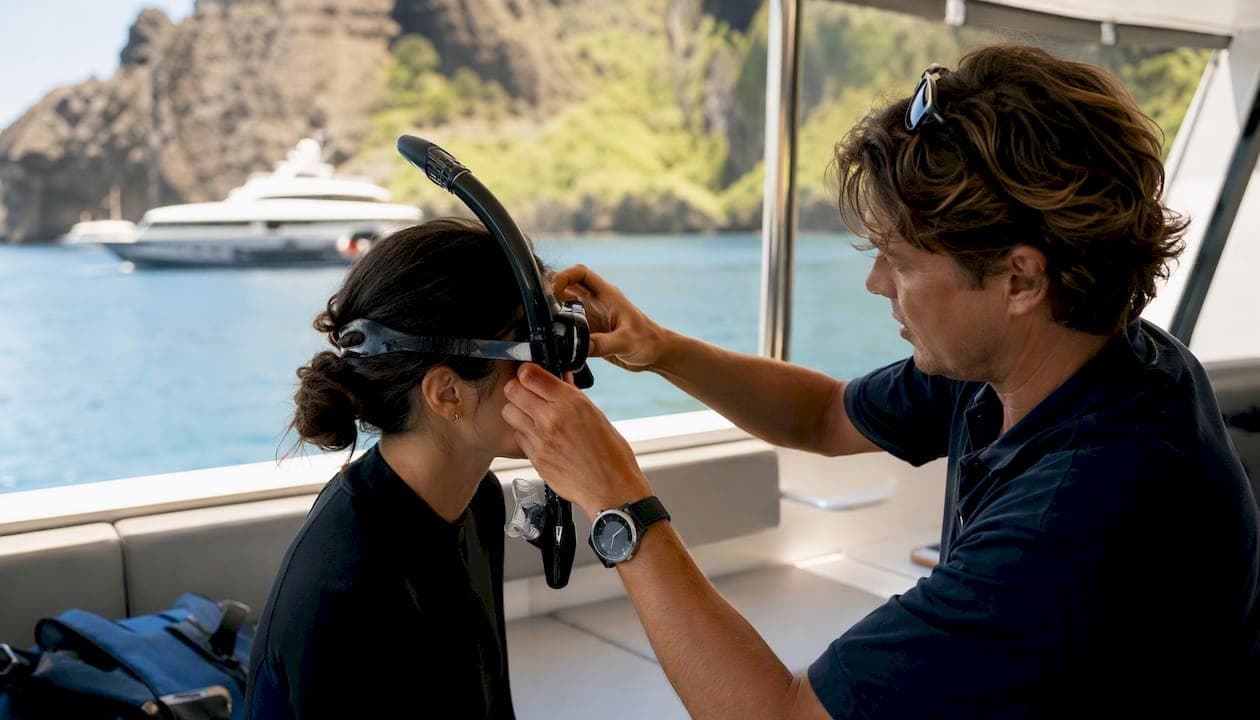
Yacht-based wildlife watching in the Galápagos is one of the most immersive, guided expedition experiences on the planet, pairing daily island landings and open-water snorkeling with dedicated naturalists and a crew that adapts the day around what the wildlife is actually doing. It's best suited to travelers who want close, flexible encounters with endemic species in small groups, not those hunting the cheapest berth on a large cruise ship.
A few things to expect from the start:
- Activities each day: guided hikes on volcanic terrain, snorkeling with sea lions and reef sharks, panga rides along dramatic cliffs, kayaking through coastal mangroves, and onboard naturalist briefings each evening.
- Standout species: Galápagos sea lions, marine iguanas, Galápagos penguins, giant tortoises in the highlands, green sea turtles, blue-footed boobies, and waved albatross (seasonal, Española Island).
- What a private yacht adds: a custom daily rhythm inside the vessel's park-permitted route, a dedicated crew, and a naturalist whose attention is entirely on your group.
- Who should look elsewhere: budget-conscious backpackers comfortable sharing a cabin with strangers on a large vessel will find per-person cabin cruises more economical. A private or small-group yacht charter is a premium experience, and the price reflects that.
Key Takeaways
Galápagos wildlife watching from a yacht delivers its best results on a small private vessel with a certified naturalist, a permit route that includes western islands, and a booking made at least 6–9 months before peak season.
| Point | Details |
|---|---|
| Small group size is decisive | Fewer guests at each landing means less wildlife disturbance and more time in the water with animals. |
| Western routes add rare species | Fernandina and Isabela are the only places to see flightless cormorants and the highest density of marine megafauna. |
| Budget for excluded costs | Park entry fee, INGALA card, domestic flights, and crew gratuities are typically not included in the charter price. |
| Book 6–12 months ahead | Peak months (June–August, December–January) sell out well in advance; permit availability is finite. |
| Exoticacharters as your specialist | Exoticacharters matches groups to curated, naturalist-led vessels and handles the permit and logistics coordination. |
Table of Contents
- Why a yacht is the best way to watch Galápagos wildlife
- What wildlife you can realistically expect to see from a yacht
- What a typical day on a wildlife-watching yacht looks like
- Which yacht type suits your wildlife-watching priorities?
- A sample 7–10 day wildlife-watching yacht itinerary
- Practical matters: costs, park fees, flights, and what to pack
- Conservation rules and safety when watching Galápagos wildlife
- How to choose a Galápagos yacht operator for wildlife-focused trips
- Exoticacharters: specialist yacht charters for Galápagos wildlife watching
- Planning your Galápagos wildlife charter with Exoticacharters
- Sources
Why a yacht is the best way to watch Galápagos wildlife
The Galápagos National Park controls exactly which visitor sites each vessel may access and when. Within that framework, a small yacht operates with a degree of flexibility that larger ships simply cannot match. You arrive at a landing site before the crowds, spend longer in the water if the snorkeling is extraordinary, and leave when your group is ready rather than when a ship's schedule demands it.
Fewer people at each landing is the single biggest practical advantage. Small-boat expedition reports consistently describe closer shore access and more time with wildlife because a group of eight or ten moves quietly and quickly, without the bottleneck of a hundred passengers funneling down a gangway. Marine iguanas don't scatter. Sea lions don't retreat. The animals here evolved without natural predators, so they tolerate proximity, but a wall of people still disrupts natural behavior in ways a small group does not.
Each day on a wildlife-focused yacht typically combines:
- Guided land hikes on marked trails through volcanic terrain, lava fields, and highland forest.
- Snorkeling from the vessel or a panga, often with a naturalist in the water alongside you.
- Zodiac or panga rides for cliff-face seabird colonies, sea cave exploration, and coastal wildlife viewing without landing.
- Kayaking and paddleboarding in sheltered anchorages, close to mangroves and intertidal zones.
- Onboard naturalist talks that frame the next day's landings and answer questions about what you saw.
For comparison, a crewed charter versus a cruise ship delivers a fundamentally different experience in terms of privacy and scheduling control, and that difference matters most to photographers and multi-generational families who need the day to flex around their pace.
Pro Tip: If wildlife photography is a priority, ask your operator to schedule the first landing before 7:30 AM. The light is extraordinary, the animals are active, and you'll almost certainly have the site to yourselves.
What wildlife you can realistically expect to see from a yacht
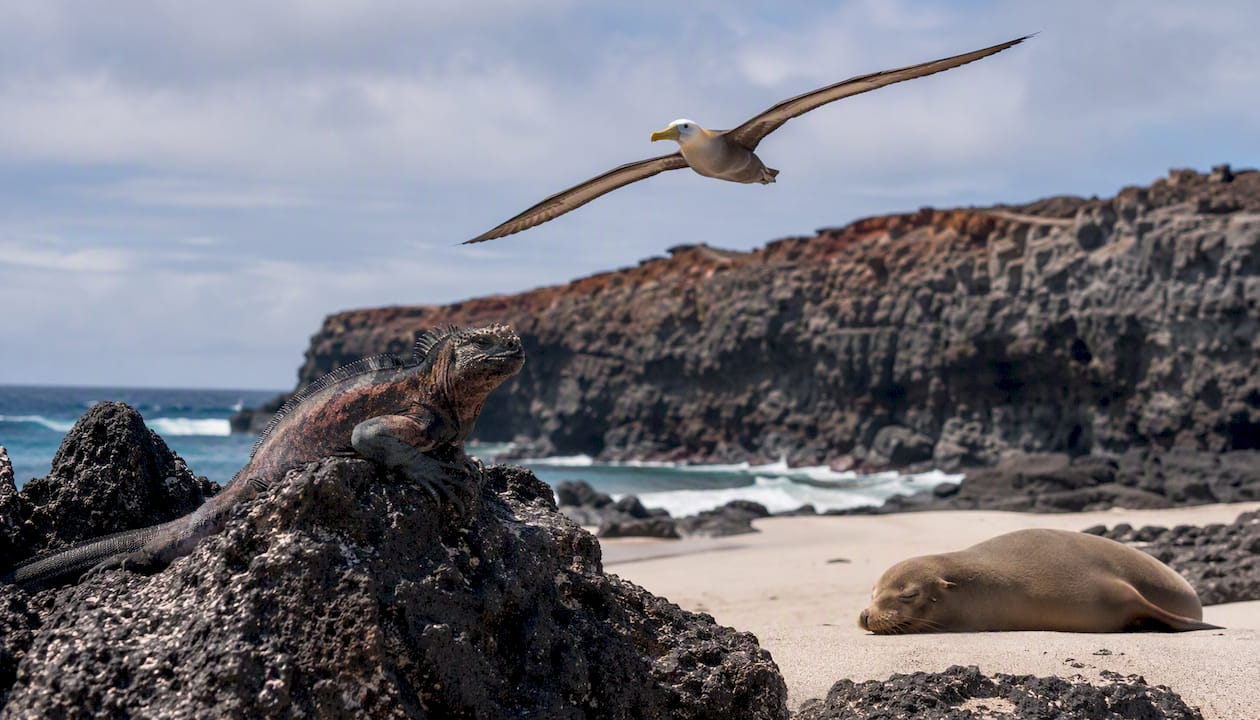
The Galápagos archipelago holds species found nowhere else on Earth, and the variety you encounter depends on which islands your route covers and which month you travel. The Galápagos Big 15 checklist links priority endemic species to specific routes and months, making it a practical planning tool for anyone who wants to maximize sightings of particular animals.
Coastal and island species
These are the animals you'll encounter on guided hikes and shore landings:
- Giant tortoises: most reliably seen in the highlands of Santa Cruz and San Cristóbal; some operators include a highland visit as part of the itinerary.
- Marine iguanas: present on virtually every island, often in dramatic black-lava aggregations at Fernandina and Española.
- Blue-footed boobies: widespread; their courtship dance is one of the Galápagos's most photographed spectacles.
- Nazca boobies: larger and white-plumed, found on Española and Genovesa.
- Flightless cormorant: restricted to Fernandina and the western coast of Isabela; a western-route exclusive.
- Galápagos hawk: the islands' apex land predator, surprisingly unbothered by human presence.
- Waved albatross: breeds exclusively on Española, with a narrow window from approximately April through November when the colony is active.
Marine species encountered while snorkeling or on panga rides
- Galápagos sea lions: playful, curious, and almost guaranteed at every anchorage.
- Galápagos penguins: the only penguin species north of the equator; most reliably spotted around Bartolomé and the western islands.
- Green sea turtles: common in calm bays; often seen feeding on algae or resting on the seafloor.
- White-tip reef sharks: resting in sandy channels, entirely uninterested in snorkelers.
- Manta rays and eagle rays: frequently encountered on deeper snorkels and panga rides, particularly in the western zone.
- Reef fish: king angelfish, parrotfish, and Moorish idols are among the most vivid species in the shallows.
Seasonality and route zones
The archipelago divides broadly into eastern and western zones, and the wildlife windows shift by month. The Charles Darwin Foundation documents how breeding and nesting cycles affect species behavior and visibility throughout the year. Waved albatross, for instance, are absent from Española between December and March. Giant tortoise nesting peaks in the dry season (June through November). The Humboldt Current brings cold, nutrient-rich water to the western islands from June through November, concentrating marine megafauna and making that period exceptional for snorkeling. The warmer, calmer months of December through May favor visibility and are gentler for families with younger travelers.
Eastern routes (San Cristóbal, Española, Floreana, Santa Cruz) tend to favor seabird colonies, giant tortoises, and marine iguanas. Western routes (Isabela, Fernandina) deliver flightless cormorants, penguins, and the highest density of marine life, including dolphins and occasional whale sharks.
What a typical day on a wildlife-watching yacht looks like
The rhythm of a Galápagos wildlife cruise is deliberately full without feeling rushed. A well-run private yacht structures the day around the animals, not a fixed timetable, and that distinction shapes every hour.
A representative day might unfold like this:
- 6:00 AM: Wake call and light breakfast before the first landing, timed to catch golden-hour light and beat any other vessels to the site.
- 6:30–8:30 AM: Guided hike on a marked trail with your naturalist. Expect close encounters with boobies, iguanas, or sea lions depending on the site.
- 9:00–11:00 AM: Snorkeling session, either from the yacht's swim platform or by panga to a specific reef or sea cave. A naturalist in the water points out species you'd otherwise miss.
- 11:30 AM–1:00 PM: Return to the yacht, shower, and lunch while the vessel repositions to the next anchorage.
- 1:00–2:30 PM: Rest period or optional onboard naturalist talk covering the afternoon's destination.
- 3:00–5:00 PM: Afternoon activity: kayaking in a mangrove bay, a second snorkel, or a panga ride along a cliff face for seabird and sea lion viewing.
- 5:30 PM: Sunset from the deck or a short Zodiac excursion for photography.
- 7:00 PM: Dinner, followed by an informal briefing on the next day's itinerary.
Expedition-style trips commonly combine snorkeling, kayaking, Zodiac excursions, guided hikes, and onboard naturalist sessions to maximize wildlife encounters, and the best private charters add a layer of flexibility that standard cabin cruises don't offer.
On a private yacht, the snorkel window can extend if a sea turtle is feeding nearby. The afternoon panga ride can shift to a different cove if a pod of dolphins is spotted. Photographers can request a slower pace at a landing site. Multi-generational groups with mixed walking abilities can split, with some members snorkeling while others take a shorter shore walk. A captained boat experience with a dedicated crew makes this kind of real-time adjustment possible in ways that group cabin cruises simply cannot accommodate.
Which yacht type suits your wildlife-watching priorities?
The vessel you choose shapes the entire experience, from how stable the deck feels during a swell to how quickly the panga deploys for an unexpected wildlife sighting. Four vessel categories dominate Galápagos wildlife cruises.
Sailing yachts (monohull, 40–65 feet, 6–12 guests): These deliver the most intimate expedition feel. The smaller deck footprint means everyone is close to the water, and the vessel can anchor in shallower bays that larger ships cannot reach. The tradeoff is motion in open-ocean crossings, which matters if anyone in your group is prone to seasickness.
Catamarans (45–65 feet, 8–14 guests): The dual-hull design provides exceptional stability, making catamarans the preferred choice for families with children and for guests who want a comfortable platform for photography. Wide deck space and multiple entry points into the water are practical advantages. Snorkel gear and wetsuit storage is typically generous.
Motor yachts (55–90 feet, 8–16 guests): Faster repositioning between islands means more time at sites and less time in transit. A well-equipped motor yacht often carries a larger tender and more water-sports equipment. The tradeoff is fuel consumption and a slightly more structured daily schedule to manage the vessel's range.
Small expedition ships (16–48 guests): These sit at the boundary between private charter and small-ship cruise. They carry more guests and follow a fixed cabin-booking model rather than a full-boat charter. The wildlife experience is still far superior to a large cruise ship, but the daily schedule is less flexible than a private yacht.
For wildlife watching specifically, Galápagos yacht charter options that emphasize small group size and in-water naturalist access tend to deliver the most memorable encounters. The ability to customize landing order and snorkel duration inside the vessel's permitted route is a meaningful advantage that only a private full-boat charter provides.
A sample 7–10 day wildlife-watching yacht itinerary
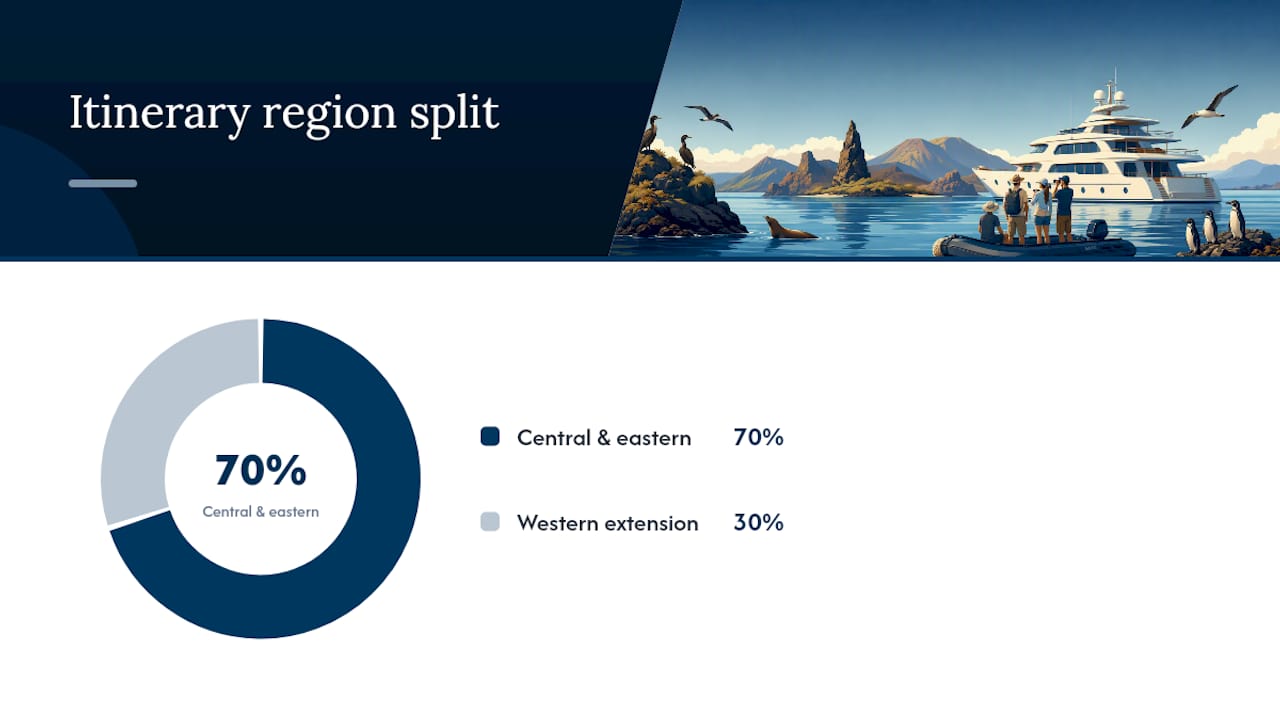
Routes in the Galápagos are park-permitted, meaning each vessel is assigned specific visitor sites it may access. Customization happens within that framework: the order of landings, the timing of activities, and the pace on shore can all be adjusted, but the permitted sites themselves are fixed per vessel. The itinerary below reflects a common central-and-eastern route with optional western extensions.
| Day | Key Sites | Wildlife Highlights |
|---|---|---|
| 1 | Baltra arrival, Santa Cruz highlands | Giant tortoises, vermilion flycatcher |
| 2 | Santa Cruz (Black Turtle Cove, Cerro Dragón) | Green sea turtles, land iguanas, flamingos |
| 3 | Española (Punta Suárez, Gardner Bay) | Waved albatross (seasonal), Nazca boobies, sea lions |
| 4 | Floreana (Post Office Bay, Devil's Crown) | Green sea turtles, white-tip sharks, flamingos |
| 5 | Isabela (Punta Moreno, Elizabeth Bay) | Penguins, flightless cormorants, marine iguanas |
| 6 | Fernandina (Punta Espinosa) | Flightless cormorant, marine iguanas, sea lions |
| 7 | Isabela (Punta Vicente Roca) | Penguins, Galápagos hawks, mola mola (seasonal) |
| 8 | Santiago (Sullivan Bay, Puerto Egas) | Fur seals, marine iguanas, lava formations |
| 9 | Bartolomé, North Seymour | Penguins, frigatebirds, blue-footed boobies |
| 10 | Santa Cruz, Baltra departure | Final highland visit or snorkel |
A 7–8 day version typically covers days 1–4 and 8–10, focusing on the central and eastern islands. The western extension (days 5–7, Isabela and Fernandina) is the route's most dramatic stretch: Punta Espinosa on Fernandina is one of the few places on Earth where marine iguanas, sea lions, and flightless cormorants share the same lava shelf within meters of each other. Punta Vicente Roca on Isabela's northern tip is a world-class snorkeling site, with cold upwellings that attract penguins, turtles, and occasionally ocean sunfish.
For a deeper look at curated day-by-day experiences, the Galápagos charter experiences page at Exoticacharters outlines what each landing zone typically delivers.
Practical matters: costs, park fees, flights, and what to pack
What a Galápagos yacht charter costs
Full-boat private charters vary considerably by vessel size, season, and itinerary length. As a general orientation, a small sailing yacht or catamaran chartered privately for 7–10 days in the Galápagos typically runs from the mid-five-figures upward for the whole vessel, divided among the group. Per-person costs on cabin-bookable small ships tend to be lower but come with a fixed schedule and shared itinerary.
What's usually included and excluded
Most wildlife-focused yacht charters include:
- All meals and non-alcoholic beverages on board
- Snorkeling gear (mask, fins, wetsuit)
- Panga/Zodiac rides and kayaks
- Naturalist guide fees
- Fuel and crew
Commonly excluded items that you'll need to budget separately:
- Galápagos National Park entry fee (currently denominated in USD, payable on arrival; confirm the current amount with the Galápagos National Park before travel)
- INGALA Transit Control Card (a per-person fee collected at the airport)
- Domestic flights from Quito or Guayaquil to Baltra (SEYMOUR Airport) or San Cristóbal
- Alcoholic beverages and crew gratuities
- Travel insurance and personal medical costs
Domestic flights and airport logistics
Most itineraries begin and end at Baltra (North Seymour Airport, GPS) or San Cristóbal (SCY). Domestic flights from Quito (UIO) or Guayaquil (GYE) are operated by Ecuadorian carriers and are booked separately from the charter. Flight times run roughly 2–3 hours. Book domestic flights as early as possible; seats sell out during peak months (June through August, and December through January).
For guidance on getting to remote expedition regions, the logistics page at Exoticacharters covers the practical steps from your home airport to the vessel.
Packing essentials
- Reef-safe, biodegradable sunscreen (required in the park)
- Rash guard and wetsuit (3mm shorty for warm months; 5mm full suit for the western islands June–November)
- Dry bag for cameras and electronics
- Polarized sunglasses for on-water glare
- Seasickness medication (consult your physician; the open-ocean crossings between islands can be rough)
- Lightweight hiking shoes with grip for lava terrain
Booking windows and deposits
Peak months (June–August and December–January) book out 9–12 months in advance for the best vessels. Shoulder months offer more availability but still warrant booking 6 months ahead. Deposit structures vary by operator, typically 20–30% at booking with the balance due 60–90 days before departure. Cancellation policies differ significantly between operators, so read them carefully before signing. For a detailed breakdown of lead times, the booking advance guide at Exoticacharters is worth reading before you commit to dates.
Conservation rules and safety when watching Galápagos wildlife
The Galápagos National Park enforces strict visitor protocols at every site, and compliance is not optional. The park's official regulations govern which sites vessels may visit, how many visitors may land at once, and exactly how guests must behave on shore and in the water. Violating these rules can result in removal from the park and jeopardizes future access for all operators.
Core conservation rules
- Stay on marked trails at all times during shore landings.
- Maintain a minimum distance of 2 meters from all wildlife (some species require more).
- Never feed, touch, or attempt to interact with any animal.
- Do not remove any natural material, including shells, rocks, or plants.
- Clean footwear and gear between islands using the brushes and disinfectant stations provided on board. The Charles Darwin Foundation identifies invasive species transfer as one of the most serious ongoing threats to the archipelago's endemic biodiversity, and these biosecurity protocols are the front line of prevention.
Do's and don'ts around specific animals
- Sea lions: they will approach you in the water. Stay calm, move slowly, and let them initiate contact. Never position yourself between a mother and pup.
- Marine iguanas: they bask on trails and rocks. Step around them; never over or past them in a way that causes them to move.
- Nesting birds: give nesting boobies and albatross a wide berth; your naturalist will indicate safe viewing distances.
- Sharks: white-tip reef sharks are docile and resting. Maintain distance and avoid sudden movements.
Water safety checklist
- Confirm your swimming ability honestly with your naturalist before each snorkel session.
- Wear a wetsuit for thermal protection and buoyancy, particularly in the western islands where water temperatures can drop significantly.
- Stay within sight of the panga or the in-water naturalist at all times.
- Follow the naturalist's signal immediately if conditions change.
- Disclose any medical conditions (heart conditions, asthma, ear problems) to the crew before water activities.
- Carry travel insurance that covers emergency medical evacuation; the nearest major hospital is on the mainland.
How to choose a Galápagos yacht operator for wildlife-focused trips
The quality of your wildlife experience depends more on the operator than on the vessel. A beautiful yacht with an indifferent naturalist delivers a fraction of what a well-crewed, smaller boat with an expert guide can offer. Here's a decision checklist to apply before you pay a deposit.
Questions to ask before booking
- What is the naturalist's certification level, and are they licensed by the Galápagos National Park?
- Is there an in-water naturalist available for snorkel sessions, or does the guide stay in the panga?
- What is the maximum guest count on board, and what is the guide-to-guest ratio?
- Which permit route does the vessel hold, and which specific visitor sites does it include?
- What wetsuit sizes are available, and is a 5mm full suit an option for western-island itineraries?
- What are the emergency protocols, and is the vessel equipped with oxygen and a defibrillator?
- What exactly is included in the charter price, and what is excluded?
Red flags to watch for
- Vague or evasive answers about the vessel's permit route ("we visit the best islands" without naming them).
- No guide biography or certification information available before booking.
- Unusually low pricing with no clear explanation of what's excluded.
- Cancellation terms that offer no refund within 90 days of departure.
- No mention of biosecurity protocols or gear-cleaning procedures.
How Exoticacharters measures up
Exoticacharters is staffed by former captains and water-sports professionals who understand the operational details that determine wildlife-viewing quality: permit routes, guide credentials, in-water naturalist availability, and the kind of vessel-level customization that makes a private charter worth the investment. Their naturalist yacht charter program is built around exactly the criteria above, and their Trustpilot ratings reflect consistent client satisfaction across multiple destinations.
For families wondering what children can realistically expect to see and do, the kids' wildlife charter guide at Exoticacharters addresses pace, safety, and species expectations in practical terms.
Exoticacharters: specialist yacht charters for Galápagos wildlife watching
Exoticacharters plans and books fully crewed, luxury yacht charters to the Galápagos with a focus on immersive wildlife and expedition experiences. The company operates as a specialist brokerage, meaning they match each group to the right vessel for their priorities rather than selling a single fixed product.
What sets their Galápagos offering apart:
- Curated vessel selection: sailing yachts, catamarans, and motor yachts matched to group size, budget, and activity priorities (photography, diving, family pace).
- Expert team: former captains and water-sports professionals who know which permit routes deliver which species windows, and when to push for a western extension.
- Naturalist-led itineraries: access to certified naturalist guides who are licensed by the Galápagos National Park and, on select vessels, available in the water during snorkel sessions.
- Biosecurity emphasis: operators vetted for compliance with park cleaning protocols and gear-handling standards.
- Transparent inclusions: clear breakdowns of what the charter price covers and what to budget separately, so there are no surprises at the airport.
Exoticacharters is rated highly on Trustpilot, and their team is available to answer pre-booking questions about permit routes, species windows, and vessel suitability before you commit to anything.
What small-yacht Galápagos expeditions actually teach you
There's a detail that rarely appears in operator brochures: the most memorable wildlife encounters in the Galápagos almost always happen during the transitions, not the main events. The sea lion that surfaces alongside the kayak while you're paddling between sites. The Galápagos penguin that rockets past the snorkeler at Bartolomé before anyone has their camera ready. The marine iguana that walks directly across your path on the lava trail at Fernandina because it simply doesn't register you as a threat.
These moments are a product of timing and group size, not luck. A small yacht arrives at a site when the animals are undisturbed. An in-water naturalist knows to hold the group still when a turtle approaches rather than swimming toward it. The flexible schedule means you can stay an extra twenty minutes at a snorkel site when conditions are exceptional, rather than returning to the panga because a larger group's schedule demands it.
The practical takeaway: bring both a wide-angle lens and a telephoto. The wide-angle is for the marine iguana three feet away on the lava; the telephoto is for the waved albatross pair on the cliff edge at Española. And accept that some of the best moments won't be photographed at all. That's not a failure of preparation. It's what happens when you're fully present in one of the most extraordinary places on Earth.
Planning your Galápagos wildlife charter with Exoticacharters
Private Galápagos yacht charters require more planning than a standard vacation, and the details matter: permit routes, vessel availability, domestic flight timing, and park fee logistics all need to align before you travel. Exoticacharters handles that coordination so you arrive at the dock ready to focus entirely on the wildlife.
To request a bespoke charter quote, have the following ready: your preferred travel dates (with flexibility of two to three weeks if possible), the number of guests and any age or mobility considerations, your top wildlife priorities (specific species, photography focus, diving), and your preferred vessel type. Exoticacharters will respond with a sample itinerary, the permit availability window for your dates, and a clear breakdown of estimated cost components, including what's included in the charter and what to budget separately.
Browse the luxury yacht options available for Galápagos charters, or speak directly with a charter specialist to match your group to the right vessel and route. The team's background in captained expeditions means they can advise on which months favor your target species and which vessel type suits your group's pace.
Sources
Core references for planning a Galápagos wildlife yacht trip: