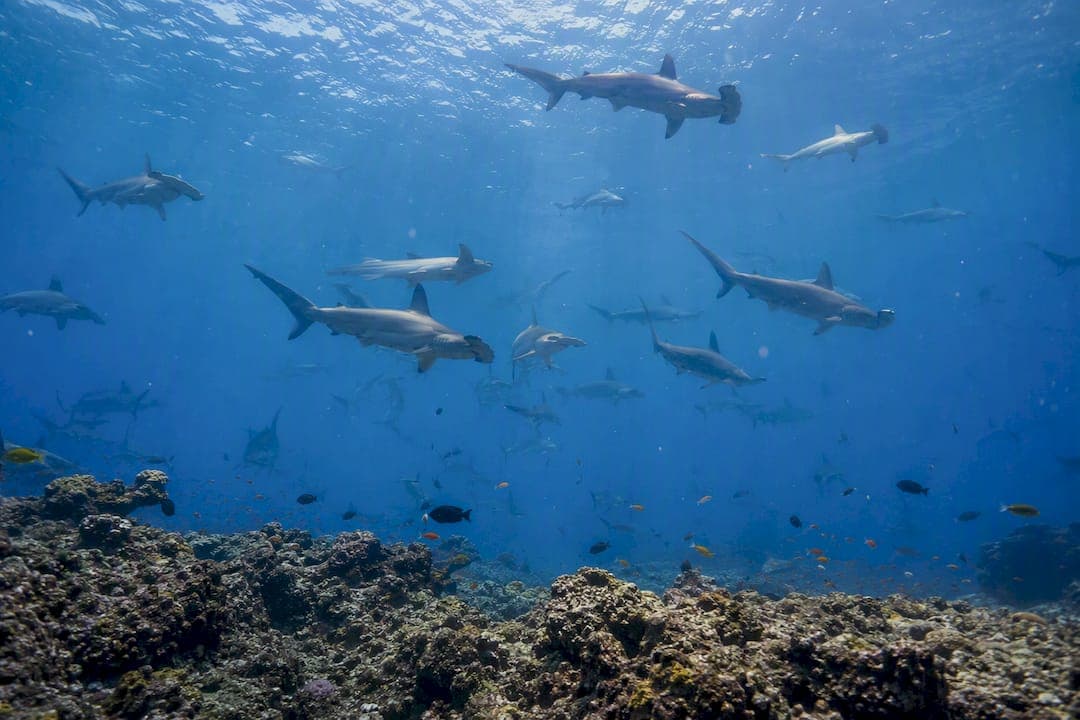
Cold season, from June through November, delivers the Galápagos's largest hammerhead schools, concentrated around Darwin and Wolf islands. Cooler, nutrient-rich currents boost fish biomass in these waters dramatically during these months, drawing scalloped hammerheads in numbers rarely matched anywhere else on Earth. Sightings happen year-round, but outside this window, they're smaller, sparser, and far less predictable.
TL;DR:
- Peak hammerhead sightings occur from June to October when nutrient-rich currents increase biomass to about 21 tonnes per hectare, compared to 5 in warm season months.
- Divers should plan for deep currents and pack appropriate cold-water gear, preferably book six to nine months ahead for optimal cold season trips.
- Responsible diving involves no chumming or touching sharks, choosing operators partnered with research, and respecting protected zones and diver limits.
- Darwin and Wolf islands host the largest known nearby populations of scalloped hammerheads, with schools passing over known cleaning stations at depths of 25 to 40 meters.
- Interannual variability, such as El Niño or La Niña conditions, can dramatically shift the timing and abundance of hammerhead aggregations, requiring flexible scheduling.
Table of Contents
- Hammerhead Season Galapagos: A Month-by-Month Guide
- Where to Dive: Darwin, Wolf, and the Cleaning Stations That Draw Crowds
- Why Hammerheads Gather Here: The Science Behind the Season
- Getting Trip-Ready: What Divers Need Before Booking
- Conservation Status and Diving Responsibly
- Planning a Yacht-Based Trip Around Peak Season
- A Captain's View From the Water at Darwin
- Book a Galápagos Charter Built Around Peak Hammerhead Season
- Sources
Hammerhead Season Galapagos: A Month-by-Month Guide
Timing your Galápagos trip around hammerhead activity comes down to understanding three distinct windows, each shaped by shifting currents and water temperature.
Cold season (June through October, sometimes stretching into November) is when the Humboldt and Cromwell currents push nutrient-dense water up around Darwin and Wolf, and the food web responds accordingly. A Charles Darwin Foundation study recorded hammerhead biomass climbing to roughly 21 tonnes per hectare during this period, versus about 5 tonnes per hectare in the warm season. That's not a marginal bump; it's a system-wide shift that pulls in schooling hammerheads by the hundreds.
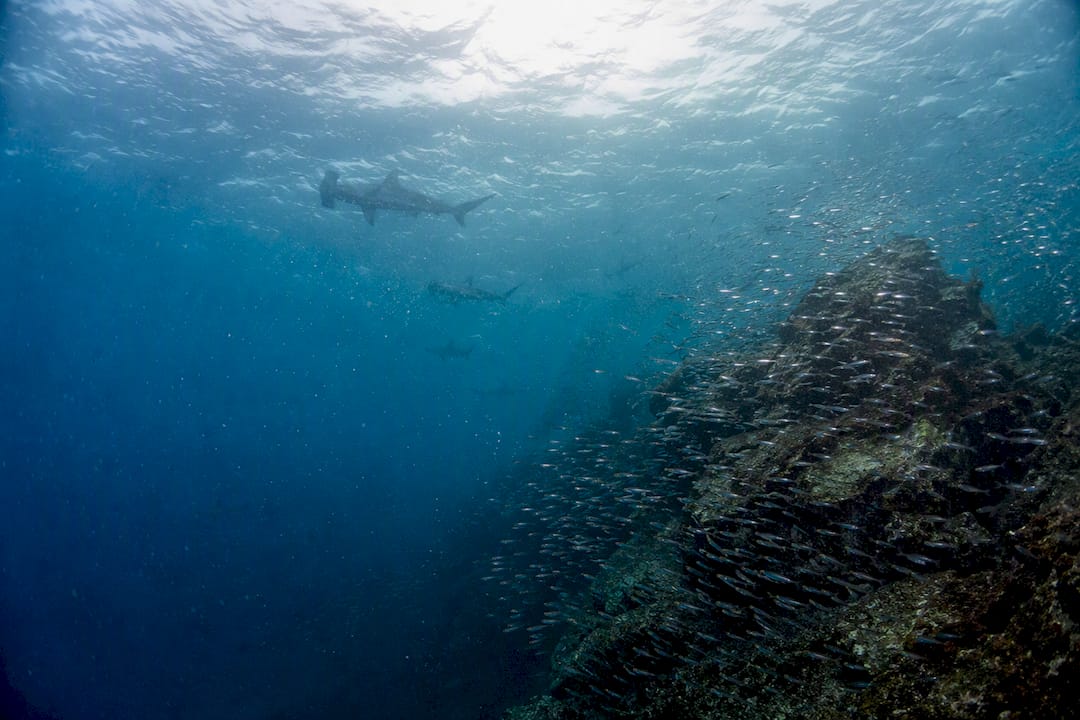
Transition months (May and November) sit in a gray zone. Currents are shifting, water temperatures are in flux, and shark behavior can swing either way depending on how quickly the cold upwelling establishes or retreats. Divers willing to gamble on these shoulder weeks sometimes land extraordinary encounters with thinner crowds, but the odds are genuinely less predictable than peak season.
Warm season (December through April) brings warmer, calmer, often clearer water, better for underwater photography of reef fish and rays, but hammerhead biomass drops off substantially. You'll still see individuals and small groups, particularly around cleaning stations, but the massive walls of schooling sharks that define cold season mostly disappear.
A few planning notes worth flagging:
- El Niño years disrupt this pattern significantly, warming the water and suppressing the nutrient upwelling that hammerheads depend on.
- La Niña years tend to intensify the cold-season effect, sometimes extending strong sightings later into November.
- Local dive guides and trip reports occasionally note peak windows as early as January through May, a reminder that interannual variability is real and no single month is guaranteed.
If your trip has flexible dates, aim for the heart of cold season, August through October, when the data and the anecdotal consensus line up most consistently.
Where to Dive: Darwin, Wolf, and the Cleaning Stations That Draw Crowds
Darwin and Wolf islands sit at the northern edge of the Galápagos Marine Reserve, isolated enough that they've become what researchers call one of the largest global concentrations of scalloped hammerheads recorded anywhere, according to Charles Darwin Foundation tagging work. The sharks return to specific cleaning stations, rocky outcrops where small fish pick parasites off their skin, and divers who position themselves at these known spots have a real shot at watching schools pass directly overhead.
What to expect on a typical dive:
- Depths of 25 to 40 meters, with the best hammerhead action often occurring at the deeper end of that range.
- Strong, sometimes unpredictable currents that require confident buoyancy control and a comfort level with drift diving.
- Access almost exclusively via liveaboard, since Darwin and Wolf sit roughly a full day's sail from the inhabited islands.
- Secondary sites like Cousin's Rock and Punta Vicente Roca, where snorkelers and less experienced divers can still find sharks, rays, and marine iguanas without the exposure of the far north.
Most itineraries build in two to three days at Darwin and Wolf as the trip's centerpiece, bookended by stops at calmer central-island sites.
Why Hammerheads Gather Here: The Science Behind the Season
The cold-season surge isn't a coincidence of weather. It's a direct response to how the Galápagos's currents restructure the entire food web each year, and understanding that mechanism helps explain why the timing is so consistent.
During the cold season, hammerhead biomass around Darwin and Wolf climbs to about 21 tonnes per hectare, roughly four times the warm-season average of 5 tonnes per hectare.
That spike traces back to upwelling currents that flood the area with nutrients, triggering plankton blooms that feed baitfish, which in turn draw predators looking for an easy meal. Hammerheads follow the food, and the food follows the cold water.
But feeding isn't the whole story. Satellite tagging has revealed something more intricate: pregnant female hammerheads aggregate around Darwin and Wolf early in the year, then undertake a nearly 6,000-kilometer round-trip migration to coastal nurseries in Panama to give birth before returning. Experienced guides watch for a visibly distended belly on large females in February, a field sign of late-stage pregnancy that adds a layer of biological drama to what might otherwise look like just another big shark.
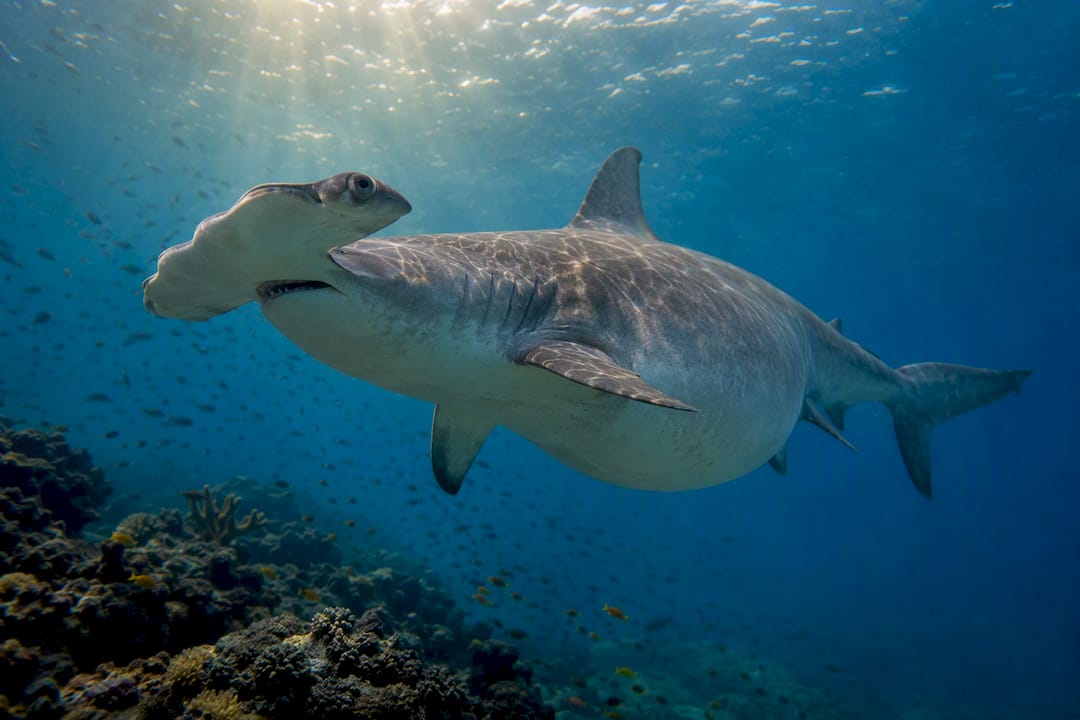
Here's the part that matters for conservation, though: a packed dive site doesn't mean a healthy population. Scientists caution that these visible aggregations can create a false sense of security, masking declines happening elsewhere along the sharks' migratory routes.
Getting Trip-Ready: What Divers Need Before Booking
Darwin and Wolf are not beginner sites, and the operators who run trips there will generally expect you to arrive with real current-diving experience under your weight belt.
- Log the right kind of dives beforehand. Advanced certification is the floor; comfort with strong drift currents and blue-water descents matters more than a raw dive count.
- Pack for depth and cold. A 5mm to 7mm wetsuit or a drysuit depending on the month, plus a backup dive light, since visibility at 30+ meters can shift fast when currents pick up sediment.
- Bring a wide-angle lens, not a macro setup. You're photographing schools moving past in open water, not small reef critters tucked into coral.
- Ask about nitrox availability, which extends bottom time at depth without adding decompression risk, a real advantage when hammerhead schools are cruising below 30 meters.
- Vet the operator's conservation posture. Ask whether their guides work with researchers, whether they follow no-touch and no-chase protocols, and how they handle emergency evacuation from such a remote location.
Pro Tip: Book six to nine months ahead for August through October departures. Liveaboard cabins at Darwin and Wolf during peak cold season sell out well before the season starts, especially on smaller vessels that cap guest counts for a better in-water experience.
Some research teams now use closed-circuit rebreathers to approach tagging targets within two meters without spooking them, a reminder that the quieter and more controlled your approach, the better the encounter for everyone involved, sharks included.
Conservation Status and Diving Responsibly
The scalloped hammerhead's Galápagos numbers may look impressive underwater, but the species carries a Critically Endangered status from the IUCN, driven largely by industrial fishing pressure, bycatch outside protected waters, and losses tied to the very migrations that make the species so remarkable. Reporting from The Guardian makes the point plainly: a thriving-looking aggregation at Darwin doesn't guarantee the species is safe once it leaves the reserve's boundaries.
What responsible viewing looks like in practice:
- No chumming, no chasing, and no touching. Every one of these disturbs natural cleaning and feeding behavior.
- Choose operators who fund or partner with regional research, a practice the sustainable diving guidance from Borneo Dream frames as central to responsible dive tourism anywhere sharks are the draw.
- Respect Galápagos National Park Directorate permit zones and diver limits, which exist specifically to reduce pressure on sensitive aggregation sites.
Planning a Yacht-Based Trip Around Peak Season
Getting to Darwin and Wolf reliably during cold season takes more than picking good dates, it takes a vessel and crew that can adapt when the Pacific throws rough weather at you. Exoticacharters plans Galápagos charters specifically around this challenge, working with captains who track sea conditions in real time and adjust routing so guests spend their peak-season days at the sites that matter, not stuck waiting out a swell. A 7 to 10 day charter built around late August through October gives divers multiple shots at Darwin and Wolf, with buffer days worked into the itinerary specifically to accommodate weather windows and the long crossing north. On board, guests get direct access to naturalist-level trip planning, the kind of insight that helps you recognize a pregnant female's distended belly or understand why a school is stacked at a particular cleaning station that week.
A Captain's View From the Water at Darwin
Guides who spend cold season anchored near Darwin talk about a particular moment: watching a hammerhead school break formation around a cleaning station, individual sharks peeling off one by one to hover motionless while smaller fish work over their skin. It's a behavior you only fully appreciate after a few dives, once you stop chasing the school and start reading the site. February dives sometimes reveal females with visibly rounded bellies, a quiet reminder that you're watching part of a migration story that stretches all the way to Panama.
The etiquette is simple: hang back, let the current do the work, and never crowd a cleaning station. For divers weighing when and how to book this kind of trip, that patience pays off in encounters far richer than a rushed pass through open water.
— Mo
Book a Galápagos Charter Built Around Peak Hammerhead Season
Chartering with a crewed yacht solves the two biggest headaches of a Darwin and Wolf trip: unpredictable weather routing and cramped liveaboard scheduling that leaves no room to chase a better window. Exoticacharters plans Galápagos itineraries with experienced captains who monitor sea conditions daily and build flexibility into the schedule, so a rough patch off Wolf doesn't cost you a full day of diving.

Guests get a private, fully crewed vessel rather than a shared liveaboard berth, with a route timed around the cold season's peak biomass window and a crew who can pivot itineraries around conditions on the water. Browse Exoticacharters's luxury yacht fleet to see vessel options suited to Galápagos expedition diving, or check how far in advance to book your Galápagos charter to lock in dates before peak season cabins fill up.
Sources
- Cold Currents, Big Predators: The Seasonal Pulse of Predatory Fish and Sharks in the northern Galápagos Islands of Darwin and Wolf - Charles Darwin Foundation
- Report on the population status of hammerhead sharks in the Galapagos Marine Reserve - Figshare / UTAS
- The Galápagos is a wildlife haven. But is that enough to protect the rare scalloped hammerhead shark? | The Guardian