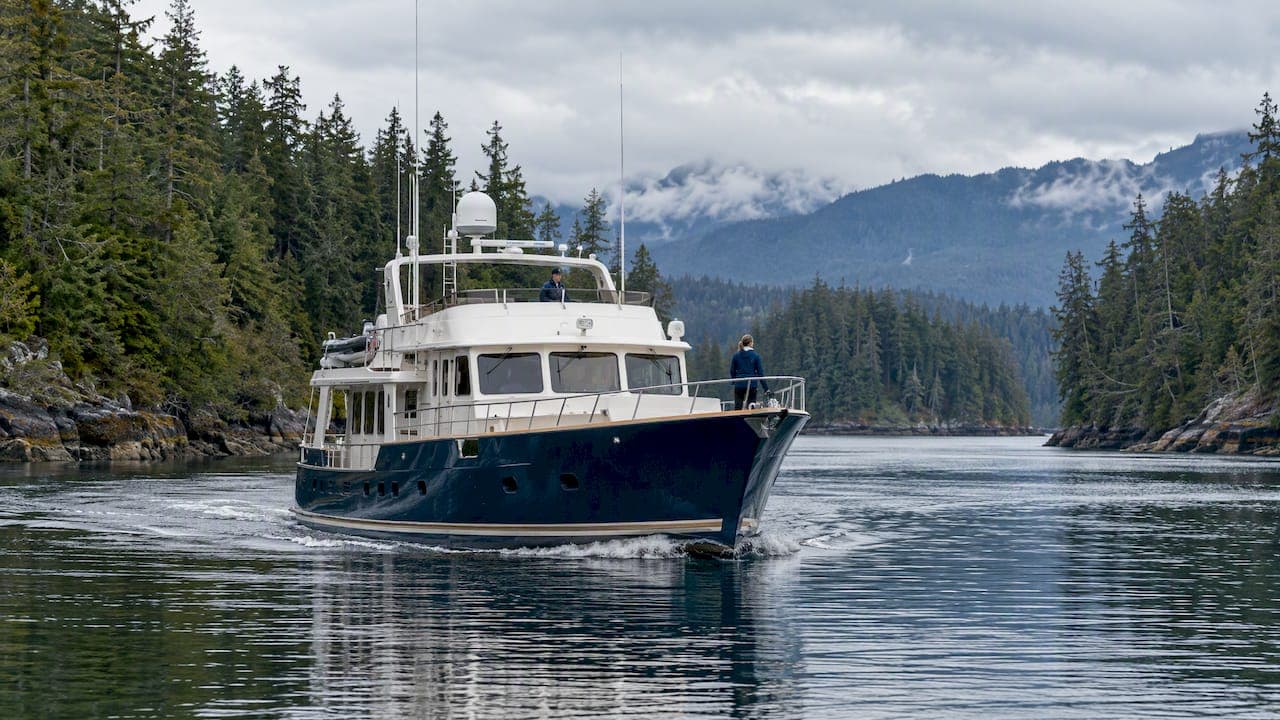
The best Inside Passage yacht itinerary is a one-week, crewed charter that links Juneau, Tracy Arm Fjord, Frederick Sound, Glacier Bay, Sitka and Ketchikan, with room left in the schedule for weather, tides and wildlife. Below we set out a day-by-day plan, explain what shapes it (a Glacier Bay permit above all), and show how to choose between a northbound and southbound route. We are building this from the viewpoint of a team of former captains and water sports professionals, so expect practical detail as well as scenery.
TL;DR
- A typical luxury yacht itinerary on the Inside Passage runs about seven days between Juneau, Sitka and Ketchikan, with Tracy Arm, Glacier Bay and Frederick Sound as the usual highlights.
- Glacier Bay is the hardest piece to secure: from June 1 to August 31 the park issues 25 private vessel permits a day, and they are issued to the vessel, not the charterer or broker.
- Keep 100 yards from whales at all times. Binoculars and a telephoto lens do the rest.
- Build slack into the plan. A week that bends around fog, ice and whales is a better week than one that keeps a rigid timetable.
Table of Contents
- Why the Inside Passage suits a yacht
- The shape of a one-week itinerary
- Day by day
- Glacier Bay: the permit you plan around
- Whales, seals and the 100-yard rule
- When to go
- Northbound or southbound?
- What we think about the Inside Passage
- How we can plan it with you
- Planning checklist
- FAQ
- Sources
Why the Inside Passage suits a yacht
The Inside Passage is a web of sheltered waterways that runs from Seattle to the Southeast Alaska panhandle. Large ships use it because the sailing is protected and smooth, but a large ship keeps to the main channels and a fixed schedule. A private yacht does not.
That difference is the whole case for chartering. A crewed yacht of modest size can slip into a side channel at dawn, hold position while a pod of humpbacks feeds, or spend an extra evening at an anchorage because the light is extraordinary. Your captain decides each morning, with you, where the day is best spent.
It also changes who the trip is for. Families get their own deck and galley. Couples get quiet. Divers and paddlers get a crew who understand launching tenders and kayaks in cold, clear water. Nature enthusiasts get a vessel that can idle with engines low while everyone watches.

The shape of a one-week itinerary
In practice most itineraries share a skeleton. The northern end is Juneau, the southern end Ketchikan, and Sitka sits on the outer side of Baranof Island between them. Tracy Arm Fjord, Glacier Bay and Frederick Sound supply the glaciers and whales. A week is enough to see all of these without feeling hurried; a shorter trip means dropping one.
The plan below is our suggested sequence, not a fixed schedule. Exact distances, timings and anchorages depend on the yacht, the captain's read of the weather and, in summer, whether a Glacier Bay permit date lines up with your week.
| Day | Area | What it is for |
|---|---|---|
| 1 | Juneau | Embark, brief with the captain, first anchorage nearby |
| 2 | Tracy Arm Fjord | Granite walls, floating ice, glacier face |
| 3 | Frederick Sound | Humpback whale watching, quiet anchorage |
| 4 | Glacier Bay National Park | Tidewater glaciers, permitted entry |
| 5 | Glacier Bay and onward | Wildlife, kayaking, transit back toward open channels |
| 6 | Sitka | Town, harbor, coastal wildlife |
| 7 | Ketchikan | Disembark, or extend the trip |
You can run this in reverse, starting in Ketchikan and finishing in Juneau. We cover how to choose below.
Day by day
Day 1: Juneau and the first evening
Juneau is the practical start: a capital city with an airport, set against steep forested mountains. Come aboard in the afternoon, meet the crew, and walk through the plan together. This is when a good captain asks what you actually want, whether that is ice, whales, fishing, hiking or simply stillness, and shapes the week around it.
A short hop to a nearby anchorage lets everyone settle in. Many guests like to spend the first night somewhere unremarkable on purpose, so the long days ahead start rested.
Day 2: Tracy Arm Fjord
Tracy Arm is a narrow fjord with sheer rock walls and ice drifting down toward the water you are moving through. Going slowly is the point. The crew picks a route through the brash ice, and a tender can take you closer to icebergs where conditions allow, with the captain judging how much ice is safe to approach.
If you want to weigh this fjord against the bigger park, our comparison of Glacier Bay and Tracy Arm as charter destinations sets out the trade-offs. Many itineraries, ours included, treat the two as complementary rather than rival.
Day 3: Frederick Sound and whale country
Frederick Sound is a common whale watching stop on Inside Passage itineraries, and a yacht is a good platform for it. You can stop, shut down, and wait. Humpbacks often do the approaching on their own terms, which is how it should be (see the rules in the wildlife section below).

Plan a long, slow day here. Bring layers, a good pair of binoculars, and patience. In the evening, tuck into a sheltered cove for dinner on deck while the light stays long.
Days 4 and 5: Glacier Bay
Glacier Bay is the centerpiece for many guests: tidewater glaciers calving into deep water, mountains rising on every side, and seabirds and marine mammals along the shore. It is also the part of the week that needs the most advance work, which is why we give it its own section next.
If Glacier Bay does not fit your dates, the week is not lost. A route built around Tracy Arm, Frederick Sound and Chatham Strait still delivers ice and whales. We compare these choices in Alaska crewed charter: Inside Passage vs Glacier Bay.
Day 6: Sitka
Sitka gives the trip a change of texture after the ice: a working harbor, a town with deep Russian and Tlingit history, and open-water wildlife on the approach. Most guests are happy to step ashore for a few hours, then return to the yacht for the evening.
Day 7: Ketchikan
Ketchikan, at the southern end, is the usual place to disembark, with an airport nearby. If you have a spare day or two, we can often stretch the route and keep exploring quieter channels rather than rushing to the finish.
Glacier Bay: the permit you plan around
Of everything that shapes an Inside Passage yacht itinerary, the Glacier Bay permit matters most. Between June 1 and August 31 all vessels operating in Glacier Bay must hold a permit. The park's private boating page states the limit: 25 private vessel permits per day, split into 15 advance-notice and 10 short-notice permits.
Three practical consequences follow.
- Permits belong to the vessel. They are issued to the yacht, not to the charterer or the broker, and they cannot be transferred. Your charter operator has to be involved from the start.
- Timing is tight. Advance-notice permits can be requested up to 60 days ahead, according to the park's guidance as we understand it, so your dates and your yacht should be settled well before that window.
- The park sets radio rules. Vessels must call KWM20 Bartlett Cove by VHF when crossing the specified boundary lines on entering and leaving park waters, including after-hours movements. Your captain handles this, but it is worth knowing why the crew sounds so deliberate at the park boundary.
Rules and quotas change, and the park updates them. Check the National Park Service private boating page for the current season before you fix dates, and confirm with your charter specialist which permit pathway applies to the yacht you choose.
Whales, seals and the 100-yard rule
The temptation on a yacht is to get closer. Don't. Federal guidance asks boaters to stay at least 100 yards from whales and at least 50 yards from dolphins, porpoises, seals and sea lions. Harassing marine mammals is illegal under federal law, and that includes causing animals to change their behavior.
There is a bonus to keeping your distance. Animals that are not disturbed behave naturally: feeding, breaching, resting. Good optics from the legal distance give you better encounters than a forced close pass ever would. We recommend that every guest bring compact binoculars and, for photographers, a long lens. A captain who knows the rules also knows how to position the boat so the whales come to you rather than the reverse.
When to go
June through mid-August is widely considered the best window for wildlife and weather. Expect cool temperatures in Southeast Alaska even then: the same source puts typical summer highs between 50°F and 60°F, occasionally into the 70s. Pack for rain and wind, and bring fleece, waterproof outer layers and warm hats.
Each month in that window has its own character, and we have written separate guides:
- Alaska Inside Passage in June vs August
- Alaska crewed yacht charter season: which months are worth it
- When does Alaska yacht charter season actually start
One reminder: the Glacier Bay permit period (June 1 to August 31) overlaps almost exactly with the busiest weeks. If you want Glacier Bay, the date you pick and the permit are tied together.
Northbound or southbound?
Both directions work, and the better choice is usually practical.
- Start in Juneau, finish in Ketchikan if you want the glaciers early, while everyone is fresh and the weather is a fresh variable. It also puts Sitka and the southern channels at the end as a gentler winding down.
- Start in Ketchikan, finish in Juneau if you prefer to build toward the ice and whales. It suits guests who want a slow warm-up and a big finish.
Flight connections, the yacht's location and your permit date often decide it for you. A specialist can work these out against each other in a single conversation.
What we think about the Inside Passage
We have spent careers on boats, and a good deal of that was spent as captains and water sports professionals, so we have a clear view of what makes a week in Southeast Alaska memorable.
First, the itinerary is a starting point. The best days on this coast rarely match the schedule: a fjord clears of fog an hour earlier than expected, a whale lingers, an anchorage turns out to be the quietest place you have ever slept. Guests who accept that, and who let the captain adjust, come home with the best stories.
Second, do not try to see everything. Seven days is generous, yet a plan that chases every glacier and town leaves little time to sit on deck. We would rather you saw four places well than seven in a blur.
Third, treat the rules as part of the experience. The permit system in Glacier Bay and the distance limits for wildlife exist to keep the place the way it is. A yacht that respects them gets calmer water, better behavior from animals and a better trip.
Finally, choose the crew as carefully as you choose the boat. Local knowledge of tides, anchorages and weather matters more than another cabin.
— Mo
How we can plan it with you
We plan crewed yacht charters to remote destinations, with a focus on diving, wildlife and adventure on the water, and Alaska is one of them. Our team is made up of former captains and water sports professionals, so we can talk through anchorages, permits and what a day aboard really looks like. Clients rate us highly on Trustpilot.
You can browse the range on our Alaska yacht charter page and our Alaska yachts listing, or see what a day looks like in our guide to a crewed charter in Glacier Bay. When you are ready to plan dates, start with our yacht charter specialists and tell us who is traveling and what you want to see.
If you are also weighing a more remote alternative, our comparison of Glacier Bay and Prince William Sound is worth reading alongside this one.
Planning checklist
Before you commit to a week, work through these points:
- Dates: pick a window in the June to mid-August season, then check whether Glacier Bay is a must-have.
- Permit: ask the operator how the permit will be handled for the specific yacht and dates.
- Group: decide who is aboard (family, couple, divers) so the crew can shape activities.
- Activities: list what matters most, from kayaking and fishing to photography and hiking.
- Clothing: pack for cool, wet weather, even in midsummer.
- Flexibility: leave a buffer on both ends of the trip for flights and weather.
- Optics: bring binoculars and, if you photograph, a telephoto lens, because you will be keeping legal distance from wildlife.
FAQ
How long should an Inside Passage yacht charter be?
Seven days is the typical length for a luxury itinerary, usually between Juneau, Sitka and Ketchikan. That is enough time for Tracy Arm, Frederick Sound and Glacier Bay without rushing. If you want a slower pace or more activities such as kayaking and fishing, we would suggest adding days.
Do I need a permit to take a yacht into Glacier Bay?
Yes, in summer. Between June 1 and August 31 vessels operating in Glacier Bay must hold a park permit, and the daily number is limited. The permit is issued to the vessel rather than to you or a broker, so your charter operator needs to coordinate it early.
How close can a yacht get to whales?
Federal guidance says to stay at least 100 yards from whales, and at least 50 yards from dolphins, porpoises, seals and sea lions. Do not place the vessel in a whale's path. Your captain will manage this, and the best viewing usually comes from stopping and letting animals move naturally.
When is the best time for a glacier viewing yacht trip in Alaska?
June through mid-August is widely considered the best window for wildlife and weather. Long daylight hours give you more time on the water. Each month feels different, so we have a June versus August comparison to help you choose.
Sources
- Private Boating in Glacier Bay, National Park Service
- Boating Regulations, Glacier Bay National Park and Preserve
- Viewing Marine Life, NOAA Fisheries
- Feeding or Harassing Marine Mammals in the Wild, NOAA Fisheries
- Navigating Alaska's Inside Passage Guide, Holland America