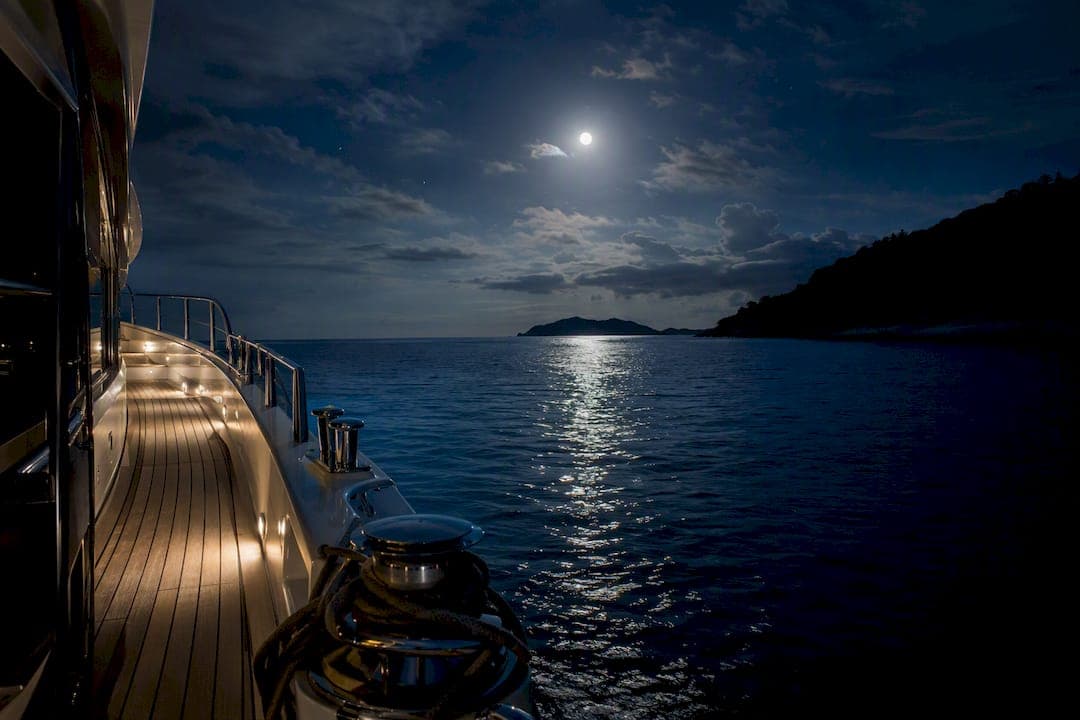
Moon phases matter for a romantic anchorage because they govern two things a good captain never leaves to chance: how much light falls on the water at night, and how hard the tide pulls at your anchor. A full moon gives you a silvered bay perfect for a late dinner on deck; a new moon gives you inky darkness where bioluminescence glows and the anchorage feels entirely your own. Either way, the tidal swing that comes with that lunar phase determines how much scope you need and how much the boat will move by 3 a.m.
- Ambience choice: full moon for a luminous, romantic backdrop; new moon for darkness that makes bioluminescence and privacy possible.
- Safety choice: neap tides (near the quarter moons) mean gentler currents and calmer overnight anchoring than the stronger pulls of spring tides.
- Planning imperative: plan for the entire overnight cycle, not just conditions at arrival, using tide data from NOAA and lunar tables from the U.S. Naval Observatory, or lean on a planner like Exoticacharters who does this daily.
Key Takeaways
Choosing a romantic anchorage successfully means matching lunar illumination to your ambience goal and lunar-driven tidal strength to your safety margin.
| Point | Details |
|---|---|
| Full moon suits ambience | Bright nights favor moonlit dinners but reduce visible bioluminescence. |
| New moon suits bioluminescence | Darker nights let bioluminescent organisms become visible above a critical light threshold. |
| Spring tides raise risk | New and full moons produce stronger currents and larger swing radius needs. |
| Plan the full overnight cycle | Sound and set scope for predicted high water, not conditions at arrival. |
| Exoticacharters plans around both | Captains build moon and tide data into every romantic anchorage itinerary. |
Where to Find Reliable Moon and Tide Data
Three sources cover nearly everything a captain or planner needs before choosing an anchorage.
- NOAA Tides & Currents: local tide predictions and tide-gauge data for arrival and departure timing, plus the tidal theory behind spring and neap cycles at Tidesandcurrents.
- U.S. Naval Observatory: lunar illumination fraction and moonrise or moonset times, useful for timing dinners and bioluminescence swims to the actual darkness window rather than the calendar date.
- Peer-reviewed marine ecology research: studies like the Strait of Messina tuna research explain why marine activity shifts with lunar brightness, which helps set realistic expectations for wildlife viewing.
For destination-specific planning, pair this data with Exoticacharters' destination guides and consider how couples elsewhere plan around romantic timing, as covered in this piece on boat day trips for romance.
Table of Contents
- How Does Moonlight Affect Bioluminescence and Nighttime Ambience?
- Why Do Spring and Neap Tides Change Anchoring Risk?
- How Do You Calculate Scope and Swing Radius Overnight?
- What's the Ideal Timeline for a Romantic Overnight Anchorage?
- Which Moon and Tide Combinations Suit Which Romantic Goal?
- What Do Experienced Captains Know That Guides Don't Mention?
- Sources
How Does Moonlight Affect Bioluminescence and Nighttime Ambience?
A bright moon floods the water's surface with ambient light and, in most marine environments, pushes bioluminescent visibility down considerably. A dark moon does the opposite: it lets even faint biological light stand out, and it wraps your anchorage in a privacy that no amount of curtain-drawing can match on a full-moon night.
The mechanism is well documented. Research on Atlantic bluefin tuna foraging in the Strait of Messina found that nighttime illumination rises steadily from new moon to full moon, and that many mesopelagic organisms respond by staying deeper during brighter phases, which thins out what's visible near the surface. A broader review of pelagic predator behavior reaches a similar conclusion: lunar brightness reliably pushes large marine animals into deeper, more daytime-like patterns, which changes what guests are likely to see at the rail after dark. Ecologists studying nocturnal species describe darkness itself as a resource: many bioluminescent organisms only become active once moonlight drops below a critical threshold, which is why the days around new moon consistently produce the brightest water trails.
For planning purposes, this means:
- Schedule a candlelit dinner on deck around the full moon, when the water itself becomes part of the lighting design.
- Reserve bioluminescence swims and night snorkels for the days bracketing new moon, ideally with low cloud cover and calm, low-turbidity water.
- Check the moon's elevation and rise time, since a moon still low on the horizon near "full" can leave a surprising amount of usable darkness earlier in the evening.
Pro Tip: Stage a bioluminescence swim from the swim platform with all deck lighting off and phones stowed. Even a single phone screen ruins night vision for the rest of the group for several minutes.
Why Do Spring and Neap Tides Change Anchoring Risk?
New and full moons pull the tide harder. When the sun and moon line up at syzygy, their gravitational pull combines to produce spring tides, which bring a larger tidal range and stronger currents through an anchorage. At the quarter moons, when the sun and moon pull at right angles, that combined force partially cancels out and produces neap tides, with a smaller range and gentler currents, according to NOAA's tidal theory guidance.
Distance matters as much as alignment. The moon's orbit isn't a perfect circle, and when perigee (its closest approach to Earth) coincides with a new or full moon, the combined gravitational effect can produce unusually large tidal ranges, sometimes called "king tides." Captains should treat any forecast perigee-syzygy overlap as a flag to add scope and check current tables twice.
- Spring tide: larger range, stronger currents, wider swing radius required.
- Neap tide: smaller range, weaker currents, generally the gentler choice for an overnight stay.
- Slack water: the brief window between tidal flows when current all but stops, often the smoothest time to set or weigh anchor.
When perigee lines up with a new or full moon, tidal range can exceed the average spring tide by a meaningful margin, a pattern NOAA documents in its work on the astronomical drivers of tidal force.
Pro Tip: Read the tide table for the full 12 hours you'll be at anchor, not just the arrival time. A gorgeous slack-water arrival at 6 p.m. can turn into a 2 a.m. current reversal that nobody's watching for.
How Do You Calculate Scope and Swing Radius Overnight?
Anchor for the tide you'll have at 3 a.m., not the depth you see when you drop the hook. That single habit separates a relaxed overnight stay from a 2 a.m. scramble. Sound to the predicted high water for the night, then calculate scope from that number, not the current reading, since a boat anchored short at low tide can come up dangerously taut, or drag, once the water rises.
- Sound for expected high water. Pull the night's high-water figure from your tide table before you calculate anything else.
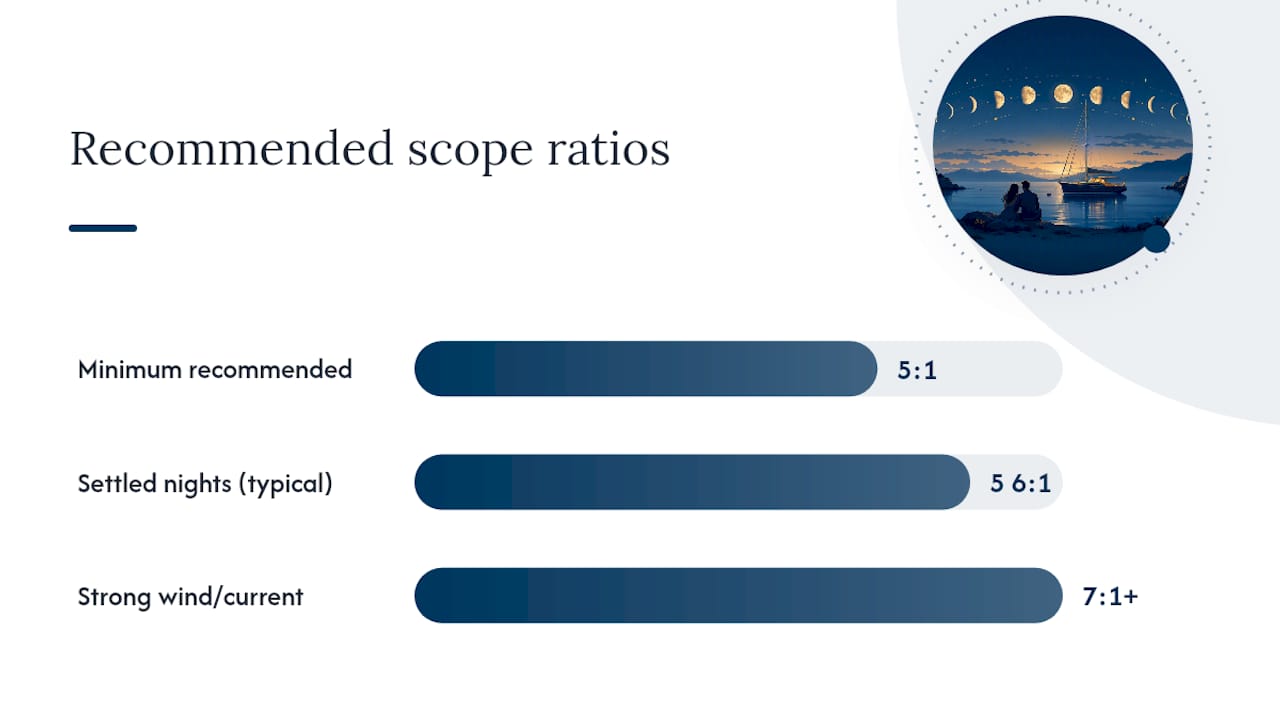
- Choose scope for conditions. A ratio of 5:1 to 7:1 (rode length to expected high-water depth) suits most settled nights; lean toward 7:1 or higher in stronger current or wind.
- Calculate your swing radius. A workable rule of thumb: boat length, plus scope times depth, plus a safety buffer of at least one boat length, gives your worst-case swing circle.
- Check ground tackle. Inspect chain for wear, confirm shackles are moused, and match your anchor type to the seabed you're setting into.
- Verify the set. Back down gently under power and watch for chain snubbing rather than dragging.
Overnight watch duties matter just as much as the initial set:
- Log position and depth at each watch change, not just at anchoring.
- Reposition the chartplotter's anchor marker to where the chain actually enters the water, rather than the GPS antenna position, to cut down on nuisance alarms as the boat swings.
- Have a clear plan for who repositions the vessel if conditions shift, and at what threshold that decision gets made.
In tidal channels during spring tides, expect steeper, shorter-period waves where an ebb current opposes incoming swell. Avoid transiting these stretches at peak spring current, and build a slack-water departure window into the plan from the start. In a crowded anchorage, remember that your swing radius overlaps with everyone else's. Exoticacharters' captains treat that overlap as a standing safety check, not an afterthought, on every overnight stop.
Pro Tip: Rehearse the full anchoring routine with your crew before the season gets busy. A well-drilled team sets a hook in the dark, in current, without waking a single guest.
What's the Ideal Timeline for a Romantic Overnight Anchorage?
Treat the whole overnight period as one planning unit, from the moment you choose an anchorage to the moment you weigh anchor the next morning. Arrival timing should weigh both the moon's illumination for the evening ahead and how close you are to the night's high or low water.
- Pre-departure: Pull moon-phase and tide data days ahead, and flag any perigee or spring-tide overlap.
- Arrival: Sound depths against the predicted high water, not the current reading, and set the hook accordingly.
- Evening: Stage lighting and dining around the moon's rise time and elevation for the ambience the guests want.
- Midnight watch: Confirm position, check chain tension, and reconfirm the swing radius against nearby vessels.
- Pre-departure prep: Time the weigh-anchor for slack water where possible, or plan for the assist (or resistance) of a moving current.
A short pre-departure checklist keeps the whole plan honest:
- Confirm the weather forecast against the tide table for overlapping risk.
- Review chain, shackles, and windlass condition before the trip, not during it.
- Set a lighting plan that balances guest privacy with safe deck visibility.
- Assign clear watch responsibilities: who checks position, who wakes the captain, and at what threshold anchor is broken and reset.
Which Moon and Tide Combinations Suit Which Romantic Goal?
Pairing the right lunar phase with the right tide takes the guesswork out of planning a specific evening. A few combinations come up again and again for couples aboard a crewed charter.
- Full moon, neap tide, sheltered bay: the classic moonlit dinner setup. Primary benefit is ambience; primary risk is minimal since neap currents are gentle. Adjustment: standard scope, relaxed watch schedule.
- New moon, neap tide, clear water: ideal for private bioluminescence viewing. Benefit is maximum bio-glow with calm conditions; risk is low visibility for navigation, so pre-mark hazards on the chartplotter before dark.
- Full moon, spring tide, open anchorage: dramatic depth and light, but stronger current and larger swing radius. Adjustment: increase scope toward 7:1, tighten the watch rotation.
- New moon, spring tide, narrow channel: best avoided for an overnight stay; strong current and poor visibility compound each other. Adjustment: relocate to a more sheltered spot if possible.
- Quarter moon, transitional tide, calm cove: a dependable middle ground for tender rides and evening swims, with moderate light and manageable current.
| Goal | Best Moon Phase | Best Tide | Key Consideration |
|---|---|---|---|
| Moonlit dinner ambience | Full moon | Neap | Standard scope, relaxed watch |
| Bioluminescence viewing | New moon | Neap | Mark hazards before dark |
| Dramatic scenery, more risk | Full moon | Spring | Increase scope, tighter watch |
| Calm tender rides and swims | Quarter moon | Transitional | Moderate light, manageable current |
Always check the site-specific tidal range and bathymetry for your actual anchorage before finalizing a plan. Lunar phase sets the general pattern, but local geography can amplify or soften it considerably.
What Do Experienced Captains Know That Guides Don't Mention?
Seasoned crews build habits around lunar and tidal quirks that rarely make it into a standard cruising guide.
- Always sound depth against the predicted high water for the night, not the depth on arrival.
- Move the chartplotter's anchor marker to the chain's entry point at the bow, not the GPS antenna, to avoid false alarms as the vessel swings.
- Rehearse anchoring routines regularly so the crew executes calmly in current or darkness.
- Never rely on a GPS anchor alarm alone; pair it with a visual watch and a manual position check each hour.
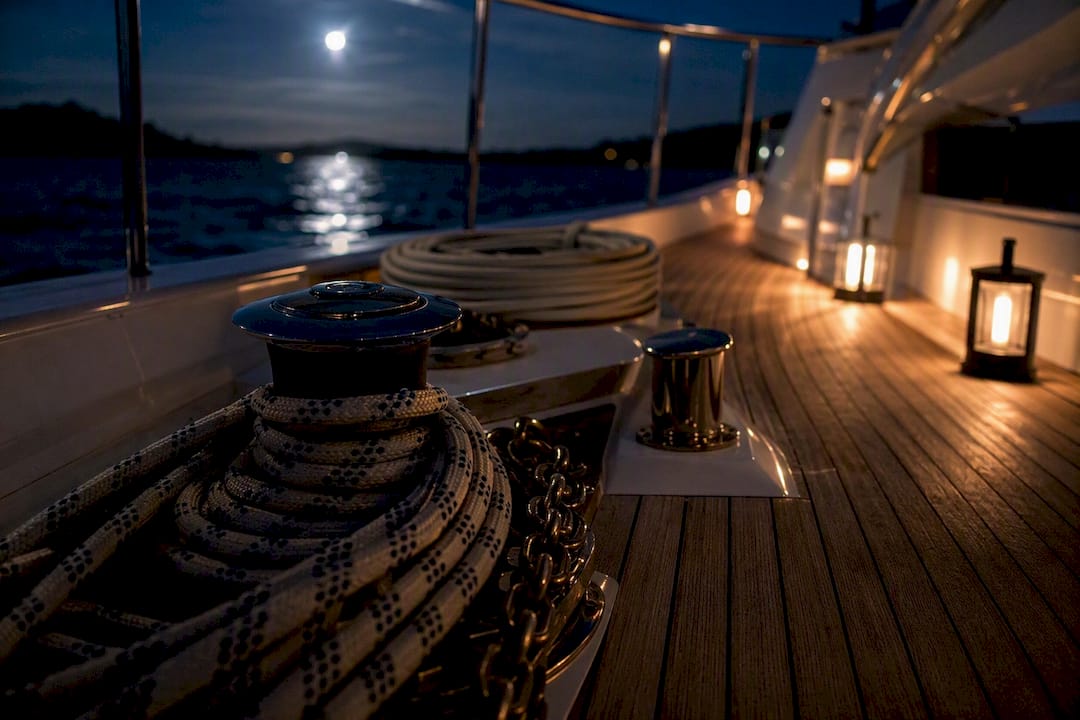
On the guest-experience side, lighting control makes or breaks a moonlit evening: dim the deck lights before a full-moon dinner so the moon does the work, and kill them entirely before a bioluminescence swim. Time shore excursions around the lower-light windows near dawn or dusk for a softer, more private feel. Exoticacharters trains its crews around exactly these habits, drawing on captains who've staged both romantic onboard dinners and late-night wildlife encounters across dozens of anchorages.
Pro Tip: Ask your captain for the moon's rise and set time before choosing a dinner hour. A "full moon" that rises at 11 p.m. won't light your table until dessert.
Why Exoticacharters Plans Around the Moon
Getting a romantic overnight right means balancing safety and atmosphere at the same time, never trading one for the other. Exoticacharters builds moon and tide data into every anchorage recommendation, so a couple's evening feels effortless while the crew is quietly managing scope, current, and swing room in the background.
Let Exoticacharters Plan Your Next Moonlit Night at Anchor
Planning a romantic anchorage around the moon takes more than checking a lunar calendar. It takes matching illumination and tidal behavior to the specific bay, channel, or reef you're visiting, and Exoticacharters builds that into every itinerary through captains who've anchored in these conditions for years. Services include hands-on captain expertise for scope and swing calculations, custom itinerary planning around moon and tide windows, onboard naturalists who can interpret nighttime marine activity, and bespoke dining and swim experiences built around the phase you want.

- Safety-first anchoring plans built around real tide data, not guesswork.
- Bespoke dining staged to match the moon's light, from candlelit full-moon dinners to dark-sky bioluminescence swims.
- Naturalists and crew who know how marine life shifts with the lunar month, so the experience matches the science.
If you're weighing a moonlit dinner against a dark-sky bioluminescence swim for your next trip, browse Exoticacharters' luxury yacht listings and talk to a specialist about which phase and anchorage fit the night you're picturing.
Sources
- Importance of the Lunar Cycle on Mesopelagic Foraging by Atlantic Bluefin Tuna in the Upwelling Area of the Strait of Messina (Central Mediterranean Sea)
- REST Lessons: Tidal theory and forces (NOAA Tides and Currents)
- Lunar cycle effects on pelagic predators and fisheries: insights into tuna, billfish, sharks, and rays
- Darkness as an ecological resource: the role of light in partitioning the nocturnal niche | Oecologia