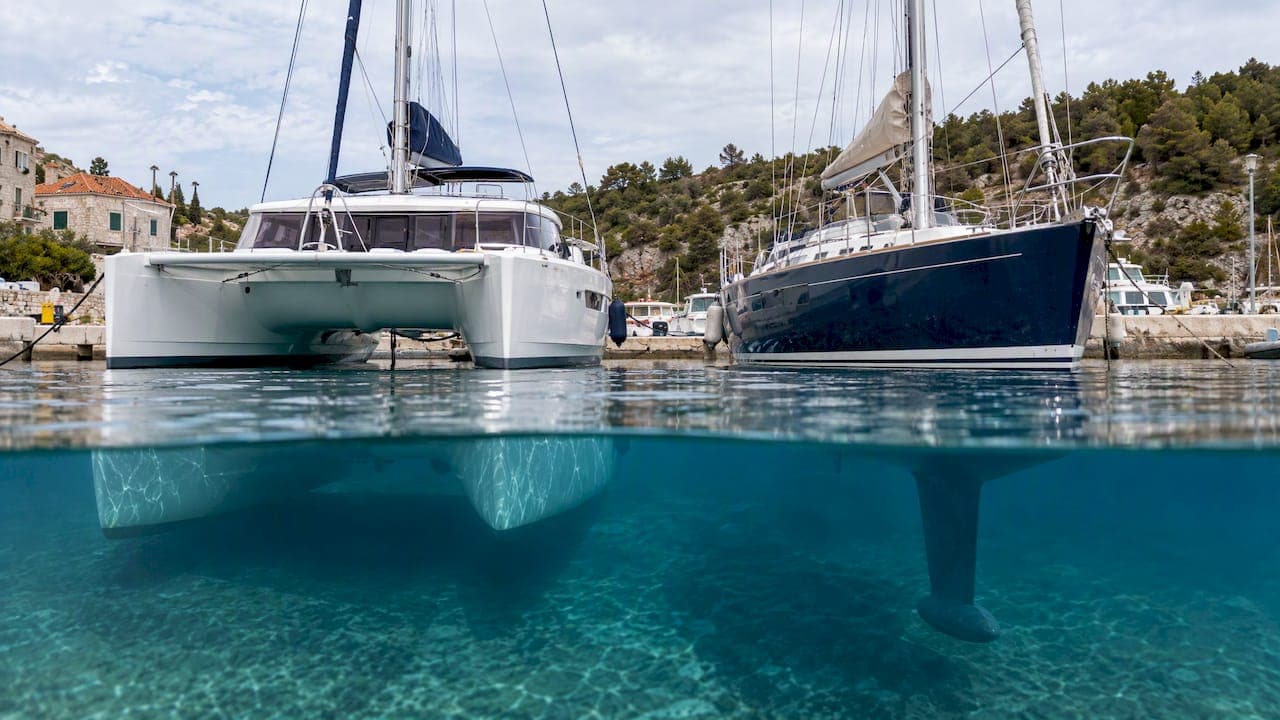
Draft is how far a yacht reaches down into the water, and it decides where the boat can go. A shallow draft yacht can slip into skinny anchorages and creep close to a beach. A deep draft yacht usually tracks better and feels steadier in open water, but it has to stay in deeper channels. For a crewed charter, neither is simply better. The right choice depends on the route you want to cruise, and on the people running the boat.
Below we explain what draft is, how the two types compare, and how to match a yacht to a destination. The examples come from the remote, wildlife-rich itineraries we plan.
TL;DR
- Draft is the distance from the waterline to the lowest point of the hull, and the figure can change with load.
- Shallow draft opens up sandbanks, lagoons and close-in anchorages. Deep draft generally adds stability and windward performance offshore.
- Catamarans, centerboard sailboats and motor yachts with tunnel or prop-pocket designs are the usual routes to shallow draft.
- On long-range expeditions, the captain's experience and the dive and safety support aboard matter more than the draft number.
- Tell your charter specialist where you want to anchor and swim, and ask for the loaded draft of each yacht on the shortlist.
Table of Contents
- What draft actually means
- Shallow draft vs. deep draft at a glance
- How yachts get a shallow draft
- When shallow draft really matters
- When deep draft earns its place
- The point many guides miss: draft is not a safety rating
- Remote destinations: Cocos Island as an example
- Our perspective
- How to choose: five steps
- Matching yacht type to your trip
- Plan your charter with former captains
- FAQ
- Sources
What draft actually means
The U.S. Coast Guard's National Vessel Documentation Center defines draft as the vertical distance from the waterline to the vessel's lowest underwater point. It is easy to mix up with depth, which the same document measures from the top of the hull to the bottom skin. Depth is a fixed property of the hull, while draft is the water the boat actually displaces in the real world, so depth is always the larger number.
Two practical points follow.
Draft moves with the load. A yacht sits lower with full fuel, water tanks, guests, luggage, dive gear and a tender on the deck. A brochure figure may describe a light condition. Ask for the draft at full charter load.
The quoted number may leave things out. Marine specialists point out that the static draft figure often excludes the lowest points, such as rudders or propellers. A captain planning a tight anchorage thinks about the whole underwater profile, not just the keel.

Shallow draft vs. deep draft at a glance
The broad pattern, as summarized by a boating education guide, is that shallow draft vessels, often flat-bottomed or fitted with a centerboard, suit coastal waters, inland routes and shallow anchorages. Deep draft vessels use a fixed keel to improve stability and windward performance in deeper, choppier water. The table below turns that into charter terms.
| Shallow draft | Deep draft | |
|---|---|---|
| Access | Lagoons, sandbanks, river mouths, close-in anchorages | Deeper channels, established harbors, open-water passages |
| Typical designs | Catamarans, centerboard sailboats, motor yachts with tunnel or prop-pocket hulls | Keelboats, larger monohull sailing yachts, many displacement motor yachts |
| Comfort at anchor | Often a gentle, wide platform; can feel lively in a beam swell | Often a deeper, more settled motion |
| Offshore behavior | Depends heavily on hull design, load and conditions | Generally steadier and better to windward |
| Best for | Island-hopping, snorkeling from the beach, tight anchorages | Longer passages, exposed crossings, big-water itineraries |
Treat the last two rows as tendencies. A well-designed shallow hull can be a very capable offshore boat, and a deep keel is no guarantee of a comfortable night.
How yachts get a shallow draft
Shallow draft is a design choice, and each route has trade-offs worth knowing.
Catamarans
Two slim hulls spread the boat's weight, so a catamaran needs less depth than a monohull of the same length. They also bring wide decks, a level ride at anchor and plenty of space for families and dive gear. If access to lagoons and sand flats is your priority, our catamarans are the natural place to start. A power catamaran, available on our power catamarans page, adds speed and range while keeping the shallow profile.
Centerboard sailboats
A centerboard lifts out of the way when you need to cross a bar or tuck into a shallow bay. Sailors who have used them are candid about the cost: on a cruising forum thread, one owner says the boards need to be of the kick-up type and held firmly, or the clunking in a rough anchorage becomes maddening. That is a maintenance and comfort detail a professional crew manages for you. Browse the range on our sailboats page.
Motor yachts with prop pockets or tunnels
Designers of power vessels often use prop pockets or tunnel technology to cut draft while keeping a protective keel and efficient shaft angles. This is why two motor yachts of similar length can draw very different depths. Our motor yachts range from compact boats to full superyachts, and the draft varies accordingly.
When shallow draft really matters
Skinny-water cruising
The Bahamas is the textbook case. Shallow banks, sand bars and cuts between cays reward boats that draw little, and cruisers have debated for years whether deeper boats can enjoy the islands at all. On a forum discussion about draft limits some sailors argue that shallow, centerboard designs have crossed oceans without more trouble than keelboats, which shows how much design and seamanship count.
For a charter guest, the benefits are concrete:
- Anchoring closer to a beach, so the tender ride is shorter
- Reaching lagoons and coves that deeper yachts skip
- More flexibility to change the plan when weather or tides alter the options
Rivers and tidal channels
Draft is not only a recreational concern. On working waterways such as the Mississippi, draft restrictions are dynamic in the sense that river conditions change, so passage depends on the water actually available that day. The same logic applies on any shallow route: charts show a depth, but the tide, a storm surge or a river stage can alter it.
Rules of the road
Draft also has a place in navigation law. The COLREGs recognize a power-driven vessel that is severely restricted in its ability to deviate from its course because of its draft relative to the water depth and width. In the Coast Guard's Navigation Rules handbook this sits within the rules on vessels with restricted maneuverability. It is a reminder that a deep-draft vessel in a narrow channel has fewer options, and a good captain plans for that.
When deep draft earns its place
A deeper keel does real work. It resists leeway, helps a sailing yacht point higher into the wind, and generally adds stability. If your itinerary includes long open-water crossings, a deep draft yacht may be the more comfortable platform because the motion is often steadier and the passage can be faster.
The cost is access. You anchor farther out, plan around tides and charts more carefully, and give up some lagoons altogether. On many classic charter routes this barely matters, because the best anchorages have plenty of depth.

The point many guides miss: draft is not a safety rating
Buyers and charterers often treat draft as a stand-in for seaworthiness. Marine experts push back on that. Draft is an access constraint: it helps decide whether a channel, anchorage or marina can take the boat, but it does not tell you how the boat will behave offshore. Hull shape, ballast, displacement, and the way the yacht is loaded and operated all shape the ride.
The practical lesson is to match the specific hull and keel arrangement to the water you actually plan to cruise, then lean on a captain who knows that water.
Remote destinations: Cocos Island as an example
Cocos Island, about 550 km off Costa Rica's Pacific coast, shows why the crew matters more than a single number. It is a protected national park, and according to a Costa Rica tourism guide only liveaboard dive vessels are permitted to visit. The park is known for schooling hammerheads, whale sharks and manta rays, which gather in open ocean with current and shifting conditions.
In that setting nobody asks whether the yacht can reach a shallow lagoon. The questions are about open-water capability, range, a dive tender, safety equipment, and above all a captain and dive team who know the sites. Draft is a footnote. Because regulations, permits and park rules change, confirm current requirements with your charter specialist and the park authorities before you commit to dates.
If Cocos or a similar dive-driven trip is on your list, start with our charter yachts with scuba diving onboard.
Our perspective
We plan charters in places where the water is clear, the anchorages are remote and the nearest harbor is a long way off. Our team is made up of former captains and water sports professionals, so we tend to look at draft the way a captain does: as one input among several, never the headline.
When a guest asks us for a shallow draft yacht, we ask a few things in return. Where do you want to swim and snorkel? Will you be diving? How much open water lies between the anchorages? How many people, and how much gear? A family chasing white-sand beaches and calm lagoons will often be happiest on a catamaran. A couple planning a long crossing to a wildlife destination may prefer a larger, deeper yacht, or an expedition-style vessel with real range.
We would also suggest a little humility about numbers. A draft figure on a listing is the start of the conversation. We would rather hear what a captain says about a route than trust a spec sheet alone.
— Mo
How to choose: five steps
- Name the places. List the anchorages, islands and dive sites you most want to reach. Shallow lagoons call for a lower draft; exposed sites call for sea-keeping and support.
- Rank your priorities. Decide whether easy beach access, a smooth passage, speed or deck space matters most. You will rarely get all four.
- Ask for loaded draft. Request the draft at full charter load, including fuel, water, guests and the tender, and ask what sits lowest: keel, rudder or propellers.
- Check the crew and the tender. For diving and wildlife trips, ask about the captain's experience in that region, the dive tender and the safety equipment.
- Leave room for the weather. A good itinerary has alternates. A yacht that can reach a second, more sheltered anchorage gives you a better trip when conditions change.
Matching yacht type to your trip
| Trip style | What to look for |
|---|---|
| Family beach and lagoon trip | Catamaran or power catamaran, shallow draft, wide deck for swimming and water toys |
| Romantic island-hopping | Sailboat or compact motor yacht with a low draft and easy tender access |
| Dive-focused expedition | Dive-ready yacht with a capable tender, strong crew, range and safety equipment |
| Wildlife expedition in remote waters | Expedition-style vessel or larger yacht, chosen for range and sea-keeping first |
| Large group or celebration | Larger motor yacht or superyacht, with the itinerary built around deeper anchorages |
If size is the first thing you want to settle, our pages for yachts under 50 ft, yachts under 75 ft and yachts under 100 ft are a good starting point. Smaller yachts commonly draw less water, though design matters more than length, so always confirm the figure.
Plan your charter with former captains
We are a commission-based yacht charter brokerage for fully crewed charters, covering sailing yachts, motor yachts, catamarans and superyachts. Tell us where you want to go and what you want to do when you get there, and we will shortlist yachts with the right access, the right crew and the right comfort for the route. We do not publish prices, because each charter is built around the yacht, the season and the itinerary.
Speak to a yacht charter specialist and we will work through draft, route and crew with you.
FAQ
Is a shallow draft yacht always better for chartering?
No. It is better when your itinerary includes lagoons, sandbanks or close-in anchorages. For long open-water passages, hull design, load, and crew experience matter more than draft alone. Many excellent charters are enjoyed on deeper yachts.
What is the difference between a boat's depth and its draft?
Depth is measured from the top of the hull to the bottom skin, while draft is measured from the waterline to the lowest underwater point. The Coast Guard notes that depth is always the greater of the two. Draft is the figure that tells you what water the boat needs.
Are shallow draft boats less stable?
They can be in rough, open water, particularly flat-bottomed or centerboard designs, but it depends on the specific design. A catamaran, for example, gets stability from its wide beam rather than a deep keel. Ask about the exact yacht and the conditions on your route.
Does draft change during a charter?
Yes, in practice. Fuel and water burn off, guests and gear come aboard, and a tender may be carried on deck. That is why we suggest asking for draft at full charter load, and for the lowest point of the underwater profile.
Does draft matter for a remote dive trip like Cocos Island?
Less than you might expect. On trips like that, the captain's regional experience, the dive tender and the safety equipment carry the weight, since conditions can shift quickly. Draft still matters for the yacht's general design, but it is rarely the deciding factor.
Sources
- USCG National Vessel Documentation Center: definitions and abbreviations
- Shallow Draft vs Deep Draft: What's the Difference? (BoatDriving.org)
- Shallow vs. Deep Draft Trawlers: Buyer Tradeoffs (North Pacific Yachts)
- Centerboards: good or bad (Cruisers & Sailing Forums)
- Effect of Draft on Seaworthiness (Cruisers & Sailing Forums)
- Vessel Traffic Service Lower Mississippi River user manual (USCG)
- Navigation Rules handbook (USCG Navigation Center)
- Isla del Coco National Park dive guide (Costa Rica tourism)