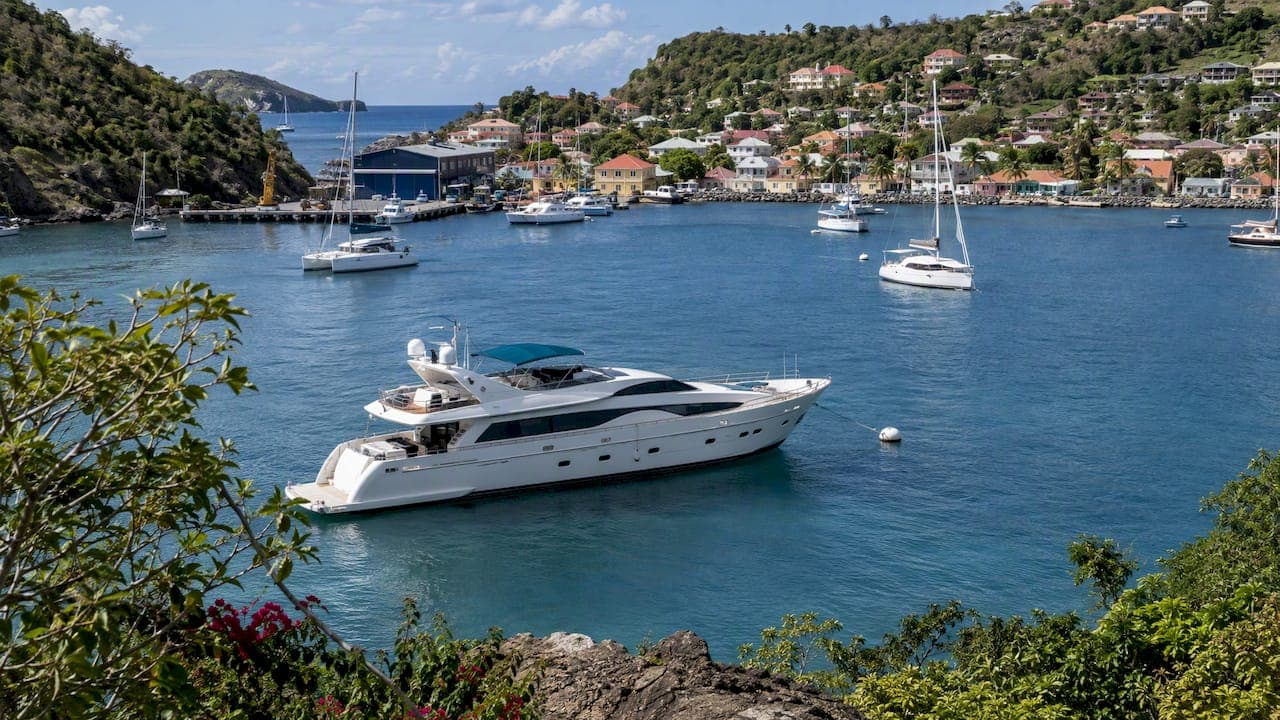
Choose the Caribbean when you want easy logistics, short hops between islands and a long list of anchorages within a day's sail of each other. Choose the South Pacific when you want scale, isolation and a sense of having the lagoon to yourself, and you are willing to travel farther to get it. Both are superb on a crewed yacht; they simply reward different travelers, different calendars and different expectations.
We plan charters in both, so what follows is how we would talk it through with a guest on the phone: seasons, storms, distances, diving, boats, rules and what a week actually feels like.
TL;DR
- Caribbean: compact, easy to reach from the US East Coast, many islands per week, with a long and well-defined charter season.
- South Pacific: larger, more remote, with dramatic volcanic peaks, vast lagoons and wildlife encounters; allow more travel time and a longer stay.
- Storms: the Atlantic and Caribbean season runs June 1 to November 30, while the South Pacific cyclone season begins around late October or early November and fades by early May, so the two calendars sit almost opposite.
- Diving: the Caribbean offers gentle, clear reef diving; the South Pacific adds scale, big pelagics and walls, particularly for experienced divers.
- Crew: on either side, a crew with real captaining and water sports experience shapes the week more than the destination label does.
Table of Contents
- First, what do we mean by each?
- Seasons and storms: two calendars, almost mirrored
- Distances and how you get there
- Scenery and the feel of a day on the water
- Diving and marine life
- Which boat suits which water
- Rules and paperwork you should know about
- South Pacific or Caribbean: a quick decision guide
- Our perspective
- Plan your charter with us
- FAQ
- Sources
First, what do we mean by each?
The two names are looser than they sound, and it helps to pin them down before comparing.
The Caribbean, in the United Nations' statistical grouping, encompasses 30 nations and territories, including Cuba, the Dominican Republic and the US Virgin Islands. The same classification puts Mexico in Central America, so the Mexican coast around Cancún is not technically Caribbean in that scheme, however it appears on a brochure. For a yacht charter, the Caribbean in practice means the chains of islands: the Virgin Islands, the Leewards, the Windwards and the Grenadines, plus a few quieter corners further west.
The South Pacific is a far bigger idea. For charter purposes, most travelers mean French Polynesia (the Society Islands around Tahiti, Moorea, Raiatea and Bora Bora, and the Tuamotu atolls), Fiji, and other island groups scattered across a very large ocean. If you are weighing two Pacific options against each other, we have set out French Polynesia vs Fiji for a yacht charter separately.
A third confusion deserves a mention. Many people searching this comparison are really asking about the Pacific and Caribbean coasts of a single country such as Costa Rica or Mexico. That is a different trip. This guide is about crewed yacht charters across the two ocean regions.
Seasons and storms: two calendars, almost mirrored
Timing is the single biggest practical difference, and it works in your favor if you plan around it.
According to NOAA, the Atlantic and Caribbean hurricane season officially runs from June 1 to November 30. In contrast, the South Pacific and Australian basin cyclone season begins in late October or early November, reaches a single peak in late February or early March, and fades by early May. NOAA also notes that 97% of Atlantic tropical cyclone activity falls within the June to November window, though cyclones can occur year-round in any basin.
In plain terms:
| Period | Caribbean | South Pacific |
|---|---|---|
| December to April | Peak charter season; hurricane season is over | Cyclone season in progress, peaking in late February or early March |
| May to October | Early season, then hurricane season from June 1 | Outside cyclone season for most of the period |
| November | Hurricane season ends on the 30th | Cyclone season begins around late October or early November |
The practical consequence: if your school holidays or work calendar force a winter trip, the Caribbean is the natural choice. If you can travel between roughly May and October, the South Pacific is outside its storm season, while the Caribbean is in the middle of its own. Neither is closed, and a good crew watches forecasts daily and adjusts the route, but the odds and the flexibility differ. A cyclone or hurricane is not a daily risk even in season, yet it is the reason an itinerary needs a Plan B, and the reason we favor flexible cancellation terms and itineraries that can shift to a sheltered cruising ground.
The Pacific's looser calendar also shows up in how people describe it. Sailors often point out that where the Caribbean has a clearly defined season, the Pacific is larger and the best months vary by island group. French Polynesia's Society Islands and its far-flung atolls do not behave identically, which is one more reason to plan with someone who has sailed them.
Distances and how you get there
The Caribbean is the easier trip to reach. From most major US cities you can connect to a charter base in the Virgin Islands or the Leewards within a day, and many guests arrive at lunchtime and are anchored in a quiet bay by evening. A week can include six or seven different islands, each a short sail from the last, which suits families with children who are happy with a swim stop and a beach lunch every few hours.
The South Pacific asks more of you. Flights to Tahiti from the US West Coast are long, and from the East Coast you will connect and probably spend a night on the way. It is wise to build in a night ashore before boarding, and a week on the water feels better as ten days or more. The reward is geography on a different scale: island groups where distances between anchorages are larger, where the lagoon is the main event, and where the nearest crowd may be another yacht a couple of bays away.
That is also where a crew's experience matters. Long passages, remote anchorages and thin infrastructure are routine for captains who have worked these waters for years. In French Polynesia, for instance, Tahiti is the main provisioning hub, but captains can use domestic air freight to deliver fresh supplies to yachts in more isolated islands, which spares you from sailing back to the main port to restock. A crew who knows that, and who plans the menu around it, makes a remote week feel effortless.
Scenery and the feel of a day on the water
Caribbean. Think of it as a string of beaches, protected bays and small harbor towns. Sailing conditions are typically friendly, anchorages are plentiful and there is something to do ashore most afternoons: a beach bar, a snorkel trail, a hike to a viewpoint. It is social and easy, and it suits first-time charterers, multigenerational groups and anyone who likes the option of dinner ashore.
South Pacific. The landscape is more dramatic: jagged volcanic peaks, turquoise lagoons inside barrier reefs, motus (tiny islets) fringed with palms and, in the atolls, water so clear that the boat appears to hover. Days are less about a town and more about the water itself: snorkeling with rays and reef sharks, paddleboarding at dawn, a picnic on a sandbar that exists only at low tide. If you want your week to feel like an expedition without giving up a chilled bottle and a cabin with a view, this is the region.

For a closer look at the islands, our French Polynesia charter itineraries show how a week can be shaped around the Society Islands and beyond, and our guide to which Tahiti islands are worth it on a superyacht helps with choosing among them.
Diving and marine life
Divers should think about what they want from a dive, not just where the reef is.
The Caribbean is forgiving. Warm water, generally gentle conditions and shallow, colorful reefs make it ideal for newer divers, for a family where some members snorkel and others dive, and for photographers who like to linger over small subjects. Divers often describe it as a place for macro life and relaxed drift or wall dives rather than big animal encounters.
The South Pacific tends to appeal more to experienced divers. Atoll passes, outer reef walls and open-ocean currents bring bigger animals into view, and the scale of the reefs is hard to match. That scale comes with stronger currents and more demanding conditions at some sites, so a dive guide who knows each pass and its tides is not a luxury; it is how you dive them well.
The US government's own figures hint at how widely reef systems are spread across both oceans. The United States has jurisdiction over roughly 7,607 square miles of coral reefs, with Caribbean reefs off Florida, Puerto Rico and the US Virgin Islands, and Pacific reefs off Hawaii, American Samoa, Guam, the Northern Mariana Islands and several remote wildlife refuges. Those are the reefs that US travelers can reach under their own flag; a charter opens up far more, in both regions.
A fair summary: if you want easy, colorful, repeatable dives with the family along, choose the Caribbean. If you want walls, passes and the chance of larger animals, and you are comfortable with current, choose the South Pacific.

Which boat suits which water
The vessel should follow the region, not the other way around.
- Catamarans work well in both. Their stability and shallow draft make them popular in the Caribbean's anchorages and in Pacific lagoons, and they give families plenty of deck space. Browse our catamaran charters and power catamarans.
- Sailboats suit guests who like the feel of a passage under sail, and the trade winds in both regions reward it. See our sailboat charters.
- Motor yachts cover distance quickly, which matters in the Pacific where the next anchorage can be farther away, and they bring generous interiors and tenders for water sports. Explore our motor yachts.
- Larger luxury yachts and superyachts add space, a larger crew, dive and water-toy inventories and the comfort that suits a long week away. Our luxury yachts are a good starting point.
Boats and crews in remote areas can differ from those in busy charter hubs, so we always match the vessel to the itinerary, not just the guest list.
Rules and paperwork you should know about
The Caribbean has a mature charter industry, with long-established bases and standard practices from island to island, though each jurisdiction has its own entry procedures.
French Polynesia is more regulated for visiting charter yachts. According to Tahiti Tourisme, the vessel must be valued at over €838,000, carry a minimum daily rate of €1,675, and keep a permanent crew of at least three professionals. Authorizations are valid for six-month renewable periods, with a processing time of five to six weeks before arrival. These conditions apply to the vessel and its operator rather than to you as a guest, and they are a quiet reason to book a properly licensed, professionally crewed yacht there. They also explain why last-minute Pacific charters are harder to arrange than Caribbean ones, and why we suggest planning well ahead. Rules can change, so confirm current requirements with the operator before you commit.
South Pacific or Caribbean: a quick decision guide
Choose the Caribbean if:
- you are traveling between December and April, or have only a week and want to minimize transit;
- you are chartering for the first time, or bringing young children or several generations;
- you want a mix of beach days, harbor towns and dinners ashore;
- you prefer gentle, shallow reef diving.
Choose the South Pacific if:
- you can take ten days or more, and the long journey does not trouble you;
- you are drawn to remoteness, dramatic landscapes and lagoons;
- you are an experienced diver, or a keen snorkeler who wants bigger encounters;
- you are celebrating something, such as a honeymoon or a milestone anniversary, and want the trip to feel once-in-a-lifetime.
If you land in the middle, consider doing both over two years: a Caribbean week to learn what you enjoy about life aboard, then a Pacific trip once you know how you like to spend your days.
Our perspective
Our team is made up of former captains and water sports professionals, and that shapes how we answer this question. We have stood on the bridge watching a forecast and deciding whether to stay or move, and we have run the dive briefings and the tender runs. So we do not treat "South Pacific or Caribbean" as a contest with a winner.
We consider the Caribbean the best introduction to chartering: reliable, sociable and easy to reach. We would suggest the South Pacific to guests who already know they love the water and want to go further, or who are marking an occasion that deserves a remote setting. What we caution against is choosing by photographs alone. A lagoon that looks identical in two pictures can ask very different things of you in travel time, calendar, budget and comfort with remoteness.
The questions we ask first are simple: when can you travel, who is coming, how many days do you have, and what would make the week unforgettable for each person aboard? Everything else, from the boat to the route, follows from those answers. Once you know them, the right ocean usually becomes obvious.
— Mo
Plan your charter with us
If you are ready to turn the comparison into a route, speak to a yacht charter specialist. We arrange fully crewed sailing yachts, motor yachts, catamarans and superyachts, and we build each itinerary around your dates, your group and your interests, whether that is diving, wildlife, water sports or simply quiet anchorages. To see the Pacific side in more detail, start with our South Pacific yacht charters or the wider destinations list. Pricing depends on the yacht, season and itinerary, so we quote each charter individually.
FAQ
Is the South Pacific more expensive than the Caribbean for a yacht charter?
It often costs more overall, mainly because of longer flights, remote logistics and the regulated charter market in places like French Polynesia. Costs vary a great deal by yacht, season and itinerary, so we price each trip individually rather than quoting a rule of thumb.
When is the best time to charter in each region?
The Caribbean's classic window is the dry months of roughly December to April, well clear of the June to November hurricane season. For the South Pacific, the cyclone season starts around late October or early November and fades by early May, so many travelers aim for the months outside it. Island groups vary, so check the specific route with your charter specialist.
Which region is better for families?
For first-time families and young children, the Caribbean is usually easier: shorter flights, short hops between islands and plenty to do ashore. Families with teenagers who snorkel or dive, and who can handle a longer journey, often love the South Pacific's lagoons and wildlife.
Is Mexico part of the Caribbean?
Not in the United Nations' statistical scheme, which places Mexico in Central America. Its eastern coast faces the Caribbean Sea, but the Caribbean region proper is the 30 nations and territories of the island arc and nearby islands.
Sources
- NOAA: Tropical Cyclone Introduction
- UN Statistics Division: Methodology, Standard country or area codes (M49)
- NOAA: The State of Coral Reef Ecosystems of the United States and Pacific Freely Associated States
- Tahiti Tourisme: Premium Guide for Captains