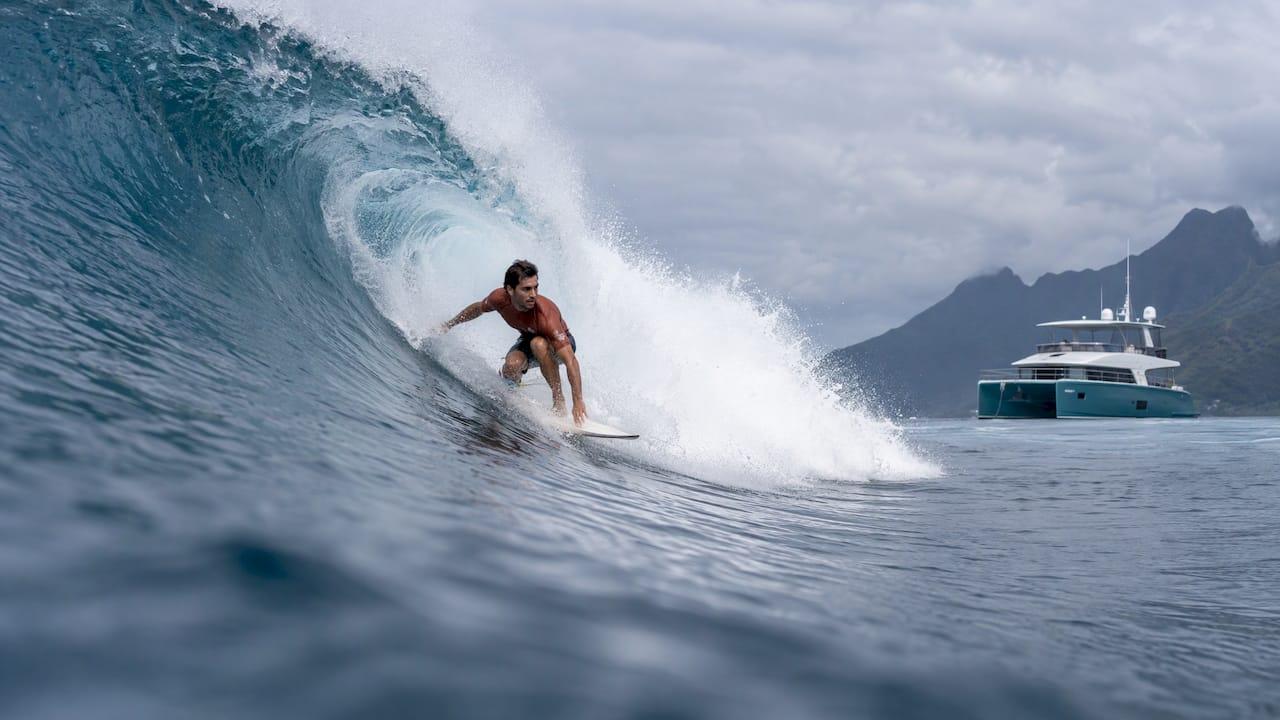
Surfing by yacht in Tahiti means living aboard a crewed charter while a captain positions you near the island's best waves, whether you paddle out, ride a tender to the lineup, or simply watch from the channel. The yacht is your hotel, your dining room and your grandstand. It also gives you something a beach resort cannot: the freedom to leave a flat bay behind and be somewhere with swell by the next morning. Below, we explain how it works, when to go, what to respect and how to plan a week that suits surfers and non-surfers alike.
TL;DR
- A crewed yacht lets you base yourself near Tahiti's reef breaks, including Teahupo'o, and use a tender to reach the channel or the lineup with local guidance.
- Plan around swell, not just weather: the south coast is a heavy reef-break environment, and first-timers do best on smaller, forgiving days.
- Teahupo'o has a good-conduct pact for boat operators covering speed, safety distances and passenger capacity; your captain should follow it.
- Mix surf days with the protected Leeward Islands, where families, divers and non-surfers can enjoy calm lagoons.
- Charters are tailored, so tell us your ability level and group mix early; we build the route around it.
Table of Contents
- What surfing by yacht in Tahiti actually involves
- The breaks you can ride or watch from a boat
- When to go: swell, wind and the seasons
- Reaching the lineup and watching from the water
- Etiquette, safety and local rules
- Planning a trip that works for surfers, families and divers
- Choosing the right yacht
- Our perspective
- Start planning your Tahiti charter
- FAQ
- Sources
What surfing by yacht in Tahiti actually involves
Tahiti is the main island of French Polynesia, and its reputation among surfers rests on powerful reef passes where open-ocean swell meets shallow coral. A yacht charter does not change the waves. It changes your access and your rhythm.
On a typical surf-focused trip, the day looks like this:
- Early breakfast on deck while the crew checks the swell and wind forecast.
- A short tender ride to the channel beside a break, or to a sheltered anchorage nearby.
- A session in the water for those who surf, with the rest of the group watching, snorkeling or reading on the yacht.
- Lunch aboard, then a second session, a dive, or a slow move to the next anchorage.
Because the yacht carries its own crew, tender and water toys, nobody has to organize road transfers or fight for a seat on a day boat. The captain decides where to anchor based on conditions, which matters more than any itinerary written months ahead.
It also helps to be honest about the mix of people on board. In our experience, a charter works best when the surfers are a minority or a small, committed group within a wider party; the yacht then has plenty to offer everybody else on the days when the surfers are busy.
The breaks you can ride or watch from a boat
Tahiti's best-known waves sit on the reef, not on the beach, which is exactly why a boat is the natural viewing platform.
Teahupo'o
At the end of the road on Tahiti's southeast coast, Teahupo'o is the wave that put the island on every surfer's map. It is a thick, hollow left that breaks over shallow reef, and it was the venue for the surfing events of the 2024 Paris Olympics. Watching it from the channel, with the spray lifting off the lip, is one of the great spectator experiences in surfing, and visiting boats are a familiar sight there.
The local advice is worth following. Former world tour surfer Michel Bourez, quoted in Surfer's guide to Teahupo'o, suggests visiting during a decent southwest swell with a forecast north wind to keep the face glassy, and he recommends first-timers start on a forgiving day of shoulder to head high. Heavy days at Teahupo'o are for experienced surfers only; for everybody else, the channel is the place to be.
Other Tahiti breaks
Along the south and west coasts you will find a string of reef passes and point-style waves, from mellow, user-friendly peaks to serious barrels. On the north coast, rivermouth and sandbar waves, such as Papenoo, tend to be friendlier for learners when northern swell arrives. Your captain and our team will pair the group's level with the right spot on the day, and we will be frank when conditions are beyond what the group should attempt.
Beyond Tahiti island
A yacht also lets you combine Tahiti's surf with the lagoons and anchorages of neighboring islands. Moorea, a short crossing from Tahiti, and the Leeward Islands of Huahine, Raiatea, Tahaa and Bora Bora offer calm water, snorkeling and some of the Pacific's most photogenic anchorages. Our French Polynesia yacht charter itineraries show how these pieces can fit together.

When to go: swell, wind and the seasons
Swell direction defines the calendar. In broad terms, the southern hemisphere winter, roughly May to October, is when south and southwest swells arrive most reliably on the south-facing reefs, and it coincides with the drier, more stable weather that many charter guests prefer. The austral summer brings a different pattern, with northern swells reaching the island's north coast, which can suit less experienced surfers.
A few practical points follow from that:
- Advanced surfers chasing the south coast should lean toward the dry months, accepting that the biggest swells can also make Teahupo'o unrideable for anyone but specialists.
- Intermediate surfers and learners may be happier with smaller days, which can occur at either end of the season, and with north-coast options when they are working.
- Mixed groups often do well to choose the season for the overall charter experience, then let the captain find the best surf within it.
Swell forecasts change day by day, so no itinerary can promise waves. We would rather build in a few extra days of flexibility than sell a fixed schedule. For the wider question of weather, crowds and cost, see our guides to the best time to charter a yacht in French Polynesia and when to book a Tahiti crewed charter.
Reaching the lineup and watching from the water
There are two ways a yacht guest experiences a wave: from the lineup or from the channel.
For surfers, the tender takes you from the anchored yacht to the edge of the break. Your crew can wait nearby, keep an eye on the group and bring you back when the session ends. Agree before you leave who is staying in the water, how long you will be out, and what the signal is if somebody needs to be picked up.
For spectators, the channel is the safe vantage point. It sits beside the breaking wave, in deeper water, and gives a close but protected view. Keep a respectful distance from the surfers' path, and let the captain or tender driver choose the position.
Bring what you would for a long day on the water: reef-safe sunscreen, a long-sleeved rash guard, a hat, a dry bag for cameras, and a waterproof case for a phone. Surfers should carry reef booties and a helmet for shallow breaks; ask us what is practical to bring or have on board.

Etiquette, safety and local rules
Surf spots in French Polynesia are working parts of local communities, and the rules around them are taken seriously.
The Teahupo'o good-conduct pact
The commune of Taiarapu-Ouest has formalized a charter of good conduct with the area's nautical service providers, reported by Tahiti Infos. It asks boat operators to respect speed limits, safety distances and each vessel's passenger capacity, and not to cross in front of a wave being surfed. Most captains have signed it. We expect any crew we place you with to follow that spirit: slow, predictable boat handling and no crowding of the surfers.
Event restrictions
During the 2024 Olympic surfing competition, the authorities imposed temporary navigation and maritime-activity restrictions outside and inside the lagoon, as set out in the official press kit on traffic and mooring, to keep people and vessels safe. Similar measures can accompany any major event, so your captain should check current local notices before you head to the south coast.
Rahui and the lagoon
On Tahiti's southern tip, rahui, a traditional practice, temporarily bans fishing and harvesting to let marine life recover, as described by the UNESCO Courier. If your crew points out a rahui zone, treat it as a firm boundary: no spearfishing, no collecting shells or coral, and no catching dinner there.
Skill and risk
Reef breaks are unforgiving. Surf only what suits your ability, never alone, and let the captain's local knowledge override your ambition. If you have a medical condition or you are unsure about your fitness for heavy surf, speak to your doctor before you travel.
Planning a trip that works for surfers, families and divers
The strength of a crewed yacht is that one boat can hold several different holidays at once.
Non-surfers and families
The islands of French Polynesia are ringed by coral reefs that create sheltered lagoons, so most passages between islands are short and calm. Guests who do not surf can snorkel, paddle, swim from the stern and explore white-sand beaches while the surfers are out. Children are well served by lagoon days, and surf spectating from the channel can be a highlight for teens.
Divers
French Polynesia's passes and drop-offs offer exceptional diving, and our team includes former captains and water sports professionals who understand how to combine dive days with surf windows. Tell us your certification level when you inquire so we can match the dive plan to the swell plan; the same conditions that produce good waves can affect visibility and currents in the passes.
Couples
For two people, a surf-and-lagoon route offers a quieter rhythm: a morning at a break, an afternoon in a remote anchorage, dinner on deck under the stars.
A sample shape for seven to ten days
| Phase | Focus | What it looks like |
|---|---|---|
| Days 1 to 2 | Arrival and Tahiti south coast | Settle on board, check the forecast, watch or surf the channel breaks |
| Days 3 to 4 | Flex days | Swell-dependent: stay for a better window or move on |
| Days 5 to 7 | Moorea or Leeward Islands | Lagoon swimming, snorkeling, diving, relaxed anchorages |
| Days 8 to 10 | Optional extension | Bora Bora, or a flight-linked addition such as the Tuamotus |
This is a framework, not a fixed route. If you want to add atolls, our guide to which Tuamotu atolls are worth adding explains the options.
Choosing the right yacht
The vessel shapes the trip as much as the route. Each type has its place:
- Catamarans offer wide, stable decks and shallow draft, which many families and groups prefer for lagoon anchorages.
- Sailing yachts give a more traditional feel and are favored by those who enjoy the passages as much as the stops.
- Motor yachts cover distance quickly, which helps when the swell moves and you want to reposition.
- Superyachts add space, toys and a larger crew for bigger parties; our piece on superyacht charter in Tahiti covers which islands reward the extra size.
Whatever you choose, ask about the tender: its size, how many people it carries and whether it can safely carry boards. The tender is the real surf vehicle on a yacht charter.
Our perspective
We have spent our careers on boats and in the water, and the lesson we return to is that the best surf trips are built around flexibility, not a fixed itinerary.
Surfing by yacht in Tahiti rewards a captain who reads the swell, respects the local community and knows when to hold position and when to move on. That is why we plan these charters with former captains and water sports professionals: they understand what a tender can safely do, how to keep a mixed group happy, and where the day's best option actually is.
We would suggest treating the waves as one chapter of a wider voyage. Give the surfers their mornings, give everyone else lagoons, reefs and long lunches, and leave a few spare days so the ocean can set the pace.
Mo
Start planning your Tahiti charter
We plan fully crewed charters in remote destinations, including French Polynesia, across sailing yachts, motor yachts, catamarans and superyachts, with itineraries tailored around diving, wildlife and water sports. Tell us your group, your surfing level and your preferred season, and a specialist will propose vessels and routes. Browse our French Polynesia yacht charters or speak to a yacht charter specialist through Exotica Charters.
If you already know the kind of boat you want, our sailboats and motor yachts pages are a good place to begin.
FAQ
Can I surf Teahupo'o from a yacht?
A yacht can anchor you near the channel and a tender can take you to the lineup, but Teahupo'o is a heavy reef break for experienced surfers. Choose a smaller, forgiving day if it is your first time, and follow your captain's guidance. Non-surfers can watch from the channel.
What is the best time of year for surfing by yacht in Tahiti?
The south coast is most consistent in the austral winter, roughly May to October, while northern swells can favor the north coast at other times. Because swell changes daily, we recommend building spare days into any itinerary. See our best-time guide for the broader season picture.
Is a surf-focused charter suitable for non-surfers and children?
Yes. Lagoon swimming, snorkeling, paddling and beach stops keep non-surfers busy, and the short passages between French Polynesian islands keep days relaxed. Spectating from the channel is often a highlight for the whole family.
What rules apply to boats near Tahiti's surf breaks?
At Teahupo'o, a good-conduct pact asks operators to respect speed limits, safety distances and passenger capacity, and not to cross a wave being surfed. Temporary restrictions can also apply during major events, and rahui zones ban fishing and harvesting. Your captain should handle these checks.
Sources
- Everything You Need to Know About Teahupo'o, Surfer
- Une charte de bonne conduite à Teahupo'o, Tahiti Infos
- Dossier de presse: réglementation circulation et stationnement, JO 2024
- In Tahiti, a lagoon rescued by tradition, UNESCO Courier