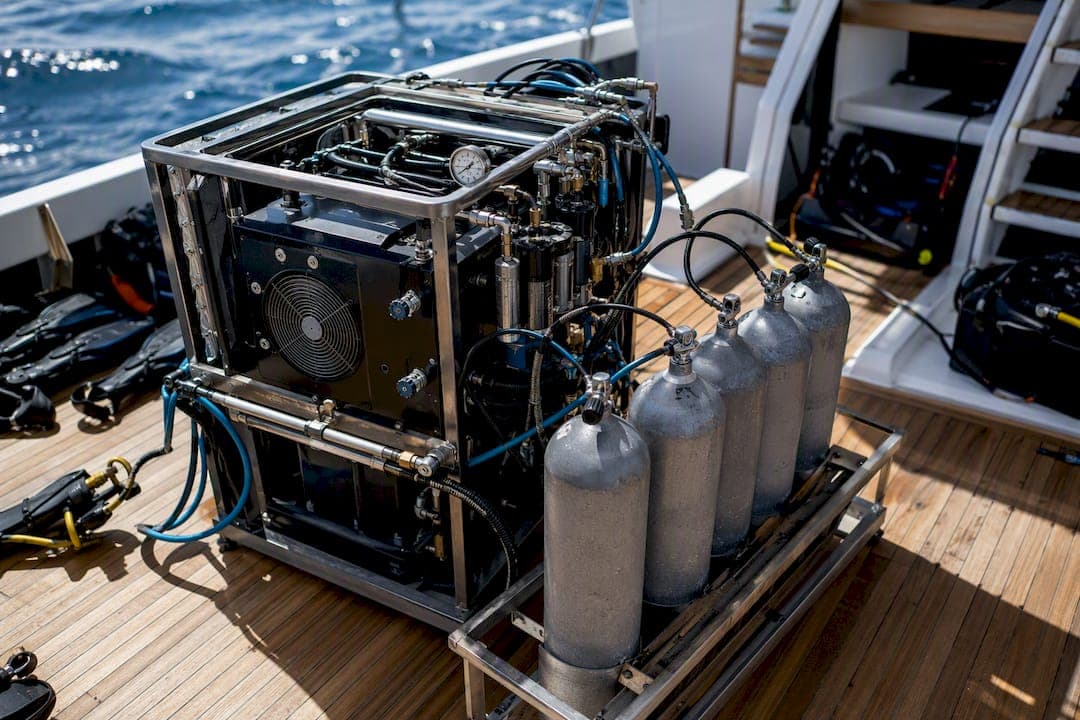
An onboard dive compressor is a marine-rated system that produces and conditions breathing air aboard your vessel, handling either high-pressure cylinder fills or low-pressure surface supply, so you can dive without ever touching a shore-based fill station. For boaters and charter guests, that single piece of equipment changes the entire shape of a trip. It is the difference between planning your dive days around a fill station's hours and diving wherever the anchorage looks good.
Two functions define the category, and most vessels are built around one or the other:
- High-pressure fill compressors charge scuba cylinders directly, typically to 200–300 bar (3,000–4,350 PSI).
- Low-pressure surface-supply systems (often called hookah rigs) feed air through a hose straight to a diver's regulator, usually at 6 to 20 bar.
- Either setup gives liveaboards, private yachts, and dive-focused charters like those Exotica Charters arranges genuine diving independence from remote anchorages.
Key Takeaways
Reliable onboard breathing air depends on staged compression with interstage cooling, multi-stage filtration meeting CGA Grade E or EN 12021, correctly placed intake away from exhaust, and a disciplined maintenance log.
| Point | Details |
|---|---|
| Two core functions | High-pressure units fill cylinders to 200 to 300 bar; low-pressure systems supply divers directly at 6 to 20 bar. |
| Filtration is non-negotiable | Particulate, coalescing, carbon, and molecular sieve stages remove oil, moisture, and particulates before air reaches a cylinder. |
| Intake placement is a safety issue | Position intakes away from all exhaust sources to prevent carbon monoxide contamination. |
| Duty cycle drives equipment choice | Continuous-duty marine units suit multi-dive charter days; portable units suit occasional, lower-volume use. |
| Maintenance prevents most failures | Scheduled filter changes, condensate draining, and periodic air sampling catch problems before they reach a diver. |
Table of Contents
- How a Dive Compressor Onboard Actually Produces Breathing Air
- Types and Pressure Ranges for Onboard Dive Compressors
- Choosing the Right Compressor for Your Vessel
- Installing and Placing a Dive Compressor Safely Onboard
- Air Quality Standards Every Dive Compressor Onboard Must Meet
- Keeping a Dive Compressor Running Reliably at Sea
- Safety Warnings and Realistic Cost Expectations
- Why Onboard Compressors Matter to How Exotica Charters Plans a Trip
- A Boat-First Take on Dive Compressors
- Frequently Asked Questions
- Sources
How a Dive Compressor Onboard Actually Produces Breathing Air
Producing breathing air at sea is a more demanding job than most boaters assume, and it is worth understanding the mechanics before you ever stand next to a running unit. A shop compressor moves air. A dive compressor has to move air and clean it to a standard you are willing to breathe underwater.
The process runs through several distinct stages:
- Intake draws ambient air through a filtered inlet, positioned away from any exhaust source.
- First-stage compression raises pressure and generates significant heat, which is why the air moves through an interstage cooler before continuing.
- Second (and often third) stage compression pushes pressure higher still, with cooling repeated between stages to strip out moisture that would otherwise condense inside the cylinder.
- Filtration removes oil vapor, particulates, and residual moisture, typically through a stack combining particulate filters, a coalescing filter, activated carbon, and a molecular sieve for final drying.
- Storage or delivery sends conditioned air either into a receiver tank for later decanting or directly to a diver through a surface-supply hose.
Interstage cooling matters more than it sounds. Compressing gas heats it, and hot, humid air holds moisture that condenses under pressure. Without cooling between stages, that moisture rides along into your cylinder, where it corrodes the tank wall from the inside and can freeze valve components at depth in cold water. Each filtration stage targets a different contaminant. Particulate filters catch dust and debris pulled in through the intake. Coalescing filters pull oil droplets out of the air stream. Carbon adsorbs oil vapor and odors. The molecular sieve handles final moisture removal, since even trace humidity left after cooling can still cause problems downstream.
Receiver tanks do double duty. They store pressurized air for peak demand, and they let a modest compressor "trickle fill" a bank over hours of idle time, then decant that stored air into cylinders quickly when divers are ready. Overpressure protection, usually a relief valve set just above working pressure, prevents the system from over-pressurizing a tank or line if a regulator or gauge fails downstream.
Types and Pressure Ranges for Onboard Dive Compressors
Not every "dive compressor" does the same job, and confusing the two categories is the most common mistake boaters make when shopping. Pressure output and airflow together determine what a unit can realistically support.
Low-pressure surface-supply units run at 6 to 20 bar (100 to 300 PSI) and feed hookah hoses directly, ideal for hull cleaning, shallow reef exploration, or supporting non-certified guests under supervision. High-pressure fill compressors operate at 200 to 300 bar (3,000 to 4,350 PSI), the range scuba cylinders are rated for.
Flow rate, measured in cubic feet per minute (cfm) or liters per minute (lpm), determines how many divers you can realistically support and how long a fill takes:
- A small portable unit producing 1 to 2 cfm might take 45 minutes or longer to top off a single aluminum 80 cylinder from empty.
- Mid-range marine compressors in the 3 to 5 cfm range cut that time roughly in half and can keep pace with a small dive group rotating tanks through the day.
- Larger continuous-duty systems paired with a receiver bank can fill several cylinders in sequence without the compressor itself running longer, since the bank stores pre-compressed air.
Portable units are genuinely useful for smaller boats and occasional divers, but they trade off flow and duty cycle. Continuous-duty, industrial-style compressors engineered for marine use can run for extended periods without overheating, which matters when a charter is running two or three dives a day for a full week. A portable unit asked to do that job will overheat, cycle constantly, and wear out its filtration stack far faster than its rated service life suggests.
Choosing the Right Compressor for Your Vessel
Sizing a dive compressor is less about picking the biggest unit you can afford and more about matching output to how you actually dive. Start with three numbers: how many fills you need per day, what pressure your cylinders require, and what flow rate gets you there without running the unit past its duty cycle.
Work through this before you buy:
- Count expected fills per day across your typical guest or crew count, then add a margin for a second dive or a top-off.
- Confirm your cylinders' rated working pressure so you're not buying a compressor that undershoots or overshoots what your tanks need.
- Match required cfm/lpm to fill time you can tolerate. Slower fills are fine if you're filling overnight into a receiver bank; they are not fine if guests are waiting dockside.
- Check available electrical capacity or generator headroom before committing to an electric model.
Power source is where most boaters get tripped up. Electric compressors run quieter and integrate cleanly with a well-equipped vessel's electrical system, but they demand serious startup current, and an undersized inverter or generator will trip trying to start the motor. Petrol-driven units sidestep that problem entirely, running independent of ship power, which makes them a common choice for deck-mounted setups on vessels where rewiring for a large electric motor isn't practical. The trade-off is noise, fuel logistics, and an added engine to maintain.
Pro Tip: Before buying, ask your electrician to calculate actual inrush current for the compressor's start cycle, not just its running wattage. Compressor motors often draw three to five times their running current for a second or two at startup, and that spike is what actually trips an underrated inverter.
Portability and mounting depend heavily on your vessel size. A day boat or small center console benefits from a genuinely portable unit that can be stowed and pulled out only when needed. A larger yacht or liveaboard, especially one running multiple dives daily, is better served by a fixed, continuous-duty installation with proper cooling and drainage built into the mount.
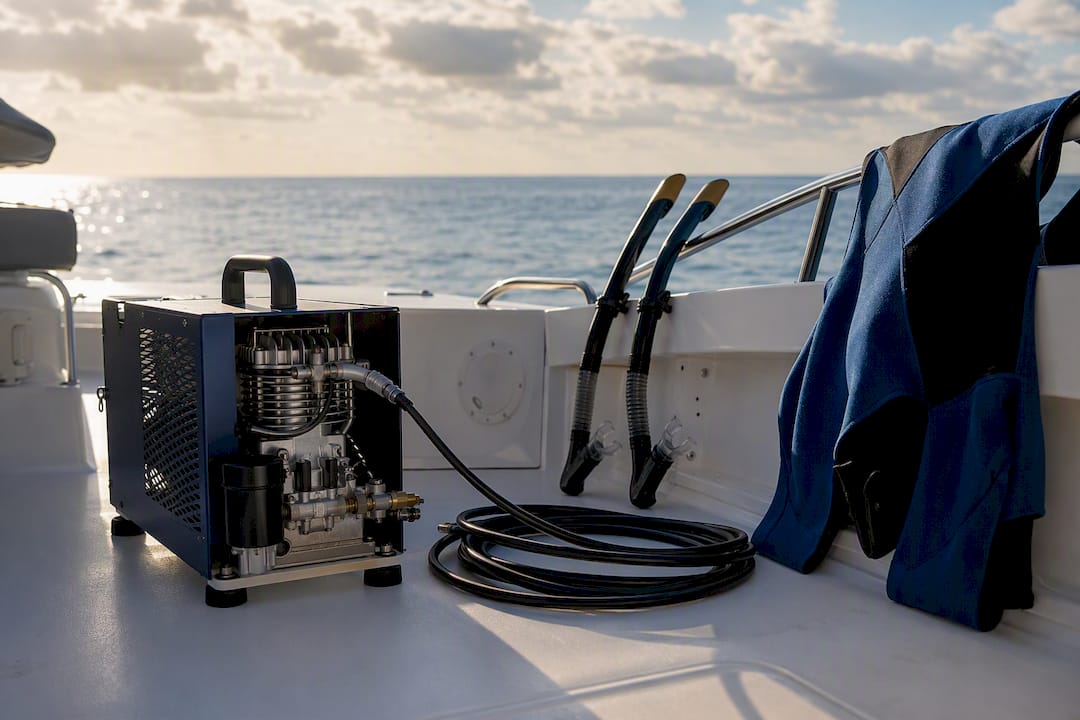
Duty-cycle ratings tell you how long a compressor can run before it needs a rest, and this number matters more than horsepower on spec sheets. Manufacturers building specifically for marine use often modify oil-sump designs, add stainless frames, and engineer coolers suited to corrosive salt-air environments, all of which extend service life well beyond what a converted industrial unit would deliver on the same boat.
Installing and Placing a Dive Compressor Safely Onboard
Where you mount a dive compressor matters as much as which one you buy. Get the intake placement wrong and you risk drawing carbon monoxide directly into the air your divers breathe.
Follow this sequence when planning installation:
- Locate the intake upwind and well clear of any exhaust source, including the vessel's own engines, generator, and any nearby boats at anchor. Even brief backflow from an exhaust plume into an intake can create dangerous CO contamination that standard filtration will not remove.
- Choose a mounting location with proper drainage and inclination tolerance. Marine-specific compressors often use modified oil-sump designs that handle a rolling deck; a converted shop compressor typically does not.
- Confirm ventilation around the unit itself. Compressors generate heat, and an enclosed, poorly ventilated space raises operating temperature and shortens component life.
- Isolate vibration and address noise before it becomes a problem. Rubber mounts reduce transmitted vibration through the hull, and petrol units in particular can run loud enough to warrant real mitigation.
Noise is worth taking seriously rather than treating as a minor annoyance. Some petrol marine compressors reach roughly 100 decibels, loud enough to cause hearing damage with prolonged exposure. Locating the unit below deck or inside a sound-dampened enclosure makes a real difference, both for crew comfort and for guests trying to enjoy a quiet anchorage.
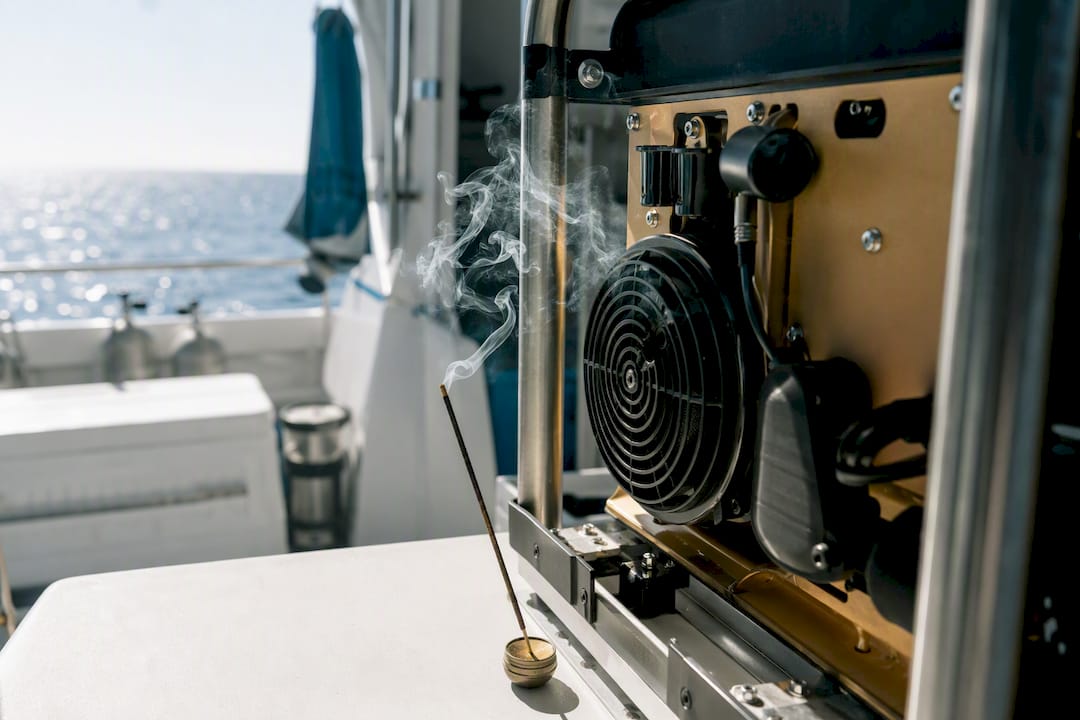
Pro Tip: Run a simple smoke test on a calm day before the compressor ever fills a cylinder. Light incense or a smoke stick near the intake and watch which way it drifts under different wind angles and engine states. If exhaust smoke ever drifts toward the intake, relocate it before you trust the air it produces.
Air Quality Standards Every Dive Compressor Onboard Must Meet
Breathing air isn't judged by "clean enough." It's judged against published standards, and knowing what those standards actually require helps you ask better questions of any compressor you're evaluating.
A standard shop compressor lacks the filtration stack to meet these benchmarks, which is exactly why it's dangerous to use one for diving. Dive-rated units are built around multi-stage filtration specifically to strip out:
- Oil vapor and mist, carried over from the compression process itself.
- Particulates, drawn in through the intake from ambient air.
- Moisture, condensed during compression and cooling.
- Carbon monoxide, which can enter through a poorly placed intake regardless of how good the internal filtration is.
Two standards come up repeatedly in manufacturer literature and diver safety guidance: CGA Grade E, the Compressed Gas Association's specification for breathing air composition, and EN 12021, the European standard covering similar parameters for compressed air used in breathing apparatus. Both set limits on oxygen content, carbon monoxide, carbon dioxide, oil content, and moisture. Marine-specific compressors built with filtration stacks designed to support compliance with these standards still depend on the operator maintaining that filtration correctly. A pristine spec sheet means nothing if the carbon filter hasn't been changed in a year.
Meeting a standard on paper and consistently producing air that meets it are different things, which is why routine air sampling matters. Send a sample to a lab periodically, particularly after any filter change or extended period of heavy use, and keep the results on file. Continuous CO monitoring near the intake adds another layer of protection that catches a developing problem before it reaches a cylinder. Regular maintenance and filter changes remain the foundation of air purity, and no amount of upfront engineering substitutes for a disciplined maintenance log.
Keeping a Dive Compressor Running Reliably at Sea
A dive compressor onboard is only as safe as its maintenance routine. Most failures trace back to skipped checks, not bad engineering, and the fix is almost always a short, boring checklist followed consistently.
- Before every start, confirm the intake area is clear of exhaust drift, check oil level against the sight glass, and drain any accumulated condensate from the previous run.
- During operation, watch discharge temperature and listen for unusual cycling. A unit running hotter than normal or short-cycling under load is telling you something before it fails outright.
- After each session, drain the system again. Small portable compressors often require manual draining every 10 to 15 minutes of run time, while larger or better-equipped units use autodrain valves that handle this automatically, a real advantage on a multi-dive charter day when nobody wants to stand next to the compressor babysitting a drain valve.
- On a weekly or monthly schedule, depending on usage, replace filtration elements per the manufacturer's stated intervals rather than waiting for a smell or a failed air sample to tell you it's overdue.
Filter replacement is the single most skipped maintenance item on boats, largely because a saturated filter doesn't always announce itself with an obvious symptom. Autodrain systems and disciplined oil management reduce crew workload during multi-dive days and keep filtration performance consistent, but they don't eliminate the need for scheduled element changes.
Pro Tip: Keep a simple logbook next to the compressor: date, run hours, filter changes, and any unusual readings. When something eventually goes wrong, that log is what a qualified technician needs to diagnose it quickly instead of guessing.
Know when to stop trusting your own judgment. Persistent overheating, oil showing up in the delivery line, or an air sample that fails testing means the unit goes offline until a qualified service technician has looked at it, full stop.
Safety Warnings and Realistic Cost Expectations
Certain warning signs demand an immediate response, not a "we'll check it later" mental note. Treat these as hard stops:
- Any unusual smell in the delivered air, chemical, oily, or otherwise.
- Visible oil in the delivery line or filter housing, indicating a filtration failure.
- Elevated CO readings on a monitor near the intake or in a sample.
- Unusual noise, vibration, or overheating during operation.
Any one of these means the compressor stops filling cylinders until the problem is identified and resolved. Placement of the intake away from any exhaust source is the single most important safeguard against CO poisoning, but ongoing monitoring is what catches a problem after installation, when conditions on the water shift and an intake that was safe at anchor might not be safe underway.
Hearing protection deserves the same seriousness as any other PPE aboard. A petrol unit running near 100 decibels for an hour a day adds up over a season, and simple foam earplugs cost almost nothing next to the alternative.
On cost, expect a wide range depending on class of equipment. Portable low-flow units start in the low thousands of dollars. Marine-rated continuous-duty compressors with proper filtration stacks and stainless construction run considerably higher, often into the five-figure range once installation is included. Full industrial systems paired with receiver banks, the kind found on larger charter vessels running multiple daily dives, sit at the top of that range. Fill time scales with flow rate and whether you're filling direct or drawing from a pre-charged bank: a well-sized receiver system can turn around a full set of cylinders in the time it takes divers to rinse gear and grab lunch, while a small portable unit filling directly might have guests waiting well over half an hour per tank.
Why Onboard Compressors Matter to How Exotica Charters Plans a Trip
A boat that can produce its own breathing air stops being limited by the map of shore fill stations, and that's exactly the flexibility Exotica Charters builds itineraries around. Our team, made up of former captains and water sports professionals, plans dive-focused charters to places like the Galápagos and French Polynesia specifically because reliable onboard air lets a captain chase the best conditions of the day rather than the nearest dive shop's hours. Charter yachts equipped with scuba diving onboard can shift a whole itinerary toward a remote reef or wreck site that would be off-limits to a boat dependent on shore fills, and that operational freedom is a large part of what distinguishes a genuine expedition charter from a standard yacht week.
If you're evaluating a dive-capable charter, ask the operator these questions before you book:
- What pressure range and flow rate does the onboard compressor deliver, and how many divers can it support per day?
- What breathing-air standard does the unit meet, and when was the last air sample tested?
- How often are filters changed, and is there a maintenance log available?
- Is the compressor electric or petrol-driven, and how does that affect noise or scheduling around dive times?
We think through exactly these details when matching guests to a vessel, whether that's a specialized dive platform or a larger crewed yacht outfitted for underwater exploration alongside wildlife viewing and adventure travel.
A Boat-First Take on Dive Compressors
Most guides treat onboard dive compressors as a spec sheet problem: pick the right pressure, right flow, done. That misses where things actually go wrong at sea. The failures we hear about from operators aren't undersized compressors. They're skipped filter changes, intakes mounted without a second thought about exhaust drift, and portable units pushed into continuous-duty jobs they were never built for.
The conventional advice also underweights power planning. Boaters research pressure ratings for hours, then discover on installation day that their inverter can't handle a compressor's startup draw. That's a five-minute conversation with an electrician that gets skipped constantly.
If you take one thing from all this: prioritize maintenance discipline and intake placement over chasing the highest flow rate on a spec sheet. A modest compressor, properly filtered and religiously maintained, produces safer air than an impressive one nobody's kept up with.
Frequently Asked Questions
Can I use a regular shop air compressor for scuba diving? No. Standard shop compressors lack the multi-stage filtration needed to remove oil vapor, moisture, and particulates to breathing-air standards, and using one for diving is genuinely dangerous.
What's the difference between a high-pressure and low-pressure dive compressor? High-pressure units fill scuba cylinders to 200 to 300 bar, while low-pressure surface-supply systems deliver air continuously through a hose at 6 to 20 bar for hookah-style diving.
How often should I change filters on a dive compressor onboard? Follow the manufacturer's stated service interval rather than waiting for a symptom, and log every change since saturated filters don't always announce themselves before they fail.
Is a petrol or electric dive compressor better for a boat? It depends on your vessel's electrical capacity. Petrol units run independently of ship power but are noisier, while electric units are quieter but need enough inverter or generator headroom to handle startup current.
What certifications should I ask about before booking a dive charter? Ask whether the compressor's air meets CGA Grade E or EN 12021 standards and when it was last tested. Exotica Charters can walk you through the specifics for any dive-equipped yacht in our fleet, and if you'd rather book a fully packaged dive itinerary without managing the logistics yourself, a private dive package through our partners is worth exploring as well.
Sources
- Guide to Air Compressors for Scuba Diving
- INSIGHTS: How to Choose the Best Dive Compressor for your Boat
- Compact Onboard Dive Compressors: Top Gear for Boating & Yachting
- DAN — Breathing gas quality assurance
- Diving air compressor — Wikipedia