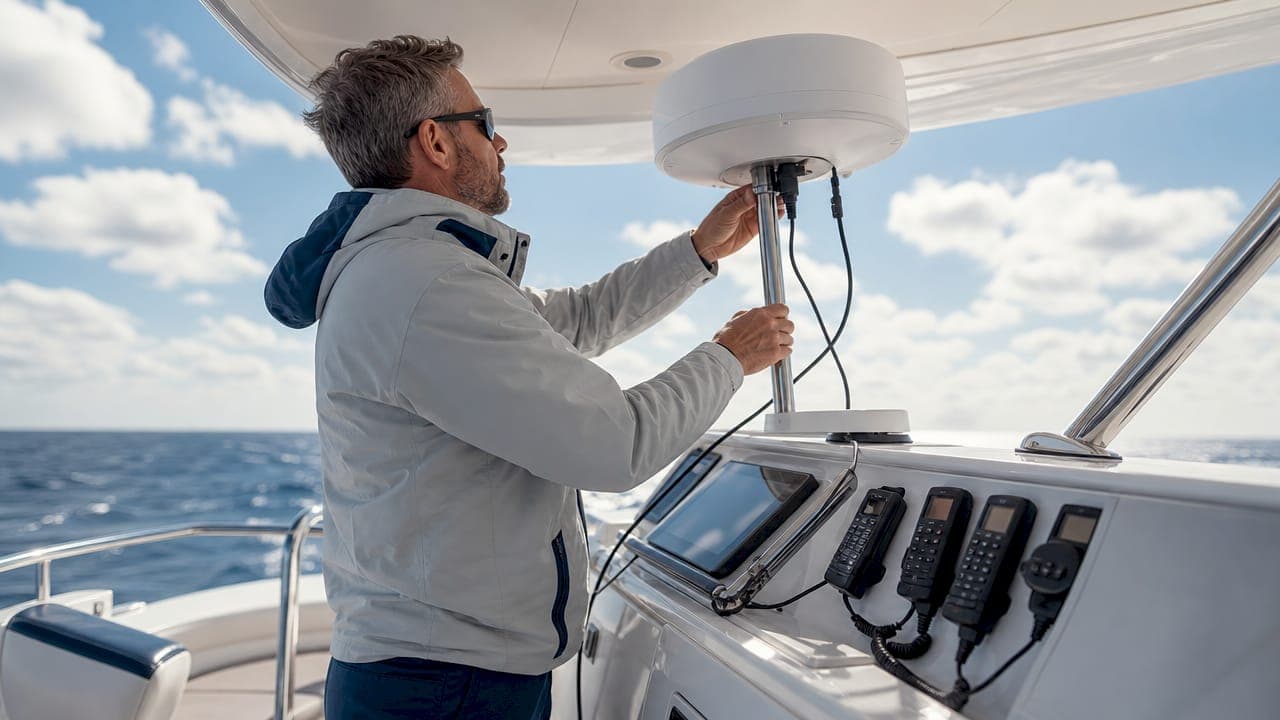
Yacht charter communication systems are defined as integrated networks of satellite, cellular, VHF radio, and emergency messaging technologies that keep vessels connected and safe at sea. Modern charters rely on a layered approach: LEO satellites like Starlink Maritime, 5G marine cellular routers, and dedicated emergency devices like Garmin InReach work together rather than as standalone solutions. Standards like GMDSS (Global Maritime Distress and Safety System) and IMO cybersecurity guidelines govern how these systems operate. The result is a communication architecture that serves guests, crew, and safety officers simultaneously, even hundreds of miles from the nearest coastline.
What types of communication technologies are used on yachts?
Modern yacht communications rely on five core technologies, each covering a different range, speed, and purpose. No single system handles everything. The strength of a well-equipped charter lies in how these technologies hand off to one another automatically.
LEO satellite systems represent the most significant shift in marine connectivity in a decade. Starlink Maritime delivers over 100Mbps with latency around 20–40ms, making video calls and cloud applications genuinely usable mid-ocean. That performance level was unthinkable on traditional GEO (Geostationary Orbit) satellite platforms, which carry latency of 500–600ms and make real-time applications feel sluggish.

GEO satellites and traditional VSAT still serve a role on longer passages where LEO coverage thins out near polar regions. Their wider footprint provides a reliable fallback, particularly for vessels cruising at extreme latitudes. The tradeoff is that higher latency limits video conferencing and live streaming.
5G marine cellular routers with high-gain antennas extend inland 5G networks up to 5–10 nautical miles offshore at a fraction of satellite data costs. For coastal cruising in well-covered regions like the Mediterranean, Australia, or New Zealand, cellular connectivity often handles the bulk of guest internet demand before the vessel moves beyond range.
VHF radio remains the backbone of short-range safety communication. Every vessel uses it for vessel-to-vessel contact, marina coordination, and distress calls on Channel 16. It requires no subscription, no internet, and no power-hungry hardware beyond a basic transceiver.
Emergency satellite messengers like Garmin InReach operate on the Iridium network and provide global two-way text messaging and SOS capability entirely independent of broadband. Garmin InReach plans start at around $7.99 per month, making them one of the most cost-effective safety investments on any vessel.
| Technology | Range | Best use case | Latency |
|---|---|---|---|
| LEO satellite (Starlink) | Global | Streaming, video calls, cloud work | 20–40ms |
| GEO satellite (VSAT) | Global | Backup broadband, polar routes | 500–600ms |
| 5G cellular router | 5–10 nautical miles | Coastal high-speed internet | Under 10ms |
| VHF radio | 20–30 nautical miles | Safety, vessel-to-vessel | Real-time |
| Emergency messenger (Garmin InReach) | Global (Iridium) | SOS, two-way text backup | Minutes |
Pro Tip: Never treat your cellular router as a primary offshore system. It works brilliantly within range, but configure your multi-WAN router to switch automatically to satellite the moment cellular signal drops below a usable threshold.
How do yacht networks manage connectivity and security?
A yacht's communication hardware is only as good as the network architecture managing it. Multi-WAN marine routers like Peplink bond satellite and cellular signals simultaneously, routing traffic by application type and switching between connections in under one second when a link degrades. That sub-second failover is what separates a professional yacht network from a consumer setup patched together with off-the-shelf gear.
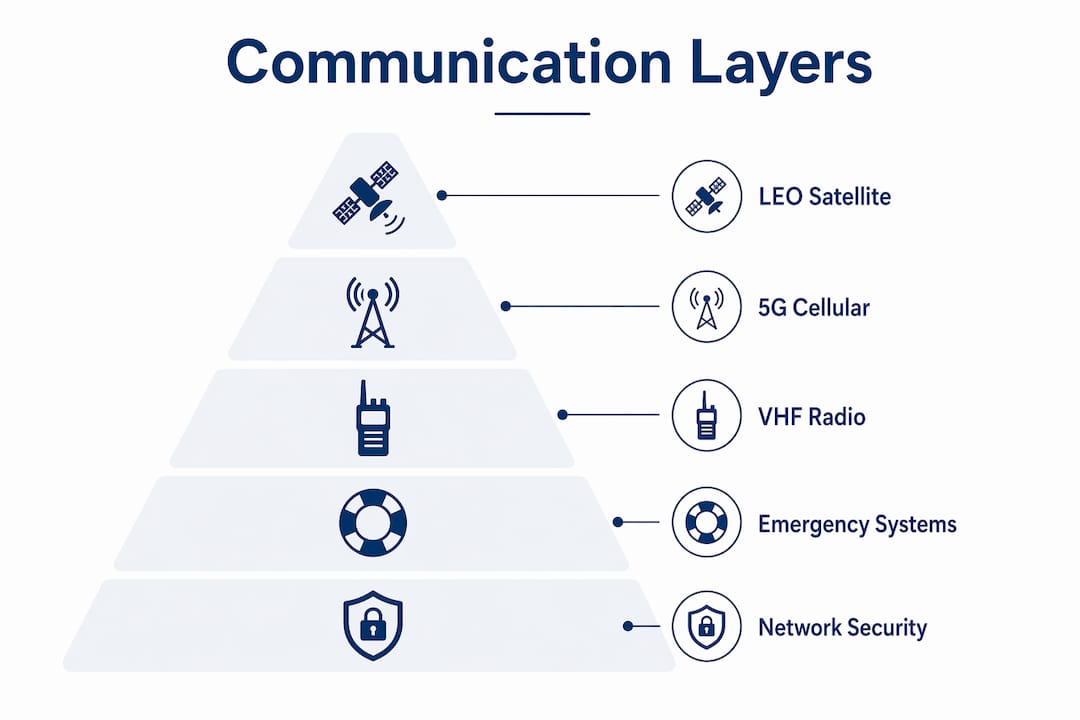
Traffic prioritization is the feature most guests never see but always benefit from. A well-configured router assigns highest priority to safety data and navigation systems, then to business-critical video calls, and finally to guest streaming and social media. This means a guest watching a movie does not accidentally consume the bandwidth a captain needs for weather routing data.
VLAN segmentation divides the onboard network into isolated lanes: one for guests, one for crew, one for navigation systems, and one for IoT devices like smart appliances and sensors. A compromised guest device cannot reach the navigation network. That isolation is not optional on a professionally managed yacht. It is the standard.
Cybersecurity follows International Maritime Organization guidelines, which require vessels to assess, protect, detect, and respond to cyber threats as part of their safety management systems. Practical measures include:
- Encrypted Wi-Fi with rotating guest passwords
- Firewall rules blocking unauthorized inbound connections
- Remote monitoring dashboards that flag unusual traffic in real time
- Regular firmware updates on all network hardware
- Separate administrative credentials for crew and technical staff
Pro Tip: Ask your charter provider whether the yacht uses a managed network service with remote monitoring. A network engineer watching the system from shore can often resolve connectivity issues before guests notice anything is wrong.
Why do yachts need dedicated safety communication systems?
Broadband internet is not a safety system. This distinction matters more than most charter clients realize. A Starlink dish can go offline in heavy weather, during a hardware fault, or when a vessel moves outside coverage. At that moment, the only reliable communication path is a dedicated, independent safety device.
GMDSS compliance is the recognized international standard for maritime safety communication. It requires vessels to carry specific equipment capable of sending distress alerts and receiving maritime safety information across defined ocean areas. Iridium Certus provides global narrowband safety communications, including polar regions, and serves as an approved GMDSS path for vessels operating in remote waters.
Layering safety communication correctly means following a clear sequence:
- VHF radio on Channel 16 for immediate short-range distress and vessel-to-vessel contact.
- Garmin InReach or equivalent Iridium messenger for two-way text and SOS when VHF range is exceeded.
- EPIRB (Emergency Position-Indicating Radio Beacon) for automatic distress alerting to rescue coordination centers when a vessel sinks or is abandoned.
- Personal flotation device beacons for individual crew and guest location during man-overboard situations.
- Satellite phone as a voice backup when broadband and VHF are both unavailable.
Separating safety and entertainment systems both physically and in network configuration keeps emergency communication available under all conditions. A guest streaming a film should never share bandwidth with an EPIRB test signal or a distress relay.
Pro Tip: Test every safety device before departure, not after. Assign one crew member as communications officer with a fixed check-in schedule. Disciplined communication protocols reduce stress and prevent failures during genuine emergencies.
How do communication systems improve the charter guest experience?
Connectivity shapes the charter experience in ways that go far beyond checking email. Guests on a well-equipped yacht can join a video conference from an anchorage in French Polynesia, stream a film at anchor in Alaska, or share live footage from a Galápagos dive directly to social media. That capability changes what remote destinations feel like. They become extraordinary rather than isolated.
The guest Wi-Fi network sits on its own VLAN, isolated from crew and navigation systems. Guests get a clean, fast connection without any risk of accidentally accessing operational data or being exposed to crew communications. For charter clients who value privacy, that separation is as important as the speed itself.
Navigation and weather data flow through separate communication channels, giving the captain real-time routing updates, sea state forecasts, and port authority communications. Better data means better passage planning, which translates directly into smoother itineraries and fewer weather-related disruptions. Guests feel the difference even if they never see the system behind it.
Operational benefits extend to the crew as well. Remote equipment diagnostics let shore-based technicians monitor engine performance, generator output, and electrical systems without boarding the vessel. Crew welfare connectivity, meaning reliable personal internet access during off-watch hours, improves morale on longer passages. A well-connected crew performs better and stays longer.
Key guest-facing benefits of advanced marine communication systems include:
- Reliable video streaming and conferencing from open ocean anchorages
- Fast, isolated guest Wi-Fi with no interference from operational traffic
- Real-time weather and navigation updates improving safety and comfort
- Remote diagnostics reducing onboard technical disruptions
- Continuous connectivity across luxury charter destinations worldwide
Key Takeaways
Yacht charter communication systems require layered satellite, cellular, VHF, and dedicated emergency hardware working together to deliver reliable connectivity and safety at sea.
| Point | Details |
|---|---|
| Layer your technologies | LEO satellite, 5G cellular, VHF, and emergency messengers each cover different ranges and failure modes. |
| Separate safety from broadband | GMDSS-compliant devices like EPIRBs and Garmin InReach must operate independently from guest internet. |
| Use multi-WAN routers | Peplink-style routers bond signals and switch connections in under one second to maintain continuous service. |
| Segment your network | VLAN isolation keeps guest, crew, navigation, and IoT devices on separate lanes for security and performance. |
| Test before departure | Assign a communications officer and run system checks before leaving port to prevent failures offshore. |
What I've learned from watching yacht connectivity evolve
The shift from legacy GEO VSAT to hybrid LEO and cellular solutions has been faster than most of the industry expected. Three years ago, a charter client asking for reliable video conferencing offshore was asking for something genuinely difficult to deliver. Today, Starlink Maritime's performance makes that a standard expectation rather than a premium request.
What concerns me more than the technology itself is how few vessels treat cybersecurity with the same seriousness as navigation safety. IMO guidelines exist for a reason, but implementation varies widely across the charter fleet. A yacht with a beautiful Starlink installation and no VLAN segmentation is a vessel with an open door.
The other thing I'd push back on is the idea that better broadband reduces the need for dedicated safety systems. It does the opposite. As guests come to expect connectivity everywhere, the temptation grows to route everything through the broadband pipe. That is a mistake. GMDSS compliance and independent emergency hardware are not legacy requirements waiting to be replaced. They are the last line of communication when everything else fails, and offshore, everything else does fail eventually.
Charter clients should ask specific questions before booking: Does this vessel run a managed network? Is the safety communication system independent of the broadband? When were the EPIRBs last serviced? The answers reveal more about a yacht's operational standard than the brochure ever will.
— Mo
Yachts built for the connected age
Exoticacharters selects vessels with integrated Starlink Maritime, marine 5G cellular routers, and independent emergency communication systems as standard. Every yacht in the fleet is chosen with connectivity and safety in mind, so guests can focus on the experience rather than the infrastructure behind it.
Whether you are planning a wildlife expedition in the Galápagos, a remote diving charter in French Polynesia, or a coastal passage through Australian waters, Exoticacharters matches you with a vessel whose communication systems are built for where you are actually going. Browse the full selection of luxury charter yachts and speak with a specialist about the onboard technology that fits your itinerary.
FAQ
What is a yacht charter communication system?
A yacht charter communication system is an integrated network of satellite, cellular, VHF radio, and emergency messaging technologies that provide connectivity and safety communication at sea. These systems combine LEO satellites, 5G marine routers, and GMDSS-compliant emergency devices to cover all conditions and distances.
How does Starlink Maritime work on a charter yacht?
Starlink Maritime uses low-earth orbit satellites to deliver broadband speeds over 100Mbps with latency of 20–40ms, enabling streaming and video calls from open ocean. It connects through a dedicated marine-grade antenna mounted on the vessel and integrates with multi-WAN routers for automatic failover.
Do charter yachts need separate safety communication systems?
Yes. GMDSS compliance requires dedicated safety hardware like EPIRBs, VHF radios, and satellite messengers that operate independently from broadband internet. Broadband systems can fail in heavy weather or hardware faults, making independent safety devices non-negotiable on offshore passages.
What is VLAN segmentation on a yacht network?
VLAN segmentation divides the onboard network into isolated groups: guest Wi-Fi, crew internet, navigation systems, and IoT devices each run on separate lanes. This prevents a compromised device on one network from accessing sensitive systems on another.
How far offshore does 5G cellular work on a yacht?
5G marine cellular routers with high-gain antennas typically reach 5–10 nautical miles offshore, depending on coastal tower density. Beyond that range, the system automatically switches to satellite connectivity through a multi-WAN router.