
Yacht charter guest capacity is the maximum number of guests a vessel can legally and safely carry during a charter, defined by international maritime regulations and vessel design. For most commercial charter yachts, that number is 12. This limit is not arbitrary. It reflects safety equipment requirements, vessel classification rules, and the practical realities of life at sea. Understanding how capacity works, from regulatory ceilings to comfort buffers, is the single most important step you can take before booking a yacht for your group.
What determines the maximum guest capacity on a yacht?
Yacht charter guest capacity explained properly starts with the rules that govern every vessel operating commercially. Two international frameworks set the foundation: the International Maritime Organization (IMO) regulations and the Safety of Life at Sea (SOLAS) convention. Together, they define how many people a commercial vessel can carry and what safety equipment must be aboard for each person.
Every yacht carries a capacity plate, a certified document that displays the maximum passengers, the combined weight limit, and the engine power rating. This plate is not a suggestion. It is a legal ceiling that operators cannot exceed without violating maritime law.
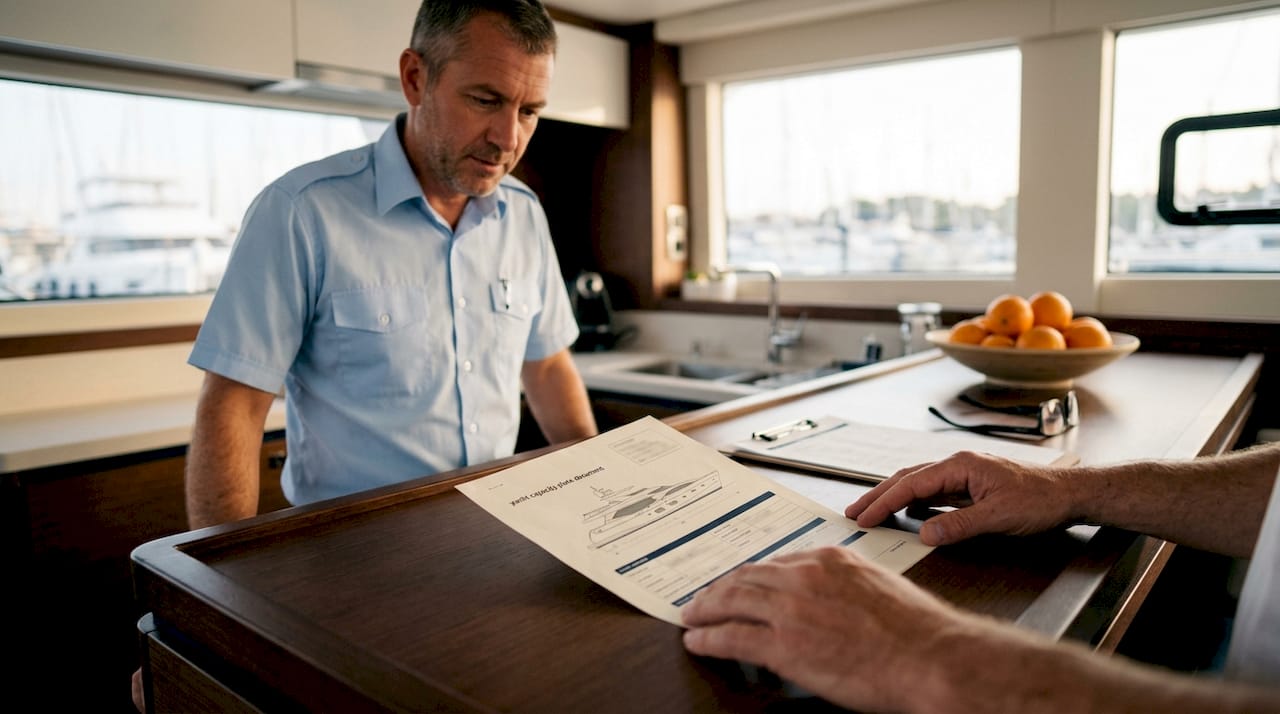
Safety equipment requirements scale directly with passenger numbers. Laws require life vests and lifeboats proportional to the number of people onboard. That means a yacht carrying 12 guests must carry 12 sets of life-saving equipment, properly certified and maintained. Adding even one extra guest without the corresponding equipment creates a legal and safety violation.
One detail that surprises many planners: crew members count toward the total certified capacity. A yacht certified for 12 people with 3 crew members aboard can legally carry only 9 guests. That gap between the number on the capacity plate and the number of guests you can actually invite is one of the most common planning mistakes in yacht chartering.
Key regulatory factors that shape certified capacity include:
- IMO and SOLAS compliance requirements for commercial vessels
- Capacity plate limits covering passengers, weight, and engine power
- Life-saving equipment ratios tied directly to total persons onboard
- Crew headcount reducing the available guest slots
- Vessel classification changing based on passenger numbers carried
Why is the 12-guest limit standard for most charter yachts?
The 12-guest ceiling exists because of a specific regulatory threshold in international maritime law. The moment a vessel carries more than 12 paying passengers, it crosses from private yacht classification into passenger ship territory. That reclassification triggers full SOLAS compliance requirements, which are far more demanding in terms of construction standards, fire suppression systems, crew certification, and emergency procedures.
"Carrying more than 12 passengers on a commercial charter vessel triggers passenger ship classification under international maritime law. That classification brings SOLAS requirements that most private yachts are not built or certified to meet. The 12-guest limit is not a preference. It is the legal boundary between a luxury charter and a regulated passenger operation."
The practical consequences of crossing that threshold are significant. Insurance premiums rise sharply. Crew must hold higher-grade maritime certifications. The vessel itself may require structural modifications to meet passenger ship standards. For most yacht owners and operators, those costs make carrying more than 12 guests economically unworkable on a private yacht.
This limit also protects the experience you are paying for. A private charter yacht with 12 or fewer guests delivers a level of personalized service, intimate anchorages, and flexible itineraries that a passenger vessel simply cannot match. The 12-guest rule, in effect, preserves the character of a true private charter.
How do yacht layout, design, and event type affect comfortable guest capacity?
Legal maximum and comfortable maximum are two very different numbers. Yacht layout is often more critical than the vessel's length overall (LOA) when it comes to how many guests can move, socialize, and relax without feeling crowded. A 90-foot yacht with a poor deck layout can feel more cramped than a well-designed 65-footer with generous social spaces.
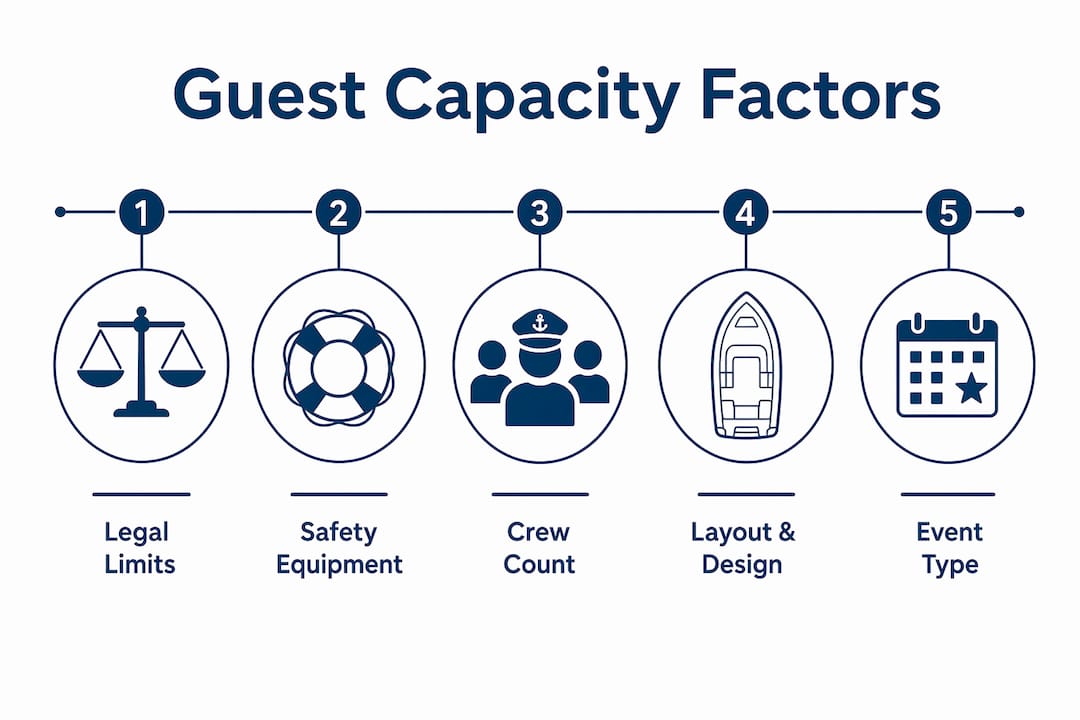
The intended use of the charter shapes the calculation further. Yachts designed for overnight passages allocate significant space to cabins, crew quarters, and storage. That space is unavailable for daytime socializing. A yacht with 6 overnight berths may feel perfectly spacious for 6 guests on a week-long trip but feel tight for 10 guests at a daytime event.
For larger vessels, stability assessments provide a more accurate picture of true capacity. Large yachts over 50 feet use stability analysis to determine how many daytime passengers the vessel can safely carry, a number that often exceeds the overnight berth count. For corporate events or day charters, this distinction matters. Seating capacity is a floor, not a ceiling, and the stability-tested maximum is the real upper limit for daytime use.
Different event types demand different spatial configurations:
| Event type | Primary space need | Capacity consideration |
|---|---|---|
| Overnight expedition | Cabins and storage | Berth count drives guest limit |
| Corporate day charter | Deck and salon space | Stability assessment applies |
| Social celebration | Lounging and dining areas | Social flow determines comfort |
| Diving or water sports | Gear storage and dive deck | Equipment reduces usable space |
Pro Tip: Ask your charter broker for the vessel's stability-assessed daytime capacity separately from its overnight berth count. For day events, these two numbers can differ significantly, and knowing both helps you plan the right experience.
How to calculate your true guest allowance accounting for crew and comfort?
The certified capacity on the vessel's plate is your starting point, not your final answer. Reaching the actual number of guests you can comfortably invite requires a few straightforward steps.
- Start with the certified capacity. Read the capacity plate or ask your broker for the vessel's certified maximum persons onboard.
- Subtract the crew. Count every crew member who will be aboard during the charter, including the captain, first mate, chef, and deckhands. Subtract that number from the certified total to find your legal guest limit.
- Apply the comfort buffer. Booking at 70–80% of maximum certified guest capacity is the standard recommendation for active charters. That buffer gives guests room to move, crew room to work, and the charter the feel of a premium experience rather than a crowded boat.
- Account for gear and activities. Diving equipment, paddleboards, kayaks, and water toys take up deck and storage space. If your charter includes water sports, reduce your guest count further to preserve usable space.
- Request both capacity figures for day charters. On larger yachts, ask for the seating capacity and the stability-assessed maximum separately. Use the stability figure for daytime events and the berth count for overnight planning.
A practical example: a yacht certified for 12 total persons with a crew of 3 has a legal guest limit of 9. Applying an 80% comfort buffer to those 9 guests suggests an ideal group size of 7. For a diving charter with gear for 7 guests, you may want to drop to 6 to keep the dive deck functional and the experience genuinely comfortable.
Pro Tip: Never plan a charter around the maximum legal guest number. Plan around the number that gives every guest enough space to enjoy the experience. The difference between a crowded charter and a memorable one is often just one or two guests.
What are alternatives when your group exceeds the 12-guest yacht limit?
Groups larger than 12 guests have real options. The most popular solution in the industry is chartering two or more yachts that cruise together in tandem. This approach keeps the group connected while each vessel stays within its legal capacity. Guests can move between boats at anchor, share meals, and experience the social energy of a larger gathering without compromising safety or comfort.
Practical alternatives for large groups include:
- Multi-vessel charters: Two or more yachts traveling together, coordinated by a single charter broker, for groups of 13–20 or more guests
- Daytime stability-rated vessels: Larger yachts with high stability-assessed capacities suited for day events rather than overnight passages
- Commercial passenger vessels: For very large events, licensed passenger vessels offer higher legal capacities with full commercial safety certification
- Staged event formats: Rotating groups through a single yacht in shifts, useful for corporate events where not all guests need to be aboard simultaneously
Coordinating multiple vessels requires careful logistical planning. Itineraries, anchorages, and provisioning all need to align across boats. Working with a large group charter specialist who has managed multi-vessel operations is the most reliable way to keep the experience smooth for everyone involved.
Key Takeaways
Yacht charter guest capacity is defined by certified regulatory limits, crew headcount, vessel layout, and a practical comfort buffer that should keep your group at 70–80% of the legal maximum.
| Point | Details |
|---|---|
| Legal ceiling is 12 guests | International maritime law caps commercial charter guests at 12 before passenger ship rules apply. |
| Crew reduces your guest count | Subtract all crew members from the certified total to find your actual legal guest allowance. |
| Comfort buffer matters | Book at 70–80% of maximum certified capacity to preserve space, service quality, and guest comfort. |
| Layout beats length | A yacht's social space and deck layout determine comfort more reliably than its overall length. |
| Large groups need multi-vessel plans | Groups over 12 guests should consider two or more yachts cruising together for a legal, comfortable experience. |
What I've learned from watching groups book the wrong yacht
The most common mistake I see is planners treating the capacity plate number as a target rather than a ceiling. They find a yacht certified for 12, invite 12 guests, subtract nothing for crew, and then wonder why the experience felt rushed and cramped. The crew of 3 or 4 was never factored in. The dive gear took up the aft deck. The salon seated 8 comfortably, not 12.
The second mistake is fixating on yacht length. A 100-foot vessel sounds impressive, but if the layout dedicates most of that length to engine rooms, crew quarters, and storage, the usable guest space may be smaller than a well-designed 70-footer. Length is a marketing number. Layout is what you actually live in for a week.
What I would suggest to anyone planning a charter: think about the experience you want your guests to have, then work backward to the vessel. A group of 8 on a yacht rated for 12 will almost always have a better time than 12 guests on that same boat. The extra space translates directly into better service, more relaxed meals, and the feeling that the yacht was chartered for you rather than filled to capacity.
Crew presence is the final piece most planners underestimate. A well-staffed yacht with 4 crew for 8 guests delivers a fundamentally different experience than 2 crew stretched across 12 guests. The ratio of crew to guests shapes everything from meal quality to how quickly a tender gets launched. When you review yacht charter insights from experienced operators, crew-to-guest ratio consistently appears as a top factor in charter satisfaction.
— Mo
Yachts sized right for your group, from Exoticacharters
Choosing the right vessel for your group size is where the planning becomes personal. Exoticacharters works with groups ranging from intimate couples to parties of 20, matching each group to a vessel where the capacity, layout, and crew complement each other.
The Exoticacharters fleet includes luxury yachts suited for groups of all sizes, from private expedition vessels for 4 guests in the Galápagos to multi-cabin yachts for full groups of 12 in French Polynesia. Every recommendation comes from a team of former captains and water sports professionals who know exactly how many guests a specific vessel handles comfortably, not just legally. Speak with an Exoticacharters specialist to find the vessel that fits your group's size, style, and destination.
FAQ
What is the maximum number of guests allowed on a charter yacht?
Most commercial charter yachts carry a maximum of 12 guests. Carrying more than 12 passengers triggers passenger ship classification under international maritime law, requiring full SOLAS compliance.
Do crew members count toward the yacht's guest capacity?
Yes. Crew members count toward the total certified persons onboard. A yacht certified for 12 with 3 crew members can legally carry only 9 guests.
How many guests should I actually book for a comfortable charter?
Booking at 70–80% of the maximum certified guest capacity is the standard recommendation. That buffer gives guests adequate space and allows crew to deliver quality service throughout the charter.
Does yacht length determine how many guests will fit comfortably?
Yacht length is not the primary factor. Layout, social space, and deck configuration determine comfort more reliably than overall length. A shorter yacht with generous deck space often accommodates guests more comfortably than a longer vessel with a poor layout.
What options exist for groups larger than 12 guests?
Groups over 12 guests can charter two or more yachts that cruise together, use stability-rated vessels for daytime events, or work with a charter specialist to plan a multi-vessel itinerary that keeps the full group connected.