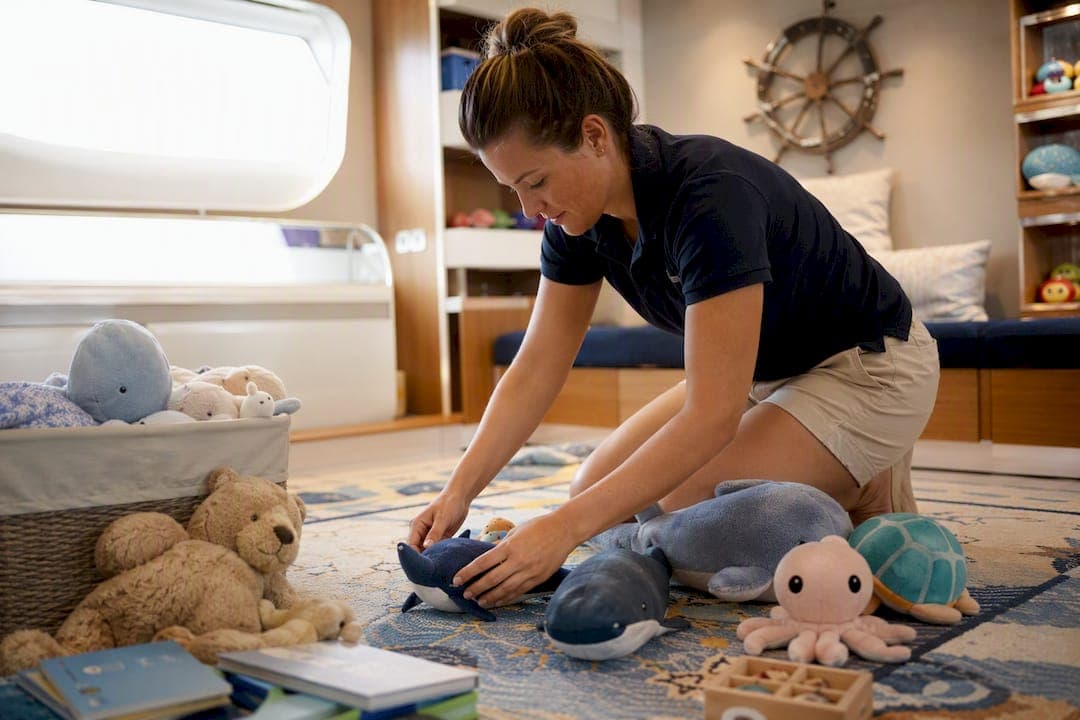
Yes: a private, fully crewed charter can absolutely include a dedicated childcare professional, and families typically choose one of three routes to get one aboard. You can book through a specialist placement agency, hire a freelance yacht nanny directly, or bring your own nanny from home. Whichever route you choose, insist on maritime safety training and current pediatric first aid; a warm, capable nanny without those credentials is the wrong hire for a moving, water-bound environment. Exoticacharters arranges family-focused charters where this logistics puzzle, from vetting to crew coordination, is handled before you ever step aboard.
TL;DR:
- A qualified yacht nanny must have current pediatric first aid, proven swimming ability, and standard maritime safety certifications like STCW and ENG1.
- Costs for a nanny vary based on yacht size, language needs, and season, with longer placements typically using a two-on/two-off shift to prevent burnout.
- Choosing between agency, freelance, or your own nanny depends on your preferred level of involvement in vetting, with agencies offering more comprehensive screening and management.
- Safety routines require constant supervision near water, enforced lifejacket use, and documented handovers to ensure continuity across shifts.
- Consider cultural, language, and dietary differences for international charters and establish emergency evacuation plans tailored to remote itineraries.
Table of Contents
- What Does a Yacht Charter Nanny Actually Do?
- What Certifications Should You Insist On?
- What Does a Yacht Nanny Cost, and How Is Pay Structured?
- Agency, Freelance, or Your Own Nanny: Which Should You Choose?
- How Does a Nanny Fit Into Crew Life and Safety Routines?
- How Do You Plan Activities, Toys, and Learning Time Onboard?
- What Legal and Contractual Details Should You Cover Before Booking?
- What Challenges Do Yacht Nannies Face, and How Are They Handled?
- How Should Families Handle Cultural Differences on International Charters?
- What Emergency and Health Protocols Go Beyond First Aid?
- How Exoticacharters Thinks About Nanny-Ready Family Charters
- Ready to Book a Family Charter With Childcare Built In?
- Sources
What Does a Yacht Charter Nanny Actually Do?
A yacht charter nanny blends the daily rhythm of traditional childcare, meals, naps, play, and quiet learning time, with a set of maritime-specific responsibilities no land-based sitter is trained for. She integrates directly with the crew, coordinating with the chef on meal timing and dietary needs, and syncing activity schedules with the captain's plans for anchorages, watersports, or shore excursions. That integration is what separates an experienced yacht nanny from a general babysitter dropped onto a boat for a week, according to placement industry guidance.
The safety layer is non-negotiable and constant, not occasional:
- One-to-one supervision any time a child is near open deck or water
- Strict lifejacket enforcement, even for confident young swimmers
- Managing safe boarding and disembarking during tender transfers
- Adjusting nap and play schedules around anchor moves, swim stops, and excursions
Crew members are rarely trained or insured for dedicated childcare, which is precisely why a professional nanny reduces risk for everyone aboard and frees the deckhands and stewardesses to do the jobs they were hired for.
What Certifications Should You Insist On?
Treat certifications as a floor, not a formality. A qualified yacht nanny should walk aboard with documentation ready, not promises to send it later.
Minimum requirements:
- Current pediatric first aid and CPR certification
- Proven, strong swimming ability (not "comfortable in water," but tested)
- STCW basic safety training, the standard maritime induction covering fire, survival, and first aid at sea
- ENG1 seafarer medical certificate where the yacht's flag state or itinerary requires it
Valuable extras worth paying for:
- RYA or powerboat qualifications, useful if she'll ever assist with a tender
- Advanced medical or yacht medical officer training for remote itineraries
- A recognized childcare diploma, with Norland-trained candidates commonly placed by specialist agencies
Agencies verify these through certificate copies, reference calls, and formal background checks before a candidate ever reaches your shortlist, a process outlined by placement specialists. Ask to see that paperwork yourself; a legitimate agency will not hesitate to share it, and neither should a freelancer.
What Does a Yacht Nanny Cost, and How Is Pay Structured?
Pricing runs on two main models: per-week charter placement fees for a single trip, and monthly or seasonal rates for families who want continuous live-aboard coverage across a longer charter season. Placement agencies publish rate ranges that shift based on yacht size, destination, language requirements, and time of year, with peak Mediterranean and Caribbean seasons commanding higher fees than shoulder months.
A few factors reliably push costs up:
- A larger yacht with more children or wider age gaps
- Bilingual or trilingual requirements for international families
- Specialized needs, from food allergies to developmental support
- High-demand booking windows around holidays and school breaks
For a single one-week charter, one experienced nanny usually covers the trip. For back-to-back charter weeks or a full season aboard, a two-on/two-off rota is the industry-standard solution to prevent burnout and guarantee true one-to-one supervision rather than an exhausted sole caregiver stretched thin. Build gratuities, flights, and any visa costs into your budget upfront, and get every clause in writing before the yacht leaves the dock.
Agency, Freelance, or Your Own Nanny: Which Should You Choose?
Each route solves a different problem, and the right one depends on how much logistics you want to handle yourself.
- Agency placement hands off recruitment, travel arrangements, and vetting entirely; agencies can even pre-purchase bespoke toys and activity kits delivered to the yacht before you board.
- Freelance hire can cost less and offers direct rapport-building, but you carry the vetting burden yourself, references, certificate checks, and background screening included.
- Bringing your own nanny preserves continuity for the kids, though she'll need maritime-specific training added before departure, and you'll need to sort her travel, cabin, and insurance separately.
Before signing anyone, run scenario-based interview questions: "What would you do if a child slipped near the swim platform?" or "How do you handle a toddler's tantrum during a tender transfer in choppy water?" Answers reveal instinct far better than a resume does.
Contracts should spell out hours, specific duties, paid time off, accommodation, travel costs, insurance coverage, confidentiality expectations, and gratuity norms.
Pro Tip: Ask any candidate, agency-sourced or freelance, for one story about a real onboard emergency and how they handled it. Hesitation or a vague answer tells you more than any certificate.
How Does a Nanny Fit Into Crew Life and Safety Routines?
Accommodation varies by yacht: some nannies bunk in crew quarters, others get a private cabin near the children, particularly on larger charters. Either way, expectations around privacy and off-duty hours should be settled before boarding, not negotiated mid-charter.
Chain of command matters more at sea than on land. The nanny typically briefs the chief stewardess or captain daily, and handovers between rota shifts should be written, not verbal, covering nap times, allergies, moods, and anything unusual from the day.
Standard safety routines every family should expect:
- Strict one-to-one supervision whenever children are on deck or in water
- Zero exceptions on lifejacket rules, regardless of swimming skill
- Controlled boarding sequences during tender embarkation, no rushing
- A clear seasickness plan, since motion sickness hits children faster and harder than adults
Parents should get a simple daily log, even a few lines, so nothing about the child's day gets lost between shift changes or busy excursion days. This isn't bureaucracy for its own sake; it's how continuity survives a rota system.
How Do You Plan Activities, Toys, and Learning Time Onboard?
Age-appropriate planning turns a charter from "kids tolerating a boat" into a trip they'll ask to repeat. Supervised snorkeling for older kids, shallow-water play for toddlers, and simple deck games fill the gaps between excursions naturally.
Pack ahead rather than improvise:
- Educational kits and books suited to the child's age and interests
- Spare safety gear: extra lifejackets, sun protection, seasickness remedies
- A short list of favorite toys, since novelty wears off fast on a small boat
Pro Tip: Send your nanny's activity list to the yacht's chef in advance. Snack timing around swim breaks and excursions matters more than most parents expect.
Maintaining sleep and meal routines, and capping screen time, keeps kids regulated even as the scenery changes daily. For longer charters, ask about lightweight schooling blocks to protect momentum during term time. Exoticacharters helps match destinations and yacht layouts to a family's specific age range and activity interests before you ever book.
What Legal and Contractual Details Should You Cover Before Booking?
A yacht nanny's employment status shifts depending on who technically hires her, the charter guest, the yacht's management company, or a placement agency, and that distinction determines who carries liability and payroll responsibility. Get clarity on this before signing anything.
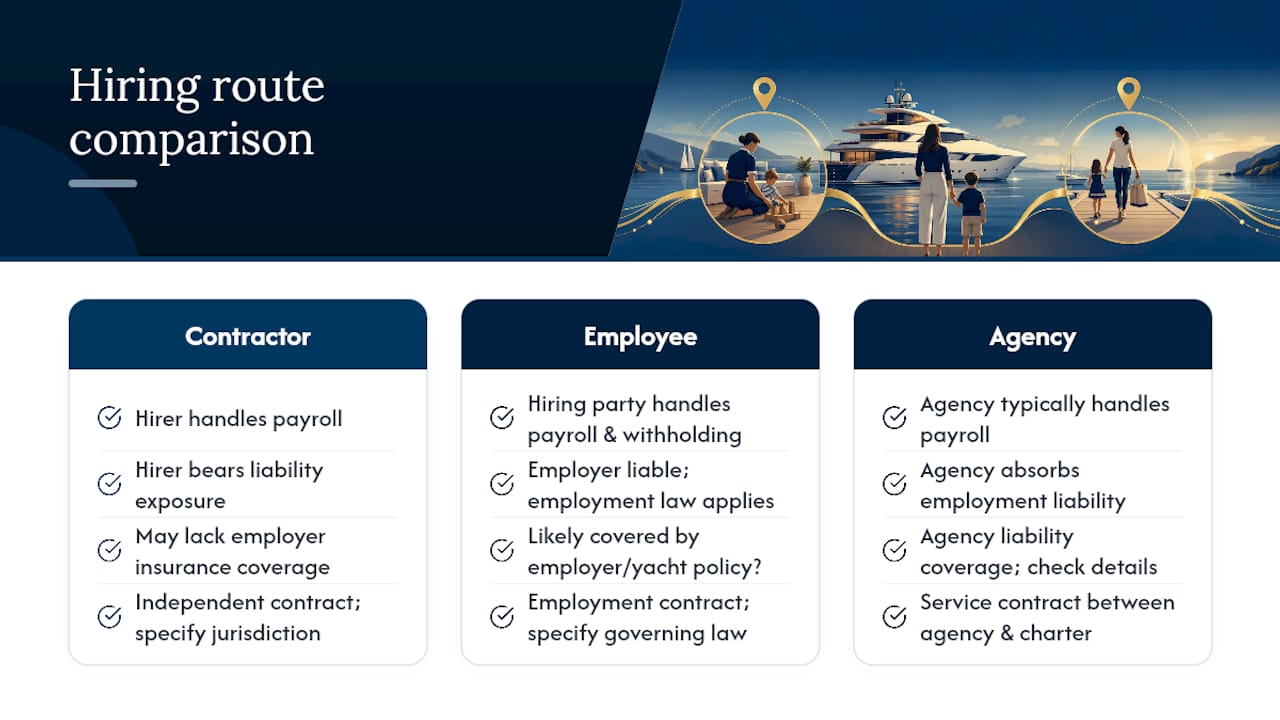
If you're hiring directly rather than through an agency, confirm whether the nanny will be treated as a contractor or an employee for the charter's duration, since that affects tax withholding, insurance coverage, and your own liability exposure as the hiring party. Agencies typically absorb this complexity by employing nannies directly and placing them under a service contract with your charter, which is one of the strongest arguments for going that route if you'd rather not manage payroll compliance mid-vacation.
Insurance deserves specific attention. Confirm the nanny carries her own liability coverage, and separately confirm whether the yacht's insurance policy extends to cover a non-crew childcare professional working aboard. Some yacht insurance policies exclude non-crew personnel from certain liability protections, so this is worth a direct question to the charter management company, not an assumption.
Written contracts should also address jurisdiction: which country's labor law governs the agreement, particularly relevant on international itineraries crossing multiple territorial waters. Confidentiality clauses matter too, given the private nature of family life aboard a charter. Finally, clarify cancellation terms; a nanny booked months ahead for a charter that gets rescheduled needs a clear policy on deposits and rebooking, spelled out before you need it.
What Challenges Do Yacht Nannies Face, and How Are They Handled?
The most common challenge is environmental: a small, moving space with no easy "step outside" option when a child is overtired or overstimulated. Experienced yacht nannies manage this by building rigid nap and quiet-time windows into the day regardless of how exciting the itinerary looks on paper.
Seasickness in children complicates everything from feeding schedules to mood management, and a nanny unfamiliar with maritime routines can mistake early motion sickness for a tantrum. This is exactly why pediatric first aid training paired with actual sea time matters more than either credential alone.
Rota fatigue is a real risk on longer placements. Without a genuine two-on/two-off handover, even the most dedicated caregiver burns out by week three, and tired supervision is where safety lapses happen. Written handover notes, not just verbal check-ins, keep continuity intact when a second nanny rotates in.
Isolation is an underdiscussed strain. A nanny living aboard for a season, away from her own support network, benefits from clear off-duty hours and a private space to decompress, something families sometimes forget to negotiate into the contract. Finally, discipline consistency across a charter with grandparents, multiple children, or blended families requires the nanny and parents to agree on ground rules before day one, not improvise them under pressure on day three.
How Should Families Handle Cultural Differences on International Charters?
International charters routinely mix nationalities, languages, and parenting norms, sometimes within a single extended family group aboard the same yacht. A nanny working a Mediterranean charter for a Gulf family, or a Caribbean charter for a Northern European one, needs more than fluency; she needs genuine cultural fluency around food customs, modesty expectations, and daily rhythms that differ meaningfully from her own.
Language matters practically, not just socially. Bilingual or trilingual nannies command higher placement fees precisely because clear communication with both children and parents reduces misunderstandings during safety-critical moments, not just pleasant conversation. If your family speaks a language the broader crew doesn't share, flag this during the vetting stage rather than discovering the gap mid-charter.
Religious and dietary practices deserve direct upfront conversation rather than assumption. A nanny should know meal timing around fasting periods, prayer schedules, or specific dietary restrictions well before the charter begins, and this information should flow to the chef through her, keeping one clear channel of communication rather than several conflicting ones.
Parenting style varies widely by culture too, discipline approaches, independence expectations, and screen time norms among them. The strongest yacht nannies adapt to the family's stated preferences rather than defaulting to their own upbringing, and the interview stage is the right moment to test this flexibility directly by asking how she has adjusted her approach for previous international families.
What Emergency and Health Protocols Go Beyond First Aid?
Basic pediatric first aid covers cuts, choking, and minor injuries. It does not cover what happens if a child needs evacuation from a remote anchorage hours from the nearest hospital, which is where a real emergency protocol earns its weight.
Every charter with children aboard should have a documented evacuation plan before departure: the nearest medical facility relative to the itinerary, how a medevac would be triggered in genuinely remote regions, and who holds authority to make that call if the parents are unreachable. This is a conversation to have with the captain directly, not something to assume is "handled."
Seasickness management deserves its own protocol, since children often can't articulate early symptoms the way adults can. A nanny trained to recognize the early signs, before full-blown nausea sets in, can intervene with positioning, hydration, or medication far more effectively than one reacting after the fact. Confirm in advance which motion sickness remedies are age-appropriate and pre-stocked aboard.
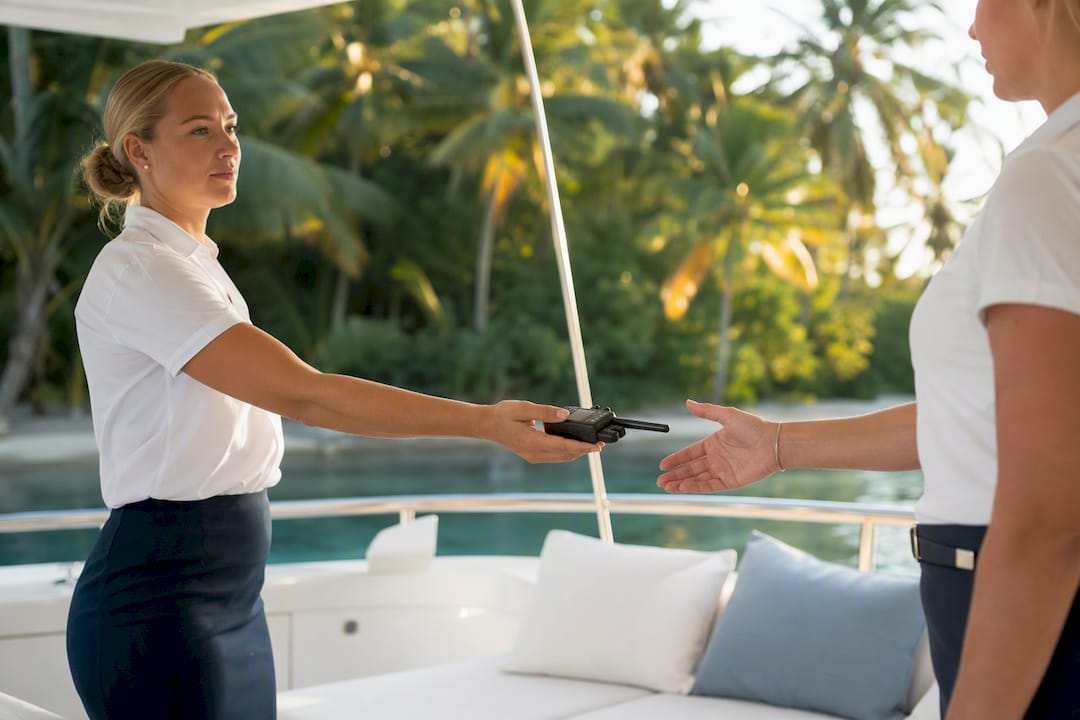
Allergy management on a yacht carries extra weight because you can't simply drive to a pharmacy. Confirm that EpiPens or equivalent are stocked, clearly labeled, and that both the nanny and at least one crew member know their location and use. Finally, ask what communication device the nanny carries at all times, since a yacht's layout means she may be several decks from the nearest crew member when seconds matter.
How Exoticacharters Thinks About Nanny-Ready Family Charters
We start every family inquiry by mapping ages, swimming ability, and activity interests against yacht layout and destination, because a toddler-friendly catamaran and a teen-focused expedition boat call for very different setups. Our team, built from former captains and water sports professionals, knows firsthand how nanny logistics and crew routines need to mesh at sea, and our Trustpilot reviews reflect that attention to detail. Expect a straightforward path: inquiry, shortlist, vetting, confirmation.
— Mo
Ready to Book a Family Charter With Childcare Built In?
Exoticacharters gives you a single point of contact for the entire puzzle, matching yacht, destination, and nanny logistics together instead of leaving you to coordinate three separate vendors. That's the real advantage over piecing together a placement agency, a charter broker, and a yacht management company on your own: one conversation covers it all.
Our luxury yachts include family-friendly layouts suited to onboard childcare, from spacious cabin configurations to yachts with dedicated play areas, and our family destination guide helps narrow down where your kids will thrive most. If transfers and arrival logistics are part of your planning, our partners at TranspOnyx handle luxury yacht transfers along the French Riviera.
When you reach out for a quote, have ready: your travel dates, children's ages, any special needs or allergies, and the activities your family wants most, diving, wildlife encounters, or calmer swim days. Contact Exoticacharters today to start shortlisting yachts and nanny arrangements for your next family charter.
Sources
For deeper reading: Lumière's yacht nanny guide covers certification standards, and Superyacht Nanny's family resources detail vetting practices.
- Yacht Nanny Guide 2026: How to Hire a Superyacht Nanny | Lumière
- How an amazing nanny can take family Superyacht charters to the next level | Angels On Board
- Superyacht Nannies: The Must-Have Addition to Luxury Charters in 2025 - Town and Country Nannies