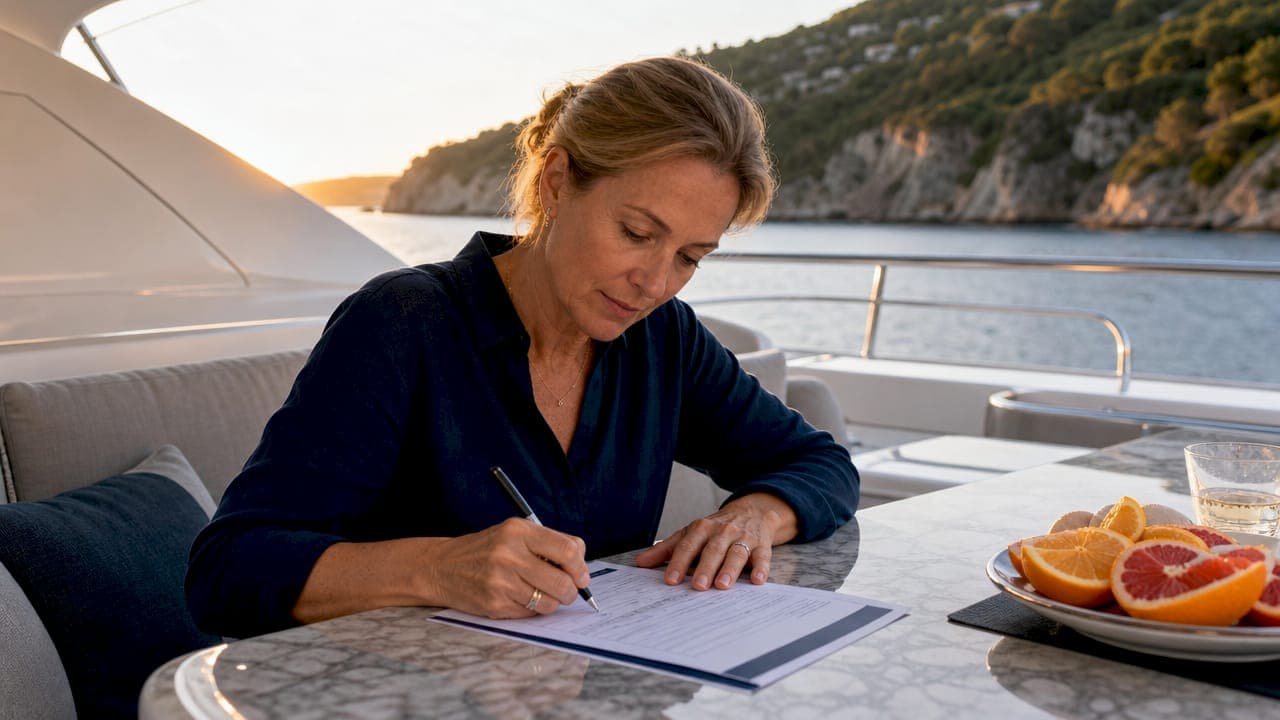
A yacht preference sheet is a detailed form that guests complete before their charter begins, communicating every personal preference to the crew so the entire experience can be tailored around them. Think of it as the blueprint the captain, chef, and stewards used to plan your meals, stock your drinks, arrange your cabin, and anticipate your needs before you ever step aboard. Without it, even the most experienced crew is working blind. Exoticacharters builds the preference sheet process into every charter it plans, treating it as the single most important document exchanged between guest and crew before embarkation.
What is a yacht preference sheet?
A yacht preference sheet is the formal document, sometimes called a VIP preference form or guest preference questionnaire, that captures everything the crew needs to personalize your charter. Industry professionals treat it as the culinary and logistical contract between guests and crew, guiding menu planning, provisioning, and onboard service from day one. The form goes well beyond food. It covers cabin configurations, crew interaction styles, special occasions, water sports preferences, and travel logistics.
The preference sheet exists because a crewed yacht charter is not a hotel stay with a fixed menu. The crew sources, prepares, and serves everything specifically for you. That level of customization requires detailed, accurate input from every guest in the party. A vague or incomplete form produces a generic experience, which is the opposite of what a private charter promises.

What information does a yacht preference sheet request?
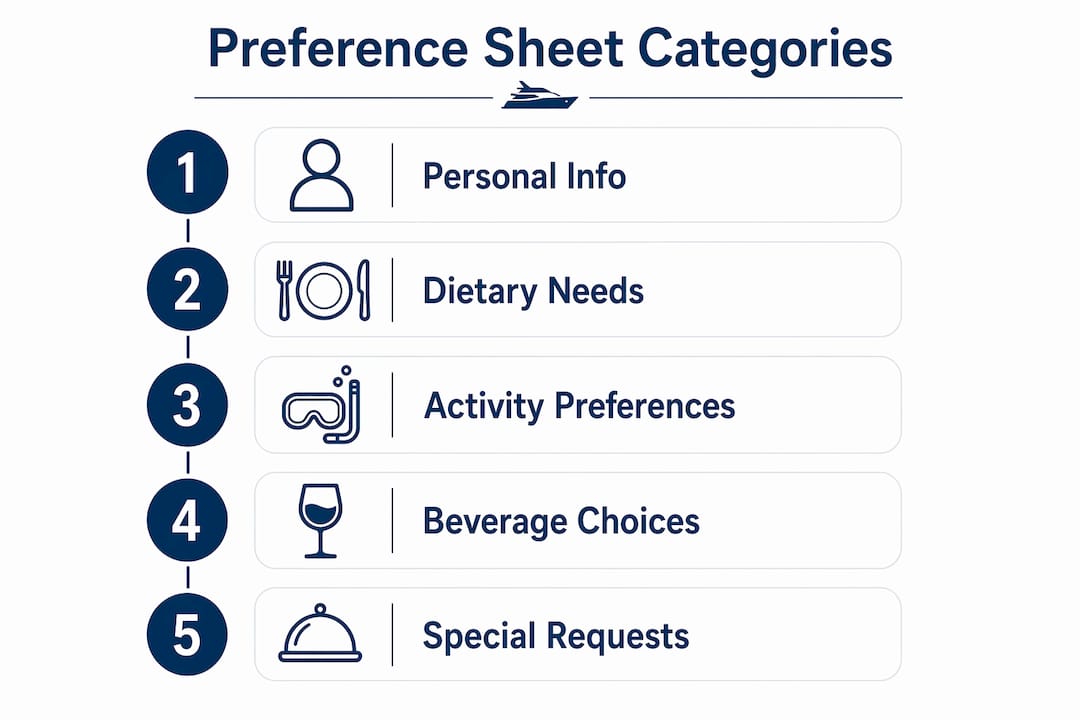
The form covers several distinct categories, each one feeding a different part of the crew's planning process.
Dietary preferences and food requests
- Favorite cuisines, preferred proteins, and any foods you actively dislike
- Dietary restrictions such as vegan, gluten-free, kosher, or low-sodium
- Severe allergies, which require the galley to be sanitized and every label checked before embarkation. Undisclosed allergies can cause medical emergencies at sea, making this the most critical section of the entire form
- Preferred breakfast style, snack habits, and whether you want formal dinners or relaxed meals on deck
Beverages and spirits
- Preferred wine varietals, beer brands, spirits, and cocktail styles
- Non-alcoholic preferences such as sparkling water brands, coffee type, and fresh juice
- Any imported or specialty brands you consider non-negotiable
Cabin and comfort preferences
- Bed configuration requests (king, twin, or pullout)
- Pillow firmness, extra blankets, and preferred cabin temperature
- Toiletry preferences and any products you want stocked
Logistics and travel details
- Arrival and departure times, flight numbers, and ground transportation needs
- Crew interaction preferences, such as whether you want the crew visible and attentive or discreet and available only when called
- Special occasions like birthdays or anniversaries that the crew can celebrate onboard
Pro Tip: List allergies and dietary restrictions for every guest individually, not just the group as a whole. A crew member preparing a shared appetizer needs to know which specific person at the table cannot eat shellfish.
When should you submit your yacht preference sheet?
Timing is not a formality. The industry standard requires submitting the preference sheet at least 3–4 weeks before embarkation. That window gives the crew time to source specialty items, order imported brands, and plan menus without relying on whatever the nearest supermarket happens to stock.
Here is why the timeline matters in practice:
- Specialty sourcing takes time. A specific wine label or a particular brand of sparkling water may need to be ordered from a city hours away from the marina.
- Remote destinations have limited supply. Charters heading to the Galápagos, French Polynesia, or Alaska face genuine logistical constraints. Local vendors in these areas carry a fraction of what a city provisioner can offer. Exoticacharters plans charters to many of these extraordinary remote destinations, and early preference submission is non-negotiable for those itineraries.
- Menu planning requires lead time. A skilled chef builds a week's worth of menus around your preferences, not around what arrived on the last supply boat.
- Last-minute changes are expensive. A major menu change requested while the yacht is anchored in a remote bay can require sending a taxi to a distant town, burning hours and funds.
- Crew preparation takes coordination. Stewards need time to arrange cabins, source décor for special occasions, and brief the entire team on guest preferences.
Pro Tip: Submit your completed form at least four weeks out, not three. The extra week creates a buffer for back-and-forth questions the crew will almost certainly have.
How does the preference sheet affect your budget and provisioning?
The preference sheet has a direct financial impact through the Advanced Provisioning Allowance, known as the APA. The APA is typically 25%–30% of the charter fee and covers groceries, fuel, dockage, and other running costs. That figure is a starting estimate. Your actual preferences determine how much of it gets spent.
Guests often underestimate how their specific requests shape the total cost of a charter. Imported brands, specialty dietary items, and requests for products unavailable in the cruising region can all increase the APA meaningfully. Unique requests in remote grounds may incur additional costs due to logistics and local taxes.
Provisioning also operates under physical constraints that most guests never consider. Fridge and freezer space on a yacht is strictly limited, and generator use during meal preparation affects timing and energy budgets. A preference sheet requesting elaborate multi-course dinners every night requires the chef to plan storage and cooking schedules carefully. Requesting ten different fresh proteins for a seven-day trip may simply not be feasible given cold storage capacity.
The table below shows how preference choices translate into different provisioning realities.
| Preference type | Provisioning impact |
|---|---|
| Standard dietary needs | Straightforward sourcing, minimal APA variance |
| Specialty imported brands | Higher cost, requires advance ordering |
| Severe allergies | Galley sanitation required, dedicated storage |
| Remote destination charter | Limited local supply, longer sourcing lead time |
| Special occasion requests | Additional décor, cake, or entertainment costs |
The clearest way to protect your APA budget is to prioritize your preferences honestly. List the items you genuinely cannot do without, and flag the ones that are simply nice to have. That distinction gives the crew room to make smart substitutions when a specific item is unavailable or prohibitively expensive in a remote anchorage.
Tips for creating an effective yacht charter preference checklist
A thorough preference sheet produces a dramatically better charter. These practices make the difference between a form that helps and one that leaves the crew guessing.
- Be specific, not aspirational. "I like white wine" gives the chef nothing. "I prefer dry, mineral-driven white Burgundy or Chablis" gives the chef something to work with.
- Rank your priorities. If you have ten preferences, indicate which three are non-negotiable. Crews appreciate knowing where to focus their effort.
- Coordinate group preferences before submitting. On a group charter, conflicting dietary needs are common. Resolve them before the form goes in, not after. One guest's strict vegan diet and another's preference for a nightly meat-focused dinner both need to be accommodated in the same galley.
- Disclose all allergies, even mild ones. A mild reaction at sea is far more serious than the same reaction on land, where medical care is minutes away.
- Include your daily rhythm. Early risers who want coffee at 6:00 AM and late-night guests who want snacks at midnight both affect how the crew schedules their day.
- Review the form before you submit it. Read every answer as if you were the chef reading it for the first time. Vague answers are the most common source of onboard disappointment.
Pro Tip: If you are chartering an expedition or dive-focused yacht, add your water sports preferences to the form too. Knowing that you want two dives per day at dawn shapes the entire daily schedule, not just the meals.
Key Takeaways
A complete, specific, and timely yacht preference sheet is the single most effective tool for ensuring your charter delivers exactly the experience you expect.
| Point | Details |
|---|---|
| Submit at least 3–4 weeks early | Early submission allows specialty sourcing and prevents costly last-minute logistics. |
| Cover all categories thoroughly | Food, drinks, cabin setup, logistics, and crew interaction all belong on the form. |
| Disclose every allergy accurately | Undisclosed allergies create medical risk and operational delays at sea. |
| Understand the APA connection | Your preferences directly determine how the 25%–30% APA is spent. |
| Prioritize and rank requests | Flagging must-haves versus nice-to-haves helps the crew make smart substitutions. |
Why the preference sheet is the most underrated part of charter planning
Most guests spend weeks researching destinations and yacht types, then rush through the preference sheet in twenty minutes the night before the deadline. I have seen this pattern repeatedly, and it almost always produces the same result: a charter that is good but not great, because the crew was working from incomplete information.
The preference sheet is not paperwork. It is the primary channel through which you communicate your expectations to a team of professionals who genuinely want to exceed them. A chef who knows you love spicy food and hate cilantro will cook differently than one who only knows you "enjoy Asian cuisine." That specificity compounds across every meal, every drink, and every morning routine over the course of a week.
The guests who get the most out of their charters, particularly on remote or expedition-style itineraries, are almost always the ones who treated the preference sheet as seriously as they treated their packing list. The form is your voice before you arrive. Use it fully.
— Mo
How Exoticacharters helps you get the preference sheet right
Planning a charter to a remote destination like the Galápagos or French Polynesia means the preference sheet carries even more weight than usual. Local provisioning options are limited, and the margin for error is narrow.
Exoticacharters guides every client through the preference sheet process from the first consultation. The team, made up of former captains and water sports professionals, knows exactly which questions to ask and which details most guests forget to include. Whether you are booking a luxury crewed charter for the first time or refining a preference sheet for a repeat trip, Exoticacharters ensures the crew receives everything they need to deliver an extraordinary experience. Speak with a charter specialist today to get started.
FAQ
What is a yacht preference sheet used for?
A yacht preference sheet communicates every guest's personal preferences to the crew before the charter begins, covering food, drinks, cabin setup, and logistics. The crew uses it to plan provisioning, menus, and onboard services.
How far in advance should I submit my preference sheet?
The industry standard is at least 3–4 weeks before embarkation. Earlier submission is better, especially for charters in remote destinations where specialty sourcing takes longer.
What happens if I submit my preference sheet late?
Late submissions limit what the crew can source, particularly in remote anchorages. Last-minute changes after departure can require costly logistics like sending crew ashore to distant towns, which increases the APA.
Does the preference sheet affect my charter cost?
Yes. Your preferences directly influence how the Advanced Provisioning Allowance is spent. Specialty imported brands and items unavailable locally increase provisioning costs beyond the standard APA estimate.
Do I need to fill out a preference sheet for every guest?
Each guest should provide their own dietary restrictions and allergy information individually. Group preferences for meals and activities can be coordinated and submitted together, but allergy disclosures must be specific to each person.
Recommended
- 7 Places Where a Luxury Yacht Charter Is Better Than a Resort – Exotica Charters
- Crewed Sailing vs Motor Yacht in French Polynesia: Which Wins? – Exotica Charters
- French Polynesia vs Maldives: Which Yacht Charter Destination Is Better? – Exotica Charters
- What Does a Private Yacht Charter in the Maldives Actually Include? – Exotica Charters