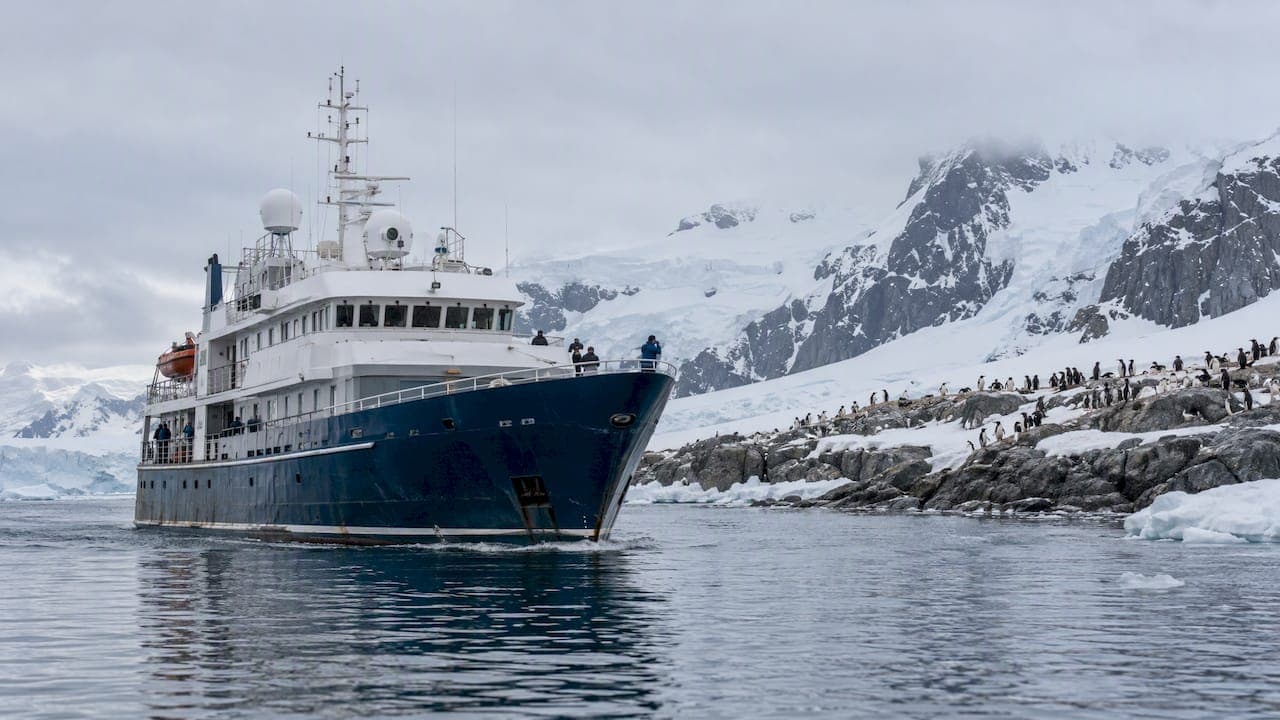
The two poles diverge at the most basic level: the Arctic is an ocean ringed by continents, while Antarctica is a continent ringed by ocean. That single distinction explains why Antarctica runs colder and remains largely uninhabited, while the Arctic, relatively milder, supports human communities and is warming faster. It also sets up the wildlife story: penguins and krill in the south, polar bears and seals in the north, each accessible to travelers in very different ways.
TL;DR:
- Arctic sea ice reached 4.60 million square kilometers in September 2026, while the Antarctic winter maximum remained subject to late season revision.
- The Arctic’s roughly four million residents, towns, airports, and cultural stops support more infrastructure; Antarctica requires a ship voyage or an offshore air transfer.
- Choose the Arctic for polar bears and cultural stops; choose Antarctica for penguin rookeries and whales that feed on krill near the peninsula.
- Book the vessel and seasonal window together, because a yacht suited to an Antarctic summer crossing differs from one built for Arctic coastal cruising.
Table of Contents
- Antarctica vs Arctic at a Glance
- Why the Geography and Geology Differ So Sharply
- The Numbers Behind the Temperature Gap
- Sea Ice Behaves Very Differently at Each Pole
- What Lives at Each Pole, and Why
- Who Governs Each Region, and How That Shapes a Visit
- How Warming Trends Diverge Between the Poles
- Choosing Between the Arctic and Antarctica for a Polar Expedition
- A Perspective on Choosing Your Polar Expedition
- Experience Either Pole Aboard a Private Crewed Yacht
- FAQ
- Sources
Antarctica vs Arctic at a Glance
Before getting into the physics and biology, it helps to see the core numbers side by side. The figures below draw on NOAA and NSIDC monitoring data, the two agencies that track polar conditions most closely.
| Metric | Arctic | Antarctica |
|---|---|---|
| Basic geography | Ocean surrounded by land | Continent surrounded by ocean |
| Average summer temperature | About 32°F at the North Pole | About −18°F at the South Pole |
| Average winter temperature | Around −40°F at the North Pole | About −76°F at the South Pole |
| 2026 sea-ice extent | Minimum of 4.60 million square kilometers | Maximum near 18 million square kilometers |
| Human presence | Indigenous communities, national territories | No permanent residents, research stations only |
| Iconic wildlife | Polar bears, Arctic seals | Penguins, Antarctic krill, baleen whales |
Why the Geography and Geology Differ So Sharply
The Arctic sits atop a deep ocean basin, hemmed in by Canada, Russia, Greenland, and Scandinavia, with ice floating directly on seawater. Antarctica is the opposite arrangement: a landmass bearing an ice sheet that in places runs several thousand meters thick, with the Southern Ocean wrapped entirely around it rather than hemmed in by it.
That ring of open ocean matters enormously. The Antarctic Circumpolar Current circles the continent uninterrupted by any landmass, isolating it thermally from warmer waters to the north. The Arctic has no such moat; warmer Atlantic and Pacific currents push directly into its basin. The result shows up in the ice itself: Antarctica carries grounded glaciers and floating ice shelves fed by that continental sheet, while the Arctic's ice forms and melts seasonally on the ocean surface, with less of it anchored to land.

The Numbers Behind the Temperature Gap
Antarctica is colder than the Arctic by a wide margin, and the seasonal averages make the gap concrete. At the South Pole, NOAA Climate.gov reports an average summer temperature near −18°F and a winter average around −76°F. At the North Pole, summer averages run closer to 32°F, the freezing point of water, while winter dips to roughly −40°F.

Elevation explains much of this difference. The Antarctic plateau sits high above sea level under a thick ice sheet, and thinner air at altitude holds less heat. The Arctic, by contrast, is essentially sea-level ocean, and that underlying water moderates temperature swings the way a plateau of solid ice cannot. Coastal Antarctica tells a more nuanced story than the deep interior: peninsula regions run noticeably warmer than the polar plateau, which is why ships and yachts bound for Antarctica typically track the peninsula rather than the frozen heart of the continent.
Sea Ice Behaves Very Differently at Each Pole
Arctic sea ice tends to persist across multiple years, building thickness over successive winters, though that multi-year ice has been shrinking steadily. Antarctic sea ice follows a more dramatic seasonal rhythm: it nearly vanishes in summer and rebuilds each winter almost from scratch, which makes it naturally more variable year to year.
The 2026 season illustrated both patterns. NSIDC recorded an Arctic minimum extent of 4.60 million square kilometers in September, while Antarctic sea ice appeared to reach a 2026 maximum at a high level of sea ice extent typical of Antarctic winters, a figure still subject to late-season revision. Winds, ocean upwelling, and the flow of warmer water beneath the ice all shape these swings, and the Southern Ocean's isolation from warm currents gives Antarctic ice room to rebuild each year in a way the Arctic's more exposed basin does not.
What Lives at Each Pole, and Why
The Southern Ocean's upwelling draws nutrient-rich deep water to the surface, feeding phytoplankton blooms that support enormous swarms of Antarctic krill. That krill base underpins a food web of penguins, seals, and baleen whales concentrated around the Antarctic Peninsula and its surrounding islands.
The Arctic runs on a different trophic structure built around different zooplankton and fish species, supporting polar bears, ice seals, and the communities that have relied on them for generations. A few species bridge both worlds: the Arctic tern migrates roughly 40,000 kilometers between poles each year, and genetic testing shows that many animals that look similar at each end of the planet are, in fact, distinct populations shaped by isolation.
Who Governs Each Region, and How That Shapes a Visit
Roughly four million people live in the Arctic, including indigenous communities with deep cultural ties to the land and sea, and the region is governed through the Arctic Council alongside the national waters of the countries that border it. Antarctica has no permanent population at all. It operates instead under the Antarctic Treaty System, which prioritizes scientific research and environmental protection over national claims.
That governance split shapes how each region is visited. Arctic trips can draw on existing towns, airports, and coastal infrastructure. Antarctic travel is expedition by nature, reached only by ship or by air transfer onto a vessel waiting offshore.
How Warming Trends Diverge Between the Poles
Arctic surface temperatures have warmed at a rate far above the global average since 1980, a trend tied directly to the multi-year sea-ice decline tracked by NOAA's Arctic Program, and some projections point toward ice-free Arctic summers within this century. Antarctica's response has been more regionally uneven. Interior temperatures remain stable while certain glaciers, particularly along the peninsula, have retreated quickly, and sea-ice extent swings more from year to year than it trends in one direction.
Marine protection faces different hurdles in each region. The Arctic's patchwork of national waters complicates coordinated conservation, while Antarctica's treaty framework, including the CCAMLR fisheries commission, offers a more unified structure, though enforcement across such a remote area remains genuinely difficult.
Choosing Between the Arctic and Antarctica for a Polar Expedition
Accessibility, wildlife priorities, and the style of expedition you want should drive the decision more than which pole sounds more exotic. The Arctic generally offers shorter transfers and more varied cultural stops; Antarctica rewards travelers willing to commit to a longer, more remote voyage with penguin rookeries and whale encounters concentrated in a smaller radius. A well-planned itinerary, as outlined in our guide to private polar yacht expeditions, weighs these trade-offs before a single anchorage is chosen.
A short framework helps narrow the choice:
- Weigh travel time and budget against how remote an experience you actually want.
- Decide whether polar bears or penguins and krill-fed whales matter more to your trip.
- Consider whether you want a culturally rich, infrastructure-backed voyage or a pure wilderness expedition.
Pro Tip: Book your seasonal window and vessel together, since the right ice-class yacht for an Antarctic summer crossing looks nothing like the boat best suited for an Arctic coastal cruise.
A Perspective on Choosing Your Polar Expedition
On one Antarctic itinerary, the richest wildlife encounters came from drifting quietly near a krill swarm rather than rushing between landing sites. That kind of patience is hard to script on a fixed-departure ship but comes naturally on a private crewed yacht, where the route bends around what the wildlife and the ice are doing that day.
— Mo
Experience Either Pole Aboard a Private Crewed Yacht
We arrange private, fully crewed yacht charters built around remote, wildlife-focused itineraries that polar travel demands, offering opportunities to explore penguin colonies or Arctic fjords for viewing seals and seabirds.
Experienced captains and water sports professionals shape each route around ice conditions, wildlife activity, and your own pace, a flexibility that fixed-departure expedition ships cannot offer in the same way. For details on vessel types and how we plan Antarctic itineraries specifically, see our Antarctica yacht charters page, and when you are ready to talk through logistics, reach out through our main booking page to start planning your private polar expedition.
FAQ
Which is colder, the Arctic or the Antarctic?
Antarctica is considerably colder than the Arctic. The South Pole averages around −18°F in summer and −76°F in winter, compared with roughly 32°F and −40°F at the North Pole in the same seasons.
Was COVID-19 ever present in Antarctica?
Antarctica's population consists of rotating research station staff rather than permanent residents, and the continent's extreme isolation historically kept it free of community transmission for longer than almost anywhere else on Earth. Specific case data for research stations falls outside what the sources behind this article cover.
What are the biggest threats to the Arctic?
The Arctic is warming far faster than the global average, driving a well-documented decline in multi-year sea ice that threatens the species and communities built around it. Fragmented governance across multiple national territories also makes coordinated conservation harder to achieve.
What covers about 98 percent of Antarctica?
Ice covers roughly 98 percent of Antarctica, making it the coldest, driest, and windiest continent on Earth. That ice sheet, several thousand meters thick in places, is what defines the continent's climate and its near total absence of permanent residents.
Sources
- Arctic and Antarctic | Ocean Portal | Smithsonian Institution
- Arctic Report Card 2025 — surface air temperature | NOAA Arctic Program