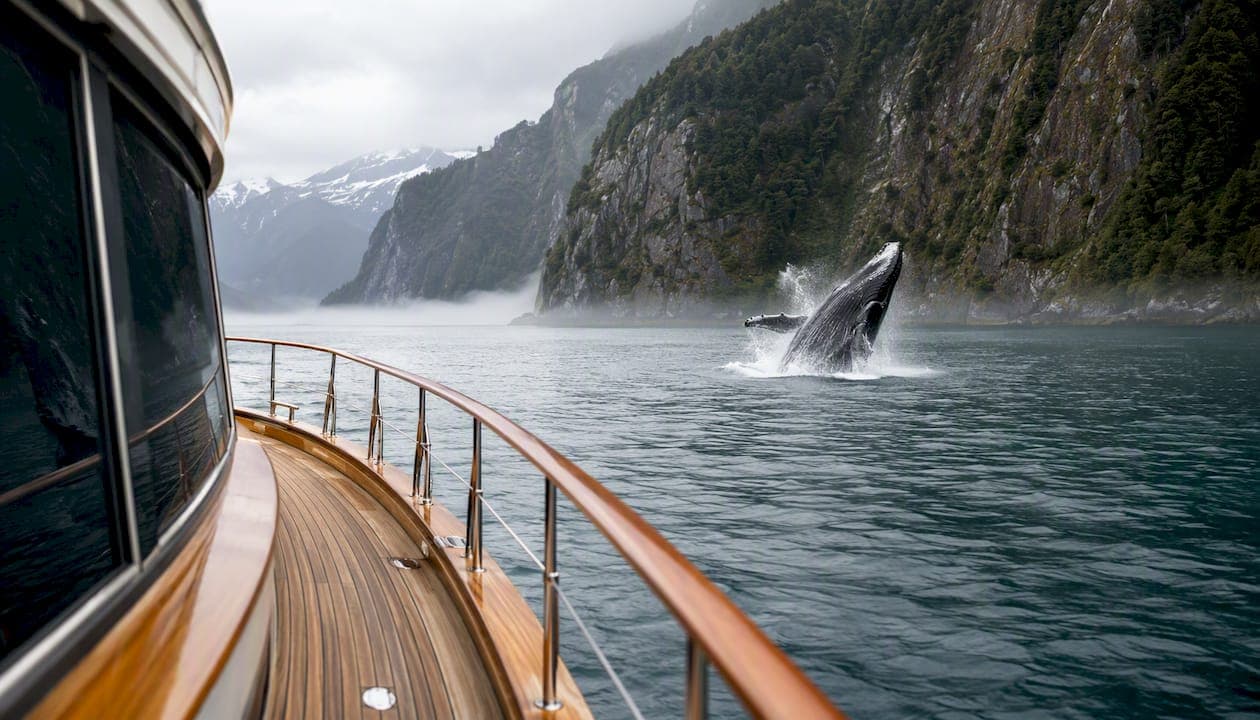
The best destinations for whale watching charters are Alaska's Inside Passage and Kenai Fjords, Maui and the Hawaiian Islands, the San Juan Islands, Stellwagen Bank off Cape Cod, Baja California Sur, Iceland's Húsavík, Newfoundland, Monterey Bay, Ningaloo Reef in Western Australia, and Trinity Bay in Newfoundland. Each rewards a private charter in a specific way: bubble-net feeding in Alaska, shallow-bay mother-calf encounters in Hawaii, resident orca pods in the Pacific Northwest, and blue whales feeding close to the California coast. The single most effective planning move is to book a backup day alongside your primary charter date. Weather and whale movement are unpredictable; a reserved second slot turns a near-miss into a sighting.
Top 10 charter-friendly whale watching destinations at a glance:
- Alaska (Inside Passage / Kenai Fjords / Prince William Sound): Spectacular bubble-net feeding by humpbacks; summer season with high sighting reliability.
- Maui & the Hawaiian Islands: Winter humpback congregation in the Au'au Channel; calm morning seas ideal for photography.
- San Juan Islands / Pacific Northwest: Resident and transient orcas year-round; dramatic tidal passages best navigated on a private RIB.
- Stellwagen Bank / Cape Cod: One of the East Coast's most reliable humpback hotspots, May through October.
- Baja California Sur (Cabo / La Paz): Winter humpbacks plus the option to combine a whale-shark swim in La Paz on a multi-day stay.
- Iceland (Húsavík / Skjálfandi Bay): Summer feeding grounds for minke, humpback, and fin whales; expedition-vessel territory.
- Newfoundland (St. John's / Trinity / Gros Morne): Humpbacks, icebergs, and seabird colonies in one extraordinary summer window.
- Monterey Bay & Central California: Blue whales seasonally; short half-day charters from a major hub airport.
- Ningaloo Reef, Western Australia: Whale shark swims March through July and humpback migration corridors later in the year.
- Azores (São Miguel / Faial): Year-round sperm whales and seasonal blue whales; small RIB charters from historic port towns.
Table of Contents
- What makes a destination truly charter-friendly?
- 1. Alaska delivers bubble-net feeding on a private expedition vessel
- 3. The San Juan Islands put you inside an orca's world
- 6. Iceland's Húsavík rewards expedition-style charters with large-species diversity
- 9. Ningaloo Reef offers swim-with encounters alongside whale shark season
- Why a private charter changes the experience: captain insights and regulations
- How to choose the right whale watching charter for your trip
- Key Takeaways
- The case for going further than the obvious destinations
- Exoticacharters plans the whale watching charter your trip deserves
- Authoritative sources for season windows, regulations, and operator schedules
What makes a destination truly charter-friendly?
Not every great whale watching location translates into a great charter experience. We evaluated each destination against six criteria: sighting reliability across a defined seasonal window, species diversity and signature behaviors, suitability for private or small-group vessels, departure-port infrastructure (marina access, fuel, provisioning), the length of the usable season, and the availability of ethical viewing conditions that allow captains to follow federal and international approach guidelines.
Charter suitability goes beyond whale density. A destination earns its place on this list when a private vessel can reach active feeding or breeding grounds within a reasonable transit time, when the port infrastructure supports crewed charters, and when the seasonal window is long enough to give travelers realistic booking flexibility. Sighting reliability data from NOAA Fisheries and the Stellwagen Bank National Marine Sanctuary informed our season windows, while operator schedules and Lonely Planet's global whale watching coverage helped cross-check species and boat-type expectations.
Private charters matter most for photographers who need to linger on a breach, families who want a flexible pace, and expedition travelers who want to combine whale days with diving or kayaking. A large tour boat runs on a fixed schedule; a private charter pivots when the captain hears a sighting report on VHF.
1. Alaska delivers bubble-net feeding on a private expedition vessel
Alaska is, by most measures, the most dramatic whale watching destination in the world for charter travelers. Humpback whales gather in the Inside Passage and Kenai Fjords from May through September, and the signature behavior here is bubble-net feeding: a coordinated hunting strategy in which a group of humpbacks herds fish into a tight column using a spiral of rising bubbles, then lunges through the surface together. It is one of the most photographed wildlife events on the planet, and a private vessel lets you hold position at the right angle rather than circling with a crowd.
Alaska's Kenai Fjords and Prince William Sound also offer killer whales, Dall's porpoise, sea otters, and Steller sea lions, making a single charter day extraordinarily productive for wildlife photographers. Operators across the region maintain VHF contact with each other to share real-time sighting intel, a networked approach that gives private charters a meaningful edge over scheduled public tours.
- Pricing: — Private yacht charters in Alaska vary widely by vessel size and duration; expect multi-day expedition packages to reflect the remoteness and provisioning costs.
Pro Tip: Book a backup day when planning Alaska charters. Weather in the Gulf of Alaska can shift quickly, and a reserved second slot is the single most reliable way to guarantee a sighting window.
3. The San Juan Islands put you inside an orca's world
The San Juan Islands sit at the convergence of several tidal channels in the Salish Sea, and the resident Southern Resident killer whale pods have used these waters for generations. Transient (Bigg's) killer whales also pass through, hunting harbor seals along the rocky shorelines. Humpbacks and gray whales add seasonal variety, and the scenery of forested islands, snow-capped peaks, and dramatic tidal passages makes every charter day visually extraordinary.
The resident orca population is present in the region across much of the year, though summer brings the highest concentrations as Chinook salmon runs peak. Spring through fall is the primary charter window, with summer offering the most predictable weather and visibility.
- Regulatory note: — Washington State and federal guidelines apply; NOAA Fisheries sets the 100-yard minimum approach distance for killer whales in this region.
6. Iceland's Húsavík rewards expedition-style charters with large-species diversity
Húsavík, on Iceland's north coast, has built a reputation as one of Europe's premier whale watching ports, and the waters of Skjálfandi Bay explain why. The bay's cold, nutrient-rich upwellings support dense concentrations of capelin and krill, drawing minke whales, humpbacks, and fin whales throughout the summer. Occasional orca sightings add to the species list, and the backdrop of volcanic mountains and midnight sun creates an atmosphere that is genuinely unlike anywhere else.
The charter season runs April through October, concentrated in summer for the best weather and highest whale density. Transit from Reykjavik to Húsavík takes roughly five hours by road or a short domestic flight to Akureyri, so plan buffer days at both ends.
- Travel note: Variable North Atlantic weather means enclosed cabins and stabilization are not optional comforts; they are practical necessities. Check vessel amenities before booking. For travelers considering similarly remote expedition logistics, Exoticacharters's guide to reaching remote expedition regions covers the planning essentials.
9. Ningaloo Reef offers swim-with encounters alongside whale shark season
Ningaloo Reef in Western Australia is the only place on this list where you can legally swim alongside whale sharks at scale. The whale shark season runs March through July, drawing aggregations of the world's largest fish to feed on coral spawn. Later in the year, humpback whales migrate along the Western Australian coast, and some operators offer in-water encounters with humpbacks as well, subject to local regulations.
The remoteness of Exmouth, the main gateway, is part of the appeal: the reef is pristine, the water is extraordinarily clear, and the marine life density is exceptional. Fly into Exmouth via Perth, and plan at least three nights to allow for weather flexibility.
- Charter types: — Small expedition vessels and RIBs equipped for snorkel deployments. Gateway: Exmouth, Western Australia.
Why a private charter changes the experience: captain insights and regulations
Private charters deliver something a large tour boat structurally cannot: the ability to stop, hold position, and wait. When a humpback begins a bubble-net sequence or a sperm whale surfaces for a long breath before diving, a private vessel can cut engines and drift at the right distance while the moment unfolds. A scheduled tour boat is already thinking about its return time.
Experienced captains maintain VHF contact with other local operators to share real-time sighting reports. That networked approach means a private charter can often redirect to an active area faster than any fixed-route vessel. Morning departures, typically between 7:00 and 10:00 AM, are preferred for calmer seas and better photographic light; in colder destinations like Iceland or Newfoundland, enclosed cabins and vessel stabilization shift from comfort features to practical requirements.
Federal and NOAA approach guidelines for whale watching:
| Rule | Standard | Notes |
|---|---|---|
| Minimum approach distance | 100 yards | Applies to all whales under federal guidance |
| Killer whale approach (Pacific NW) | 100 yards | Washington State and federal rules for Southern Residents |
| Recommended vessel speed near whales | 7 knots or less | Reduces disturbance and collision risk |
| Maximum viewing time per group | a short viewing time recommended | Allows animals to resume natural behavior |
Source: NOAA Fisheries
Booking checklist for a whale watching charter:
- Confirm the captain holds a valid USCG or equivalent license for the vessel class and passenger count.
- Verify VHF radio and radar are operational on board.
- Ask whether the vessel has an enclosed cabin, particularly for Alaska, Iceland, or Newfoundland departures.
- Confirm the cancellation and rescheduling policy for weather-related cancellations before paying a deposit.
- Ask whether a naturalist or trained wildlife guide joins the trip. Knowing what naturalists and expedition guides offer on board can meaningfully shape your sighting experience.
- Check the maximum guest count; fewer guests means more deck space and a quieter approach.
- Ask about the vessel's waste and discharge policy; responsible operators follow no-discharge standards in sanctuary waters.
Pro Tip: Ask your captain directly whether they have a backup-day policy and whether they maintain radio contact with other local operators. Both answers reveal a lot about how seriously they take the wildlife encounter.
How to choose the right whale watching charter for your trip
The right charter depends on three variables: who is traveling, what behavior you want to witness, and how much transit time you are willing to trade for proximity to the whales. A family with young children prioritizes stability and enclosure; a wildlife photographer prioritizes agility and positioning; an expedition traveler wants multi-day range and combined activities.
Charter type comparison:
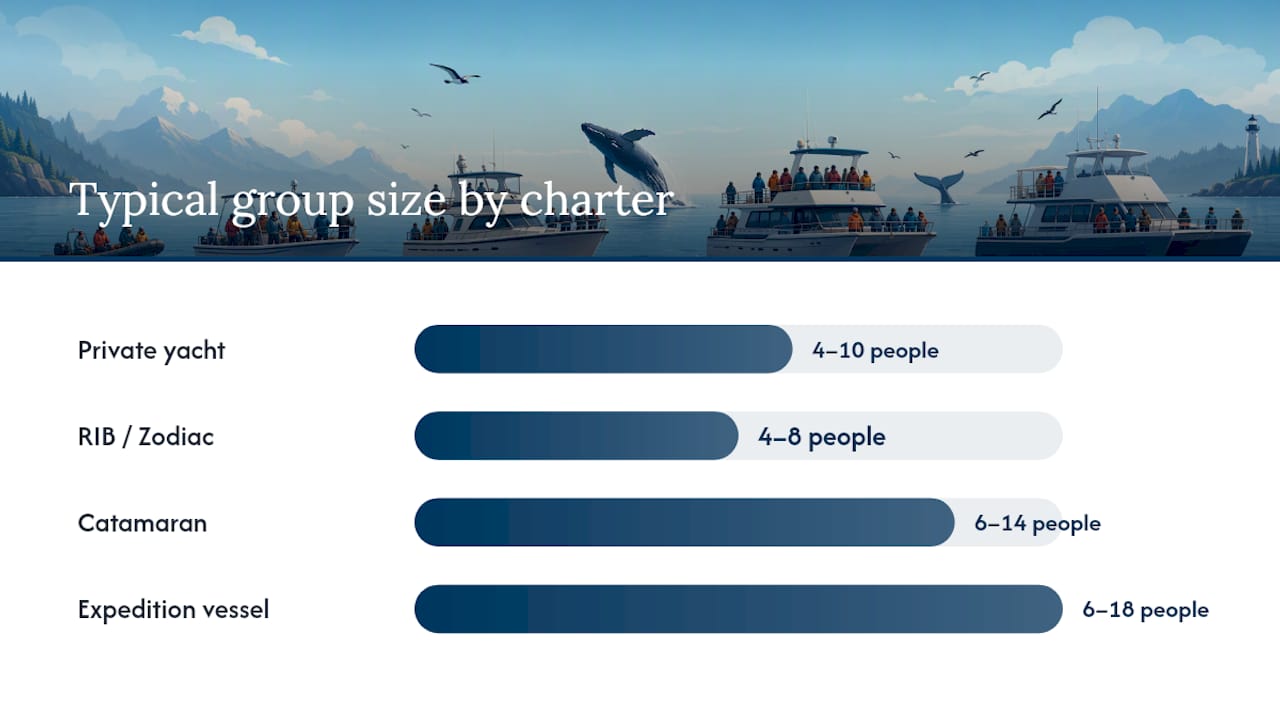
| Charter type | Best for | Stability | Approach agility | Typical group size | Multi-day range |
|---|---|---|---|---|---|
| Private yacht | Families, photographers, multi-day | High | Moderate | 4–10 | Yes |
| RIB / Zodiac | Photographers, close approaches | Low–moderate | High | 4–8 | Limited |
| Catamaran | Families, comfort-focused groups | High | Low | 6–14 | Yes |
| Expedition vessel | Remote destinations, large species | High | Moderate | 6–18 | Yes |
Questions to ask any operator before booking:
- What is your cancellation and rescheduling policy for weather?
- How do you share sighting intel with other local operators?
- What is the maximum guest count on this vessel?
- Do you carry a naturalist or trained wildlife guide?
- What is your waste and discharge policy in sanctuary waters?
Red flags to watch for: any operator who guarantees a sighting, uses aggressive approach tactics to get closer than 100 yards, cannot produce safety credentials, or has no formal weather-reschedule policy. Sighting guarantees are a commercial fiction; responsible captains offer reschedule policies instead.
Pricing for private yacht charters varies considerably by destination, vessel size, and season length. Per-person rates on shared small-boat trips are the most affordable entry point; a dedicated private yacht charter commands a premium but delivers the flexibility, privacy, and photographic positioning that serious wildlife travelers find worth the difference. Compare total trip time, including transit to and from the whale grounds, rather than hourly rates alone.
Key Takeaways
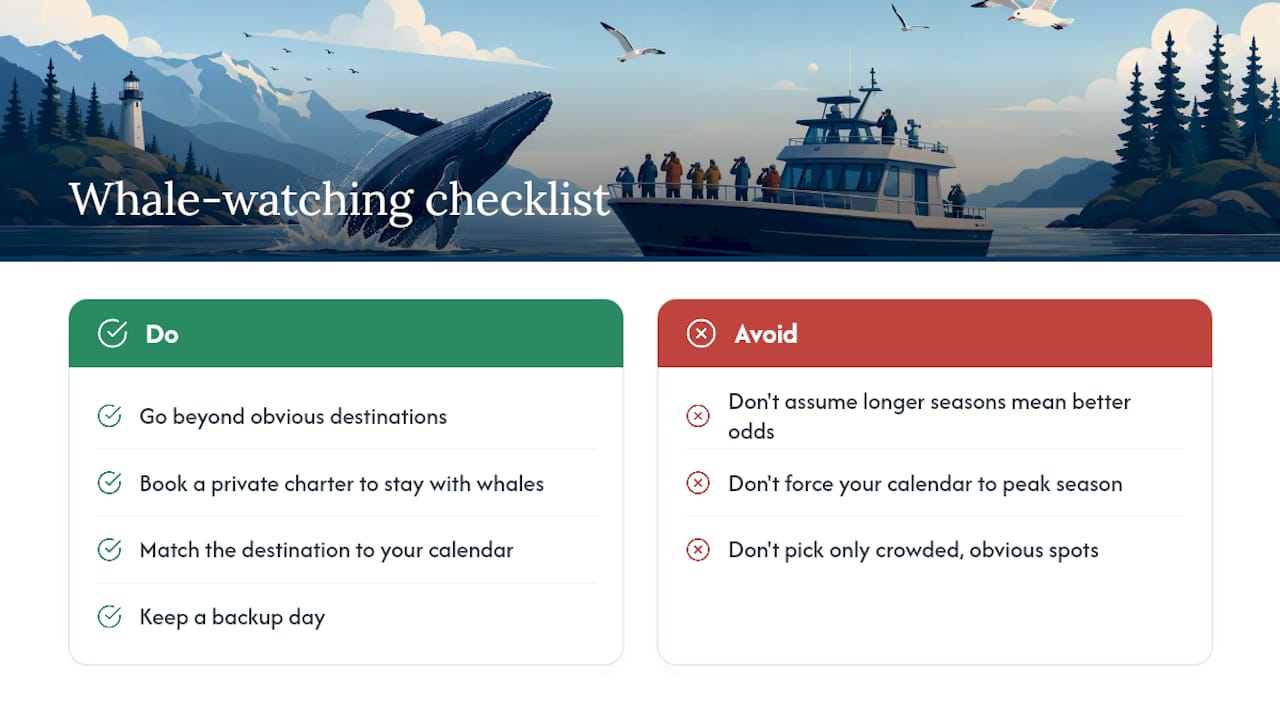
The best whale watching charter destinations reward private vessels with flexible positioning, early morning departures, and a backup day built into the itinerary.
| Point | Details |
|---|---|
| Season choice is decisive | Each destination has a defined peak window; booking outside it reduces sighting odds significantly. |
| Always hold a backup day | Weather and whale movement are unpredictable; a reserved second slot is the most reliable planning hedge. |
| Private charters outperform tour boats | A dedicated vessel can hold position, redirect on VHF intel, and approach ethically at the captain's discretion. |
| NOAA approach rules apply everywhere | A 100-yard minimum distance and 7-knot speed limit near whales are federal standards; choose captains who follow them. |
| Exoticacharters for custom itineraries | Exoticacharters plans fully crewed private yacht and expedition charters to Alaska, Baja, and beyond, with naturalists available on request. |
The case for going further than the obvious destinations
The ten destinations on this list are well-documented for good reason: they deliver. But the most memorable whale charter experiences we have seen planned are rarely the most obvious ones. Iceland's Húsavík in June, when the midnight sun keeps the light golden at 11 PM and a fin whale surfaces fifty yards off the bow, is a different category of experience from a crowded summer day off Cape Cod. Newfoundland in late May, with pack ice still visible on the horizon and humpbacks feeding in Trinity Bay, rewards travelers who are willing to accept variable weather in exchange for genuine remoteness.
The practical argument for private charters is often framed around photography or flexibility, and both are real. But the deeper case is about pace. A private vessel lets you stay with an animal for as long as the regulations allow and the animal permits. You are not watching a whale; you are spending time with one. That distinction shapes the entire experience, and it is why the charter format, whether a luxury sailing yacht in Hawaii or a heated expedition vessel in Iceland, consistently produces the encounters that travelers describe years later.
We would also push back gently on the assumption that longer seasons mean better odds. A destination like the Azores, with year-round sperm whales, offers a different kind of reliability than Alaska's concentrated summer window. Matching the destination to your travel calendar, rather than forcing your calendar to fit a peak season, often produces the best outcome. The backup day remains non-negotiable regardless of where you go.
Exoticacharters plans the whale watching charter your trip deserves
For travelers who want a private crewed yacht or expedition vessel, not a shared tour boat, Exoticacharters builds custom whale watching itineraries around your destination, your schedule, and the species you most want to encounter. The team includes former captains and water-sports professionals who know the difference between a vessel that can reach active feeding grounds quickly and one that simply looks good in a brochure.
Exoticacharters arranges luxury private yachts and expedition vessels for whale watching charters in Alaska, Baja California, and destinations across the globe, with naturalists available on request and multi-day itineraries designed to combine whale days with diving, kayaking, or wildlife photography. Pricing varies by destination, vessel, and season; every quote reflects the actual cost of a fully crewed private charter rather than a per-person estimate. Weather dependence is real, and every itinerary we plan includes a rescheduling framework. Speak with an Exoticacharters specialist to check availability and design an itinerary around your preferred destination and travel window.
Authoritative sources for season windows, regulations, and operator schedules
Before booking any whale watching charter, verify current season windows, approach regulations, and operator credentials directly with primary sources. Regulations and sanctuary schedules are updated periodically, and the most reliable information comes from the agencies and sanctuaries that manage these waters.
- NOAA Fisheries
- Stellwagen Bank National Marine Sanctuary — Whale Watching
- Alaska’s Best Whale Watching Spots | ALASKA.ORG
- Whale Watch Cabo — Best Time
- Whale watching in Australia | australia.com
- The world's best whale watching tours | Lonely Planet
- The best whale watching spots and tips from an Oregon Coast expert | Register-Guard
- The 15 Best Places to Watch Whales Across the Globe | Explore With Alec
Confirm operator credentials, vessel safety certifications, and current sanctuary schedules directly before placing a deposit on any charter.
Recommended
- 11 Most Unique Yacht Charter Destinations in the World – Exotica Charters
- 5 Epic Expedition Yacht Charter Destinations for True Adventure – Exotica Charters
- Which Crewed Charter Destinations Offer the Best Marine Biology Experiences? – Exotica Charters
- Rare Bird Species Seen on Yacht Charters: Top 10 Guide