
That figure is calculated on the charter fee alone, never the Advance Provisioning Allowance. Both the MYBA trade association and brokers cited by YATCO treat this range as the accepted baseline for a crewed vacation at sea.
TL;DR:
- Tips generally range from 10 to 20 percent of the base charter fee, depending on regional customs, with Mediterranean charters averaging lower than Caribbean ones.
- The gratuity pool is typically handed to the captain, who then divides it among crew members based on seniority and department roles.
- Gratuity should be calculated only on the base charter fee, excluding the Advance Provisioning Allowance, fuel surcharges, and taxes.
- Hand the tip in a sealed envelope to the captain before disembarkation, preferably on the final morning, with either cash or wire transfer arrangements.
- Extra considerations include tipping more for exceptional service during crises or multi-week charters, and clarifying fee and tip details with your broker in advance.
Table of Contents
- Why Gratuity Matters More Than You Might Think
- Who Receives the Tip and How It Gets Divided
- How Much Should You Actually Tip?
- What Base Should You Calculate the Tip On?
- When and How to Hand Over the Tip
- Adjusting for Special Circumstances
- How Exotica Charters Supports Gratuity Planning
- A Simple Rule Worth Remembering
- Ready to Book? Let Exotica Charters Handle the Details
- Sources
Why Gratuity Matters More Than You Might Think
Crew earn a base salary from the yacht's owner, but on a busy charter boat, tips often make up a meaningful share of what they actually take home over a season. The gratuity you leave isn't a courtesy tacked onto the bill; it's a direct reward for effort that mostly happens where guests never look.
- Engine checks and generator troubleshooting that keep the air conditioning running at 2 a.m.
- Provisioning runs to track down the exact wine or produce a guest mentioned once
- Night watches, anchor resets, and weather calls that reroute the whole week's itinerary
- Constant small adjustments, extra towels, rebooked excursions, quiet fixes to problems you never saw
MYBA's own guidance frames tipping as customary but voluntary, never a mandatory surcharge. That distinction matters for how you think about it: a gratuity is earned recognition, not a fee owed.
Who Receives the Tip and How It Gets Divided
The standard model is a single pooled envelope handed to the captain, who then divides it among the crew. You are not expected to tip individually, and doing so, or announcing the total in front of the crew, tends to create awkwardness rather than goodwill.
On a typical eight-person crew, the split usually favors seniority and department leadership:
- Captain: largest individual share, often close to double a deckhand's cut
- Chief stewardess, chief officer, and chef: next-largest shares, reflecting department responsibility
- Second stewardess and second officer: a moderate mid-tier share
- Deckhands and junior stewards: smaller, roughly equal shares
Industry sources note that captains typically take the largest single share, with department heads next and junior crew receiving proportionally less. Trust the captain to divide it fairly. That's precisely why the envelope goes to one person, not eight.
How Much Should You Actually Tip?
Regional custom shapes the number more than most guests expect. Mediterranean charters typically run 10 to 15% of the base fee, while Caribbean and Bahamas charters trend higher, usually 15 to 20%, according to charter etiquette guides tracking regional tipping patterns.
Some brokers prefer a per-diem calculation instead, particularly on very large charters where a straight percentage can produce a lopsided per-person payout. A working figure here is $250 to $350 per crew member, per day, which Yachting Magazine treats as a practical alternative to percentage math on high-value boats.
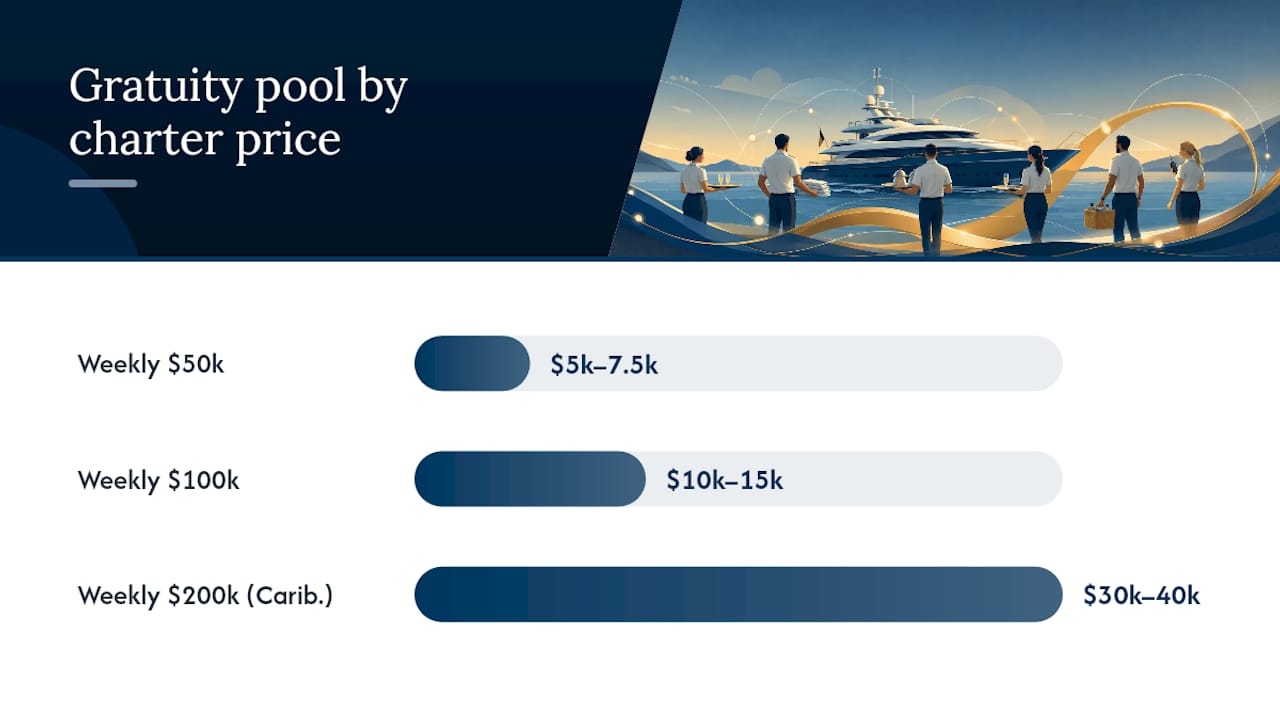
Here's how that plays out in dollars:
- $50,000 weekly charter: 10 to 15% puts the gratuity pool at $5,000 to $7,500.
- $100,000 weekly charter: the same range works out to $10,000 to $15,000, split across the crew by seniority.
- $200,000 weekly charter, Caribbean: at 15 to 20%, that's $30,000 to $40,000, which is exactly the scenario where a per-diem check against crew size can sanity-test the percentage.
Adjust from there based on what actually happened onboard. A crew that handled a medical scare calmly, or kept two toddlers entertained through a squall, earns the top of the range or beyond it. A charter with real service gaps justifies sitting near the bottom, not skipping the gratuity altogether.
What Base Should You Calculate the Tip On?
The base charter fee is the contracted weekly rate for the yacht and crew. The Advance Provisioning Allowance, or APA, is a separate deposit covering fuel, food, dockage, and incidentals, and it should never factor into your tip math. Gratuity applies to the base fee only, excluding APA, fuel surcharges, and taxes.
Before you land on a number, confirm three things with your broker or in the contract:
- The exact base charter fee stated in the agreement, separate from any APA line item
- Whether any delivery or repositioning fees are bundled into that base figure
- Whether the contract itself references a suggested tipping range
Pro Tip: Ask your broker to write the base charter fee and the APA as two clearly separated numbers before you sign. It takes thirty seconds and it removes any ambiguity when it's time to tip.
When and How to Hand Over the Tip
Timing is more practical than sentimental. Hand the envelope over on the final morning, before disembarkation, rather than waiting for a farewell dinner the night before departure. It's simply cleaner logistically, and it avoids the awkward math of tipping before the trip has technically ended.
- Confirm with the captain or broker in advance whether cash or a wire transfer to a port-side bank works better for the crew.
- If paying cash, bring the full amount in a sealed envelope addressed simply to "The Crew."
- Declare large cash amounts where local customs regulations require it, particularly when crossing international borders during the charter.
- Avoid announcing the total in front of guests or crew; let the gesture speak for itself.
Wire transfers work well on longer, higher-value charters where carrying tens of thousands of dollars in cash becomes its own headache. Guides on charter tipping etiquette recommend asking early, since arranging a port bank transfer takes lead time the last morning doesn't offer. One note on brokers: they're paid through owner commission, so a tip isn't expected there. A small non-cash thank-you is a nice touch if a broker went well beyond the booking itself.
Adjusting for Special Circumstances
Some charters call for a number outside the standard range, and knowing when to move is as useful as knowing the baseline.
- Tip above the range when the crew managed a genuine crisis calmly, handled complex medical or child-care needs without missing a beat, or pulled off a logistically difficult multi-island itinerary flawlessly.
- Tip toward the lower end when service was merely adequate, and raise any specific concerns with the captain during the charter rather than saving it all for the final envelope.
- On multi-week charters, percentages naturally compress since the base fee scales with length; some charterers switch to per-diem thinking to keep the total proportional.
- On smaller crews, a per-person daily figure often produces a fairer result than a strict percentage split.
How Exotica Charters Supports Gratuity Planning
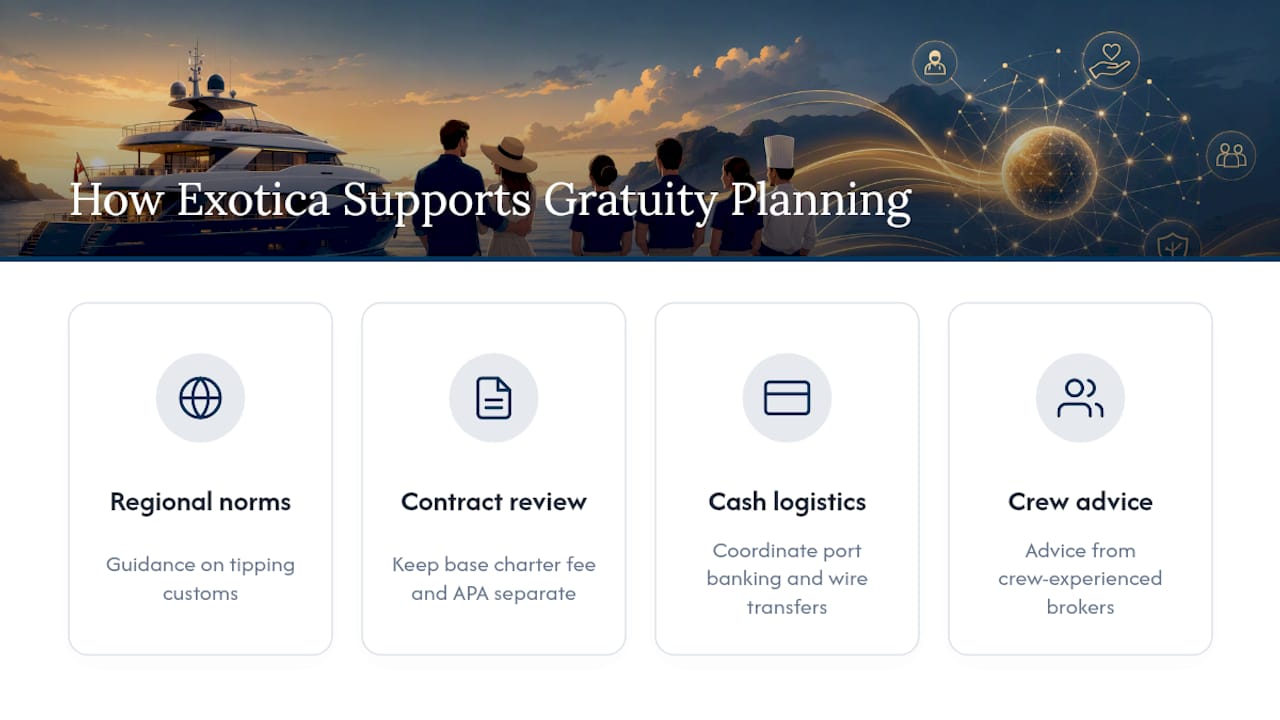
Working out tipping etiquette shouldn't be the stressful part of a charter you've spent months planning. Guidance on regional norms, contract review to keep the base charter fee and APA clearly separated, and coordination with port-side banking or wire transfers when cash logistics get complicated on longer routes is available from experienced brokers. Advice from individuals with firsthand crew experience can help refine gratuity planning. For a deeper look at how charter contracts break down fees and inclusions, the Yacht Charter Insights library covers exactly this kind of detail, and it's worth reading alongside a breakdown of what a full crew actually consists of on a typical charter.
A Simple Rule Worth Remembering
Before you fly out, run through three things: confirm the base fee in writing, decide cash or wire ahead of time, and keep the envelope simply labeled for the crew. It removes the guesswork exactly when you'd rather be enjoying the last morning on deck.
— Mo
Ready to Book? Let Exotica Charters Handle the Details
Specialist brokers arrange fully crewed charters and can assist with gratuity planning by advising on regional norms, reviewing contracts to ensure the base fee is clearly separated from the APA, and coordinating wire transfers or port-side banking when cash isn't practical. That kind of hands-on, discreet planning is what separates a smooth final morning from a scramble. If you're weighing a crewed trip somewhere further afield, a private charter model like the ones offered through partners such as Hurghada's crewed yacht experiences shows how regional norms shift even within a single sea.

Browse available luxury yachts and get a tailored quote that includes clear guidance on crew gratuity from the very first conversation with your specialist.
Sources
- How Much Do Yacht Crew Make in Tips | YATCO
- MYBA
- How to Tip a Yacht Crew: The 2026 Charter Reference — Trillionaire Daily
- Yacht Charter Tips: What’s Normal & How It Works (Med + Caribbean) — Yachting Magazine