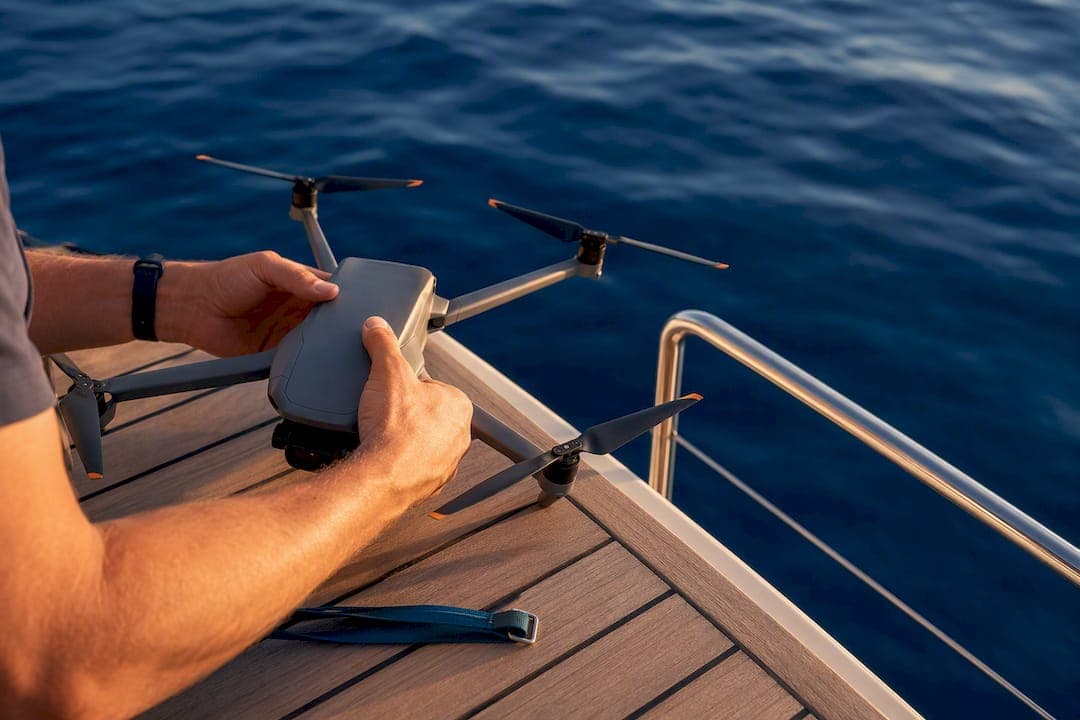
Yes, you can fly a drone from a yacht, but only with the captain's explicit approval and full compliance with aviation rules for the waters you're in. Before any launch, ask the captain, check no-fly zones and Notices to Mariners for your route, and set a hand-launch and hand-catch plan rather than a deck landing. Skip any of these, and you risk a lost drone, an unhappy crew, or a real safety incident, since a moving vessel turns return-to-home into one of the most common failure points at sea.
TL;DR:
- Drone flights from yachts require captain approval, strict adherence to no-fly zones, and a clear launch and recovery plan to ensure safety at sea.
- FAA registration is mandatory for drones over 250 grams, and flights over people or in restricted areas can lead to legal penalties without proper permits.
- Hand-launch and hand-catch methods are safest for sea operations, with home point updates or disabling RTH to prevent drone loss during return.
- Saltwater, glare, and metallic structures accelerate drone wear and affect sensors, so routine rinsing, calibration, and cautious launch zones are essential.
- Proper preflight planning, crew briefing, and respecting local restrictions significantly increase the likelihood of safe, successful drone use on charter vessels.
Table of Contents
- Drone Rules on Yachts: The Legal Basics That Actually Apply
- Who Has to Approve a Drone Launch on a Charter Yacht?
- How Do You Safely Launch and Recover a Drone at Sea?
- What Marine Conditions Threaten Your Drone the Most?
- What Should Be on Your Preflight Checklist Before Launching From a Yacht?
- Where Are Drones Banned Near Yachts and Marinas?
- Do You Need Insurance to Fly a Drone on a Charter?
- What Yacht Captains Wish Every Drone Pilot Knew
- Where to Verify the Rules Before You Fly
- What Guests Should Expect From Us on a Charter
- Fly With Crew Support Instead of Guessing Alone
- Sources
- FAQ
Drone Rules on Yachts: The Legal Basics That Actually Apply
The Federal Aviation Administration's rules don't disappear once you leave the dock. If your drone weighs 250 grams or more, it needs FAA registration regardless of whether you're flying over a backyard or a bow. Visual line of sight (VLOS) still applies, meaning you keep the aircraft within visual line of sight at all times, no matter how tempting it is to chase a dolphin pod past the horizon. Flights over people who haven't consented, including other guests sunbathing on a neighboring boat, remain restricted under the same rules that govern flights over crowds on land.
The distinction that trips up most charter guests is recreational versus commercial use. If you're capturing footage purely for personal memories, you're flying under the FAA's recreational exemption. The moment that footage ends up in marketing material, on a yacht's brokerage listing, or in a paid social media campaign, you've crossed into commercial territory, which requires a Part 107 remote pilot certificate. Charter companies that supply promotional drone footage understand this distinction well, since drone footage used to market a vessel has to meet a different regulatory bar than a guest's holiday clip.
Local and destination rules stack on top of federal ones, and they vary more than most pilots expect. A marine protected area might ban drones outright to protect nesting seabirds. A busy port might restrict airspace near shipping lanes. National parks bordering the coastline often have their own no-fly policies that have nothing to do with the FAA. Countries outside the US frequently follow EASA-style frameworks with their own weight classes and registration thresholds, and local rules for national parks and military zones can shift from one anchorage to the next even within the same country.
Before you fly, verify the rules that apply to your exact location:
- Check FAA no-fly-zone maps or an equivalent aviation authority overlay for restricted airspace near your anchorage.
- Review Notices to Mariners for the route, since these often flag temporary restrictions tied to naval exercises, regattas, or VIP transits.
- Ask the captain whether the destination country has its own drone registration or permit requirements.
- Confirm whether the footage will be used commercially, which changes the certification you need before you even pack the drone.
Operators who treat these checks as a formality rather than a real workflow are the ones who end up grounded, fined, or worse, flying blind into a restricted corridor they never bothered to look up.
Who Has to Approve a Drone Launch on a Charter Yacht?
The captain has final say over every drone flight on the vessel, full stop. That authority isn't bureaucratic overreach. Drones can interfere with navigation electronics, drift into rigging, or create an entanglement hazard the moment something goes wrong near the mast or antennae. Captains treat drone operations as safety decisions, not content requests, which is exactly why the best way to get a yes is to frame your request the same way they do.
Ask early, not at the moment you want to launch. Tell the captain what you plan to shoot, roughly how long the flight will take, and whether you'll need the vessel to hold a steady heading or slow down for recovery. A captain who understands the plan is far more likely to approve it than one who's ambushed with a drone case on the aft deck five minutes before sunset.
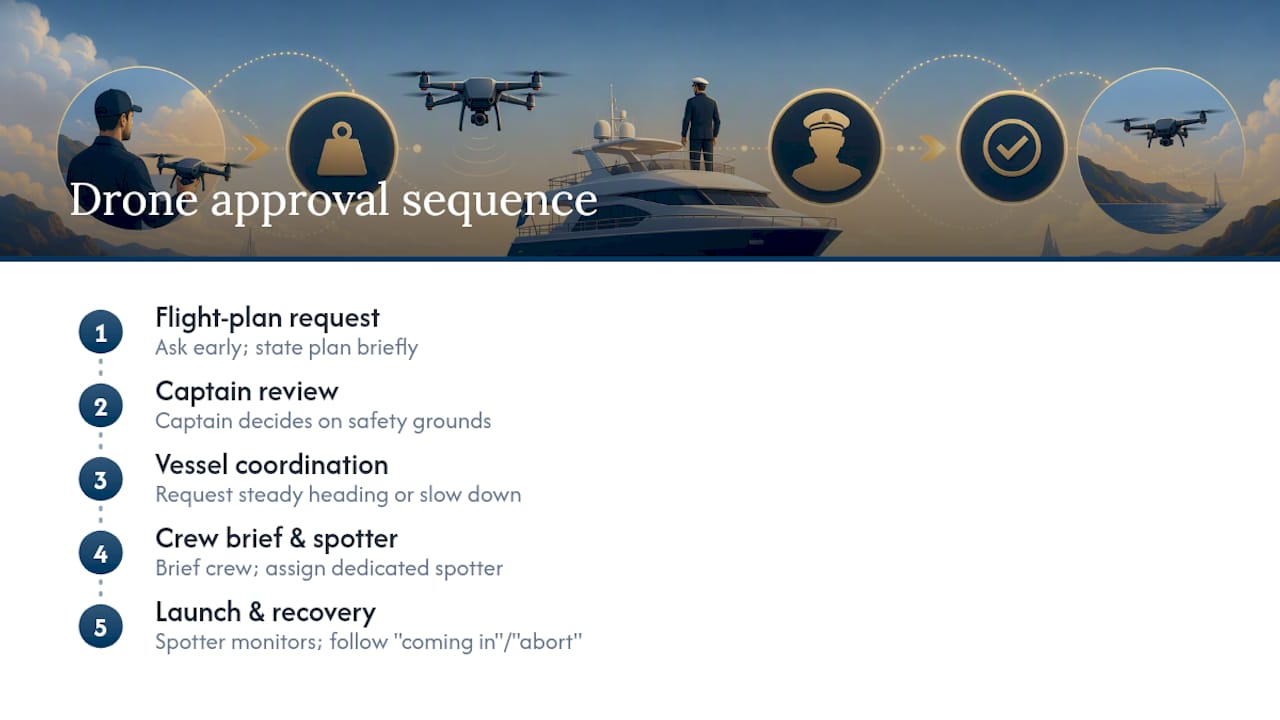
Once you have approval, brief the crew like you would any operation with moving parts. Assign one crew member as a dedicated spotter, someone whose only job is watching the aircraft and the water around the vessel, not filming or supervising guests. If you're planning a hand-catch on recovery, that spotter becomes your catcher, and you'll want a clear voice or radio signal for "coming in" versus "abort." On larger yachts with VHF-equipped crew stations, a quick call on the handset avoids shouting over engine noise or wind.
Etiquette matters as much as procedure. Don't fly over neighboring vessels or film guests on other boats without asking. Anchorages in popular bays get crowded fast, and a drone buzzing over someone else's sundeck is the fastest way to sour relations between crews who'll be sharing the same water for days. The same goes for wildlife: if you're near nesting birds, marine mammals, or a dive site, cut the flight short rather than pushing for one more angle. Exotica Charters' crews follow the same etiquette standards guests are expected to observe throughout a charter, and drone use fits squarely into that framework.
Pro Tip: Brief the crew on your flight plan the night before if conditions allow. A captain who's had time to think through anchorage logistics is far more likely to say yes than one asked on the spot.
How Do You Safely Launch and Recover a Drone at Sea?
Hand-launch and hand-catch beat deck landings almost every time on a yacht, because a rolling deck turns a routine landing into a coin flip. Here's the sequence that keeps a flight from a boat closer to routine than risky.
- Launch by hand, away from rigging. Hold the drone at arm's length, clear of antennae, outriggers, and overhead lines, and let it lift straight up before moving toward your shot.
- Fly away from the vessel first, then climb. Gaining altitude too close to the boat increases the odds of clipping a mast or superstructure if a gust pushes you sideways.
- Set or disable return-to-home before you take off. On a moving boat, RTH will try to land the drone where the vessel used to be, not where it currently is. Dynamic home-point handling means updating the home point to the controller's position, or disabling RTH entirely and relying on manual return under a spotter's direction.
- Watch your battery like a fuel gauge on a long passage. Set a hard abort threshold, commonly 30 percent remaining, and treat it as non-negotiable rather than a soft suggestion you can push past for one more pass.
- Slow the vessel or hold position for recovery. Recovery is the highest-risk moment of the flight. Launching and catching only at very low speeds, generally under about 3 knots, or while stationary, gives your catcher a stable platform to work from.
- Bring the drone to hover height near the catcher, then approach slowly. The pilot flies; the catcher reaches up and grabs the drone by the frame, never the propellers, on a clear verbal count.
- Power down immediately after the catch. Don't let props keep spinning while the catcher repositions or hands the drone off; that's how fingers get nicked and confidence gets shaken.
Hand-catching is a two-person job, and it should never be attempted solo. Hand-catching requires two trained people and protective gloves, and neither of you should try it in heavy seas or high wind. If conditions have shifted since launch, land on a stable tender or, as a last resort, a clear patch of deck rather than forcing a catch that's likely to fail.
The RTH issue deserves its own callout, because it's the single most common cause of drones lost at sea. A drone left on default return-to-home settings will fly to GPS coordinates recorded at launch, not to wherever the yacht has since drifted or motored. On a vessel making even modest headway, that gap can put the home point hundreds of feet from the boat's actual position by the time the drone tries to land, often over open water with no vessel beneath it at all.
What Marine Conditions Threaten Your Drone the Most?
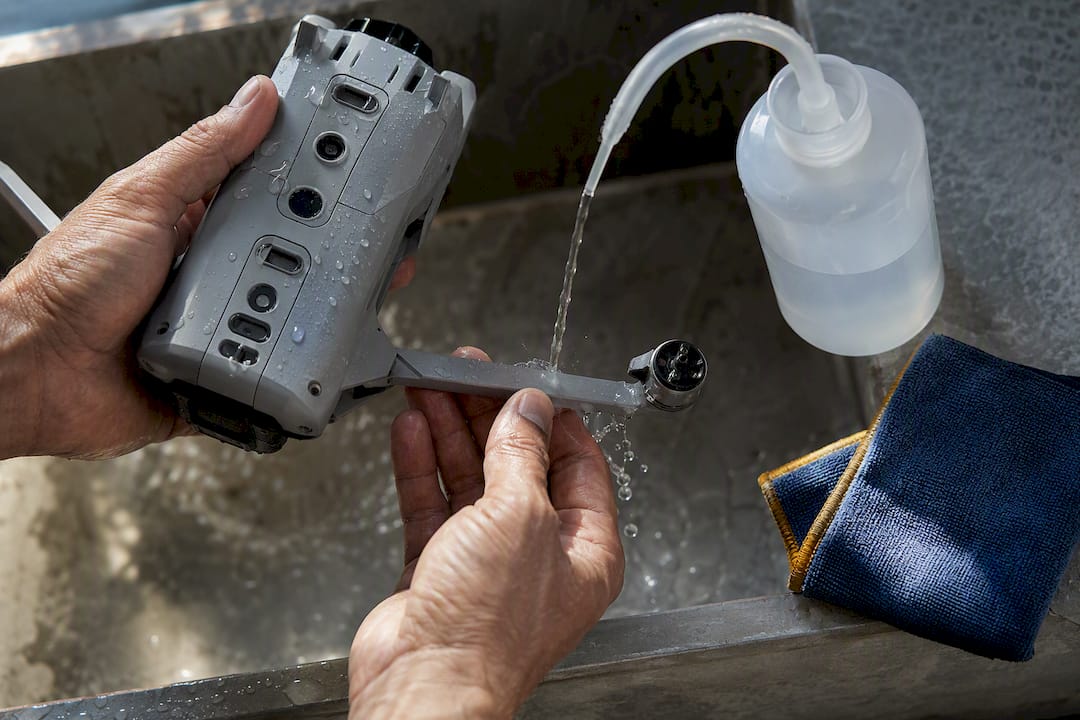
Salt air is the quiet killer of maritime drone gear. Corrosion sets into motor bearings, connector pins, and exposed circuitry faster than most pilots expect, especially after a flight through sea spray or a landing near breaking waves. Rinsing the airframe with fresh water and inspecting motors after every marine flight should become as automatic as stowing the controller.
Reflective water plays tricks on vision sensors and can cause GPS signal degradation, particularly around midday when sun glare bounces hard off the surface. Drones that rely heavily on downward vision positioning may drift or hunt for a stable hover over open water, since there's no textured surface for the sensors to lock onto. Pilots who know how to switch to ATTI mode or fly manually when vision positioning drops out have a real advantage over those who've only ever flown in GPS-assisted modes over land.
Metal decks and mast structures throw off compass calibration in ways that catch first-timers off guard. Calibrating a compass on a steel deck gives false readings because the surrounding metal distorts the magnetic field the compass depends on. Always calibrate on land before you board, and if a mid-trip recalibration becomes necessary, do it as far from the hull, rigging, and electronics as the deck layout allows.
Practical mitigations worth building into your routine:
- Rinse the airframe and check exposed motor housings after any flight involving spray or humid air.
- Choose a launch zone away from radar domes, satellite antennae, and engine exhaust, all of which can interfere with radio links or introduce heat distortion.
- Carry spare props and a small toolkit, since salt exposure shortens the working life of plastic components faster than land-based use.
- Fly a test hover close to the deck before committing to a full mission, checking for drift that signals a sensor issue.
What Should Be on Your Preflight Checklist Before Launching From a Yacht?
A methodical preflight sequence separates a smooth flight from a scramble. Treat it the way a good crew treats any pre-departure check, because planning drone operations as formal safety procedures with defined roles consistently outperforms ad-hoc filming sessions.
- Confirm captain sign-off and crew roles. Nobody launches until the captain has approved the flight and a spotter has been assigned.
- Inspect the aircraft. Check propellers for nicks, confirm battery charge and physical condition, and verify the SD card has space and isn't corrupted from a prior session.
- Check wind and sea state. Sustained winds above the manufacturer's rated limit, usually in the 20 to 25 mph range for consumer drones, are a hard no. Choppy seas that make the deck unstable are a signal to wait.
- Scan for nearby traffic. Other vessels, jet skis, or low-flying aircraft in the anchorage change your flight plan; note their positions before takeoff.
- Set your home point or disable RTH, based on the plan you settled on for that specific flight.
- Confirm your recovery plan. Know who's catching, where they'll stand, and what happens if a catch is missed and the drone touches water.
- Set up communications. Decide whether you're using hand signals, voice commands, or a VHF handset, and make sure the spotter and pilot agree on the terms before the props start spinning.
- Pack a floating retrieval option if the drone lacks flotation. A pool noodle taped to the frame or a dedicated flotation kit can turn a total loss into a five-minute recovery if the drone does go down.
Pro Tip: Keep a small dry bag near the launch zone with spare props, a microfiber cloth, and a permanent marker to log battery cycles. Small friction points like a missing prop or a dead marker add up fast when the whole crew is waiting on you.
If the drone does land in the water, cut power immediately if it's still transmitting, note the GPS coordinates from your last known telemetry, and use a boat hook or the tender to retrieve it before saltwater intrusion reaches the battery compartment. Speed matters more than technique here.
Where Are Drones Banned Near Yachts and Marinas?
Ports and harbors sit near the top of the restricted list, largely because commercial shipping lanes and low-altitude approach corridors leave no margin for an unregistered aircraft wandering into the mix. Marine protected areas frequently prohibit drones outright to shield nesting colonies, coral systems, or marine mammal habitats from disturbance, and violations in these zones tend to carry real fines rather than warnings.
Marina drone restrictions vary by facility, but many enforce no-fly policies close to fuel docks, superyacht berths, or areas with heavy foot traffic, partly for privacy and partly for liability. Offshore installations, including oil platforms and some research buoys, maintain exclusion zones that show up on aviation charts even in open water far from any coastline. Weather, regulation, and integration challenges are common enough at sea that treating every new anchorage as a fresh check, rather than assuming yesterday's rules still apply, is the safer habit.
Before committing to a flight in unfamiliar waters:
- Cross-check FAA or destination-country no-fly-zone overlays against your planned route.
- Review Notices to Mariners for temporary restrictions tied to naval activity, regattas, or diplomatic visits.
- Ask harbor or marina staff directly if signage doesn't make the policy clear.
- Assume a marine protected area is off-limits until you've confirmed otherwise with local park or wildlife authorities.
Special permits or prior authorization typically come into play near airports, military installations, or during scheduled events like air shows and race weeks. If your itinerary includes any of those, build in time to research permitting requirements well before departure rather than discovering the restriction from a suspicious harbor master.
Do You Need Insurance to Fly a Drone on a Charter?
Recreational drone flights, the kind covered by most homeowner or renter policies, generally don't require separate insurance, though coverage limits and exclusions vary enough that it's worth a quick call to your provider before the trip. Once footage crosses into commercial use, whether that's selling clips, using them in marketing, or handing them to a charter company for promotional purposes, the insurance and liability picture changes considerably.
Commercial use requires Part 107 certification and appropriate liability coverage, since a certified operator carrying their own insurance shifts liability away from both the guest and the vessel owner. On a charter, damage caused by a drone, whether to the aircraft itself, the yacht, or a third party, typically falls back on whoever operated it unless a specific waiver or insurance arrangement says otherwise. That's worth clarifying with the captain or charter company before you fly, not after something goes wrong.
For any shoot intended for marketing or resale, hiring a certified commercial operator and documenting the approvals in writing protects everyone involved, from the guest to the crew to the yacht owner.
What Yacht Captains Wish Every Drone Pilot Knew
Captains don't refuse drone requests out of caution for caution's sake. They refuse them when the request feels rushed, undefined, or disconnected from how the vessel actually operates that day. A pilot who shows up with a plan, a spotter in mind, and a clear sense of when the flight needs to happen earns trust fast, because captains prioritize risk mitigation over content creation, and a well-organized request signals that the pilot understands that priority too.
Crew roles during a launch tend to follow a familiar pattern on well-run charters: one crew member handles the spotter and catcher duties, another stays near the helm to relay speed or heading changes if recovery calls for the vessel to slow, and the captain keeps an eye on overall conditions from the bridge. Communication stays short and specific, "coming in from the stern, hold your speed," rather than long explanations shouted over wind.
The best drone flights we've supported happen when the guest treats it like any other water activity request, something to plan around tides, wind, and the day's itinerary, not something to squeeze in at the last minute. When a guest asks early and includes the crew in the plan, the flight almost always goes smoothly.
Exotica Charters' crews, many with backgrounds as former captains and water sports professionals, apply that same safety-first lens to drone requests as they do to diving or watersports logistics on charters across the South Pacific and beyond.
Where to Verify the Rules Before You Fly
For the most current registration and recreational flight rules, check the FAA's official guidance directly rather than relying on secondhand summaries, since thresholds and requirements do shift. Beyond federal rules, the operational guidance compiled from maritime drone specialists and charter industry sources referenced throughout this piece, including detailed breakdowns of launch and recovery best practices and maritime-specific safety considerations, covers the practical gaps that federal rules alone don't address. Cross-referencing both before departure remains the most reliable way to avoid a grounded flight or a legal headache mid-charter.
What Guests Should Expect From Us on a Charter
Guests sometimes assume a fully crewed charter means someone else handles the drone logistics entirely. That's only partly true. Our crews, many of whom came up as captains and water sports professionals before joining the team, will absolutely support a well-planned flight with a spotter, a briefing, and honest feedback about conditions that day. What we won't do is approve a flight that feels rushed or unsafe, because the same judgment that keeps a dive excursion safe applies just as much to a drone launch off the stern.
If you're planning to bring a drone on your next charter, tell your specialist during the planning stage, not after you've boarded. It gives the captain time to think through anchorage logistics and gives you a much better shot at the shots you actually came for.
— Mo
Fly With Crew Support Instead of Guessing Alone
A solo drone flight from a rented bareboat means figuring out launch logistics, recovery help, and local restrictions entirely on your own. Exotica Charters puts a captain and trained crew behind every drone request, so the planning, the spotter, and the local knowledge of where you can and can't fly are already part of the charter.
Our charters run through some of the most remote and visually striking waters on the planet, from Galápagos wildlife corridors to French Polynesian lagoons, exactly the kind of scenery worth capturing safely. Every itinerary is built around former captains and water sports professionals who know how to fold a drone request into the day's plan without turning it into a production. If commercial footage is part of your trip, our team can help you think through the certification and documentation that keeps everyone covered.
Ready to plan a charter where your drone flights have real crew support behind them? Visit Exotica Charters to start a conversation with a specialist about your itinerary, or browse motor yachts with the deck space and crew experience to make drone-friendly cruising straightforward from day one.
Sources
- Flying A Drone From A Boat: Safety, Best Practices & Key Dangers
- Your essential guide to maritime drone solutions
- Drones on deck | YATCO
- 7 ways superyachts and charter companies use drone footage to promote their vessels
- Drone use on yacht charter explained for guests and crews
FAQ
Is It Legal to Fly a Drone From a Boat?
Yes, flying a drone from a boat is legal under FAA rules as long as the drone is registered where required, stays within visual line of sight, and avoids flights over people without consent. On a charter yacht, it also requires the captain's approval, since the captain has final authority over anything that affects vessel safety.
What Are the Newest Drone Rules Pilots Should Watch For?
Rules continue to tighten around registration thresholds and no-fly zones near ports, protected marine areas, and event corridors, and destination countries often layer their own restrictions on top of FAA requirements. The most reliable approach is checking current FAA guidance and local Notices to Mariners before every trip rather than assuming last year's rules still apply.
Can the FAA Know You Flew a DJI Drone?
Registered drones carry a Remote ID broadcast that transmits location and identification data, which means flights are traceable to a registered operator in most cases. Flying an unregistered or unmarked drone in restricted airspace still carries legal risk even without active enforcement nearby.
Is It Legal for a Neighbor to Fly a Drone Over My House?
Flights over private property without consent are legally murky and generally discouraged, since FAA rules restrict flights over people rather than property lines specifically, but many local and state laws add privacy protections on top of federal aviation rules. The same principle applies on the water: flying over another vessel's deck or guests without asking is both poor etiquette and a potential legal problem depending on local law.
Does Exotica Charters Allow Guests to Bring Drones?
Exotica Charters supports guest drone use on charters when the flight is planned in advance and approved by the captain, with crew available to assist as spotters during launch and recovery. Pricing for charters is available on request through the Exotica Charters site, where a specialist can help build drone plans into your itinerary from the start.