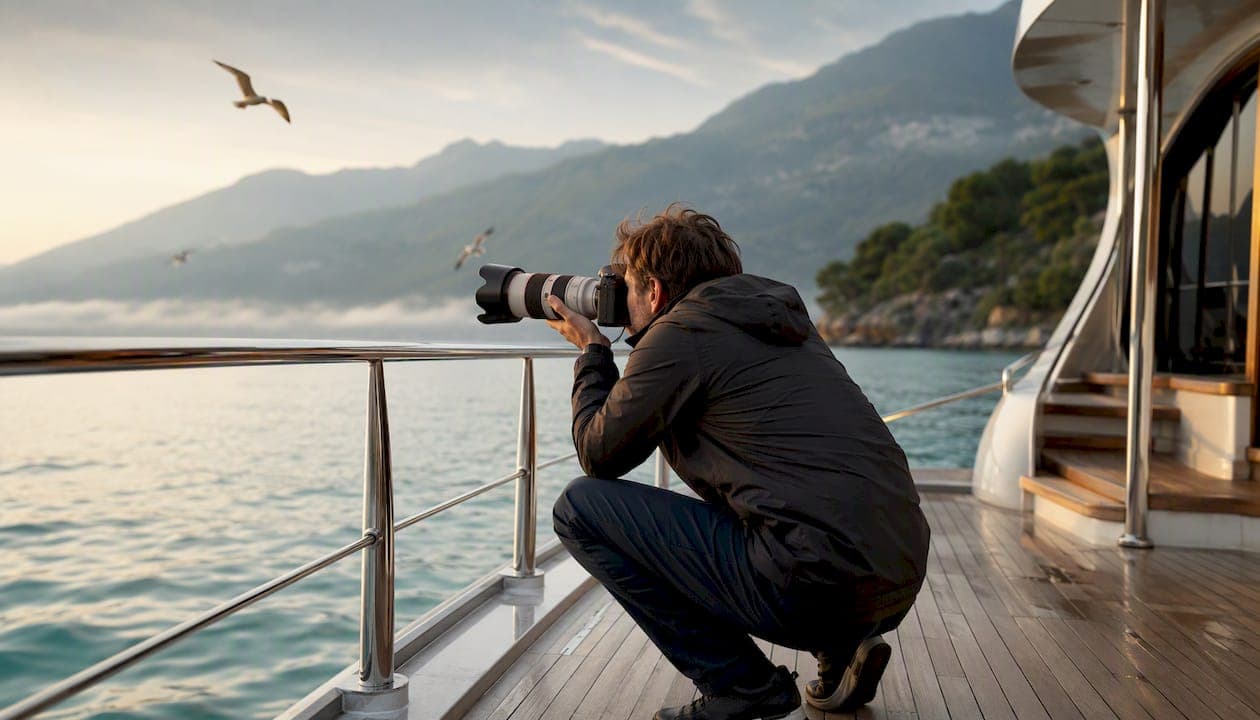
Ethical wildlife photography on water expeditions puts animal welfare first, always before the shot. The core rules are straightforward: do no harm, maintain species-appropriate distances, minimize noise and wake, never bait or use playback calls, and check NOAA regulations and National Park Service permit requirements before any U.S. marine expedition. Avoid sharing precise geotags for sensitive sites, and choose a vetted operator like Exoticacharters that enforces low-impact protocols.
- Do no harm: National Geographic's ethical framework makes animal welfare non-negotiable — document behavior, never manage it.
- Know the rules: Secure permits for marine protected areas, confirm drone restrictions, and review state-specific distance requirements before departure.
- Use long glass: Long telephoto lenses or remote triggers keep you distant; flash and drones near sensitive species cause measurable stress.
- Stay quiet: Cut engines and drift; let animals approach rather than closing the gap yourself.
- Protect locations: Omit GPS coordinates when posting images of rare or nesting species.
Key Takeaways
Ethical wildlife photography on water expeditions requires animal welfare to take precedence over every photographic decision, from approach distance to image sharing.
| Point | Details |
|---|---|
| Do no harm first | Animal behavior is your distance gauge; any sign of disturbance means you are already too close. |
| Permits before departure | Check NOAA, National Park Service, and state rules; drone restrictions and commercial photo permits are separate requirements. |
| Long lenses, not close approaches | A Long telephoto lenses or remote triggers keeps you at a respectful distance without sacrificing image quality. |
| Disclose methods, protect locations | Caption every image honestly and omit precise coordinates for rare or nesting species. |
| Exoticacharters | Embeds naturalists, small-group zodiacs, and permit management into every wildlife expedition charter. |
Table of Contents
- Why ethical wildlife photography looks different on the water
- Pre-trip planning: permits, U.S. marine rules, and biosecurity
- How to approach wildlife from a vessel without causing harm
- Choosing the right gear for water-based wildlife photography
- Honest captioning, disclosure, and the geotagging decision
- What to do if you find an animal in distress
- How to vet an ethical water-expedition operator
- Why this guidance is trustworthy
- Timing your expedition around animal behavior
- The shot will always be there — the animal may not be
- Exoticacharters brings these principles aboard every expedition
- Sources
Why ethical wildlife photography looks different on the water
Water platforms change the disturbance equation in ways land photographers rarely anticipate. A vessel's engine noise travels efficiently underwater, wake can separate nursing seal pups from their mothers, and a zodiac circling a whale feeding ground triggers the same stress response as a predator. The confined geometry of a bay or anchorage means there is nowhere for an animal to retreat without abandoning its territory, feeding site, or young.
The Natural History Museum's Wildlife Photographer of the Year program warns explicitly that drones disturb birds and marine mammals, and advises photographers to avoid revealing exact locations of rare species. Regulatory closures in places like the Florida Keys National Marine Sanctuary and the Channel Islands demonstrate that repeated disturbance leads to restricted access for everyone.
Wildlife Photographer of the Year guidance also flags the poaching risk that precise geotagging creates for vulnerable species. One viral image with embedded coordinates has, in documented cases, directed collectors to previously undisturbed nesting sites within days.
Pre-trip planning: permits, U.S. marine rules, and biosecurity
Always research and secure the necessary permits before any expedition. Arriving unprepared is not a minor inconvenience; in federal waters it can mean fines, vessel detention, and permanent exclusion from sensitive sites.
- Check NOAA and National Park Service rules. Marine sanctuaries, national parks, and wildlife refuges each carry distinct permit requirements. The Stellwagen Bank National Marine Sanctuary, for example, sets specific vessel approach distances for humpback whales.
- Confirm drone restrictions. Drones are banned or tightly controlled in most U.S. national parks and many marine protected areas. Verify with the managing agency, not just the operator.
- Clarify commercial photo permits. Editorial and commercial shoots often require separate permits from personal recreational photography. State your intended use clearly when applying.
- Research state-specific distance rules. Florida, Hawaii, and Alaska each publish species-specific approach distances that differ from federal minimums.
- Complete biosecurity requirements. Hull cleaning, bilge treatment, and fuel-tank protocols protect remote ecosystems from invasive species; remote destinations with strict biosecurity publish specific requirements that must be met before arrival.
- Confirm camera trap and remote rig permissions. Fixed installations on shorelines or reefs often require separate authorization from the land or water manager.
Pro Tip: Keep a laminated emergency contact card aboard with permit numbers, the managing agency's dispatch line, and a one-sentence statement of your trip's purpose (research, editorial, or personal). Rangers and coast guard officers process compliant vessels faster.
How to approach wildlife from a vessel without causing harm
The animal's behavior is your distance gauge, not a fixed number on a chart. Any sign of altered behavior — a bird flushing, a whale changing direction, a seal hauling out — means you are already too close.
| Action | Correct approach | Harmful approach |
|---|---|---|
| Engine use | Cut to idle or drift at 100m+; approach at idle from the side | High-speed crossing too close; circling |
| Angle of approach | Parallel drift, oblique angle | Head-on or from directly behind |
| Group size | Small groups per zodiac are recommended; staggered positions | Multiple vessels converging simultaneously |
| Noise | Whispered communication; no music | Shouting, motor revving, anchor drops near animals |
| Departure | Slow withdrawal in the direction you came | Rapid acceleration away from the subject |
Platform-specific notes matter. Kayaks offer a near-silent approach but sit low, which can startle surface-feeding birds at close range. Yachts provide stability for long-lens work but generate significant wake even at low speed; assign a deck ethics officer to monitor disturbance and coordinate photographer movements.
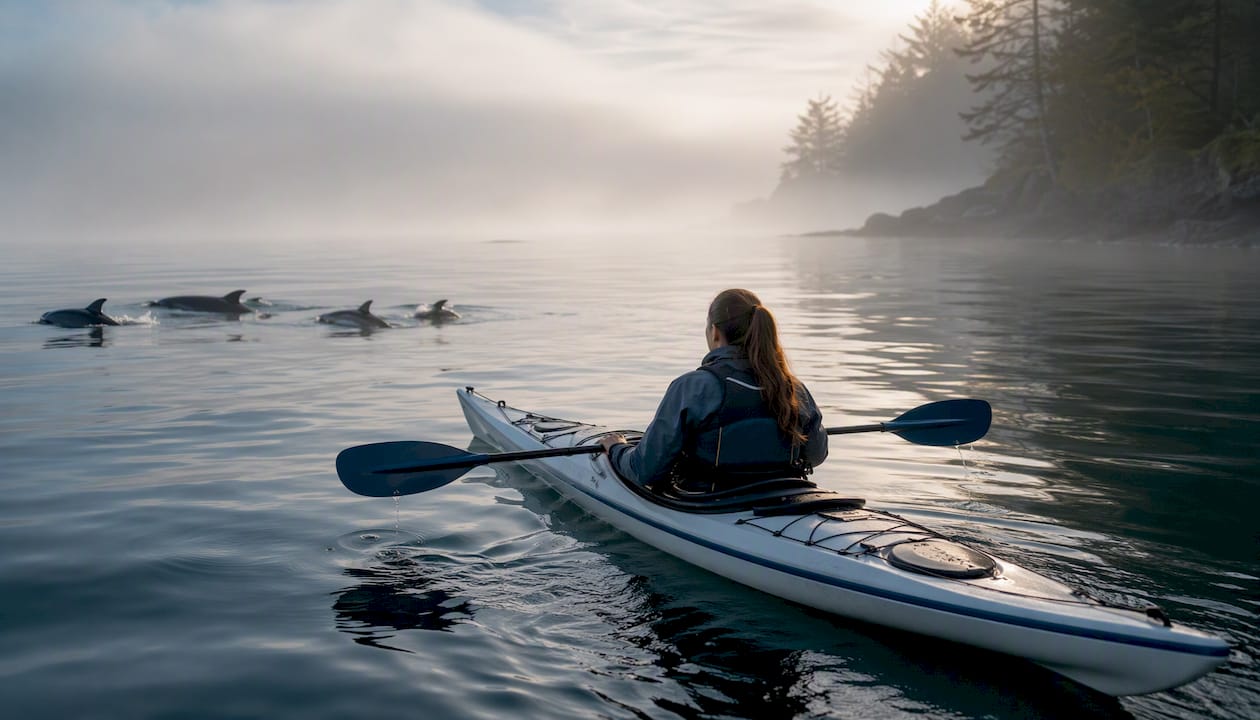
Pro Tip: Brief every photographer before a sighting, not during it. Agree on a hand signal for "stop moving" and a maximum shutter count per approach. Expedition-style photo voyages that limit group size — as dedicated photo expeditions consistently demonstrate — produce both better images and measurably lower disturbance.
Choosing the right gear for water-based wildlife photography
Long lenses and remote triggers are the ethical photographer's first line of defense. A Telephoto zoom or prime lenses of appropriate focal length lets you fill the frame from a respectful distance; a remote shutter release or motion-activated camera trap removes your physical presence from the equation entirely.
- Telephoto priority: 400mm is the practical minimum for most marine mammals and seabirds; 600mm opens up options for skittish species.
- Remote systems: Motion-triggered housings mounted on buoys or fixed platforms reduce disturbance dramatically for species that habituate to static objects.
- Drone caution: Fieldcraft guides are unambiguous — drones disturb birds and marine mammals, are banned in most U.S. protected areas, and require specific permits where allowed. Treat drone use as a last resort, not a default.
- Flash discipline: Repeated flash disorients nocturnal species and can temporarily blind marine mammals at the surface. Use continuous low-level LED lighting or natural light whenever possible.
- Underwater systems: Housed mirrorless cameras with wide-angle ports work well from dive platforms; yacht-based underwater photography benefits from a dedicated camera station with rinse tanks and drying racks.
- Waterproofing workflow: Rinse all gear in fresh water after every salt-water session, store in sealed dry bags between dives, and carry silica gel packs in every housing case. Corrosion on electrical contacts is the most common failure point on extended expeditions.
Honest captioning, disclosure, and the geotagging decision
Always disclose the method behind an image. National Geographic's ethical standards are direct: any technique that alters natural behavior must be disclosed, and images of captive or managed subjects require clear labeling.
"Prioritize the well-being of nature over photography. Use discretion if sharing locations and follow Leave No Trace principles." — Nature First Principles
For social media, a one-line disclosure is sufficient: "Photographed using a remote camera trap, no bait used" or "Subject is a managed rehabilitation animal." For editorial submissions, expand to a brief methodology note. When an image documents a rare nesting site or a species under conservation pressure, consult the managing researcher or park authority before sharing any location detail, even a general one.
Pro Tip: If your image captures something scientifically significant — an unusual behavior, a rare species interaction — contact a local university or wildlife agency before posting. Researchers can advise on safe disclosure and may want the data.
What to do if you find an animal in distress
Do not approach, and do not attempt any form of medical intervention. Your safety and the animal's welfare both depend on keeping distance and getting qualified help on scene quickly.
- Document from a safe distance: Note the animal's general location (nearest landmark, GPS grid square — not a precise pin), visible condition, and behavior.
- Call the right authority: In U.S. federal waters, contact NOAA's marine mammal stranding network or the nearest National Park Service dispatch. State wildlife agencies handle incidents in state waters.
- Stay on scene if safe: Maintain a respectful watch until responders arrive; your position report helps rescuers locate the animal.
- Do not share the precise location publicly until rescue is complete — crowds of well-meaning observers cause additional stress and can block access for rescue vessels.
- Report entanglement separately: NOAA's large whale disentanglement network operates regionally; report entangled whales to the Coast Guard on VHF Channel 16, who will coordinate response.
How to vet an ethical water-expedition operator
Choose operators who enforce low-impact practices, carry qualified naturalists, manage permits, and publish a clear wildlife interaction policy.
- Ask for guide qualifications. Naturalists should hold recognized credentials in marine biology, ecology, or a related field — not just local knowledge.
- Confirm group size limits. Six or fewer per zodiac is the standard on serious expeditions; small-group logistics consistently reduce disturbance while improving photographic access.
- Request the wildlife interaction protocol in writing. Ethical operators share this without hesitation.
- Verify permit management. The operator should handle all marine protected area permits and brief clients on restrictions before each landing or approach.
- Check biosecurity and waste procedures. Hull cleaning logs, gray-water management, and single-use plastic policies signal operational seriousness.
- Look for conservation partnerships. Affiliations with recognized bodies (NOAA, local marine research stations, Leave No Trace) indicate accountability beyond marketing language.
- Red flags: Any operator advertising baiting, staged interactions, or unrestricted drone use should be avoided. Silence on permit policies is equally telling.
Ask to see a sample itinerary and a written code of conduct. Operators who cannot produce both are not ready for serious wildlife photography work. Exoticacharters provides naturalists and expedition guides on board and structures itineraries around wildlife behavior rather than fixed schedules.
Why this guidance is trustworthy
Exoticacharters is rated highly on Trustpilot, and the team's background in crewed expedition charters to destinations including the Galápagos, French Polynesia, and Alaska informs every practical recommendation here. The crew and expedition structure reflects years of operating in environments where a wrong decision has immediate ecological consequences.
Timing your expedition around animal behavior
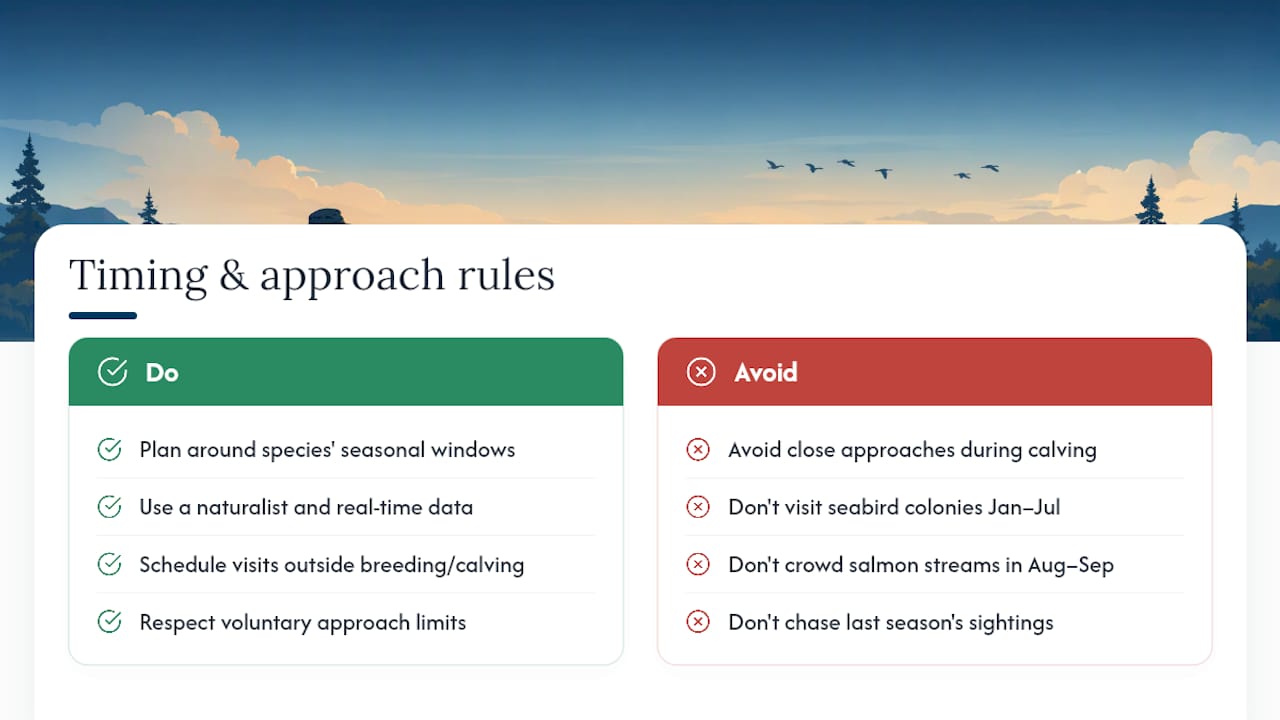
Season and species determine everything. Humpback whales in Hawaiian waters are most accessible between January and March; attempting a close approach during peak calving concentrates disturbance at the most vulnerable moment. In Alaska, brown bears at salmon streams peak in August and September — crowds of vessels during this window have prompted voluntary approach limits at several sites.
Seabirds nest on predictable schedules, and many colonies are legally protected during breeding. The Farallon Islands off California are closed to landing from January through July to protect nesting seabirds and elephant seals. Planning around these windows — rather than against them — produces better images and leaves the site intact for the next season.
Migratory corridors shift year to year with ocean temperature. Working with a naturalist who monitors real-time data (sea surface temperature charts, cetacean sighting networks) lets you position the vessel where animals are moving naturally, rather than chasing a location that was productive last season. Expedition charter wildlife planning built around current behavioral data is what separates a memorable trip from an expensive disappointment.
The shot will always be there — the animal may not be
There is a moment on every expedition when the light is extraordinary, the animal is close, and every instinct says push a little further. We have watched that moment from the deck many times. The right call is always the same: hold position, let the animal set the terms, and accept whatever the frame gives you.
Restraint is not a concession. A photograph taken without disturbing the subject carries a different weight — ethically and aesthetically. Clients who have sailed with us to the Galápagos or French Polynesia consistently report that the images they value most came from patient, quiet observation, not from a rushed approach. Briefing the group before a sighting, assigning clear roles, and enforcing a no-movement rule during the first minutes of contact are the practical tools that make restraint possible under pressure.
The conservation value of an image is also higher when the method is clean. An undisturbed behavioral sequence, honestly captioned, contributes to science and public understanding in ways a staged or baited shot never can.
Exoticacharters brings these principles aboard every expedition
Exoticacharters builds conservation ethics into the structure of every charter, not as an afterthought but as the operating framework. Qualified naturalists brief photographers before each approach, small-group zodiacs limit disturbance at sensitive sites, and the team manages all marine protected area permits so clients can focus on the photography. Biosecurity protocols are standard on every remote itinerary, and the crew actively requests delayed posting for images from sensitive locations during critical seasons.
For photographers who want luxury yacht charter experiences built around genuine wildlife access rather than proximity theater, Exoticacharters offers bespoke itineraries across destinations including Alaska, the Galápagos, and French Polynesia. When you inquire, ask specifically about the wildlife interaction policy and the naturalist's credentials for your target species. Browse available luxury yachts and speak with a charter specialist to build an itinerary that puts conservation first.
Sources
The following sources informed this guide. We recommend consulting each directly, particularly NOAA and the National Park Service for U.S.-specific rules before any marine expedition.
- How to photograph wildlife ethically | National Geographic
- Wildlife Photographer of the Year: Taking ethical photos | Natural History Museum
- Nature First Principles
- What Ethical Wildlife Photography Really Means: A Fieldcraft Guide for Respectful Photographers — The Wildlife Nomad
- The Polar Photography Expedition: What a Dedicated Photo Voyage Offers That a Regular Cruise Does Not
- Wildlife Photography Expedition. - Priority Wild Safaris