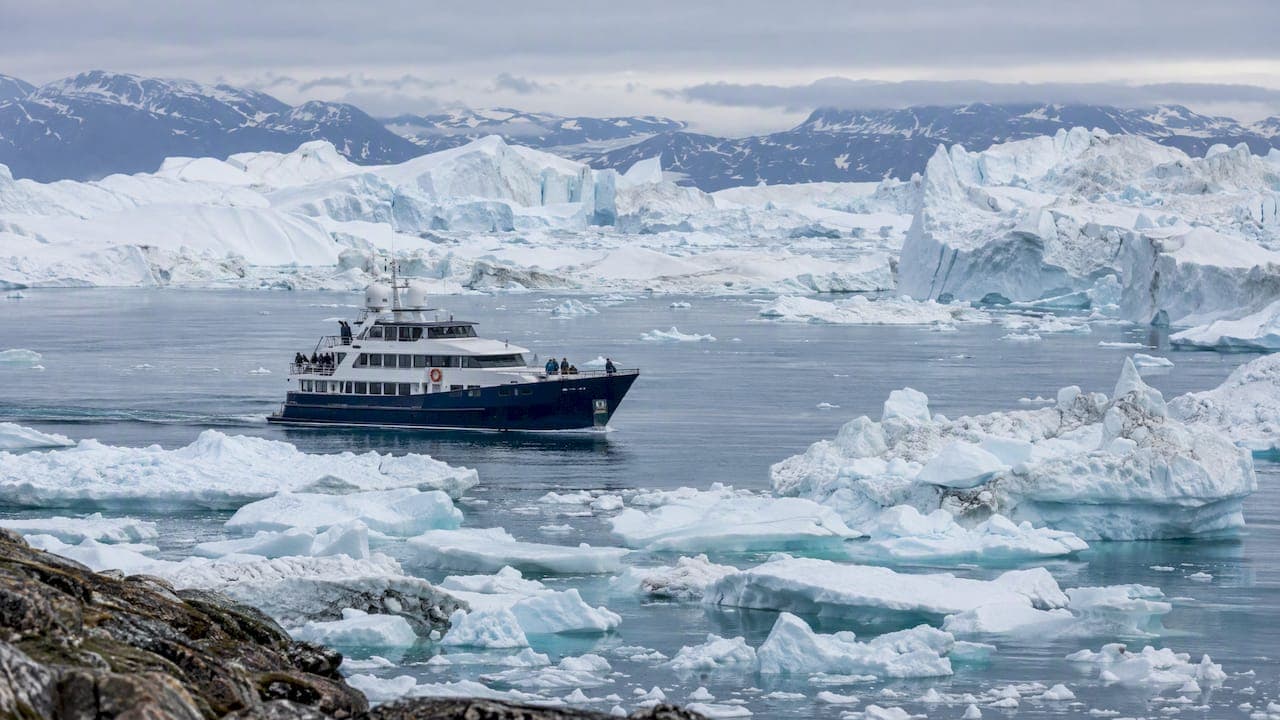
Choose Svalbard if you want polar bears, glaciers and the High Arctic with simple access: a flight from mainland Norway and you are there. Choose Greenland if you want scale, fjords, icebergs and living Inuit culture, and you are happy to plan more logistics around it. Both are extraordinary; they are simply different kinds of remote, and the right one depends on what you hope to see, how much time you have and how you want to travel.
We plan crewed yacht charters in the Arctic, and this is one of the questions we are asked most often. What follows is how we would answer it over a chart table.
TL;DR
- Svalbard is compact, regulated and easy to reach, with a reliable focus on polar bears, walrus, sea ice and dramatic fjords.
- Greenland is vast and culturally distinct, with huge icebergs, ice-sheet scenery, Inuit settlements and far more variety, but with longer distances between places.
- Access: Svalbard is reached by air from Oslo or Tromsø; Greenland has six international airports, with connections from Denmark, Iceland, Canada and the US.
- By private yacht, both open up anchorages that large ships and day tours never reach; Svalbard suits a tight, wildlife-led week, Greenland rewards ten days or more.
Table of Contents
- The two destinations at a glance
- Getting there
- Wildlife: where the Arctic comes to you
- Landscapes and light
- Culture and the feel of the place
- Rules, safety and practicalities
- Seeing both by yacht
- Which one should you choose?
- Our perspective
- Plan your Arctic charter with us
- FAQ
- Sources
The two destinations at a glance
The first thing to grasp is scale. Greenland is the largest island in the world, at about 2.2 million square kilometers, and the national statistics office notes that 81 percent of it is covered by ice. Svalbard is an archipelago of islands lying between mainland Norway and the North Pole, with Longyearbyen as its largest settlement.
That difference shapes every trip. In Svalbard you can see a great deal in a week because the wildlife, glaciers and sea ice are concentrated within reach of one another. In Greenland the coast is so long and so indented that a single itinerary can only ever sample it.
| Svalbard | Greenland | |
|---|---|---|
| Character | Compact High Arctic archipelago | Vast island, High Arctic to subarctic |
| Governance | Norway, under special Svalbard regulations | Autonomous country within the Kingdom of Denmark |
| Main gateway | Longyearbyen, by air from Oslo or Tromsø | Six international airports, including Nuuk and Ilulissat |
| Headline wildlife | Polar bears, walrus, reindeer, seabirds, whales | Whales, muskoxen, seabirds, seals; polar bears mainly in the east and northeast |
| Landscapes | Glaciers, mountains, tundra, sea ice | Giant icebergs, fjords, ice sheet, tundra |
| Culture | Mining heritage, research, small international community | Inuit communities, Greenlandic language and traditions |
| Best for | Wildlife-focused, shorter trips | Scenery, culture, longer expeditions |
Getting there
Svalbard is the simpler of the two. Norwegian and SAS fly to Longyearbyen; the flight from Oslo takes about three hours and from Tromsø about an hour and a half. Svalbard is outside the Schengen area, so you will be asked for ID or a passport even when you arrive from elsewhere in Norway.
Greenland requires a little more thought. Commercial airlines are the only way in unless you arrive by cruise ship or chartered boat, with international airports served from Denmark, Canada, Iceland and the United States. Routes and seasons change, so confirm current schedules before you commit to dates. Once you land, onward travel is by small aircraft, helicopter or boat, because there are no roads between towns.
For American travelers, the State Department notes that no visa is needed for stays of up to 90 days in Greenland, and that your passport should be valid for at least 90 days beyond your intended departure. The same page lists Greenland at Level 2, Exercise Increased Caution, and says consular help there is extremely limited. Check it again close to departure, since advisories are updated.
If you charter a yacht, your vessel can meet you at either gateway. We explain how this works in our guide to getting to remote expedition regions.
Wildlife: where the Arctic comes to you
Svalbard is the stronger choice if polar bears are the main ambition. The archipelago is built around Arctic wildlife, and a boat moving along the edge of the pack ice offers the best odds of an encounter in a calm, respectful setting. Walrus haul-outs, reindeer on the tundra and enormous seabird cliffs add to the days between sightings. Nothing is guaranteed in the wild, and any operator who promises a bear is overselling.

Greenland offers a different richness. Whales feed in its fjords in summer, muskoxen graze the northeastern tundra, and the icebergs calving from the ice sheet are the real spectacle. Polar bears are possible in the far east and northeast, but they are not the reason to choose west or south Greenland. If you want to see a bear on your first Arctic trip, we would lean toward Svalbard.
Landscapes and light
Svalbard has the look of a classic polar world: sharp mountains dropping into dark fjords, blue glacier fronts and a horizon that is often pale with sea ice. In summer the sun does not set, which gives photographers long hours of low golden light.
Greenland is bigger in every way. Ilulissat's icefjord is crowded with towering bergs, East Greenland's coast is almost unvisited, and the interior ice sheet gives a sense of scale you will not forget. Within Greenland the character also changes: the north is High Arctic, while the south is subarctic, with greener valleys and warmer summers.

On cold, Greenland holds a record. The World Meteorological Organization recognized -69.6°C (-93.3°F) at a Greenland weather station on 22 December 1991 as the lowest ever recorded in the Northern Hemisphere. That is a winter figure, of course. In summer, expect cool, changeable days that are far milder than the record suggests, with weather that can turn quickly, so layers matter.
Culture and the feel of the place
This is where the two diverge most. Greenland is an autonomous country within the Kingdom of Denmark, and its settlements are home to a largely Inuit population with their own language, food and traditions. Visiting a small Greenlandic community, hearing about hunting and fishing from the people who live from them, is as much a part of the trip as the ice.
Svalbard feels different: a small, international, research-and-tourism community in Longyearbyen, with a mining past still visible in the landscape. It is polished and safe, a gateway to wilderness rather than a culture in itself. Both approaches are valid; it depends whether you are traveling for the nature, the people or both.
Rules, safety and practicalities
Svalbard is tightly regulated for safety and environmental protection. One rule surprises many visitors: outside the settlements you need polar bear protection, which in practice means an armed guide or carrying a firearm. On a crewed charter, the captain and guides handle this, so it is never your concern.
Insurance deserves attention for both. Standard policies often exclude Arctic rescue, so look for commercial insurance that includes search and rescue cover, and read the policy wording before you buy. If you are unsure whether you are covered, speak to your insurer or a specialist travel insurance broker before booking.
Budget-wise, expect Arctic prices in both places. Goods are imported, so food, fuel and supplies cost more than you are used to at home. On a fully crewed charter, much of this is built into the program, which makes cost easier to plan; our overview of what an expedition charter costs explains what is and is not included.
Seeing both by yacht
A private crewed yacht changes the comparison. Instead of fixed departures and shared decks, you set the pace with the captain, wait out weather in a sheltered anchorage and change course when a whale or a bear appears. A vessel with the right build is essential in ice, which we cover in what makes a yacht suitable for polar waters.
A few practical thoughts from our side:
- A week in Svalbard is well spent. Fjords, glaciers, walrus beaches and the ice edge are close together, so little time is lost in transit.
- Greenland rewards time. Ten days or more lets you reach beyond the nearest fjord. Distances are long and ice and weather set the schedule, so build in flexibility.
- Crossing between them is a true expedition, not a connection. The sea between them is open ocean, and it suits experienced crews and travelers with plenty of time.
- Shoulder seasons can be wonderful but shorten the window when ice permits access. Your captain will advise on timing for the route you want.
Our Svalbard vs Greenland charter guide goes deeper into itineraries, and our pages on Arctic yacht charters and Nordic and Arctic Europe show the wider region.
Which one should you choose?
Choose Svalbard if:
- polar bears and High Arctic wildlife top your list;
- you have about a week and want simple travel;
- you prefer a regulated, well-supported destination;
- you are traveling with family or on a first polar trip.
Choose Greenland if:
- you want icebergs, fjords and ice-sheet scale;
- meeting Inuit communities matters to you;
- you have ten days or more and enjoy a real expedition feel;
- you want a destination that still feels uncrowded and emerging.
If you are also weighing the Arctic against the far south, our piece on Antarctica vs the Arctic covers that choice, and five epic expedition destinations gives wider inspiration.
Our perspective
We are former captains and water sports professionals, and we have a strong view here: do not pick the destination first and the boat second. Pick what you want to feel. If you imagine a quiet fjord at midnight with the sun still up and a bear walking the ice edge, we would suggest Svalbard. If you imagine drifting between icebergs the size of cathedrals and stepping ashore in a village at the end of the world, we would suggest Greenland.
What we consider most valuable about a private charter is flexibility. The Arctic does not keep a timetable, and the best days are often the ones nobody planned. A crew that knows when to wait, when to move and when to turn back is worth more than any itinerary on paper. We would always rather build you a plan with room to breathe than a plan with every hour filled.
— Mo
Plan your Arctic charter with us
We arrange fully crewed expedition charters, from sailing yachts to motor yachts, catamarans and expedition vessels, around your interests, whether that is wildlife, diving, photography or a family adventure. Tell us your dates and what you hope to see, and we will advise honestly on Svalbard, Greenland or a combination. Speak to a yacht charter specialist at Exotica Charters to begin.
FAQ
Is Greenland or Svalbard better for polar bears?
Svalbard is the stronger choice for most travelers, because bears are regularly seen along the coast and sea ice there. Greenland has polar bears too, mainly in the east and northeast, but those areas are far more remote. No operator can guarantee a sighting.
Is Greenland harder to visit than Svalbard?
Generally yes. Svalbard is a single flight from Oslo or Tromsø, while Greenland has six international airports and then relies on small aircraft, helicopters or boats between settlements. A crewed yacht removes much of that friction.
Do Americans need a visa for Greenland?
No, U.S. citizens can visit Greenland for up to 90 days without a visa, but your passport must be valid for at least 90 days beyond departure. Check the State Department page before you travel, as requirements can change.
Can you visit both on one trip?
Yes, but treat it as a true expedition. There is open ocean between them, so it suits longer itineraries and an experienced crew. Most travelers are happier choosing one and exploring it well.
Do I need special insurance?
Yes, check carefully. Standard policies often leave out Arctic search and rescue, so confirm that yours includes it and ask your insurer if the wording is unclear.
Sources
- Greenland in Figures 2025, Statistics Greenland
- Everything you need to know before departure, Visit Svalbard
- How to travel to Svalbard, Visit Svalbard
- How to get to Greenland, Visit Greenland
- Greenland International Travel Information, U.S. Department of State
- WMO verifies -69.6°C Greenland temperature as Northern Hemisphere record
- Visa policy of Greenland, Wikipedia
- Svalbard, Norway: Flights, Docs & When to Go 2026