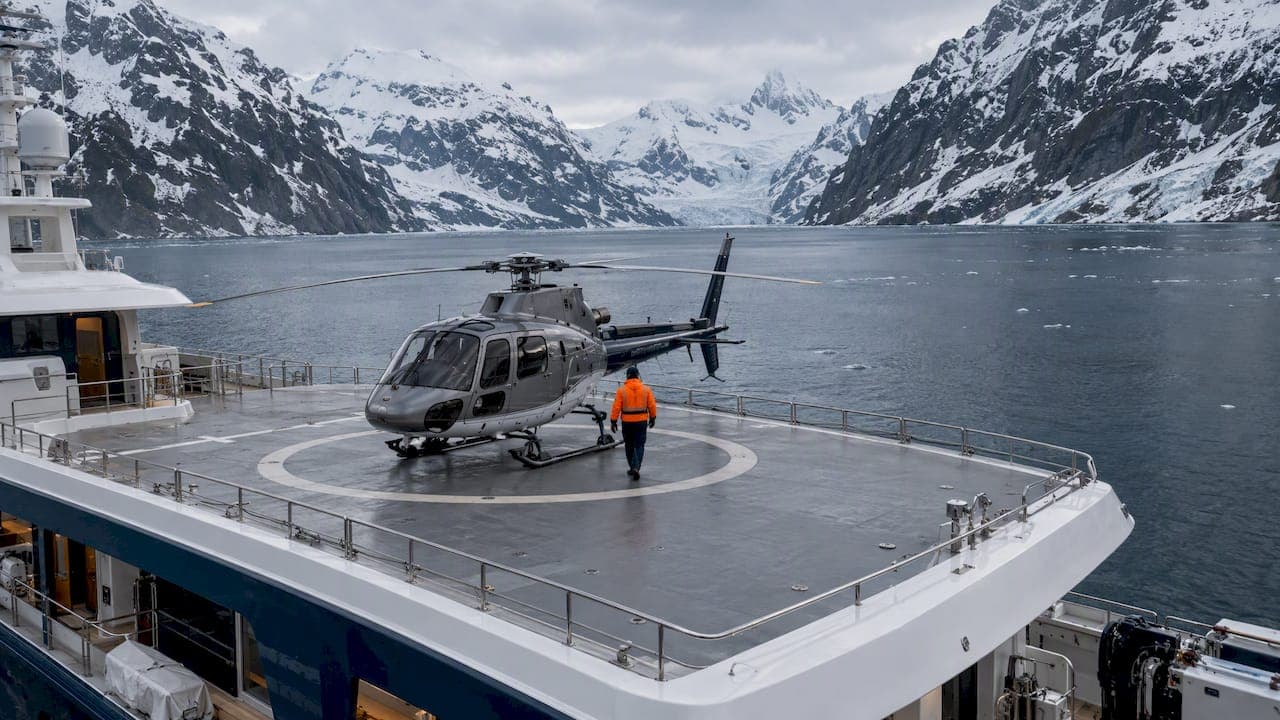
A heli ski yacht charter pairs helicopter access to untouched alpine terrain with a fully crewed vessel as your floating base camp, delivering first tracks without the compromise of a mountain lodge. It suits fit, experienced skiers who want extreme remoteness, flexible logistics and five-star comfort between runs. Expect multi-week planning, specialized helicopter operations, and a short list of destinations capable of supporting both skiing and yachting at this level.
TL;DR:
- Remote regions like Antarctica, Greenland, and Patagonia each demand different vessel features, helicopter hours, and booking windows due to weather and terrain constraints.
- Only expedition and ice-class vessels support polar heli-skiing, requiring certified helipads, strong hulls, and specialized safety and refueling plans.
- Costs vary widely based on destination, vessel size, and season, with Antarctica and Greenland trips costing significantly more than British Columbia or Patagonia routes.
- Detailed planning, early booking, and verified permits are essential, especially for polar destinations with strict environmental regulations.
- Choosing a reputable operator involves verifying pilot credentials, crew certifications, insurance coverage, and documented contingency plans for grounded days.
Table of Contents
- Top destinations and what each offers heli-ski yacht guests
- What makes a yacht suitable for heli-skiing
- A typical heli-ski yacht week, day by day
- Cost, booking timeline and planning considerations
- How to choose a broker or operator
- Protecting fragile terrain while heli-skiing
- Getting physically ready before you go
- The rules that govern flying, skiing and sailing
- Exotica Charters' perspective on heli-ski yacht planning
- Plan your heli-ski yacht charter with Exotica Charters
- FAQ
- Sources
Top destinations and what each offers heli-ski yacht guests
Choice of destination shapes everything else: the vessel you need, the helicopter hours you will burn, and the season you must book within. Boat International's guide to heli-skiing yacht charters frames the experience as expedition travel first, with weather windows and flight time as the real constraints rather than simple luxury itineraries.
- Antarctica delivers expedition-scale terrain and total isolation, but only within a narrow austral season and with the most formal permitting of any heli-ski destination.
- Greenland offers enormous vertical and reliably deep powder, though long helicopter legs and Arctic operating conditions demand more fuel planning and backup time.
- Patagonia brings dramatic, glacier-carved peaks with genuinely mixed weather, which often pushes operators toward multi-helicopter setups for flexibility.
- British Columbia and the Bella Coola region have the most established yacht-to-ski logistics anywhere, with shorter transfers and more predictable flying days.
Each region sets a different bar for vessel class, helicopter hours, and the calendar window in which a charter can realistically run.
What makes a yacht suitable for heli-skiing
Not every superyacht can support heli-skiing. The vessel needs a certified helipad with enough deck load capacity for the aircraft in use, a workable refueling plan, and secure stowage when the helicopter is not flying. In polar or sub-polar waters, hull strength and ice-class design matter as much as the helipad itself; a vessel built for the tropics has no business pushing through Greenland's coastal ice.
Guest-facing features matter just as much as the technical ones:
- Drying rooms and dedicated gear storage for skis, boots and outerwear.
- Onboard medical facilities suited to altitude and cold-injury response.
- Enough tender and helicopter crew separation to keep daily operations calm and unhurried.
Specialist personnel round out the picture: certified heli pilots with mountain experience, IFMGA-level mountain guides, and a documented medic or evacuation plan specific to the terrain. Insurance and permits typically attach to the vessel's capabilities, not just the itinerary, so a yacht's expedition rating often determines which regions it is even allowed to operate in. Exotica Charters' own technical page on what makes a yacht suitable for polar or expedition waters is worth reviewing before you commit to a specific vessel.
Pro Tip: Ask for the helicopter's maximum takeoff weight and the yacht's helipad load limit in writing; mismatches between the two are a common and avoidable planning failure.
A typical heli-ski yacht week, day by day
Days follow a rhythm built around weather, not the clock. Mornings start early with a safety and snow briefing, followed by helicopter lifts to the first run of the day.
- Pre-dawn weather and avalanche briefing with the guide team.
- Helicopter transfer to the first zone, typically two to four runs before a midday return.
- Lunch and gear reset aboard the yacht, followed by an afternoon session if conditions hold.
- Return to the vessel for apres-ski, massage or spa time, and a guide debrief over dinner.
Most remote-region trips run about a week to justify the positioning and permitting costs, while winter rentals in Florida for snowbirds offer a seasonal market perspective more suitable for marketing luxury travelers who might be interested in such exclusive heli-ski yacht charters, while British Columbia itineraries can run shorter. Group sizes stay small by design, often with a guide-to-guest ratio tight enough to manage avalanche risk closely. Inclusions typically cover the yacht, crew, meals and a set number of flying hours; fuel surcharges, extra landing fees and weather-related rebooking usually sit outside the base price. When helicopters are grounded, strong operators pivot to skinning, ice climbing or onboard activities rather than losing the day entirely.
Cost, booking timeline and planning considerations
Price is driven by helicopter hours, yacht size and class, season, destination and group size, in roughly that order. A Greenland or Antarctica trip with a larger expedition vessel and heavy flying days will sit well above a shorter British Columbia charter on a smaller motor yacht.
- Helicopter hours are usually billed separately from the yacht charter fee and add up quickly in marginal weather.
- Expedition-rated and ice-class vessels command a premium over standard motor yachts because of their build and crew requirements.
- Deposits and booking windows for expedition-grade charters tend to open far earlier than standard Caribbean or Mediterranean bookings, given limited helicopter and vessel availability.
Operators commonly describe heli-ski yacht charters as expedition-style travel rather than conventional luxury ski vacations, a framing Boat International uses throughout its guide to the category, precisely because weather and flight hours, not price alone, dictate the shape of the trip.
Insurance deserves early attention: standard travel policies rarely cover helicopter skiing or medevac from remote coastlines, so specialized coverage should be arranged well before departure. Permits and environmental rules, particularly in Antarctica and parts of Greenland, can also add real lead time and cost if left until the last minute.
How to choose a broker or operator
A good broker will answer technical questions without hesitation. Ask directly about the helicopter operator's credentials, pilot flight hours in mountain terrain, mountain guide certifications, and the written evacuation plan for the specific region.
- Request a sample day-by-day itinerary and crew biographies before signing anything.
- Ask for proof of insurance covering both the yacht and the helicopter operation, not just one or the other.
- Treat vague or evasive answers about helicopter operations as a serious red flag.
- Insist on seeing pilot licenses and guide certifications rather than taking a verbal assurance.
A documented contingency plan for grounded flying days is a reliable sign of an operator who has actually run this kind of trip before, not just sold one.
Protecting fragile terrain while heli-skiing
Heli-skiing takes place almost exclusively in ecologically sensitive terrain: glacial valleys, fjord systems and polar coastlines that recover slowly from any disturbance. Helicopter noise can affect wildlife behavior near nesting or denning sites, which is part of why reputable operators plan flight paths and landing zones around known wildlife corridors rather than simply chasing the best snow.
Fuel handling is a particular concern in Arctic and Antarctic waters, where a spill has an outsized and long-lasting impact compared with temperate coastlines. Expedition operators typically build strict fuel transfer protocols into their vessel operations for exactly this reason. Many also support or reference broader expedition philanthropy work, including groups like Pelorus Foundation, which focuses on conservation and community support tied to remote expedition travel, and YachtAid Global, which channels aid and resources through the yachting industry into the communities and ecosystems these charters pass through.

Landing zone selection itself carries weight. Repeated helicopter touchdowns on the same slope can compact snow and disturb ground vegetation once it is exposed later in the season, so experienced guide teams rotate zones deliberately rather than returning to the same reliable run every day. None of this eliminates the footprint of flying a helicopter into wilderness, but it does separate operators who treat the environment as a backdrop from those who treat it as something to be managed carefully.
Getting physically ready before you go
Heli-skiing is more physically demanding than resort skiing, and the remoteness of a yacht-based trip removes the safety net of a nearby medical clinic. Strong cardiovascular fitness matters more here than raw strength, since runs are often longer and more sustained than a typical resort pitch, and altitude in some destinations adds another layer of strain.
A few months of focused preparation makes a real difference:
- Build leg endurance and core strength with squats, lunges and sustained cardio sessions.
- Practice on variable, ungroomed snow before departure rather than relying solely on groomed resort runs.
- Confirm with a physician that you are fit for high-altitude exertion and cold exposure, particularly if you have any cardiovascular history.
Pack layered, breathable technical clothing rather than fashion-first ski wear, since conditions can shift fast in Patagonia or Greenland. Comfort with avalanche safety basics, even as a guided guest, speeds up the daily briefing and lets guides focus on terrain rather than re-explaining equipment.
The rules that govern flying, skiing and sailing
A heli-ski yacht charter sits at the intersection of maritime law, aviation regulation and, often, international environmental treaties, which is part of why planning takes longer than a standard charter. The yacht itself must meet flag-state requirements and any additional rules specific to the waters it enters, while the helicopter operation runs under separate aviation authority rules that govern pilot certification, aircraft maintenance and flight permissions.

Antarctica adds another layer entirely: operators there work within the framework of the Antarctic Treaty System, which restricts landing sites, group sizes and environmental impact in ways that do not apply anywhere else on this list. Greenland and parts of the Arctic carry their own national permitting requirements for helicopter landings outside established airstrips.
None of this is a do-it-yourself undertaking. A reputable broker or operator coordinates vessel registration, helicopter permits and guide certifications as a package, which is precisely the kind of detail worth confirming before you commit a deposit to any single operator.
Exotica Charters' perspective on heli-ski yacht planning
A team including former captains and water sports professionals understands both sides of this equation: the vessel and the terrain. We arrange expedition yachts, motor yachts and jetski-equipped vessels for clients chasing remote, adventure-led itineraries, not just sun-and-anchor trips.
The planning for this category demands attentive, detail-driven work, as reflected in strong client satisfaction. Heli-ski charters are complex by nature, and our role is to match the right vessel and crew to the terrain you actually want to ski.
— Mo
Plan your heli-ski yacht charter with Exotica Charters
Specializing in planning remote, fully crewed yacht charters, heli-skiing itineraries represent a type of complex, multi-element trip suited for experienced coordinators.

If you are weighing vessel options, our luxury yachts collection is a useful starting point, and our page on expedition charter activities covers what to expect when flying is grounded. Reach out through Exoticacharters to start planning your own heli-ski yacht charter.
FAQ
How much does a yacht with a helipad cost?
Pricing for helipad-equipped yachts is not published as a fixed figure and varies widely by size, class and season, so it is quoted on request through a charter broker. Expedition-rated vessels with ice-class features and certified helipads generally command a premium over standard motor yachts of similar length.
What is the average cost to heli ski?
Heli-ski costs depend heavily on destination, helicopter hours and trip length, with remote regions like Antarctica and Greenland costing considerably more than established zones like British Columbia. Rather than a single average, operators typically quote a range once they know your destination, group size and desired flying hours.
What is the 12 person rule on a yacht?
Commercially registered yachts carrying more guests fall under a different, more stringent set of maritime safety regulations than smaller private charters. This is why many luxury charter yachts, including those used for heli-skiing, are deliberately capped to stay within the simpler regulatory category.
How much is a 3 day charter on a yacht?
Short charters are priced per the vessel's daily or weekly rate, adjusted for crew, fuel and any added services like helicopter operations, and are not fixed figures across the industry. A broker can provide an accurate quote once the yacht, dates and any heli-ski add-ons are specified.