Expect three tax buckets on any yacht charter: consumption tax (VAT or a local equivalent), federal income tax on charter revenue, and sometimes state sales or use tax layered on top. Itinerary and embark port largely decide how much VAT gets owed. Before signing a charter agreement, confirm the embark country's VAT treatment, log every voyage in detail, and get a tax advisor familiar with maritime rules involved early.
TL;DR:
- The VAT or consumption tax on a yacht charter depends mainly on the embark port and itinerary, not the vessel’s flag or owner’s residence.
- US federal income tax applies to net charter income regardless of where the vessel sails, but state sales or use taxes are triggered by the vessel’s berth location and domestic use days.
- Mediterranean VAT rates vary by country, with France and Monaco applying flat rates from the embark port, while Turkey and Montenegro often offer zero-VAT options for non-residents.
- Proper documentation, voyage logs, and advance registration are essential for compliance, especially when crossing multiple jurisdictions during a single charter.
- Accurate record-keeping, early legal setup, and itinerary planning based on tax considerations can significantly reduce exposure and support substantiation during audits.
Table of Contents
- What Yacht Charter Taxes Actually Cover
- Region-By-Region: Where VAT Bites Hardest
- U.S. Federal and State Tax Rules for Charter Income
- Depreciation, Section 179, and the Hobby-Loss Trap
- Sample 2026 Charter VAT Rates by Country
- Compliance Checklist: Records, Registration, and Filing Rhythm
- Crossing Borders Mid-Charter: The Jurisdiction Problem
- How Charter Length and Booking Frequency Change Your Tax Picture
- Paying Foreign Crew: Withholding Tax Basics
- When a Yacht Changes Hands: Estate and Gift Tax Basics
- Exotica Charters' View From the Deck
- Plan Your Itinerary With VAT in Mind, Not Against It
- Where to Verify These Rules Yourself
- Sources
- FAQ
What Yacht Charter Taxes Actually Cover
Charter income touches three distinct tax systems, and confusing them is the fastest way to misjudge what you owe. Consumption tax, usually VAT outside the United States, applies to the charter fee itself and is determined largely by where the charter starts. Federal income tax applies to net charter receipts regardless of where the boat sails. State sales or use tax, a distinctly American wrinkle, can apply on top of federal tax depending on where the vessel is berthed and used.
The concept that trips up most first-time charter owners is "place of supply." Tax authorities in Europe and the Mediterranean generally tax the charter where it begins, not where the yacht company is registered or where the guests live. That single rule explains why two nearly identical two-week charters, one embarking in Nice and one in Split, can carry very different effective VAT rates.
- VAT/consumption tax: tied to embark port and itinerary, not vessel flag or owner residency
- Federal income tax: applies to net charter income no matter where the trip happens
- State sales/use tax: triggered by berth location and days of in-state use, not purchase location
Region-By-Region: Where VAT Bites Hardest
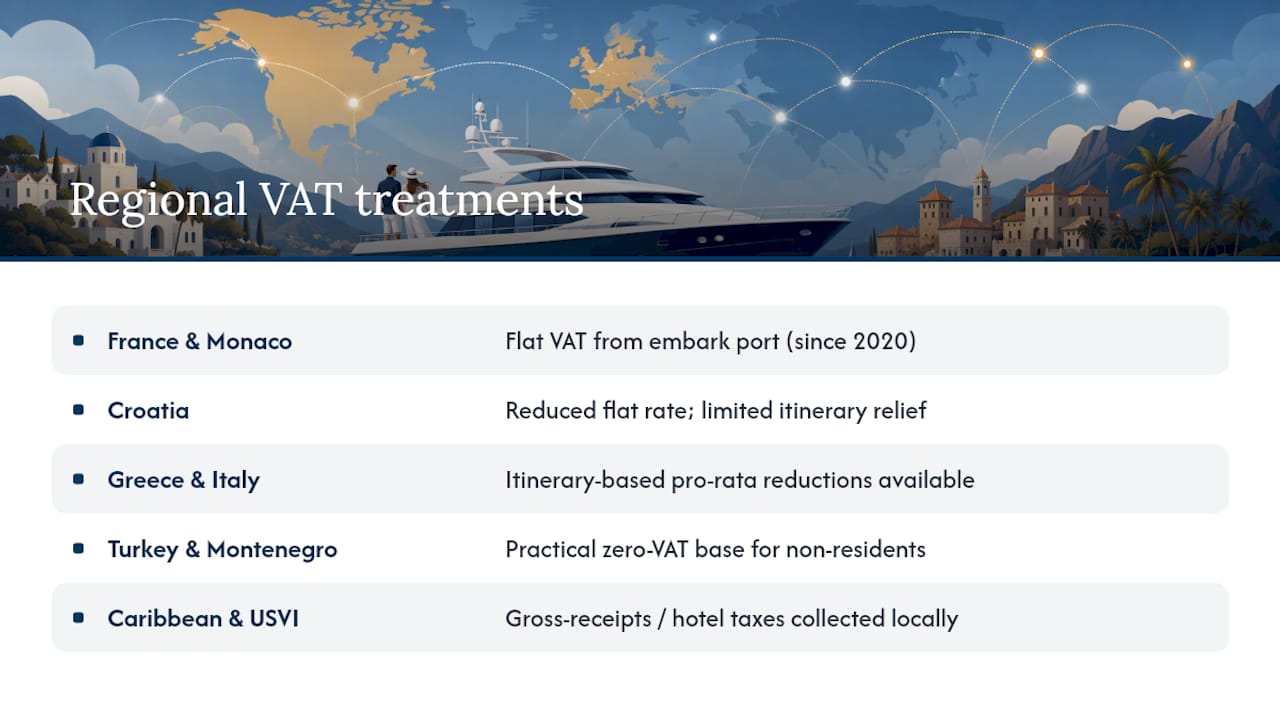
VAT rules across the Mediterranean and Caribbean vary enough that identical charters can carry very different tax loads depending purely on where guests step aboard.
Croatia applies a reduced flat rate with less flexibility for itinerary-based reductions than Greece or Italy offer.
France and Monaco. France moved to a flat VAT rate applied from the embark port following its 2020 reform, closing off most of the pro-rata reduction strategies still available in Italy and Greece. Charters departing Monaco are generally treated the same way as French charters, due to Monaco's close coordination with French tax authorities.
Low-VAT and zero-VAT jurisdictions. Turkey and Montenegro function, in practice, as zero-VAT charter bases for non-resident guests, which attracts many Mediterranean itineraries to start or end there. The trade-off is usually logistics: fewer full-service marinas, longer positioning legs for the yacht, and less established fiscal infrastructure than France or Italy offer.
Caribbean and USVI. Consumption tax in the Caribbean rarely resembles European VAT. Most jurisdictions instead levy gross-receipts taxes or hotel-style taxes on charter fees, collected directly by the local charter operator or agent rather than reclaimed later like EU VAT. Confirming who is actually registered to collect and remit that tax before your guests fly in avoids an ugly surprise at settlement.
Itinerary planning, specifically embark port choice and time spent in non-EU or international waters, remains the single most actionable lever for controlling Mediterranean VAT exposure.
U.S. Federal and State Tax Rules for Charter Income
If you actively operate the vessel as a charter business, that income belongs on Schedule C, which triggers self-employment tax on net profit. Bareboat arrangements with minimal owner involvement sometimes look more like Schedule E rental income, though the line between the two is exactly where the IRS scrutinizes hardest.
- Pick the right entity early. Many owners run charter operations through an LLC taxed as a partnership (Form 1065) or S corporation (Form 1120-S), both of which change how self-employment tax and losses flow to the owner's personal return.
- Pay estimated tax on time. Once expected federal liability crosses $1,000, quarterly estimated payments become mandatory, not optional.
- Watch state sales and use tax triggers. States generally tax based on where the vessel is berthed and how many days it spends in-state, not where you bought it or where the LLC is registered.
- Get a sales tax permit before you need one. Several states require registration before you can legally collect or remit tax on chartered days within their waters.
- Track home port against actual operating days. A yacht nominally based in a low-tax state but chartering heavily in a high-tax state can still generate use-tax liability there.
State sales and use tax enforcement almost always focuses on actual use location rather than purchase location, so buying in a low-tax state offers less protection than owners assume.
Depreciation, Section 179, and the Hobby-Loss Trap
Vessel depreciation under MACRS, combined with Section 179 expensing and bonus depreciation, can meaningfully accelerate write-offs, but only when business use clears 50% for the year. The 2026 tax rules restored 100% bonus depreciation for qualifying property acquired after January 19, 2025, which makes the business-use threshold more consequential than ever.
The bigger risk sits with hobby-loss rules under IRC §183. The IRS presumes profit motive if an activity turns a profit in three of the last five years; falling short shifts the burden to you, and examiners lean on the nine factors in Treasury Regulation §1.183-2(b) to decide. Material participation under §469 rules, including significant annual involvement hours, determines whether losses can be used against other income.
- Overstating business-use percentage without contemporaneous logs
- Mixing personal cruising days with charter days on the same voyage without clear separation
- Claiming entertainment-style deductions the IRS routinely disallows on pleasure vessels
Pro Tip: Keep a simple day-by-day log noting charter contract number, guest names, and business purpose for every trip aboard. That single habit does more to survive a §183 audit than any accountant's memo written after the fact.
Sample 2026 Charter VAT Rates by Country
Headline rates below reflect 2026 positions; actual charter cost often runs lower once itinerary-based reductions apply.
Compliance Checklist: Records, Registration, and Filing Rhythm
Protecting deductions and VAT reclaims comes down to documentation discipline, not clever tax positions.
- Register for VAT in the embark country before the first charter departs, not after.
- Appoint a fiscal representative where required. Several EU jurisdictions demand local fiscal representation before a foreign-flagged yacht can charter legally.
- Obtain tax-paid certificates and keep them aboard; port authorities can request them on arrival or departure.
- Log every voyage with AIS-backed positioning data tied to the signed charter contract.
- Segregate finances into a dedicated business bank account, separate from personal expenses.
- File on a fixed cadence: quarterly federal estimated payments, periodic VAT returns per jurisdiction, and state sales tax filings wherever the vessel operates.
Pro Tip: Store digital copies of contracts, tax-paid certificates, and crew payroll records aboard the vessel itself, not just in a shoreside office. A customs official asking for proof at 8 a.m. rarely waits for an email from your accountant's inbox.
Separate business bank accounts, written charter agreements, and voyage-by-voyage logs showing commercial bookings materially strengthen your position if the IRS ever asks questions.
Crossing Borders Mid-Charter: The Jurisdiction Problem
A single charter that crosses from French to Italian waters, or from EU territory into Turkish or Montenegrin waters, can trigger tax exposure in more than one jurisdiction during the same trip. This is where itinerary planning stops being a marketing exercise and becomes a genuine tax strategy.
Consumption tax generally attaches at the embark port, so a yacht that begins in Nice and cruises into Italian or Croatian waters typically still owes French VAT on the full charter fee. The itinerary afterward rarely reopens that liability. What does shift is the calculation for reductions in countries like Italy and Greece, where documented time spent in international or non-EU waters lowers the effective rate. Captains and brokers need to log exact positions and dates, not approximate them, because tax authorities in Rome and Athens will ask for AIS-backed proof, not a verbal itinerary summary.
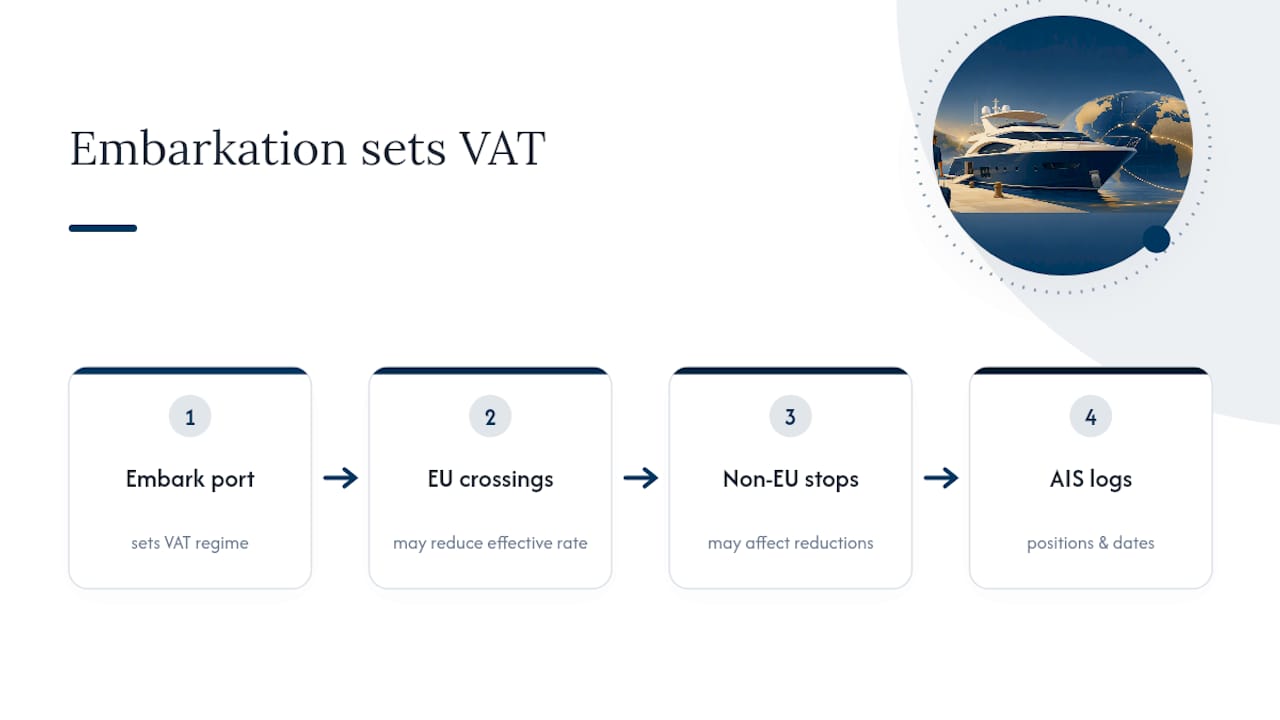
Charters that touch non-EU waters, say a stop in Montenegro or Turkey mid-trip, raise a different question: does any portion of the fee attributable to that leg escape EU VAT entirely? The honest answer is that most tax authorities look at the whole contract and the embark point first, and itinerary segments mainly affect reduction calculations rather than splitting the tax base outright. Guests chartering a single yacht across multiple countries in one trip should expect the embark country's VAT regime to govern the transaction, with reductions layered in based on documented time outside that country's waters. Anyone piecing together a multi-country itinerary should confirm the calculation with a tax advisor before finalizing the embark port, not after the deposit clears.
How Charter Length and Booking Frequency Change Your Tax Picture
A single one-week charter and a boat chartering forty weeks a year face genuinely different tax exposure, and not just because of total revenue.
Occasional charter activity, say a handful of weeks a year, sits closest to the hobby-loss line. The IRS's three-of-five-year profit presumption becomes harder to satisfy when charter weeks are sparse and expenses like dockage, insurance, and crew wages run year-round regardless of booking volume. An owner chartering eight weeks annually needs airtight documentation showing genuine commercial intent, because the raw numbers alone won't carry the argument.
Higher-frequency charter operations, boats running 20 or more weeks a year through a management company, look more like an active trade or business almost by default. That classification carries real benefits, easier qualification for Section 179 and bonus depreciation among them, since business-use percentage is simpler to prove when the vessel spends most of its operating days under charter rather than idle.
Frequency also compounds state tax exposure. A yacht chartering occasionally in a single state might stay under the radar; one chartering dozens of weeks there raises the odds a state revenue department notices and asks whether use tax or a sales tax permit applies. Duration matters for VAT calculations too: itinerary-based reduction formulas in Italy and Greece are calculated per voyage, so a string of short, EU-only charters back to back yields a different annual VAT profile than fewer, longer voyages that spend real time in international waters.
Paying Foreign Crew: Withholding Tax Basics
Crew wages paid to non-U.S. citizens working aboard a charter yacht can trigger U.S. withholding obligations even when the vessel never touches American waters, depending on the employer's tax residency and how the crew payroll is structured.
U.S.-based charter operators paying foreign crew members generally need to determine each crew member's tax status, resident alien, nonresident alien, or exempt under a tax treaty, before wages go out. Nonresident alien crew typically face federal withholding unless a treaty exemption applies, and getting that determination wrong creates liability for the employer, not just the crew member.
Payments to foreign service providers, brokers, provisioning companies, or maintenance contractors based outside the United States, raise a separate question under withholding rules for payments to foreign persons. A U.S. charter management company paying a foreign-flagged maintenance yard directly may need to collect a completed W-8BEN or similar form before treating the payment as exempt from withholding.
None of this is optional paperwork. Getting crew classification wrong doesn't just risk a payroll tax bill; it can expose the charter operator to penalties for failure to withhold, on top of whatever back taxes apply. Owners running charters with international crew rosters, common on larger crewed yachts, should have payroll set up by someone specifically familiar with maritime employment and cross-border withholding rules, not a general small-business bookkeeper handling it as an afterthought.
When a Yacht Changes Hands: Estate and Gift Tax Basics
Transferring yacht ownership, whether through a gift to a family member, a sale between related parties, or inheritance after an owner's death, carries its own tax consequences separate from charter income tax entirely.
A yacht held in an owner's name at death becomes part of the taxable estate at its fair market value on the date of death, which for an actively chartered vessel means a professional appraisal reflecting both the hull and any goodwill tied to an established charter business. Estate tax exposure depends on the size of the overall estate relative to the current federal exemption, but a valuable yacht can meaningfully move the needle for estates that are otherwise close to the threshold.
Gifting a yacht, or a fractional interest in one, during the owner's lifetime triggers gift tax reporting once the value exceeds the annual exclusion amount, even if no tax ends up due because of the lifetime exemption. Shared ownership structures, common among families splitting a large vessel's costs, add complexity: transferring a percentage interest to a child or sibling needs its own valuation and its own gift tax filing, separate from any charter income allocation among the co-owners.
Owners planning to eventually transfer a charter yacht within the family should build that transfer into the entity structure from the start. An LLC holding the vessel makes fractional gifting cleaner than trying to carve up direct ownership of a single asset later, and it keeps the charter business's tax reporting separate from the ownership transfer itself.
Exotica Charters' View From the Deck
Most charter tax problems Exoticacharters sees aren't rate disputes. They're paperwork failures: a captain with no voyage log, an owner who mixed a family week into a charter contract, or an EU itinerary booked without a fiscal representative in place before departure. Two habits fix most of it. Draft a voyage-specific commercial contract for every charter, and keep a dedicated business account with receipts backed up to the cloud, not a shoebox. Loop in your captain, broker, and tax advisor before locking the embark port, not after the deposit clears.
— Mo
Plan Your Itinerary With VAT in Mind, Not Against It
Professional charter brokers arrange fully crewed charters and coordinate directly with local agents and fiscal representatives when a booking crosses into jurisdictions that require one, so the tax question gets answered before the contract is signed rather than after.

Choosing an embark port isn't just about proximity to the best anchorages; it's a decision that shapes your consumption tax bill for the entire voyage, and getting expert input before booking beats untangling it afterward. Experienced brokers with nautical backgrounds often work directly with clients planning multi-country itineraries across the Mediterranean, Caribbean, and further afield, weighing tax exposure alongside diving conditions and wildlife seasons. If you're comparing embark ports across destinations or trying to figure out how VAT gets built into your quoted charter price, that's worth understanding before you book. Browse luxury crewed charters and reach out to plan an itinerary that accounts for tax exposure from the first port of call.
Where to Verify These Rules Yourself
Tax rates and registration procedures change, and national tax authorities are the final word on both. Start with IRS guidance on Schedule C versus Schedule E filings, consult your embark country's tax authority for current VAT registration steps, and confirm state-specific sales and use tax rules with local tax counsel before finalizing any charter contract.
This article is general information, not a substitute for advice from a qualified financial advisor. Consult a qualified financial professional about your own circumstances before acting on anything here.
Sources
- Yacht Charter Tax Compliance: Rules, Filings, and Penalties - LegalClarity
- VAT on Yacht Charters: The 2026 EU Rules, Decoded — Trillionaire Daily
- Gregory v. Commissioner — hobby-loss rules analysis
- Yacht marine tax guide - ReedCorp
FAQ
Do you have to pay taxes on a chartered yacht?
Yes. Charter revenue is generally subject to federal income tax, plus VAT or a local consumption tax determined largely by the embark port, and sometimes state sales or use tax depending on where the vessel operates.
What is the "12 person yacht rule"?
It refers to U.S. Coast Guard passenger limits distinguishing small passenger vessels from larger commercial vessels, not a tax rule; it can indirectly affect licensing and insurance costs that factor into overall charter economics.
How much are taxes on a yacht charter?
It depends entirely on jurisdiction. Charters add federal income tax and, in some states, sales or use tax.
Are boat charters taxable in Florida?
Yes. Florida generally applies sales tax to charter fees, and use tax can apply separately based on where the vessel is berthed and how many days it operates in-state, so confirming permit requirements with local tax counsel before chartering there is worthwhile.
Does itinerary planning actually lower my VAT bill?
In several Mediterranean countries, yes. Italy and Greece both allow pro-rata reductions tied to documented time spent in international or non-EU waters, making embark port and route choice a genuine tax lever rather than just a logistics decision.