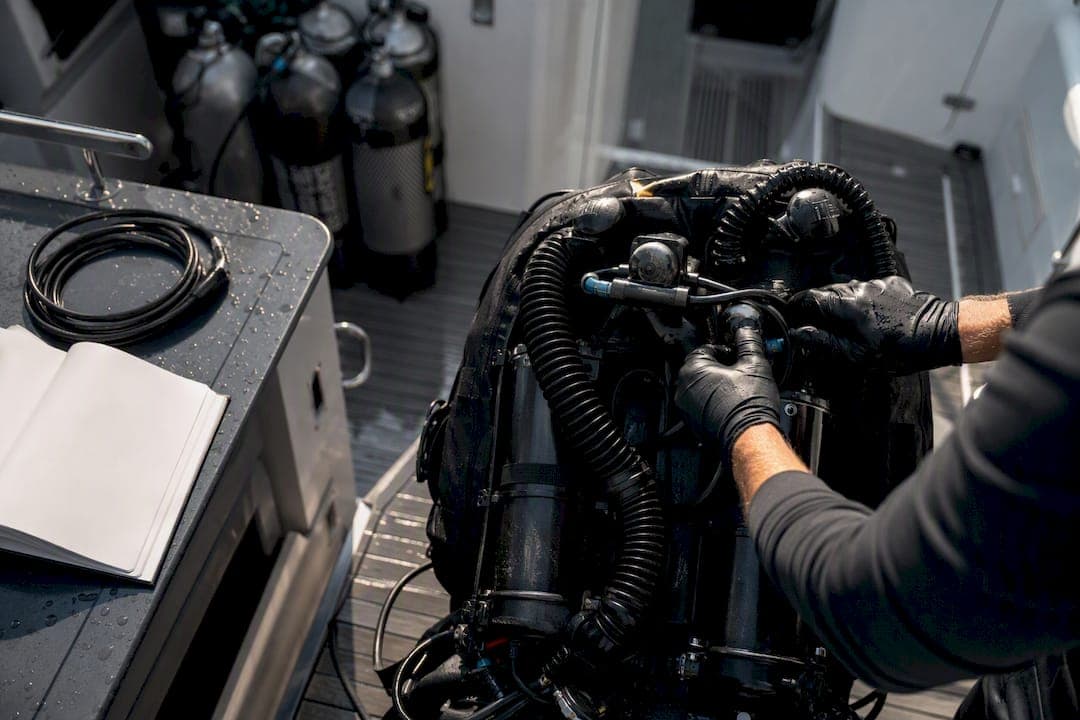
Yes, rebreather-friendly yacht charters exist, and they are one of the most rewarding ways to reach dive sites that recreational boats never touch. But CCR divers cannot book like open-circuit travelers do; a good operator will ask for proof of certification, unit-specific logged dives, and a clear consumables plan before confirming your berth.
Three things to check before you contact anyone:
- Certification and logged dives: MOD 1 or an equivalent CCR rating, plus a logbook showing substantial hours on your specific unit.
- Consumables and crew support: confirm the vessel stocks oxygen, sorb, and dedicated cylinders, and that crew have handled CCR divers before.
- Model compatibility: your rebreather's fittings, sorb type, and bailout configuration need to match what the boat can service.
Exotica Charters arranges fully crewed yachts built around exactly this kind of diving, with captains who understand what a closed-circuit rig demands from a vessel and a crew.
Key Takeaways
Rebreather-friendly yacht charters work when certification, logged dives on your unit, and a written consumables agreement are confirmed before departure.
| Point | Details |
|---|---|
| Certification floor | Expect operators to require MOD 1 or equivalent CCR certification plus a substantial logged dive history on your specific unit. |
| Consumables in writing | Confirm oxygen, sorb, and cylinder policy before paying a deposit, since verbal assurances rarely hold up onboard. |
| Test gear at home | Service and test your unit repeatedly in home waters; never rely on a fresh service done just before travel. |
| Crew coordination is critical | Submit detailed dive plans in advance, since crews can't track CCR divers visually the way they track bubbles. |
| Exotica Charters | Arranges fully crewed, dive-focused yacht charters with crew experienced in coordinating CCR logistics and onboard support. |
Table of Contents
- What Certification and Experience Do CCR Charters Require?
- What Consumables and Cylinders Do Charters Actually Provide?
- How Should You Prep Equipment Before a Remote Charter?
- How Do Crews Manage Safety and Checkout for CCR Divers?
- What Should You Confirm Before Signing a Charter Contract?
- Which Dive Sites Suit Rebreather Charters Best?
- Will the Crew Brief You on Local Diving Conditions?
- How Are Emergencies Handled on a CCR-Equipped Charter?
- How Do Rebreather Charters Protect the Marine Environments They Visit?
- Why the Standard CCR Charter Advice Undersells the Prep Work
- How Exotica Charters Arranges Rebreather-Ready Trips
- Sources
What Certification and Experience Do CCR Charters Require?
Most operators that welcome rebreather divers set a floor: MOD 1 or an equivalent CCR certification, combined with a logged dive history on the same unit you plan to bring. Expeditions that push into deeper wrecks or remote pelagic sites often raise that bar further, sometimes asking for MOD 2 training or triple-digit hours on the loop.
The insistence on unit-specific dives isn't bureaucratic box-checking. A diver with 40 hours on a Poseidon and two hours on a borrowed Sofia doesn't have the same muscle memory for bailout drills or scrubber monitoring, and a crew running a remote itinerary needs to trust that instinct will kick in correctly under stress. Familiarity with your own unit is what lets you troubleshoot a high pO2 alarm without hesitation, three hours from the nearest chamber.
Before you inquire, gather:
- Your CCR certification card and the specific unit model it covers.
- Logbook pages showing dives on that same unit, not just cumulative CCR hours across different rigs.
- Medical clearance for diving, particularly if you're over 45 or have any cardiovascular history.
- Dive insurance that explicitly covers technical and closed-circuit diving. Standard recreational policies frequently exclude it, and understanding how insurers weigh diver experience against coverage terms is worth doing before you're mid-negotiation with a charter broker.
Charters that skip this vetting aren't doing you a favor. They're setting up a situation where you find out about a gap in your paperwork, or theirs, on day one of a ten-day trip.
What Consumables and Cylinders Do Charters Actually Provide?
A rebreather-friendly yacht typically stocks three things as standard: medical-grade oxygen, sorb (sodalime), and dedicated small DIN cylinders, commonly in the 3-liter range for onboard gas top-offs. Many operators bundle these into a fixed consumables package rather than itemizing every liter of O2 you burn, which keeps billing simple and avoids the awkward math of metering gas mid-charter.
That said, "provides consumables" can mean wildly different things depending on the vessel, so verify specifics rather than assuming:
- Ask whether oxygen and sorb are unlimited within the package or capped at a per-dive allowance.
- Confirm cylinders are dedicated and clearly labeled for CCR use, not shared with open-circuit tanks that could introduce contamination risk.
- Check storage conditions: is there a proper oxygen cabinet, or is O2 stored loose in a locker that also holds fuel or solvents?
- Find out if bailout cylinders are supplied or if you need to bring your own, sized to match your configuration.
Pro Tip: Get the consumables policy in writing before you wire a deposit. A verbal "yes, we handle all that" from a charter broker means nothing if the actual vessel only carries a single oxygen cylinder for a six-diver group.
Some listings for CCR-focused trips spell this out clearly, itemizing unlimited O2 and sorb alongside a mandatory consumables fee. That level of transparency is the standard to hold every quote to, whether it comes from a dedicated dive event or a private charter broker.
How Should You Prep Equipment Before a Remote Charter?
The single biggest mistake CCR divers make before a remote trip is treating a fresh service as a green light to travel. It isn't. Service your unit, then test it repeatedly in home waters before you pack it, because a rebreather that behaves oddly three days after an overhaul is far easier to diagnose at your local quarry than on a boat six hours from the nearest technician.
Build your spares kit around what your specific unit cannot borrow from anyone else on board:
- O-rings and seals in the sizes your unit uses, not a generic assortment.
- Backup electronics or PCB spares, since a failed handset or solenoid can end a trip instantly if you're the only diver running that model.
- Extra hoses, mouthpieces, and valves covering the wear points that fail first under heavy use.
- Spare scrubber canisters and enough approved sorb to repack for every planned dive day, plus a buffer.
- Bailout stages and labeled bailout cylinders sized and valved to match your rig's configuration exactly.
Pro Tip: Confirm your unit's specific sorb granule size and fill weight with the charter in advance. Two rebreathers that look nearly identical can require different scrubber packing, and remote destinations rarely stock the wrong type.
Different rebreather models rarely share parts, and a charter's spares locker almost never covers unit-specific electronics. What you pack is what you have.
How Do Crews Manage Safety and Checkout for CCR Divers?
Open-circuit diving gives a crew a visual cue: bubbles at the surface mean everything is fine. Closed-circuit rebreathers eliminate that signal entirely, which is why crews on CCR-friendly yachts operate on a different rhythm built around communication rather than observation.
Expect the crew to ask for a detailed dive plan before you ever get in the water, including planned bottom times, decompression obligations, and turnaround points. That information lets them position the tender correctly and know exactly when to expect you back.
A checkout process typically follows this pattern:
- A shallow verification dive on day one, confirming your setup, trim, and bailout readiness in low-consequence conditions.
- An equipment check by crew or a designated dive lead, looking for loop integrity and correct scrubber assembly.
- A briefing on emergency oxygen protocols and how the crew will respond if you don't surface on schedule.
Some operators make that first check dive mandatory before allowing access to deeper or more remote sites, and that's a reasonable filter, not an inconvenience. Before booking, ask directly whether the crew has prior CCR experience or a written CCR operations plan; a vague answer here is a signal to keep looking.
What Should You Confirm Before Signing a Charter Contract?
A booking conversation for a CCR trip needs to cover ground that a standard dive charter inquiry never touches. Work through this list with the broker or operator before you commit funds:
- Consumables policy in writing: what's bundled into the charter fee versus billed separately, and whether O2 and sorb are capped.
- Cylinder inventory: how many dedicated CCR and bailout cylinders the vessel carries, and whether sizes match your rig.
- On-deck facilities: dedicated setup stations, rinse tubs large enough for loop components, secure oxygen storage, and a dive tender that can support a CCR team.
- Checkout and cancellation terms: what happens, and what you're refunded, if the onboard checkout finds you ineligible for planned dives.
- Insurance requirements: confirm minimum coverage levels and whether evacuation or medical coverage for technical diving is mandatory.
- Crew CCR familiarity: ask plainly whether they've supported your specific rebreather model before, not just CCR diving in general.
A charter that answers all six without hesitation is one you can plan around with confidence. If you want to see how one operator structures these details before you even inquire, Exotica Charters lays out its approach to dive-equipped vessels in plain terms.
Which Dive Sites Suit Rebreather Charters Best?
The real payoff of a CCR-capable charter shows up at the sites you can reach that open-circuit divers can't linger at. Extended no-bubble bottom times mean wreck penetration dives, deep pelagic drifts, and skittish-species encounters that would be cut short by gas limits on standard scuba.
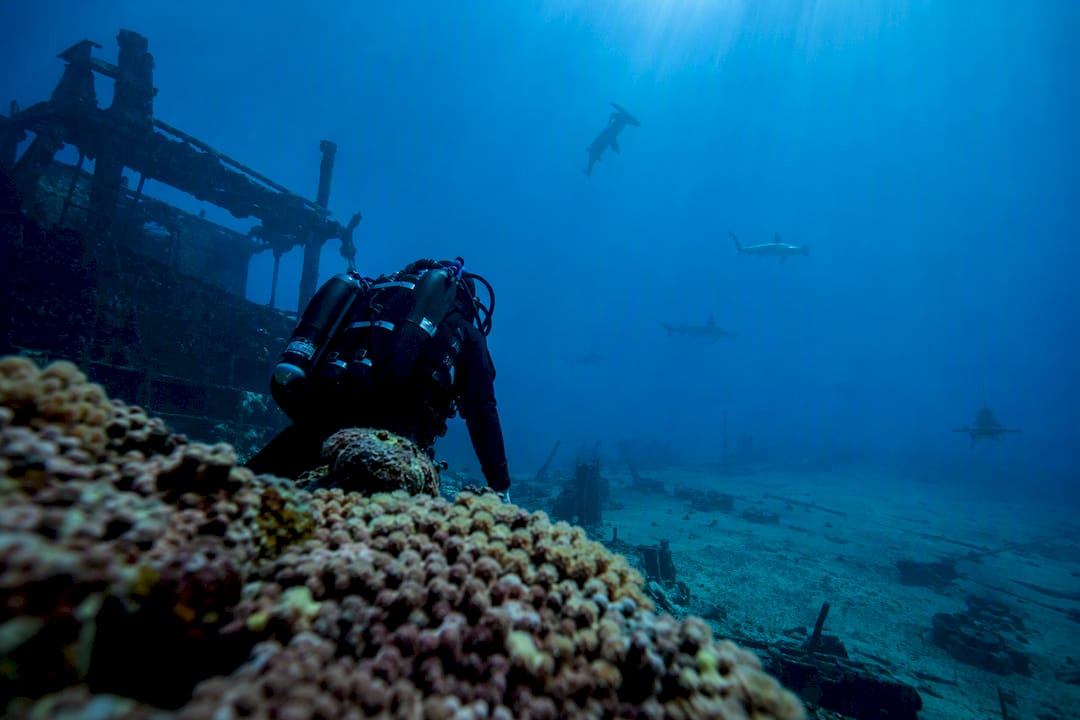
The Galápagos stands out as a proving ground for this, where CCR divers can hold position at depth near hammerhead schools and manta cleaning stations far longer than an open-circuit tank allows, without the noise and bubble stream that pushes marine life away. French Polynesia's outer atolls offer similarly quiet, current-swept channels where silence matters, since many pelagic species react to bubble noise long before they react to a diver's silhouette.
Alaska's cold, nutrient-rich waters present a different case entirely: shorter dive windows dictated by temperature rather than gas, but rebreathers still deliver a real advantage in warmth retention through loop-recycled breathing gas and in the extended observation time needed to document deep-water invertebrate life.
A well-planned itinerary blends a few demanding technical sites with easier days for equipment recovery and crew logistics. Ask an operator how their route balances that mix; a schedule packed with back-to-back deep technical dives, with no slack for weather or gear issues, is a red flag regardless of how good the sites look on paper.
Will the Crew Brief You on Local Diving Conditions?
A charter crew's job on a CCR trip goes beyond driving the boat. Expect a site-specific briefing before every meaningful dive, covering current direction and strength, thermocline depth, known hazards like fishing line entanglement or overhead terrain, and the planned pickup point for the tender.
This briefing matters more for CCR divers than for open-circuit groups because your extended bottom time means conditions can shift meaningfully between when you descend and when you ascend. A crew that has run the site before, in a current that reverses on the tide, will tell you that upfront rather than let you discover it thirty minutes into a dive.
Ask specifically whether the crew has operated CCR trips at your planned destinations before, or whether this itinerary is new territory for them too. Neither answer should disqualify a charter outright, but it changes how much independent research and conservative planning you should bring to the table. A crew running unfamiliar waters for the first time should be more willing to schedule a shallow scouting dive before committing your group to a deep, current-exposed site.
How Are Emergencies Handled on a CCR-Equipped Charter?
Emergency response on a rebreather charter starts before anyone gets wet, with a rehearsed protocol the crew can execute without hesitation. That includes a designated emergency oxygen station, a tender crew member briefed on lost-diver procedures, and a clear chain of communication to the nearest medical facility or hyperbaric chamber, however far that might be.
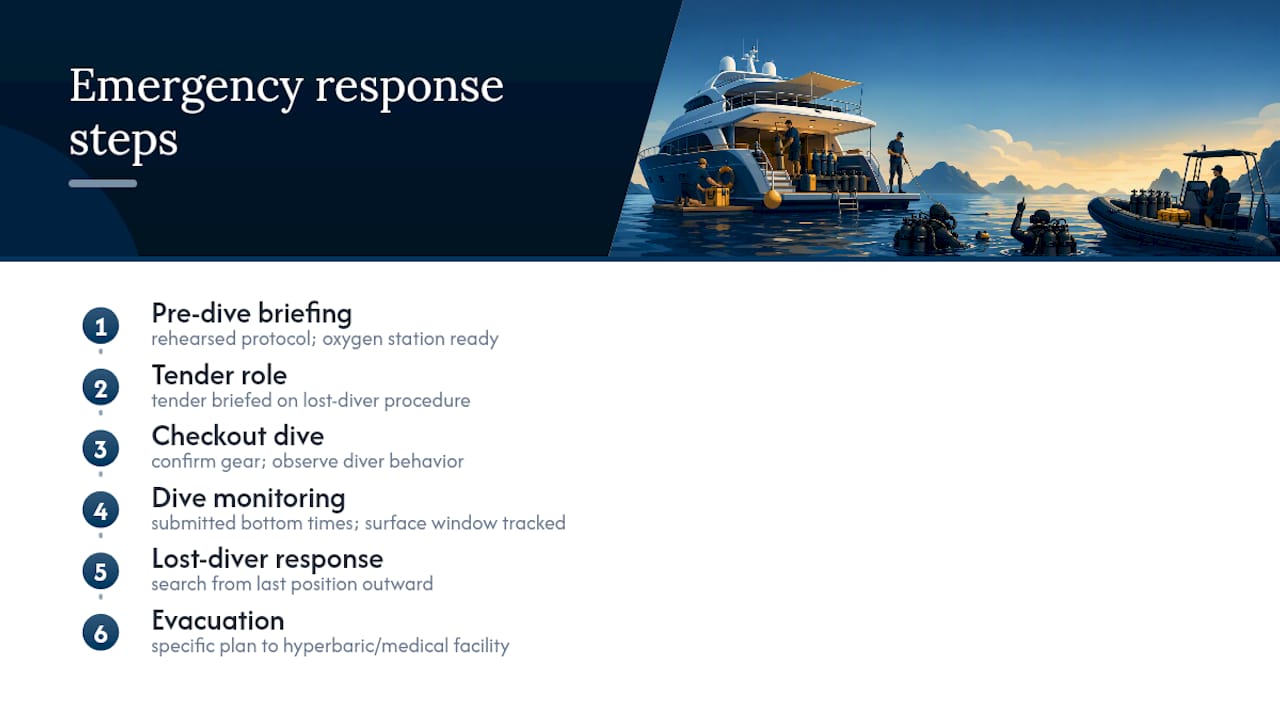
Because CCR divers submit bottom times and decompression obligations in advance, the crew has a defined window for when a diver should surface. If that window passes without contact, an experienced crew moves through a structured search pattern rather than a general scramble, starting at the last known position and working outward along the current line.
A mandatory checkout dive earlier in the trip does double duty here. It confirms your gear functions correctly, and it gives the crew a chance to see your real-world diving behavior, information that becomes useful if something does go wrong later. Ask directly what evacuation plan the vessel has for a decompression illness case at your specific destination, since remote itineraries in places like French Polynesia or the outer Galápagos can mean hours, not minutes, to definitive care. That answer should be specific, not reassuring in the abstract.
How Do Rebreather Charters Protect the Marine Environments They Visit?
The quiet, low-disturbance nature of closed-circuit diving is itself a conservation advantage, but it doesn't excuse careless buoyancy or contact with reef structure. Rebreathers remove exhaled bubble noise, which means marine life often stays closer and calmer around a CCR diver, and that proximity carries responsibility: a careless fin kick does more damage when a shark or ray hasn't fled the area the way it would from a noisy open-circuit diver.
Good charters reinforce a few practices as standard, not as an afterthought bolted onto the safety briefing. Divers should maintain a buffer distance from cleaning stations and nesting sites, even when a rebreather's silence makes closer approaches tempting. Sorb and oxygen waste needs proper disposal onboard rather than anywhere near reef systems, and any tender or dinghy anchoring should avoid coral structure entirely.
The extended bottom time a rebreather allows is a privilege, not a license to overstay at a single site when other divers or wildlife would benefit from space. A well-run charter builds site rotation into the itinerary partly for this reason, spreading diver pressure across a region rather than concentrating it on one reef day after day.
Why the Standard CCR Charter Advice Undersells the Prep Work
Most of what circulates online about rebreather travel focuses on the gear itself: which unit to buy, how scrubber duration works, how to read a HUD. That's the easy part. The harder, less discussed piece is the operational fit between diver, unit, and vessel, and that's where trips actually fall apart.
The conventional advice treats certification as the finish line. It isn't. A diver with a fresh MOD 1 card and thirty logged dives is legally eligible for plenty of charters, but eligibility and readiness aren't the same thing. What actually predicts a smooth trip is whether the diver tested their unit repeatedly after service, packed model-specific spares nobody else on the boat can lend them, and confirmed consumables in writing rather than trusting a verbal assurance.
If there's one thing to prioritize first, it's documentation, not gear. Get your logbook, certification, and insurance paperwork airtight before you even start comparing itineraries. A charter that takes CCR divers seriously will ask for it, and one that doesn't ask probably hasn't thought through what supporting your dive actually requires.
— Mo
How Exotica Charters Arranges Rebreather-Ready Trips
Exotica Charters plans fully crewed yacht trips built specifically around diving and adventure travel, not general cruising with diving added as an afterthought. That distinction matters for CCR divers, because the difference between a boat that "allows diving" and one genuinely equipped for closed-circuit operations shows up exactly in the details covered above: dedicated setup stations, oxygen storage, and a crew who won't blink when you hand them a decompression profile instead of a tank pressure.

The team behind Exotica Charters includes former captains and water sports professionals who have coordinated dive logistics on remote itineraries in places like the Galápagos and French Polynesia, and that experience shapes how they vet vessels before recommending them. Client feedback on Trustpilot reflects consistent satisfaction with how these trips get organized, from consumables planning through onboard support.
If you're ready to look into a CCR-focused trip, start your inquiry with four details: your certification level, logged dives on your specific unit, your rebreather model, and your target dates. That's enough for the Exotica Charters team to begin matching you with a dive-capable yacht suited to your itinerary, and to flag any consumables or crew-experience gaps before you've committed to anything.
Sources
- Silent Diving — Rebreather diving: remote-reef expedition logistics
- Dressel Divers — Closed-circuit rebreathers maintenance guide