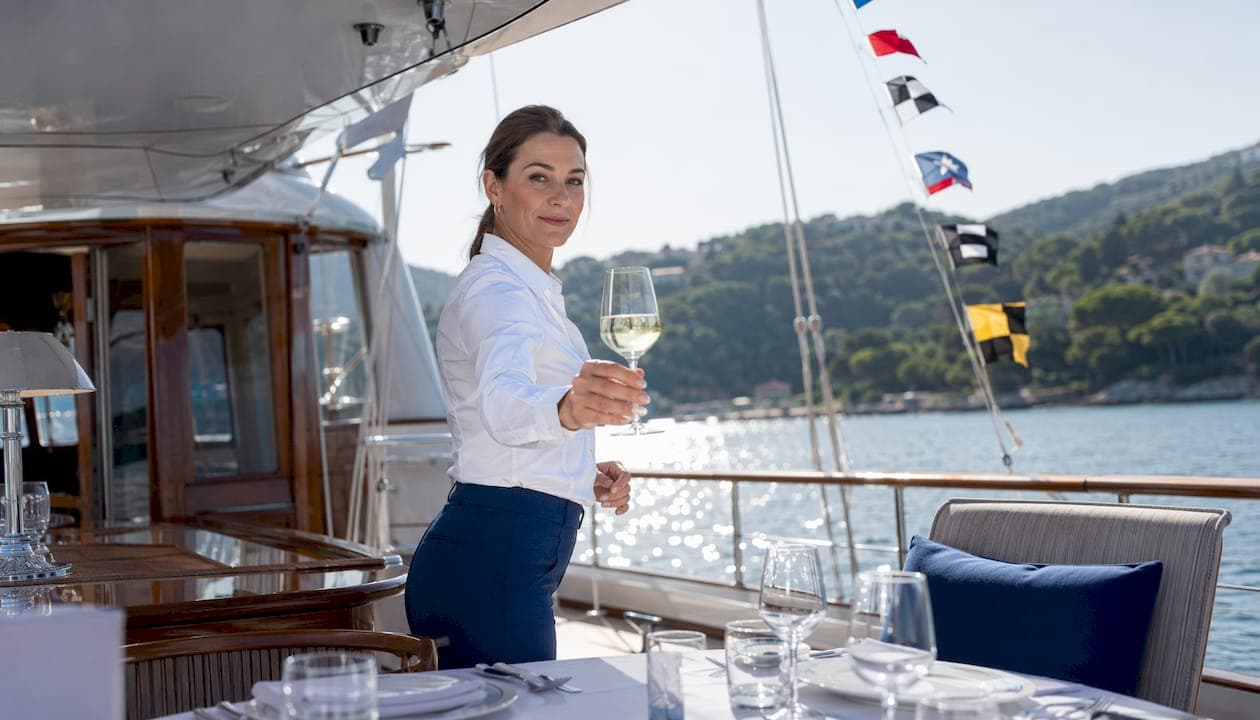
Wine pairing's role on a charter yacht is to create a seamless floating fine-dining experience — one where each bottle chosen complements the menu, the setting, and the mood of the voyage. This is not simply about matching a white to fish; it is about choreographing a sensory experience where the wine, the sea air, and the chef's menu move together as one. Onshore Cellars' destination-driven selection advice captures this well: the best wine for a yacht trip begins with where you are sailing, not just what is on the plate.
Who benefits most:
- Guests receive a curated, effortless experience where wine choices feel considered, not improvised
- Chef and crew gain a structured cellar that supports changing menus without mid-charter scrambles
- The charter itself earns a defining character — the kind guests describe long after they disembark
One implementation cue: A crew-managed cellar paired with concise, course-by-course pairing notes is the single most reliable way to deliver this experience consistently.
Table of Contents
- Why does wine pairing matter aboard a charter yacht?
- Who handles wine pairing on board: crew roles and sommelier options
- How do you design a balanced onboard wine cellar?
- What are the best wine pairings for common yacht menus?
- Service logistics: how do storage, temperature, and glassware shape the experience?
- How far ahead should you plan wine provisioning for a charter?
- How can you make wine pairing an interactive guest experience?
- How Exoticacharters approaches wine pairing in practice
- Key Takeaways
- Wine pairing is the detail that defines the voyage
- A curated wine experience is one conversation away
- Useful sources and further reading
Why does wine pairing matter aboard a charter yacht?
A well-paired wine turns a good meal into a memory. Aboard a yacht, that effect is amplified by everything surrounding the table: the quality of light at golden hour, the salt in the air, the intimacy of a small guest group sharing a meal in motion.
Restaurants can rely on a fixed menu and a stable cellar. Charter yacht dining cannot. Menus shift daily based on the local catch, the port market, and what guests request that morning. That variability makes pairing both more challenging and more rewarding. The right wine does not just complement a dish — it anchors the experience to a specific place and moment.
Concrete benefits of thoughtful wine pairing on board:
- Enhances the flavor of fresh, local ingredients (a crisp Assyrtiko alongside just-caught sea bass is a different experience than the same fish with a generic house white)
- Creates ceremony and pacing across multi-course dinners, signaling to guests that each course is an event
- Supports destination storytelling — local wines from the itinerary region add a layer of place that no imported label can replicate
- Simplifies guest decisions, reducing the friction of an open wine list mid-service
Pro Tip: Stock two-thirds crowd-pleasers — familiar, approachable styles guests will reach for without hesitation — and reserve one-third for discovery bottles that spark conversation. That ratio keeps service smooth while giving the sommelier or chief steward something interesting to present.
Structured yacht wine and dine experiences demonstrate how powerfully this works: a four-course gourmet menu paired course-by-course by a sommelier transforms dinner into the evening's headline event.
Who handles wine pairing on board: crew roles and sommelier options
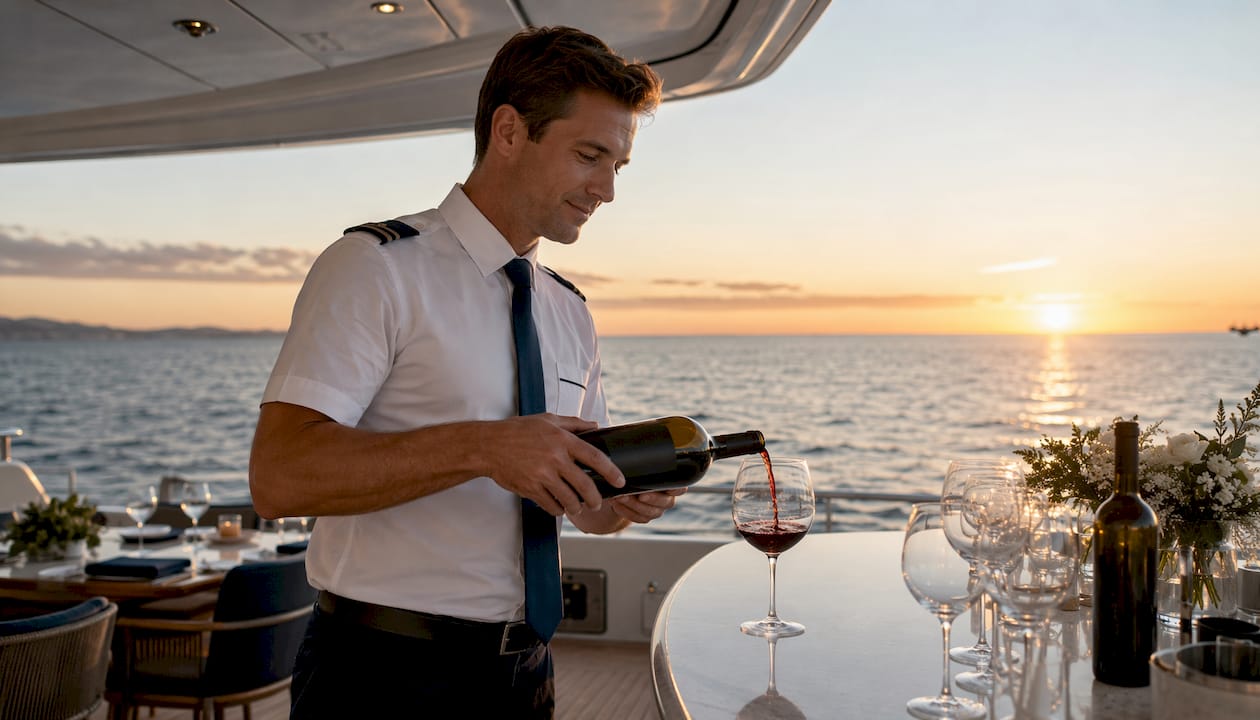
On most crewed charters, the chief steward or stewardess owns the wine program, working closely with the head chef. A dedicated sommelier is optional — but for elevated, formal experiences or tasting-focused cruises, one is worth every dollar.
Responsibilities by role:
- Chief steward/stewardess: provisioning, cellar organization, service timing, managing open bottles, and handling BYO guest wines
- Head chef: menu-driven pairing recommendations, communicating daily dish changes to the steward before service
- Sommelier (when engaged): full cellar curation, at-table presentation, guest consultation, and tasting-menu design
- Winemaker or guest host: reserved for special events; winemaker-hosted cruises pair a four-course dinner with wines poured and narrated by the producer — an extraordinary format for wine-focused charters
Pro Tip: Before provisioning begins, send guests a short preference sheet covering budget range, favorite styles, and any bottles they want to bring aboard. Resolving those details before embarkation eliminates the most common mid-charter friction points.
For guests booking through crewed yacht charters, asking specifically about the chief steward's wine background — or requesting sommelier support — is a straightforward way to calibrate the experience before departure.
How do you design a balanced onboard wine cellar?
Prioritize versatility first. A cellar that can support a grilled fish lunch, a multi-course dinner, and a sunset aperitif without restocking mid-charter is far more valuable than one stocked with impressive labels that only work with specific dishes.
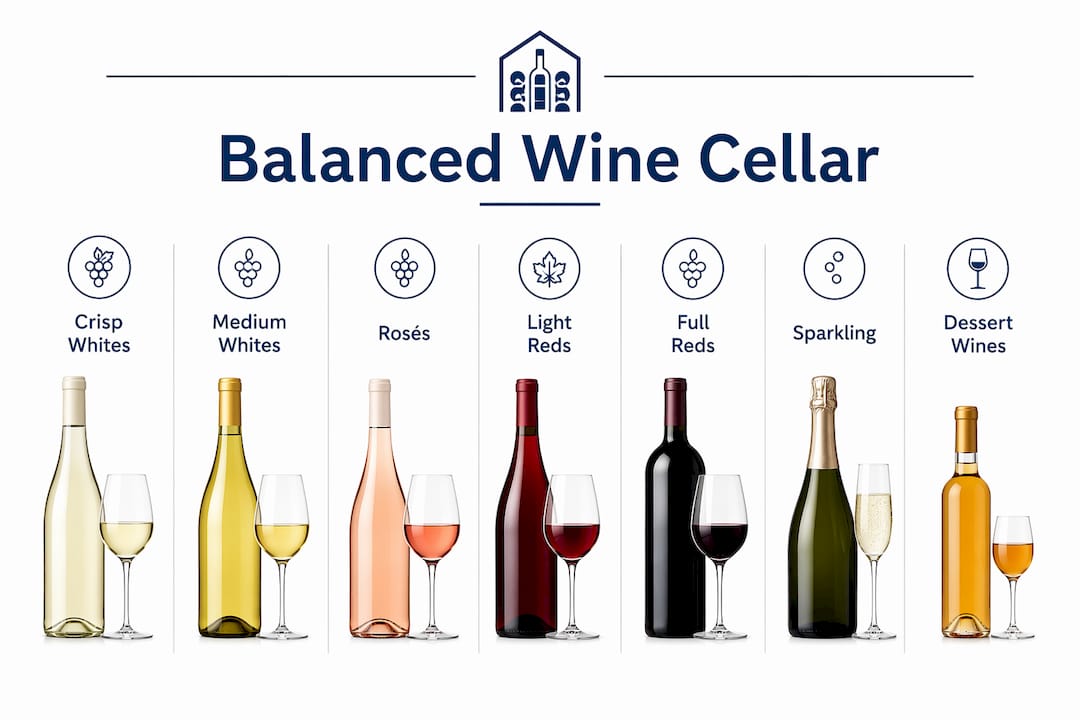
Sample cellar mix for a 7-day charter (8 guests) includes a balance of crisp dry whites, medium-bodied whites, rosés, light to medium reds, full reds, sparkling wines, and dessert or fortified wines in proportions that support versatile meal pairings.
Onshore Cellars recommends calculating bottles carefully and adding a small buffer — storage on yachts is finite, but running short mid-passage is far more disruptive than carrying two extra cases.
Must-have style types:
- Crisp dry white (Sauvignon Blanc, Albariño, Assyrtiko) for seafood and warm-weather lunches
- Medium-bodied white (white Burgundy, Vermentino) for richer fish and vegetable dishes
- Dry rosé as the universal bridge wine across lunch, aperitif, and light dinner
- Light red (Pinot Noir, Gamay) for grilled meats in warm climates
- Full red (Cabernet, Syrah) for cooler evenings and red-meat courses
- Sparkling for arrivals, toasts, and dessert pairings
For Mediterranean itineraries, destination-aware selection favors zesty whites and rosés; cooler-water routes through Alaska or the Pacific Northwest open the door to fuller Pinot Noirs and even light Bordeaux blends.
Storage essentials: maintain whites and rosés between 45°F and 55°F, reds between 55°F and 65°F. Vibration from the engine is the silent enemy of delicate wines — store bottles horizontally in padded racks away from the engine room.
Pro Tip: Prepare a one-page mini-brochure summarizing the cellar: each wine's style, origin, and suggested pairing. Crew can use it confidently during service; guests use it to make decisions without feeling pressured.
What are the best wine pairings for common yacht menus?
The guiding principle: choose pairings that either harmonize with a dish's dominant flavor or intentionally contrast it to create brightness and lift. Both approaches work — the key is intention.
- Light seafood (ceviche, crudo, sashimi): Albariño or Assyrtiko; serve at 45°F in a standard white wine glass. Substitute: Muscadet
- Grilled fish (sea bass, snapper, mahi-mahi): White Burgundy or Vermentino; serve at 50°F. Substitute: unoaked Chardonnay
- Shellfish (oysters, clams, mussels): Chablis or Picpoul de Pinet; serve well-chilled at 43°F in a tulip glass. Substitute: dry Champagne
- Shellfish with citrus or butter sauce: White Bordeaux or Viognier; serve at 48°F. Substitute: Roussanne
- Richer fish (salmon, tuna steak): Dry rosé or light Pinot Noir; serve rosé at 50°F, Pinot at 58°F
- Grilled meats and steaks: Cabernet Sauvignon or Syrah; serve at 62°F in a large-bowled glass. Substitute: Malbec
- Salads and vegetarian dishes: Sauvignon Blanc or Grüner Veltliner; serve at 46°F. Substitute: dry Riesling
- Desserts (fruit-based): Sauternes or Moscato d'Asti; serve lightly chilled. Substitute: late-harvest Riesling
- Toasts and arrivals: Champagne, Cava, or Crémant; serve at 43°F in a flute or coupe
Full-day experiences like Tuscan wine-and-food cruises pair Brunello, Chianti, and Vernaccia with local gourmet products across eight hours — a helpful model for planning a destination-driven pairing day on longer charters.
Service logistics: how do storage, temperature, and glassware shape the experience?
Service logistics determine whether a pairing reads as intentional or accidental. The finest bottle, served at the wrong temperature in the wrong glass, loses most of its impact.
Storage and chilling checklist:
- Use a dedicated wine fridge or insulated wine locker — never the galley refrigerator, which runs too cold
- Chill whites and rosés 30–45 minutes before service; reds need only 10–15 minutes in a cool space if stored at ambient temperature
- For imperfect conditions, a wine sleeve or ice bucket with a 50/50 ice-water mix corrects temperature in under 10 minutes
Glassware basics (minimum inventory for maximum impact):
- One all-purpose tulip glass covers whites, rosés, and light reds
- A larger-bowled glass for full reds and aged whites
- A flute or coupe for sparkling service
Pacing and sequencing: present the pairing verbally before pouring — a single sentence about the wine and why it fits the dish is enough. Decanting a red 20–30 minutes before service is achievable even in a compact galley; use a simple glass decanter stored upright in a padded rack. Never decant on a moving vessel without securing the decanter.
How far ahead should you plan wine provisioning for a charter?
Plan wine choices 2–6 weeks ahead of embarkation. Sourcing standard varietals takes two weeks; special or vintage bottles may require four to six.
Provisioning scenarios
| Approach | Lead Time | Cost Shape | Who Manages |
|---|---|---|---|
| BYO (guest-sourced) | 4–6 weeks | Guest pays retail + corkage | Guest |
| Curated package | 2–3 weeks | Bundled into charter fee | Charter/crew |
| Sommelier-curated | 4–6 weeks | Sommelier day fee + wine cost | Charter + guest |
Planning milestones:
- Send guest preference sheet (6 weeks out)
- Cellar briefing with chef and chief steward (4–5 weeks out)
- Provisioning order placed with supplier (3–4 weeks out)
- Delivery and cellar organization (1 week before embarkation)
- Embarkation check: temperatures verified, brochure printed, glassware inventoried
As a planning heuristic, budget roughly half a bottle of wine per guest per meal, plus one bottle per two guests for aperitif and post-dinner service. Sommelier day fees vary widely by market and experience level; confirm rates directly with your charter specialist.
How can you make wine pairing an interactive guest experience?
Interactive formats convert wine service from a background detail into entertainment — the kind that shapes how guests remember the entire charter. Sommelier-led tasting menus and at-table pairing experiences are consistently cited as memorable highlights unique to yacht dining.
Practical formats to consider:
- Pre-dinner tasting flight: three pours (white, rosé, red) with brief crew commentary before the first course — low-key, social, and sets the tone
- At-table pairing with chef explanations: the chef or steward introduces each wine as the course arrives; works beautifully for four-course dinners
- Winemaker-hosted evening: a producer joins the charter for one evening and pours their own wines — extraordinary for wine-focused groups
- Informal drop-in tastings: during a calm afternoon at anchor, offer two or three bottles from the cellar with light snacks; no structure required
Pro Tip: Keep tasting language grounded in everyday references — "this tastes like a squeeze of lemon over fresh herbs" lands better than "high-acid, herbaceous profile." Give guests a simple palate cue for each wine and the conversation takes care of itself.
For guests who want the full experience, upscale boat tour hospitality models show how curated drink service, when woven into the flow of a cruise, becomes the defining memory rather than a footnote.
How Exoticacharters approaches wine pairing in practice
Exoticacharters positions wine pairing as a core element of its curated floating fine-dining experience, not an afterthought. The process begins before guests ever step aboard.
The team — built from former captains and water sports professionals — starts with a preference intake that captures budget range, favorite styles, and any special-occasion bottles guests want featured. From there, the crew curates a cellar that balances familiar, reassuring labels with a handful of distinctive bottles tied to the destination. On a French Polynesia charter, that might mean a crisp Burgundy alongside a local Tahitian-influenced rosé; on a Galápagos expedition, lighter Pacific-friendly whites that hold up in tropical heat.
At the table, the chief steward presents each pairing with a brief, approachable note — enough context to spark curiosity, never enough to feel like a lecture. Guest feedback, collected after each voyage, consistently highlights the wine program as one of the most memorable elements of the experience.
Exoticacharters' Trustpilot rating reflects exactly this kind of attention: guests return not just for the destinations, but for the quality of every detail, from anchorage to aperitif.
Pro Tip: Exoticacharters uses a concise mini-cellar brochure for each charter — one page, printed before embarkation, summarizing the wines on board with pairing cues. Crew confidence goes up, guest decisions get easier, and service flows without interruption.
Key Takeaways
Wine pairing on a charter yacht works best when the cellar, the crew, and the service flow are designed together as a single, cohesive program rather than assembled separately.
| Point | Details |
|---|---|
| Cellar balance matters most | Stock a balanced mix of crisp whites, rosé, light red, along with sparkling and dessert wines to round out the selection. |
| Crew ownership drives quality | The chief steward or sommelier should manage the full program, from provisioning to at-table presentation. |
| Provision 2–6 weeks ahead | Standard wines need two weeks; vintage or special bottles require four to six weeks of lead time. |
| Service logistics are non-negotiable | Correct serving temperatures and appropriate glassware shape how guests perceive every pairing. |
| Exoticacharters delivers this end-to-end | From preference intake to curated cellar and at-table service, Exoticacharters builds the wine program into the charter experience from day one. |
Wine pairing is the detail that defines the voyage
Most guests cannot articulate exactly why a charter felt extraordinary. They remember the light, the anchorage, the meal — and the wine that made the meal feel like it belonged to that specific evening in that specific place. That is the real role of wine pairing on a charter: not to impress, but to make the experience feel complete.
What we find, time and again, is that the charters guests talk about for years are the ones where every element was considered — where the crew knew the cellar, the cellar matched the menu, and the menu matched the destination. Wine pairing is the thread that connects all three. Get it right, and guests stop noticing the wine entirely. They simply feel that everything was exactly as it should be.
A curated wine experience is one conversation away
Exoticacharters builds wine pairing into every fully crewed charter from the first planning call — preference intake, curated cellar, at-table service, and all the details in between. Whether you are planning a multi-course dinner under the stars in French Polynesia or a sunset aperitif off the Galápagos coast, the wine program travels with you.
Browse luxury yacht charters and connect with a charter specialist to discuss your wine preferences, destination, and ideal provisioning timeline. The earlier you reach out, the more precisely the cellar can be tailored to your voyage. Speak to the team at Exoticacharters to start planning your floating fine-dining experience today.
Useful sources and further reading
- Choosing the Perfect Wine for Your Yacht Charter — Onshore Cellars: practical provisioning guidance, bottle-count heuristics, and climate-aware selection advice
- The Ultimate Foodie Experiences Onboard a Yacht — Yacht.com: overview of sommelier-led tasting menus, cooking classes, and multi-course dinners aboard charter yachts
- YACHT WINE & DINE EXPERIENCE — La Pasión: turnkey four-course sommelier-paired dinner program including transport, aperitif, and digestif
- Winemaker Cruise on the Wine Yacht — WineCountry Experiences: Napa winemaker-hosted four-course dinner cruise; a strong model for elevated guest-hosted tasting events
- Private Cruise Day to Baratti Gulf with Wine Tasting — Kenzly: eight-hour Tuscan wine-and-food cruise pairing Brunello, Chianti, and Vernaccia with local gourmet products
- Romantic Onboard Dining Experiences on a Yacht — Exoticacharters: deeper reading on curated wine pairings and gourmet onboard dining from the Exoticacharters team
- Sunset Cruises — PCB Prestige: hospitality-focused cruise experiences where curated drink service shapes the guest journey