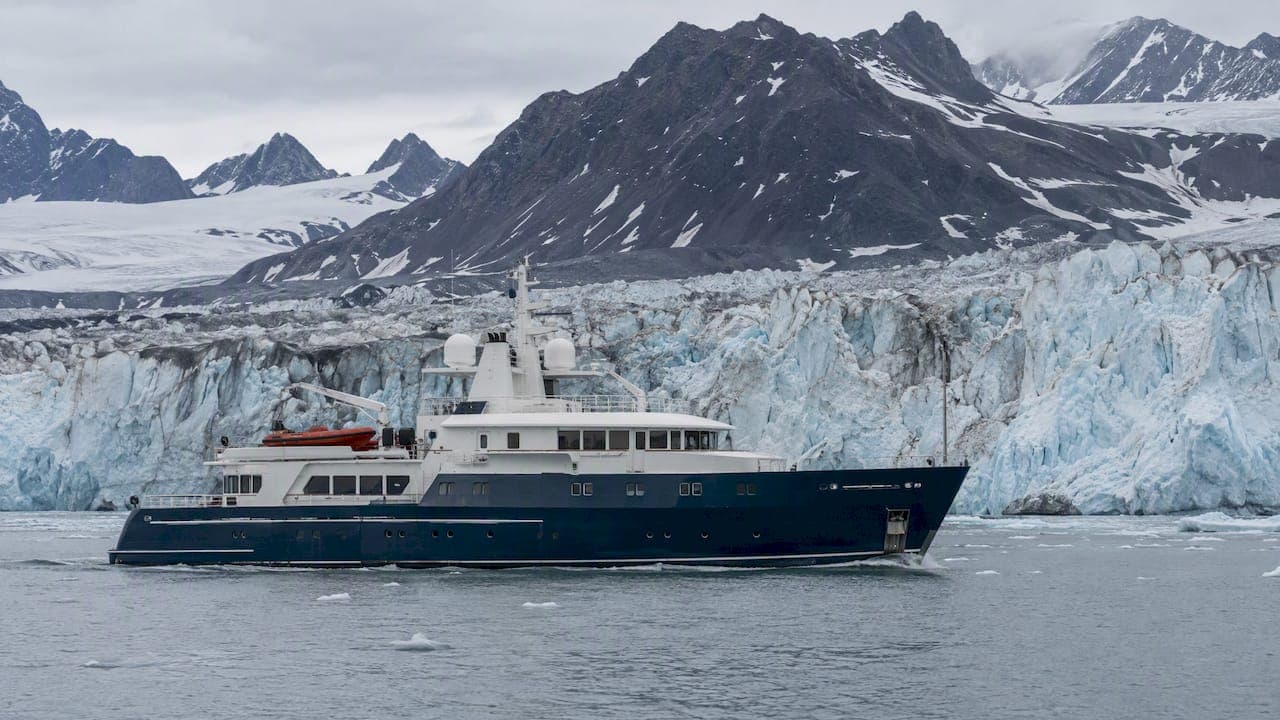
A Svalbard charter is a private, fully crewed voyage through an archipelago of glaciers, fjords and tundra, roughly midway between mainland Norway and the North Pole. The best window is the polar summer, when the sun stays up around the clock and the sea ice has retreated enough to open the northern fjords. What separates a good trip from a great one is the vessel, the crew's Arctic experience and the paperwork, because Norway regulates travel here more strictly than almost anywhere else you can sail.
This guide covers when to go, what you will see, which rules apply, what kind of yacht suits these waters, and how Svalbard compares with Norway's fjords and with Alaska's Inside Passage and Prince William Sound.
TL;DR
- Plan for the polar summer, which runs from May 17 to September 30; the midnight sun holds until late August.
- Private trips outside Management Area 10 require advance notice to the Governor, adequate insurance or a guarantee for search-and-rescue costs, and an emergency beacon.
- Polar bears shape every landing: your crew must carry protection and know how to use it, and the best landings are planned around them.
- Choose a vessel built for cold, ice and distance, with a crew who have worked high-latitude waters before.
- If you want a gentler first Arctic or northern voyage, Norway's fjords are an excellent step before Svalbard.
Table of Contents
- Why Svalbard suits a private yacht
- When to go: the polar summer
- What you will see
- The rules you need to know
- Choosing the right yacht
- A sample route through the northwest
- A day on board
- How Svalbard compares with other northern voyages
- Getting there, and what it costs
- Our perspective: plan around the Arctic, not against it
- Start planning your Svalbard charter
- FAQ
- Sources
Why Svalbard suits a private yacht
Svalbard is a place of scale and silence: glaciers that calve into the sea, black mountain ridges, and bays where the only other sign of life may be a walrus hauled out on a gravel spit. A large expedition ship can show you some of this. A private yacht lets you shape it.
With a small vessel, you choose the anchorage, linger when a bearded seal surfaces beside the tender, and move on when the ice or weather says so. Itineraries are set around conditions rather than a fixed timetable, and that flexibility is the whole point of chartering in the Arctic.
The trade-off is responsibility. Svalbard's weather, ice and wildlife are serious, and the rules reflect it. A good charter plan treats the regulations and the safety margins as part of the voyage, not as an afterthought.
When to go: the polar summer
The Arctic summer is short and bright. According to Visit Svalbard, the polar summer runs from May 17 to September 30, and the midnight sun does not dip below the horizon until late August. For a charter, that translates into long days for landings, kayaking and photography, with light that is soft and golden at what would elsewhere be midnight.
Here is how we think about the season in practice:
| Part of the season | What it tends to offer | Worth knowing |
|---|---|---|
| Early summer (late May to June) | Snow-covered landscapes, active sea ice, endless daylight | Ice can limit how far north you can sail; flexibility matters most |
| High summer (July to mid-August) | The most open water, tundra in bloom, the busiest wildlife viewing | The most popular period; book the vessel you want early |
| Late summer (late August to September) | The first sunsets, deeper light, quieter anchorages | Weather can turn faster; the summer period ends September 30 |
Ice conditions vary from year to year, so treat any itinerary as a plan rather than a promise. A skipper who has worked these waters will have alternatives ready for every leg.
What you will see
Svalbard is best known for polar bears, but a charter reveals much more. Expect walrus on haul-outs, reindeer grazing on the tundra, Arctic foxes, seabird colonies crowding the cliffs, and whales offshore. Glaciers meet the sea in several fjords, and the scenery changes sharply from the dark, jagged west coast to the more open waters farther north and east.

The point of a yacht is that you can stay with an encounter. Drift quietly in a tender near a calving glacier face, or watch a bear patrol a shoreline from a safe distance, with the crew reading the animal's behavior and the wind.
Distance rules protect the wildlife, and your trip
Norway has tightened distance limits in recent years. Reporting on the new regulations notes a 5-knot speed limit within 300 meters of walrus haul-sites, as well as a limit within 500 meters of land near bird cliffs between April 1 and August 31. Our advice: bring long lenses and binoculars and let the animals set the pace.
The Association of Arctic Expedition Cruise Operators (AECO) publishes yacht guidelines that ask visitors to avoid disturbing wildlife, keep noise down and follow biosecurity protocols to reduce the risk of introducing invasive species and disease. A well-run charter follows them as a matter of course.
The rules you need to know
Svalbard is not a place where you simply arrive and sail. These are the main points a private charter has to plan around. Always confirm current details with the Governor of Svalbard before you commit, because regulations are updated.
Notification, insurance and a beacon
The Norwegian Polar Institute's cruise handbook explains that private trips outside Management Area 10 require advance notification to the Governor, sufficient insurance or another guarantee to cover search-and-rescue costs, and an emergency beacon. For a charter, your broker and captain should handle these steps, but you should understand them, and ask who is responsible for each.
Polar bear safety
The same handbook states that visitors must have firearms and protective devices at hand for polar-bear self-defense. In practice, this is a job for trained crew and guides. You will not be asked to carry anything yourself, but you will be asked to follow instructions on shore without debate. Landings are chosen, scouted and sometimes abandoned because of a bear.
Guide requirements are changing
Norway is introducing a requirement that tourism and field activities outside inhabited areas use approved Svalbard guides, under a new field safety regulation. Approval is issued by the Governor and requires basic safety training. If you are planning a charter that will go ashore, ask early how your crew or shore guides meet this requirement and when it applies to your dates.
Fuel and vessel standards
From July 1, 2024, the use and carriage of heavy fuel oil as fuel in Arctic waters is prohibited, with a later date of July 1, 2029 for vessels that meet specified fuel-tank protection requirements. The Norwegian Coastal Administration also notes that passenger ships in Svalbard's territorial waters must meet SOLAS safety standards, including the Polar Code, subject to the regulation's provisions. Whether those provisions apply to a particular private yacht depends on its size, use and flag, so it is a question for your charter specialist and the captain.
The Coastal Administration also advises navigators to plan with reference routes and to account for Arctic climate, ice conditions and limited communications. That last point is real: mobile coverage is limited, so expect to rely on the yacht's satellite systems.
Choosing the right yacht
Not every luxury yacht belongs in Svalbard. These waters reward a vessel with a strong hull, reliable heating, good stabilization and a deck layout that makes tender operations easy in cold conditions. In our experience, a few things matter more than the interior finish:
- Hull and ice capability. Some vessels have ice-strengthened hulls, which widens your options when floes are present. Our page on what makes a yacht suitable for polar or expedition waters explains the terms you will hear.
- Range and self-sufficiency. Distances are long and there are few ports, so fuel range, water-making and provisioning capacity count.
- Tenders and toys. Sturdy tenders for landings and wildlife watching matter more than a long list of water toys. Kayaks and hiking are common highlights; see what activities there are on an expedition charter.
- Cabin plan. Think about who is traveling. Families, two couples sharing, or a group of divers and photographers each want a different layout.
- Crew. The captain's high-latitude record is the single most valuable asset on board. Read about which crew are on an expedition charter.
Motor yachts and expedition vessels are the natural fit for most Svalbard itineraries, since they offer range, heating and stability. Sailing yachts and catamarans can work for the right crew and itinerary, but the cold, wind and ice make them a more specialist choice. Our Arctic and Nordic yacht charters page is the best place to start looking at options.
A sample route through the northwest
Most voyages start and end at Longyearbyen, the archipelago's main settlement and airport. A typical week might run like this, depending on ice and weather:
- Longyearbyen: embark, safety briefing, provisioning and a first evening in Isfjorden.
- Northwest along the coast: fjords and glacier fronts, with a first tundra landing under bear watch.
- Kongsfjorden: a classic stop for glaciers, seabirds and the research settlement at Ny-Ålesund, subject to access rules.
- Further north: the more remote bays and islands, where ice, walrus and bears become the focus.
- Return south: a slower day or two with the best weather window for hiking and kayaking.
Treat this as an outline, not a promise. We build real itineraries around the ice charts, the weather and what the captain sees on the day, with a spare day in hand.
A day on board
A good Svalbard day begins with the captain's briefing: ice, wind, where the last bear was seen. After breakfast, the tender takes you to a landing, perhaps a walk on a beach scattered with whalebone, perhaps a quiet cruise along a glacier front. Lunch is on deck or ashore, depending on the weather. By late afternoon you are back on board, warm, with the chef preparing dinner while the light slants across the water.
Because the sun is up, the schedule is yours. Some guests are on deck at midnight with a camera; others sleep through with blackout curtains. When you are planning the evenings on board, it helps to think about what you want to drink after a cold landing, and cocktails for a boat trip can be a pleasant starting point for ideas, though your onboard crew will usually stock the bar to your taste in advance.

How Svalbard compares with other northern voyages
Many guests who ask about Svalbard are also weighing other cold-water destinations. Here is how we see the main alternatives.
Norway's fjords
The fjords are the gentler cousin. Cruising there is possible year-round, according to the regional guide for Sognefjord, though the best months for mountain hiking are July, August and September, while winter brings blue-ice glacier caves and a special fjord light. Wildlife includes white-tailed eagles, harbour seals, porpoises, minke whales and puffins, often visible from the deck.
If this is your first high-latitude voyage, or you are traveling with children or older relatives, the fjords are comfortable, scenic and close to services. Our guide to Norway's fjords by crewed yacht in each season sets out the details. Some guests combine the two: fjords first, Svalbard on a second trip.
Svalbard or Greenland
Both are true Arctic wilderness, with different character. We compare them in Svalbard vs Greenland: which Arctic yacht charter is right for you. In short, Svalbard is more accessible and has the most dependable wildlife viewing, while Greenland is bigger, with more distance and fewer services.
Alaska: Inside Passage or Prince William Sound
For American travelers, Alaska is the closer cold-water option, and it is often the right first step. Per one charter guide, the Inside Passage is a sheltered, roughly 350-nautical-mile route through channels and forested islands, while Prince William Sound, near Anchorage, is wilder and more remote, with ancient ice fields, quiet bays and fewer charter vessels.
The season is also short. According to the U.S. Forest Service, Alaska's charter season runs from late May to early September, with July and August among the peak months, and salmon runs draw brown bears to coastal streams. The same document notes that the Chugach National Forest, which covers 3,500 miles of shoreline in Prince William Sound, issues approximately 250 permits a year for commercial activities, including boat charters.
If Alaska is on your list, read our comparison, Inside Passage vs. Prince William Sound: which Alaska charter route wins, and browse our Alaska yacht charters. If you are not sure when to book, see when the Alaska yacht charter season actually starts.
| Svalbard | Norway's fjords | Inside Passage | Prince William Sound | |
|---|---|---|---|---|
| Character | High Arctic, ice and polar bears | Sheltered, dramatic, scenic | Sheltered channels and forests | Remote, glacial, wild |
| Season | Polar summer, May 17 to Sept 30 | Year-round cruising | Late May to early September | Late May to early September |
| Best for | Wildlife and true remoteness | Comfort, culture and hiking | First-time charterers | Experienced travelers wanting solitude |
| Rules to plan for | Governor notification, insurance, bear safety | Standard Norwegian maritime rules | U.S. permits and park access | Forest Service permits |
Getting there, and what it costs
Most guests fly to Longyearbyen via Oslo or Tromsø, then step aboard. Our overview of how we get to remote expedition regions covers flights, transfers and timing, and it is wise to arrive a day early in case of delayed bags or weather.
Charter pricing depends on the vessel, the crew, the season and how far you travel, and it is quoted per charter rather than published as a set figure. Our page on how much an expedition charter costs explains what is usually included and what is typically extra, such as fuel, provisions, port fees and insurance, so you can compare quotes on the same basis.
Our perspective: plan around the Arctic, not against it
We are former captains and water sports professionals, and we have learned that the best Arctic voyages are not the ones with the longest itinerary. They are the ones with the most room to move. When we help a guest choose a Svalbard yacht, we look first at the captain's northern experience, then at the hull and range, and only then at the saloon and the spa pool.
We would also suggest starting the conversation early. The right vessels are limited, the rules take time, and the loveliest weeks of the polar summer are the first to be taken. Be honest about what you want: serious wildlife time, family comfort, a diving or kayaking focus, or simply the feeling of being somewhere very few people go. Each answer leads to a different yacht and a different route.
Above all, hold the plan lightly. In the Arctic, a day lost to fog can become the evening you remember, when the cloud lifts and a bear walks along the shore in perfect light.
— Mo
Start planning your Svalbard charter
Exotica Charters plans fully crewed yacht charters to remote destinations, with motor yachts, sailboats, catamarans and expedition vessels, and a team that understands the practical side of cold-water voyages. Tell us when you want to travel, who is coming and what you hope to see, and we will propose vessels and routes that fit. Begin at our Exotica Charters homepage, or look through our motor yachts if you already know the style of vessel you prefer.
FAQ
When is the best time for a Svalbard yacht charter?
The polar summer, from May 17 to September 30, is the season for yacht travel, and the midnight sun lasts until late August. July and early August generally offer the most open water. Ice conditions differ each year, so ask your captain what to expect for your dates.
Do I need a permit to sail my own or a chartered yacht to Svalbard?
Private trips outside Management Area 10 need advance notification to the Governor, insurance or a guarantee for search-and-rescue costs, and an emergency beacon. On a crewed charter, your captain and broker normally handle this, but confirm who is responsible. Check the Governor of Svalbard's current guidance before booking.
Is it safe to go ashore with polar bears around?
Landings are made with crew who carry protective equipment and are trained to assess bear risk, and Norwegian rules require protection at hand. You follow instructions, stay with the group and accept that a landing may be cancelled. Never go ashore alone.
Should I choose Svalbard, Norway's fjords or Alaska?
Choose Svalbard for high-Arctic wildlife and remoteness, Norway's fjords for comfort and scenery over a longer season, and Alaska for a closer-to-home trip with a choice between the sheltered Inside Passage and the wilder Prince William Sound. A first-time charterer often does well to start with the fjords or Alaska.
What kind of yacht is best for Svalbard?
Usually a motor yacht or expedition vessel with a strong hull, good range, reliable heating and sturdy tenders. Ice strengthening gives more options when floes are present. Above all, look for a captain who has worked in high latitudes.
Sources
- Polar summer | Visit Svalbard
- Regulations concerning travelling in Svalbard | The Cruise Handbook
- New Guide Requirements in Svalbard | regjeringen.no
- Approaching Svalbard: Regulations and Information Services | Norwegian Coastal Administration
- Yacht Guidelines | AECO
- New regulations on distance to walrus and polar bears | The Barents Observer
- I am Sognefjord guide
- Wildlife of the Norwegian Fjords | Fred. Olsen
- Yacht Charter Alaska: Routes, Prices & Tips
- U.S. Forest Service, Chugach National Forest
- Cocktails for a boat trip | Cocktails by Nina