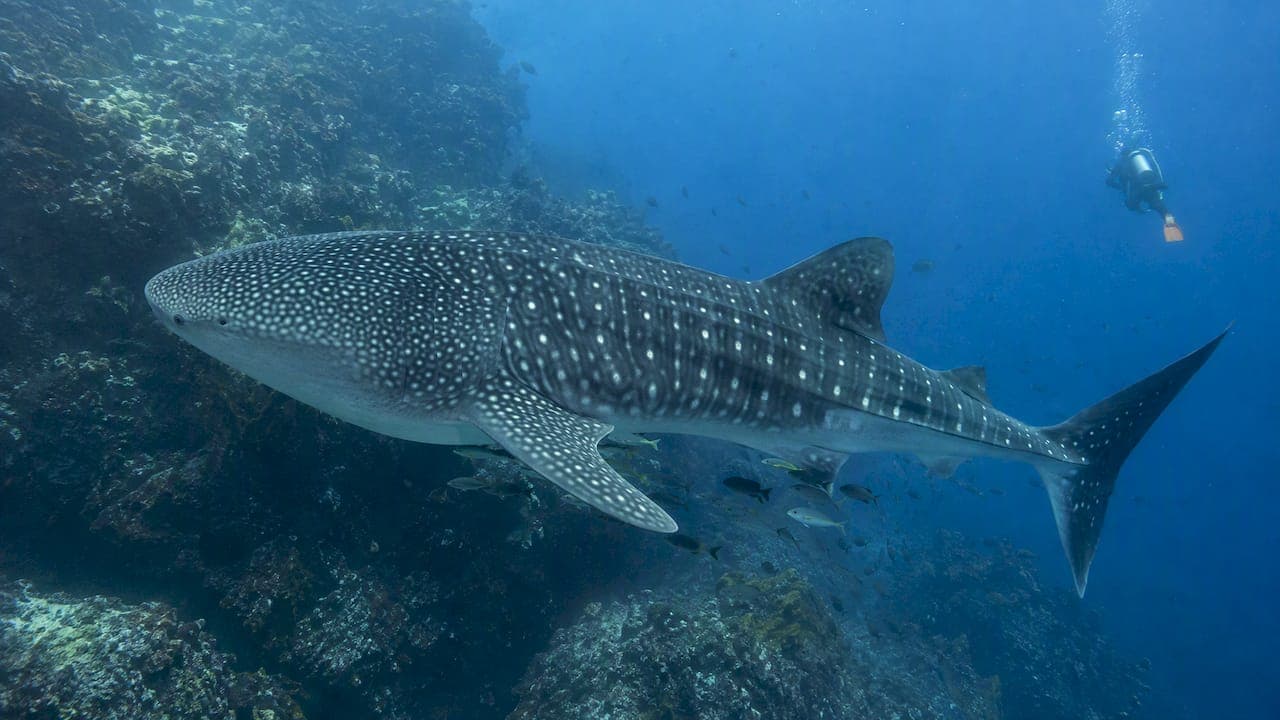
The best months to see whale sharks in the Galápagos run from June through November, with the cool, nutrient-rich season peaking between July and October. Darwin Island and Wolf Island are the only consistent hotspots, and both sit at the edge of what most divers would call advanced conditions. Even in peak months, sightings depend on a wild animal's movements, so no itinerary can promise an encounter.
TL;DR:
- At Darwin, mean sighting rates reached 1.51 per hour in the cool season, versus 0.30 in the warm season, when encounters usually involve juveniles.
- Neither island is reachable on a day trip, so choose a northern liveaboard with multiple dedicated dives and at least seven to ten days.
- Strong, shifting currents, cool water, and remote conditions make Darwin and Wolf advanced dives; bring a 5 to 7 mm wetsuit and reef hook.
- Strong El Niño can suppress whale shark presence even during the cool season, so check forecasts and allow one or two buffer days for crossings.
Table of Contents
- Season timing and probability: month-by-month patterns and El Niño variability
- Where to see them: Darwin, Wolf and the northern hotspots
- Why currents and temperature drive the whale shark season
- What diving conditions to expect at Darwin and Wolf
- How to improve your odds of a sighting
- Planning a liveaboard trip to Darwin and Wolf
- What the research and our captains agree on
- A realistic view of planning your whale shark trip
- Planning your Galápagos charter with us
- FAQ
- Sources
Season timing and probability: month-by-month patterns and El Niño variability
The Galápagos run on two seasons: a warm, calmer season from roughly December through May, and a cool, upwelling-driven season from June through November. Whale sharks track the cool season closely. A peer-reviewed study at Darwin Island found that most records occurred between July and December, with the core peak falling in July through October.
The difference between seasons is not subtle.
During the cool season, divers have a significantly higher chance of spotting a whale shark compared to the warm season. The same Darwin Island study recorded mean sighting rates of 1.51 ± 0.17 per hour in the cool season versus just 0.30 ± 0.14 per hour in the warm season, a gap wide enough to reshape how any diver should plan a trip.
A few practical patterns follow from this data:
- Warm season sightings (January through May) are rare and usually involve juveniles rather than the large adults typically seen at Darwin.
- The cool season's peak window, July through October, is where liveaboard operators concentrate their northern itineraries.
- Shoulder months like June and November can still produce sightings, though with less reliability than the core peak.
Interannual variability complicates even this pattern. Strong El Niño events warm the eastern Pacific and have previously suppressed whale shark presence at Darwin, regardless of the calendar. Divers planning a dedicated trip around a strong El Niño forecast should treat that year's cool season with caution and build in flexibility, since the oceanographic signal that draws whale sharks north can simply fail to arrive on schedule.
Where to see them: Darwin, Wolf and the northern hotspots
Darwin's Arch and the waters around Wolf Island are the two places in the Galápagos Marine Reserve where whale sharks show up with any regularity. Everywhere else in the archipelago, encounters are closer to chance.
What makes these two sites different is partly who shows up. The animals recorded at Darwin are overwhelmingly adult females, many exceeding 11 meters, and researchers believe the island functions as a migration stopover rather than a feeding ground; individuals typically stay only a couple of days before moving on. That short residence time, combined with a preference for intermediate depths, suggests the sharks are passing through on a larger journey rather than settling in.
A few things to know before booking around these sites:
- Darwin and Wolf sit at the far northern edge of the archipelago, well beyond range for any day boat.
- Reaching them requires a northern-focused liveaboard itinerary, typically running several days each way from the central islands.
- Because access depends entirely on vessel range and sea conditions, day trips are not a realistic option here.
Why currents and temperature drive the whale shark season
The timing behind all of this traces back to ocean currents. The Humboldt Current pushes cold, nutrient-rich water up from the south during the cool season, triggering upwelling around the Galápagos platform. That upwelling fuels plankton blooms, and plankton blooms are what eventually draw transient, mature whale sharks north to feed and pass through.

Temperature is the clearest signal of this process from a diver's seat.
Sightings cluster tightly around sea surface temperatures of 23 to 25°C, according to the Darwin Island study, with sighting frequency dropping off as the water warms beyond that range.
A few findings worth keeping in mind underwater:
- Whale sharks at Darwin favor intermediate depths, generally 20 to 30 meters, rather than the shallows or the deep blue.
- Their visits are brief, often around two days per individual, consistent with a stopover rather than a resident population.
- Plankton pulses tied to upwelling create short windows of abundant food, which is likely what pulls these animals through the area rather than past it.
Understanding this cause and effect matters for planning: a cool, upwelling-driven ocean is the entire reason the season exists at all.
What diving conditions to expect at Darwin and Wolf
Underwater, Darwin and Wolf feel nothing like a relaxed reef dive. Visibility during the season typically runs 15 to 25 meters, and water temperatures sit around 20 to 25°C, cool enough that exposure protection matters more than many divers expect coming from tropical destinations.
Currents are the defining feature of both sites, and they are a major reason operators and guides commonly recommend experienced divers for these dives. Surge and strong lateral currents can appear with little warning, and drift diving skills, good buoyancy control, and comfort with negative entries all make a real difference in both safety and enjoyment.
Gear recommendations follow directly from those conditions:
- A 5 to 7mm wetsuit is standard for the cool season; some divers prefer a semi-dry suit when temperatures sit at the lower end of the range.
- A hood and boots help considerably given the water temperature and current exposure.
- A reef hook can be useful for holding position in current without damaging the reef or expending excess air.
Pro Tip: Rent or test your exposure protection before the trip. Cold hands and a poorly fitted hood are the two most common complaints on Darwin and Wolf dives.
How to improve your odds of a sighting
No itinerary guarantees a whale shark, but certain choices measurably improve the odds. Longer trips matter more than almost anything else, since more dives at Darwin and Wolf simply means more chances to be in the water at the right moment.
A few steps worth taking before and during the trip:
- Book a liveaboard of at least seven to ten days that dedicates multiple dives specifically to Darwin and Wolf rather than treating them as a single stop.
- Aim for the mid-to-late cool season, July through October, when sighting rates are consistently highest.
- Build in a buffer day or two in your schedule in case weather or sea conditions delay a crossing to the northern islands.
- Photograph the underside pattern and left flank of any whale shark you encounter, which are the standard reference points for individual identification.
- Submit clear photos to the Galapagos Whale Shark Project, which maintains an identification database used to track migratory routes and population trends over time.
Pro Tip: A wide-angle lens with no strobe works best for whale shark photo-ID; the goal is a clean, well-lit shot of the flank pattern, not a close-up.
Planning a liveaboard trip to Darwin and Wolf
Reaching Darwin and Wolf means committing to a northern-focused liveaboard itinerary, and these trips book out well ahead of the July through October peak. Vessels capable of the crossing are limited, and demand during the strongest sighting months is high enough that late planning often means settling for shoulder-season dates instead.
The Galápagos Marine Reserve enforces strict rules for visiting divers, including no touching marine life and keeping a respectful distance from whale sharks regardless of how approachable they appear in the moment.
Before booking, it helps to confirm:
- Trip length and how many dedicated dive days are allocated to Darwin and Wolf specifically.
- Travel insurance that covers remote diving and emergency evacuation, given the distance from medical facilities.
- A realistic expectation that sightings are a biological event, not a scheduled activity, however strong the season's odds may be.
What the research and our captains agree on
The Darwin Island study and years of operator logs point to the same conclusion: whale sharks are a cool-season, northern-islands phenomenon, dominated by large adult females passing through on short visits. Our former captains, who have run northern Galápagos itineraries directly, see that pattern reflected season after season: the strongest encounters cluster in the peak months, and patience in the water pays off more than any particular dive technique. Divers who want to contribute beyond their own trip can submit identification photos to the Galapagos Whale Shark Project, adding to a dataset that has shaped much of what we now know about these animals.
A realistic view of planning your whale shark trip
Expect good odds in peak season, not a guarantee. The sharks that pass through Darwin are transient, so patience across several dive days matters more than any single dive. Choosing an experienced, crewed liveaboard improves both safety in strong current and the odds of being in the right spot. Pack a proper wetsuit, a reef hook, and more patience than you think you need.
— Mo
Planning your Galápagos charter with us
We plan liveaboard charters built around the Galápagos whale shark season, with itineraries that reach Darwin and Wolf. That experience means fewer wasted dive days and a schedule shaped around when the cool season is strongest.

A few things we can help with when planning your trip:
- Matching your dates to the July through October peak window whenever your schedule allows it.
- Selecting a vessel suitable for multi-day northern crossings to Darwin and Wolf.
- Building contingency days into the itinerary, since even the best season can't guarantee a sighting.
We are candid that a whale shark encounter is a wildlife event, not a scheduled stop, which is exactly why experienced planning and flexible timing matter so much. If you want to check available dates for a Galápagos itinerary, visit our Galápagos yacht charters page or reach out directly through Exoticacharters to start planning.
FAQ
What time of year are whale sharks in Costa Rica?
Whale shark patterns in Costa Rica differ from the Galápagos and depend on local oceanographic conditions specific to that coastline. This article focuses on Galápagos seasonality, where the cool season from June through November, peaking July through October, is the well-documented window.
Are there great white sharks in the Galápagos?
Great white sharks are not a feature of Galápagos diving; the sharks divers typically encounter there include whale sharks, hammerheads, and Galápagos sharks. Darwin and Wolf are known specifically for whale shark and hammerhead aggregations rather than great whites.
Is diving in the Galápagos difficult?
Diving at Darwin and Wolf is generally considered advanced due to strong currents, cooler water, and remote conditions, and destination guides recommend experienced divers for these specific sites. Diving elsewhere in the archipelago can be more moderate, but the whale shark hotspots are the most demanding sites in the reserve.
What are five animals only found in the Galápagos Islands?
The Galápagos host several endemic species, including the Galápagos giant tortoise, the Galápagos penguin, the flightless cormorant, the marine iguana, and the Galápagos land iguana. Whale sharks themselves are not endemic to the islands; they are migratory visitors drawn there seasonally by cool, nutrient-rich water.
When is the best time to see whale sharks in the Galápagos?
The most reliable window is July through October, within the broader cool season that runs June through November, based on sighting-rate data from Darwin Island. Outside these months, sightings become uncommon and typically involve juveniles rather than the large adults seen in peak season.
Sources
- Whale Shark (Rhincodon typus) Seasonal Presence, Residence Time and Habitat Use at Darwin Island, Galapagos Marine Reserve | PLOS ONE
- Galapagos Whale Shark Project
- Scuba diving in the northern islands of the Galapagos, Ecuador (Wolf, Darwin, Pinta, Genovesa, Marchena): description of dive sites, maps, dive operators (Zubi)