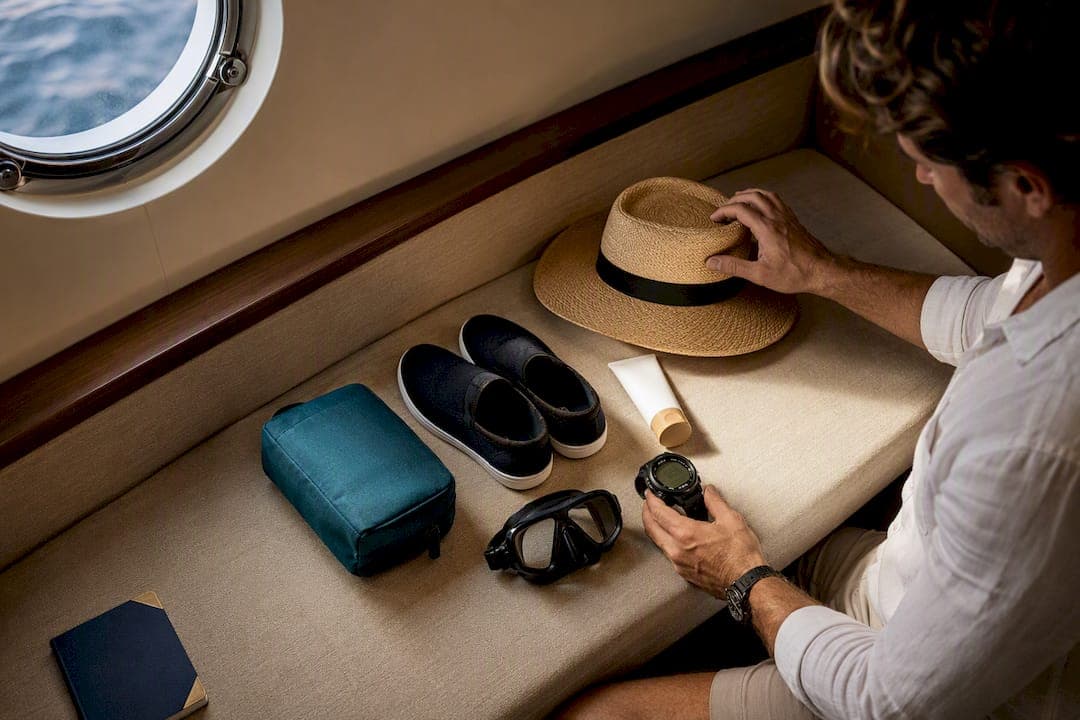
Three things must be confirmed before you set foot on the tender: your travel documents and dive insurance, your certification card and personal gear, and the yacht's onboard equipment and instructor availability. Contact your broker now to lock in arrival timing and confirm what the boat supplies, because that single call resolves most of what could otherwise go wrong.
TL;DR:
- Confirm your passport has at least six months of validity and that your travel insurance explicitly covers scuba diving and medevac services.
- Pack versatile clothing, including quick-dry layers, reef-safe sunscreen, and multiple shore shoes, with essentials in your carry-on for the first 24 hours.
- Bring a personal diving mask and snorkel, and verify the yacht's equipment, gear sizing, and onboard instructor availability before departure.
- Prepare lightweight gear for wildlife viewing and shore excursions, including binoculars, a camera, layered clothing, and biodegradable toiletries.
- Allow extra time for transfers, confirm luggage restrictions, and ask about additional charges like port fees, fuel surcharges, and provisioning costs.
Table of Contents
- Travel Documents and Bookings to Confirm Before Departure
- Core Packing Essentials for a Multi-Activity Luxury Yacht
- What Divers Need to Confirm Before Boarding
- Gear for Wildlife Viewing and Shore Excursions
- Health, Medication, and Onboard Safety Prep
- Timing, Transfers, and Costs to Verify
- Onboard Etiquette and Safety Conduct
- Your One-Page Pre-Boarding Checklist
- What Most Guests Forget on Their First Dive Charter
- Let Exotica Charters Handle the Details You Can't Google
- Sources
Travel Documents and Bookings to Confirm Before Departure
A denied boarding over a lapsed passport or a diving exclusion buried in your travel insurance policy is entirely preventable, and entirely avoidable with a week of admin. Most remote charter destinations require six months of passport validity beyond your travel dates, plus a visa depending on your nationality and port of entry. Your paperwork list should include:
- Passport with sufficient validity, plus a digital and printed copy stored separately from the original
- Travel insurance that explicitly names scuba diving and medevac coverage, with the policy number shared with your broker
- Your diver certification card and recent logbook pages, scanned and uploaded if the charter requests them
- Confirmed embark and disembark times, transfer reservations, and any dietary or allergy notes on file
- Emergency contacts and medical information passed along to the chief steward before you board
Handle this early, and the rest of the yacht charter checklist becomes a matter of packing well rather than scrambling at the dock.
Core Packing Essentials for a Multi-Activity Luxury Yacht
Pack for versatility, not volume. Days on a working expedition charter swing from a wetsuit change to a smart-casual dinner in the span of a few hours, and your bag should keep pace without weighing down the tender.
- Quick-dry layers, a sun-protective long-sleeve shirt, a light jacket for evening breezes, and one smart-casual outfit for dinners ashore or on deck
- Deck shoes, water shoes for rocky landings, and a pair of sandals; pack everything in soft duffels rather than hard-shell suitcases, since crew stowage space rewards flexible luggage
- Reef-safe sunscreen, a wide-brim hat, and polarized sunglasses for glare off the water
- Chargers, a power bank, a waterproof phone case, and spare batteries for cameras, since outlets are limited once you're underway
- A dry bag for tenders, a small daypack for shore excursions, and clear luggage tags for transfer legs
Pro Tip: Pack your first 24 hours' essentials, meds, swimsuit, and a change of clothes, in your carry-on. Checked luggage on remote transfers occasionally lags a flight behind you.
What Divers Need to Confirm Before Boarding
Diving from a private charter removes the daily shuttle to a dive resort, but only if the boat's equipment and your paperwork line up before day one. Modern charter yachts often carry onboard compressors, full scuba gear sets, and PADI-certified Divemasters, which means guided dives and even certification courses can happen without leaving the anchorage. Confirm these points with your broker in this order:
- Bring your certification card, recent logbook entries, and, where possible, your own mask, snorkel, fins, and dive computer.
- Ask exactly which gear the yacht supplies. Most dive-equipped boats carry tanks, regulators, BCDs, and wetsuits, but sizing and availability vary by vessel.
- Confirm whether a PADI or SSI instructor or Divemaster is aboard, along with the tender procedure, rinse-station setup, and surface marker buoy protocol.
- Ask the crew's recommended surface interval before your flight home, since dive schedules on remote itineraries often need to be planned backward from your departure time.
Bringing personal gear isn't about distrust of the equipment locker. Fit and familiarity change how a dive feels, especially on multiple-dive days when a borrowed mask that leaks becomes the difference between a great dive and an irritating one. Exotica Charters' scuba-capable yacht listings spell out which vessels carry compressors and instructors, so you can verify capability before you ever request a quote.
Gear for Wildlife Viewing and Shore Excursions
Non-diving days call for a lighter kit, but a few items make the difference between watching wildlife from a distance and actually seeing it clearly.
- Compact binoculars, 8x to 10x magnification, easy to hold steady from a moving tender
- A camera or GoPro with spare batteries and a memory card or two, since remote anchorages rarely have a camera shop nearby
- Layered clothing for excursions, insect repellent, and a water-resistant jacket for sudden squalls
- Grippy, quick-dry shoes or boots for wet landings, plus reef-safe sunscreen and biodegradable toiletries to keep the ecosystems you're visiting intact
Health, Medication, and Onboard Safety Prep
Pack prescription medications in your carry-on with a copy of the prescription, and tell your broker about any allergies or conditions before you board. A small personal first-aid kit and motion-sickness remedies belong in every bag, and it's worth asking whether the yacht carries oxygen and emergency medical supplies as part of its standard safety equipment.
- Prescription meds in carry-on, plus a written copy of the prescription
- Personal first-aid kit and your preferred motion-sickness remedy
- Confirmation of onboard oxygen and emergency medical supplies
- A check with a travel clinic on recommended or required vaccinations for your destination
- An emergency contact and medical-information card handed to the crew at embarkation
Pro Tip: Even confident sailors get queasy on their first open-water crossing. Pack motion-sickness tablets in your carry-on, not your checked bag, so you're not caught out on transfer day.
Timing, Transfers, and Costs to Verify
Getting to a remote anchorage rarely means a single flight and a taxi. Guests should allow extra buffer time for tenders and seaplane transfers, and soft bags are frequently required for the final leg.
- Build in buffer time at your embarkation hub for customs, connecting flights, and island transfers.
- Confirm luggage limits for tender, seaplane, or vehicle transfers, and pack in soft duffels rather than rigid cases.
- Finalize special requests and equipment sizing two to four weeks before departure, while the crew still has time to source what you need.
- Ask about extra costs beyond the charter fee: port and harbor fees, fuel surcharges, provisioning, and the Advance Provisioning Allowance (APA) that covers onboard consumables.
Onboard Etiquette and Safety Conduct
Attend the first-day safety and dive briefing, and know your life jacket and muster station before the anchor comes up. Follow crew guidance on shore landings and wildlife encounters, and never approach or feed animals, even when they seem approachable. Raise tipping questions or special requests through the purser or your charter broker, and go easy on charging multiple devices at once in remote areas where generator capacity is limited.

Your One-Page Pre-Boarding Checklist
Print this before you leave home and check items off as you pack.
Documents & confirmations: passport with validity checked, visa if required, dive insurance policy number on file, certification card and logbook, embark and disembark times confirmed, transfer reservations booked.
Packing & activity gear: personal mask and dive computer, reef-safe sunscreen and wide-brim hat, quick-dry layers and deck shoes, binoculars and camera with spares, first-aid kit and motion-sickness remedy, chargers and a power bank.
What Most Guests Forget on Their First Dive Charter
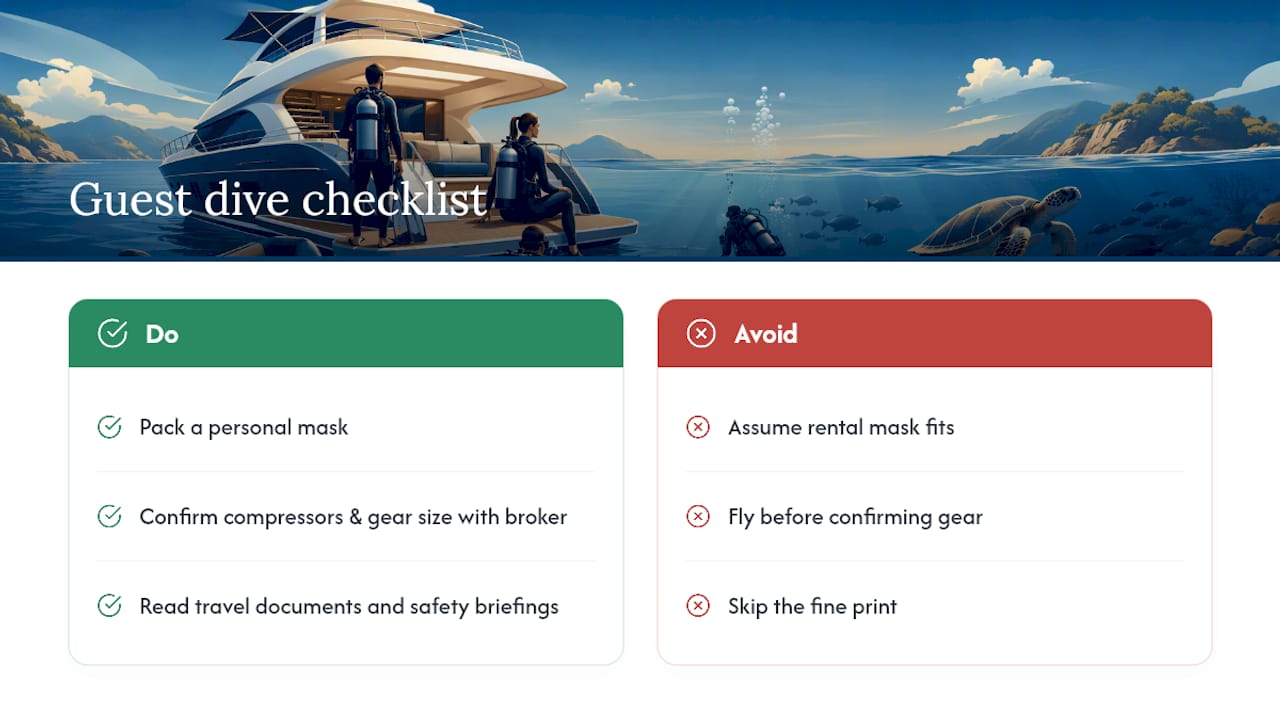
The item I see skipped most often isn't exotic. It's the personal mask. Guests assume a rental will do, then spend their first dive fighting a slow leak that has nothing to do with the reef and everything to do with an unfamiliar seal against their face. Confirming onboard compressors and gear sizing with your broker before you fly solves this before it becomes a problem at 40 feet.
None of this replaces reading the fine print, though. Exotica's Yacht Charter Insights library goes deeper on travel documents and safety briefings than any single checklist can, and it's worth a read if this is your first expedition-style charter rather than a standard week on the water.
— Mo
Let Exotica Charters Handle the Details You Can't Google
Confirming compressor specs, tank sizes, and instructor schedules across a dozen yacht operators isn't a weekend project, and that's exactly the gap Exotica Charters closes for dive and wildlife itineraries. Our team of former captains and water-sports professionals verifies onboard equipment and crew credentials before you ever see a quote, so the guesswork in this checklist becomes a five-minute confirmation call instead of a research project.

Browse Exotica's luxury yacht listings to see fully crewed vessels built for exactly this kind of trip, or go straight to the scuba-equipped charter fleet if diving is the priority. Reach out to a charter specialist today, share your destination and dates, and let the crew confirm the equipment list before you finish packing.