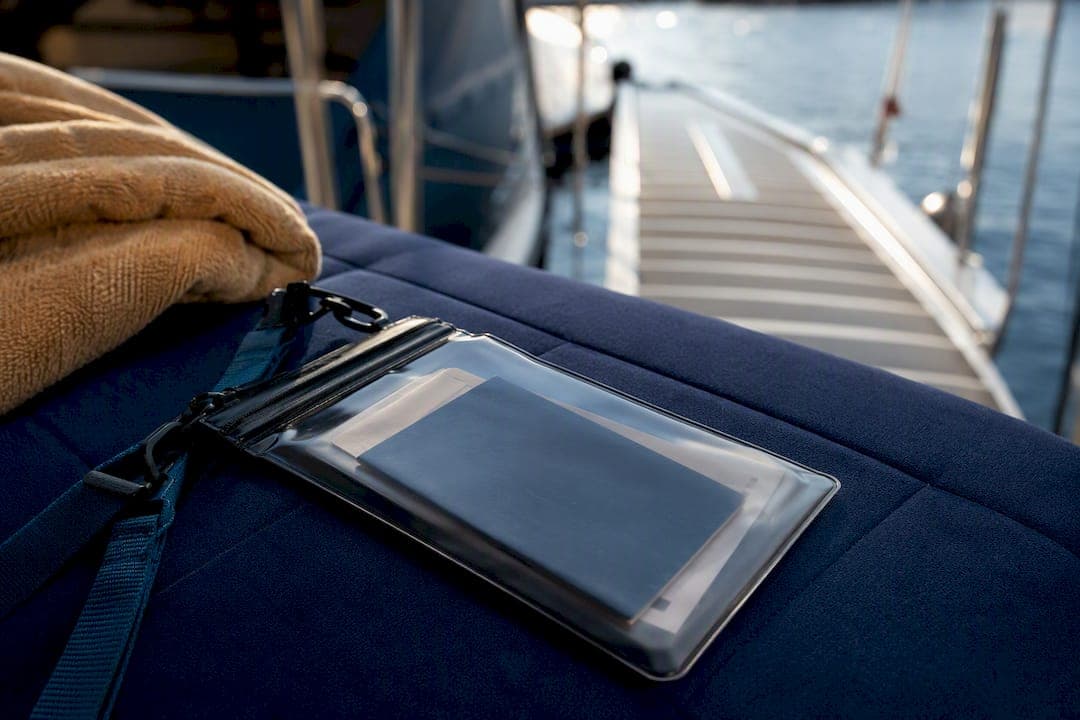
Three documents make or break a smooth embarkation: a valid passport, your charter confirmation with matching guest manifest details, and a personal travel insurance policy. Keep the originals in a waterproof pouch inside your carry-on, and back everything up digitally before you leave home. Exotica Charters confirms your manifest and boarding instructions in writing well ahead of departure, so nothing is left to guesswork at the dock.
TL;DR:
- Personal identification must include a valid passport with at least six months of validity beyond the trip end date and a government-issued photo ID.
- Travel documents should be kept in a waterproof pouch inside your carry-on and backed up digitally, with activity-specific certifications stored in easily accessible locations.
- Personal travel insurance, covering medical evacuation and trip interruption, is essential since yacht owner policies do not cover guest medical expenses or evacuation costs.
- Confirm manifest details with your broker weeks before departure, ensuring passport info, emergency contacts, and destination permits are accurate and complete.
- Additional documents like visas, permits, or waivers are required for remote or multi-island trips, and itineraries crossing borders demand advance coordination of clearance procedures.
Table of Contents
- What Documents Do You Need for a Yacht Charter?
- How Should You Pack and Protect Your Travel Documents?
- Which Insurance Actually Protects You on a Charter?
- What Happens at Embarkation and the Manifest Check?
- Do You Need Extra Documents for Remote or Multi-Island Itineraries?
- How Do Customs and Immigration Work on a Yacht Charter?
- What Documents Do You Need for International Waters?
- How Exotica Charters Takes the Paperwork Off Your Plate
- Let Exotica Charters Handle Your Pre-Departure Checklist
- Where to Confirm Final Document Requirements
- Sources
What Documents Do You Need for a Yacht Charter?
A charter trip has its own document logic, distinct from a resort stay or a cruise. Think of it in three tiers: what you absolutely cannot board without, what crew and port officials will usually ask for, and what applies only if you're diving, fishing, or heading somewhere with local permit rules.
Must-have personal identification:
- Valid passport for every guest, valid for at least six months beyond your planned return date
- Government-issued photo ID as backup (driver's license or national ID card)
- Printed charter confirmation with your booking reference number
Booking and manifest details to confirm with your broker:
- Guest name spellings matching passports exactly, including middle names
- Passport numbers, dates of birth, and nationalities for every guest
- Emergency contact name and phone number for each traveler
Insurance paperwork to carry:
- Policy number and 24 hour emergency assistance line, printed and saved to your phone
- Coverage summary noting medical evacuation and trip interruption limits
- Note the purchase window for CFAR or pre-existing condition waivers, often within 1 to 21 days of your deposit, so you don't miss eligibility
Activity-specific items, when relevant:
- Diving certification card (PADI, NAUI, or equivalent) for any charter with scuba components
- Signed medical waivers for water sports or high-adrenaline excursions
- Fishing permits or licenses if your itinerary includes recreational angling
- Credit card and photo ID matching, for onboard incidentals and provisioning
Our Family Packing Guide for Yacht Charter Vacations 2026 breaks this checklist down further for guests traveling with kids, including which documents minors need beyond a passport.
How Should You Pack and Protect Your Travel Documents?
Never pack anything on this list in checked luggage. Delayed bags and misrouted transfers happen even on well-planned trips, and a passport locked in a suitcase somewhere over the Atlantic is not a problem you can solve dockside.
Keep originals in a dedicated waterproof pouch inside your carry-on. Yacht charter packing guidance consistently recommends this exact setup: passport, charter confirmation, and insurance details together, sealed, and never buried at the bottom of a bag. Photograph every document with your phone, then store encrypted copies in a secure cloud folder. Email a set to a trusted contact back home who can retrieve and forward them if your phone is lost overboard, which does happen more often than you'd think on tender rides.
Organize by use case rather than by document type. One folder for day-one embarkation items, another for activity certifications you'll need mid-trip, a third for anything tied to shore excursions. Former captains recommend keeping activity certifications somewhere reachable in your cabin rather than packed away, since dive checks often happen with little notice.
Pro Tip: Carry a small dry bag specifically for tender runs to shore. Passport, wallet, and phone go in that bag, not your pockets, every single time you step off the main vessel.

Crew will typically request your passport and confirmation at the top of the gangway on embarkation day, so keep them accessible rather than zipped into a suitcase pocket.
Which Insurance Actually Protects You on a Charter?
The yacht owner's insurance protects the vessel and the crew. It does not cover your deposit, your medical bills, or your evacuation if something goes wrong two hundred miles from the nearest hospital. That distinction catches first-time charter guests off guard more than any other document issue.
Personal travel insurance should be treated as your primary protection for medical emergencies, evacuation, and trip interruption, not a nice-to-have layered on top of the charter contract. On remote expedition itineraries, this matters even more: evacuation logistics from a remote anchorage can be complex and expensive, and standard domestic health coverage rarely extends offshore.
Before you buy, verify:
- Medical evacuation limits high enough for helicopter or boat transport from a remote location
- Adventure-activity language that explicitly names diving, jet skiing, or whatever water sports your itinerary includes
- Charter-disruption wording covering weather delays or vessel mechanical issues, not just flight cancellations
- CFAR and pre-existing condition waiver windows, since these typically require purchase within days of your deposit
A charter contract review confirms the owner's policy protects the owner, not the guest, which is why brokers ask new clients about personal coverage before finalizing details. Print a one-page summary with your policy number and emergency line, and hand it to the crew at boarding. Our guide to yacht charter insurance requirements walks through policy language line by line if you want the longer version before you buy.
What Happens at Embarkation and the Manifest Check?
The guest manifest is the single document that ties your booking to what port authorities and coastguard officials see on paper. Passport data has to match your booking exactly, down to middle names and spelling, or you risk delays right at the point you're most eager to board.
- Confirm manifest details with your broker weeks before departure. Passport numbers, date of birth, nationality, and emergency contacts typically need to be submitted in advance, not handed over dockside.
- Arrive at your check-in time with passports and confirmation in hand. Most crews expect boarding to begin thirty to sixty minutes before departure, giving time for a final identity check.
- Present IDs when asked, along with any signed medical declarations. Crew will cross-reference names against the submitted manifest.
- If a document is missing or a name doesn't match, tell the crew immediately. Captains have handled this before and can often coordinate a same-day fix with local authorities rather than delaying the whole charter.
Our complete guide to the yacht charter manifest explains exactly which fields get submitted and when, so there are no surprises the week before you fly out.
Do You Need Extra Documents for Remote or Multi-Island Itineraries?
Visa rules deserve a second look even on short island hops between neighboring countries, since entry requirements can differ from country to country within the same region despite geographic proximity. What's visa-free from your home country might not be visa-free for the next island on your itinerary.
Certain destinations layer on local permits beyond the standard document set:
- Galápagos itineraries typically require transit permits and park entry documentation arranged in advance, not purchased on arrival
- Remote national park regions often mandate conservation fees or entry permits tied to specific dates
- Some archipelago nations require advance notification for inter-island movement by private vessel
If your itinerary touches any of these, confirm requirements with your broker or a local agent months, not weeks, ahead. Expedition charters can also call for specialist waivers, proof of required vaccinations, and signed forms from third-party activity operators (dive shops, kayak outfitters) working alongside the crew. Guests heading into these regions should read our notes on what to pack for an expedition charter before finalizing their document folder.
How Do Customs and Immigration Work on a Yacht Charter?
Customs and immigration for a private charter guest usually happen at two points: your arrival into the charter destination country, and any subsequent island or port stops the itinerary includes. Most affluent charter guests fly in commercially or by private jet, clear immigration at the airport like any other traveler, and then join the yacht at the marina, where the crew handles vessel-level clearance separately.
Where it gets more involved is on multi-country itineraries. If your route crosses from one nation's waters into another's, the vessel itself typically clears customs at each port, a process the captain manages, but you as a guest may still need to present your passport for a stamp or declaration at that stop. This is common in regions like the Eastern Caribbean or parts of the Mediterranean, where island nations sit close together but maintain separate immigration authorities.
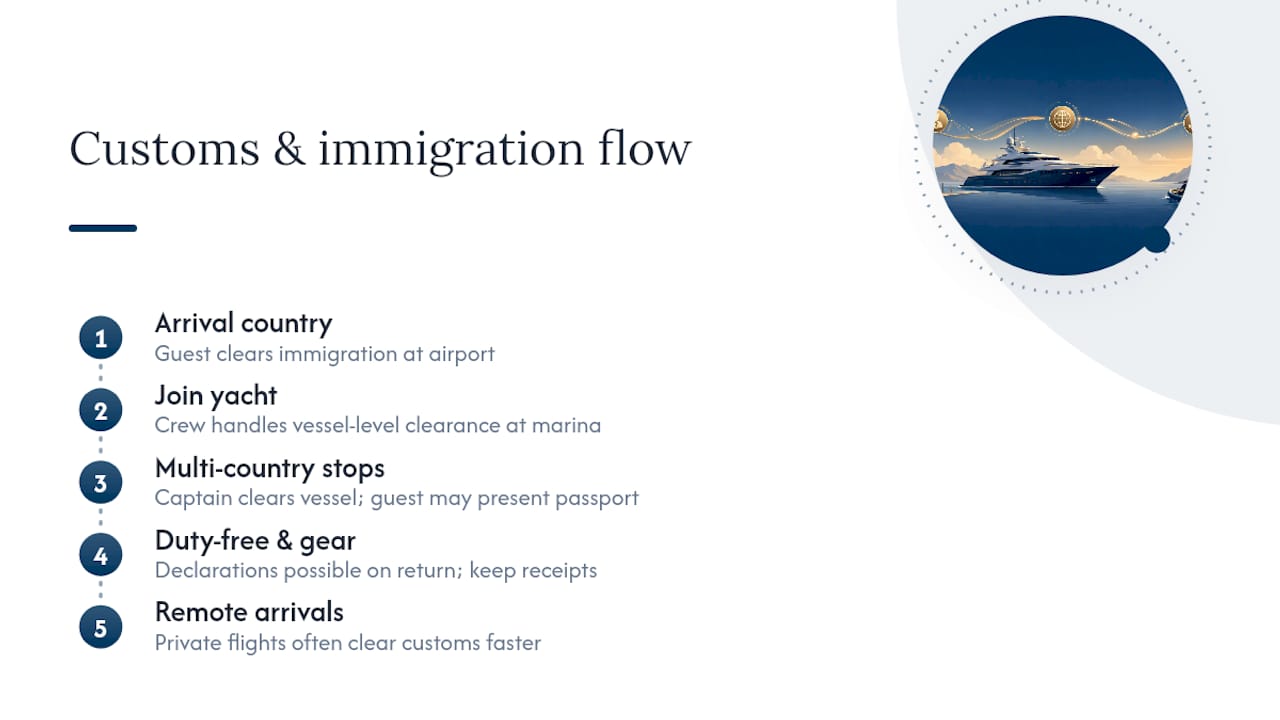
Duty-free items purchased onboard or ashore, along with anything you're bringing in for extended stays (dive gear, specialized equipment), can trigger standard customs declarations on arrival home. Keep receipts for anything of meaningful value. For guests flying into remote regions to meet their yacht, private aviation routes into smaller island airfields often clear customs faster than commercial terminals, which matters when your charter's departure window is tight.
What Documents Do You Need for International Waters?
Crossing between countries' territorial waters, or transiting through international waters between two nations, calls for a slightly different document posture than a single-country itinerary. The vessel carries its own registration and clearance paperwork, but guests should still keep passports easily accessible throughout, not just at the start and end of the trip.
Coastguard or naval patrol checks are uncommon on private charters but not unheard of in certain regions, particularly near contested or heavily monitored maritime borders. When they happen, officials generally want to see passports and confirmation that everyone aboard is a legitimate charter guest, which is exactly what the manifest exists to prove.
If your itinerary includes a border crossing at sea, ask your broker in advance whether a specific clearance document or advance notification is required for that route. Some nations require yachts to file a pre-arrival notice before entering territorial waters, separate from anything the guest needs to carry personally. This is arranged by the captain and broker, but guests benefit from knowing it's happening, since it can shift arrival timing by a few hours. Keep your passport in the waterproof pouch discussed earlier through every leg of a multi-border trip, not just the first and last days.
How Exotica Charters Takes the Paperwork Off Your Plate
Our team is built from former captains and water-sports professionals who have sat on the other side of this checklist, checking passports at the gangway and coordinating manifests with port officials. That experience shows in how we run pre-departure prep, and it's part of why guests rate us highly on Trustpilot.
Before you travel, we confirm in writing:
- Your complete guest manifest, cross-checked against passport spellings
- Boarding time, location, and what to bring to the dock
- Destination-specific permit or visa requirements for your itinerary
- Recommended insurance features to verify before you buy a policy
You show up with your documents in order. We handle the coordination with the crew and local authorities.
— Mo
Let Exotica Charters Handle Your Pre-Departure Checklist
Most charter guests spend hours cross-referencing visa rules, manifest fields, and insurance fine print across five different websites before they ever pack a bag. Exotica Charters removes that friction entirely: our brokers confirm your manifest, flag destination-specific permits, and issue written boarding instructions before you leave home, so the only thing you're managing on travel day is getting to the dock.
Whether you're booking a crewed yacht for a family trip or planning an expedition charter into remote waters, our team confirms every document detail specific to your route, from Galápagos transit permits to dive certification requirements. Reach out through our luxury yacht charter listings to request your trip's document checklist and get your manifest confirmed in writing before you book your flights.
Where to Confirm Final Document Requirements
Check Travel.State.Gov's international travel checklist for current passport and consular guidance, and review our manifest guide for booking details. Confirm destination-specific permit rules with your embassy or local agent close to your departure date.