
A yacht charter manifest is the official legal record of every person aboard a vessel for a specific trip, required by maritime authorities worldwide for safety and regulatory compliance. Most charter guests never think about it until their captain asks for passport details two days before departure. Understanding what goes into a manifest, why it matters, and how it varies by region will save you from last-minute scrambles and potential delays. This guide covers every component you need to know, from mandatory data fields to privacy considerations that most charter guides skip entirely.
What is a yacht charter manifest?
A yacht charter manifest is a formal document that identifies every individual aboard a chartered vessel for a defined trip, serving as the primary record for regulatory bodies, port authorities, and emergency services. Think of it as the vessel's official headcount, one that carries legal weight far beyond a simple guest list. The US Coast Guard and equivalent maritime authorities in the European Union, the Caribbean, and the Pacific all require compliant manifests before a commercial vessel departs. Without one, the captain risks penalties, and the trip may not leave the dock.
The manifest is distinct from the charter contract. Charter manifests serve as operational proof of who is actually aboard the yacht during the charter, while the contract governs the commercial terms. A guest list in the contract and the manifest may look identical before departure, but discrepancies between the two create administrative and insurance problems that can take weeks to resolve. Keeping both documents consistent is a basic but often overlooked step in charter trip planning.

What information is required on a charter manifest?
A compliant manifest must include each passenger's full legal name, the trip dates, and the total headcount verified against the vessel's certificated capacity. Exceeding that capacity is a serious violation, not a technicality. Emergency contact details are strongly recommended for every passenger, even when not legally mandated.
For international charters, the data requirements expand significantly. Authorities in the Mediterranean, the Caribbean, and the Pacific typically require:
- Full legal name as it appears on a government-issued ID
- Date of birth
- Nationality
- Passport number and expiration date
- Port of embarkation and disembarkation
- Trip start and end dates
International charters require passport details and additional data points like date of birth and nationality to satisfy immigration and customs requirements. That level of detail is standard for any voyage crossing national borders.
| Data field | Domestic charter | International charter |
|---|---|---|
| Full legal name | Required | Required |
| Trip dates | Required | Required |
| Passenger headcount | Required | Required |
| Passport number | Rarely required | Required |
| Date of birth | Optional | Required |
| Nationality | Optional | Required |
| Emergency contact | Recommended | Recommended |
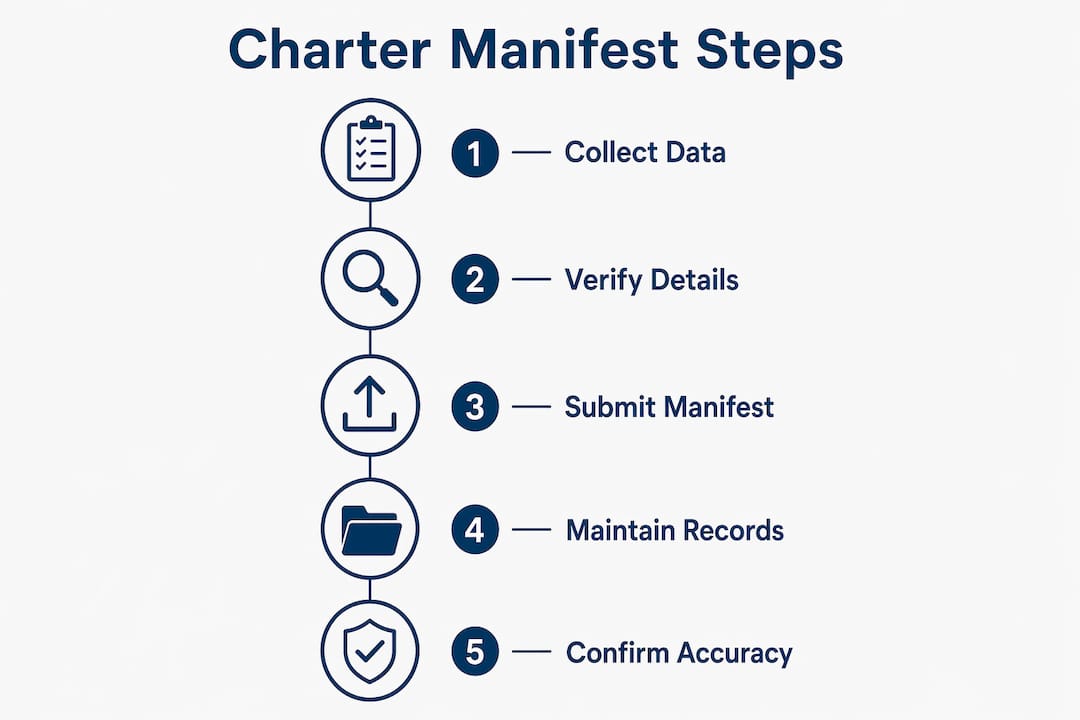
Pro Tip: Collect all passenger details at least one week before departure. Last-minute requests for passport scans create stress for everyone and may delay clearance in jurisdictions that require advance submission.
Why is maintaining an accurate manifest legally essential?
Operating without a compliant manifest exposes the captain and the charter operator to severe regulatory penalties, legal liability, and potential loss of commercial operating status. That last consequence is the most serious. A vessel that loses its commercial certification cannot legally carry paying guests, which ends the business entirely. Accuracy is not optional paperwork; it is the foundation of a legal charter operation.
The manifest also plays a central role in emergency response. If a vessel goes down or a passenger goes missing, search and rescue teams rely on the manifest to confirm exactly who was aboard. An inaccurate or missing manifest turns a manageable emergency into a chaotic one.
"Reconstructing a manifest after an incident renders it legally and operationally useless. The document must exist, be accurate, and be accessible before the vessel leaves the dock. Professional captains treat predeparture completion as non-negotiable."
For inspected or larger commercial vessels, a copy stored ashore before departure is a best-practice requirement. Onshore copies allow port agents or management companies to confirm passenger identities if the vessel's own records are lost or inaccessible during an emergency. The logic is simple: the document that lives only on the boat cannot help rescuers if the boat is the problem.
The manifest also connects directly to insurance claims. Insurers reviewing a casualty event will request the manifest as primary evidence of who was aboard and under what conditions. A manifest that contradicts the charter contract or shows an uncertified passenger count can void coverage entirely.
Here is a practical checklist for manifest compliance before any departure:
- Confirm every passenger's legal name matches their ID exactly.
- Verify total headcount against the vessel's certificated capacity.
- Collect passport details for all international passengers.
- Provide a complete copy to your onshore contact or port agent.
- Cross-check the manifest against the charter contract guest list.
- Confirm submission deadlines with local port authorities.
Pro Tip: Assign one person in your group as the "manifest coordinator." This person collects details from all guests and submits them to the captain in a single organized document, reducing back-and-forth and the risk of errors.
How do manifest requirements vary by region and type of charter?
Manifest requirements vary significantly by region, vessel size, and whether the charter is crewed or bareboat. Commercial vessels face stricter documentation standards than private or small recreational charters. Understanding the regional picture before you book prevents surprises at the port.
In Greece, for example, the Hellenic Coast Guard requires a passenger manifest for all commercial charter vessels, and the document must reflect the vessel's licensed passenger capacity. In the US, the Coast Guard enforces manifest requirements for vessels carrying six or more passengers for hire under its Subchapter T and Subchapter K regulations. The Caribbean varies by island nation, with some jurisdictions requiring advance submission to customs and immigration authorities before arrival.
Some jurisdictions require manifests submitted days before departure to satisfy immigration and customs clearance. Port authorities in those regions may refuse departure clearance if the manifest has not been processed. That means a last-minute guest addition is not just inconvenient; it can physically prevent the boat from leaving.
The distinction between crewed and bareboat charters also matters:
- Crewed charters: The professional captain holds legal responsibility for the manifest. The charter operator or management company typically handles submission to authorities. Guests provide their details to the broker or captain in advance.
- Bareboat charters: The charterer assumes the captain's responsibilities, including manifest preparation and submission. This places the compliance burden directly on the person renting the vessel.
For crewed yacht charters, the crew handles the administrative side, which is one of the practical advantages of choosing a fully staffed vessel. For bareboat renters, researching local submission deadlines and required data fields before departure is a necessary part of trip planning.
Cross-border voyages add another layer. Customs and immigration authorities treat the manifest as an entry document, similar to a passenger list on a commercial flight. Any discrepancy between the manifest and the actual persons aboard can trigger inspections, fines, or denial of entry into port.
What privacy risks come with sharing manifest data?
Passport scans and personal details frequently circulate through email chains among brokers, captains, stewards, and port agents. Each forwarded email creates a new uncontrolled copy of sensitive data on systems with no guaranteed security standards. This is a real and underdiscussed risk in the charter industry.
The data collected on a manifest, including passport numbers, dates of birth, and contact details, is exactly the type of information that identity theft relies on. Most charter guests hand it over without asking a single question about how it will be stored or deleted.
Manifest data retention policies are often vague, and best practice calls for defined retention periods and secure storage. Passenger data should be deleted after the charter season or per applicable legal requirements. The EU's General Data Protection Regulation (GDPR) applies to any charter operator handling data from European guests, regardless of where the vessel operates.
Before your next charter, ask your broker or operator these questions:
- Who receives a copy of the manifest and my passport scan?
- How is that data stored, and on what platforms?
- When will my personal data be deleted after the trip?
- Does your data handling comply with GDPR or equivalent local law?
Pro Tip: Send passport scans as password-protected PDF files rather than open attachments. Ask your charter operator to confirm receipt and deletion after the trip ends. It takes two minutes and meaningfully reduces your exposure.
Privacy of charter guest data remains an underdiscussed risk, and charterers should proactively ask providers how personal data is stored, shared, and deleted after the trip. The best operators will have a clear, confident answer ready.
Key takeaways
A yacht charter manifest is the legally required record of all persons aboard a vessel, and its accuracy before departure determines compliance, emergency response effectiveness, and insurance validity.
| Point | Details |
|---|---|
| Core definition | The manifest is the official legal record of every person aboard for a specific charter trip. |
| Mandatory data fields | Full legal names, trip dates, headcount, and passport details are required for international charters. |
| Legal consequences | An inaccurate or missing manifest risks penalties, voided insurance, and loss of commercial status. |
| Regional variation | Requirements differ by country, vessel size, and charter type; some jurisdictions require advance submission. |
| Privacy risk | Passport scans circulate through multiple parties; ask your operator about data retention and deletion policies. |
What I've learned from watching manifests go wrong
After years of working with charter operators across the Pacific, the Mediterranean, and the Caribbean, I've seen the manifest treated as an afterthought more times than I can count. Guests assume the captain handles it. The captain assumes the broker collected the details. The broker assumes someone sent the forms. Nobody sent the forms.
The manifest is the one document where "we'll sort it out when we get there" genuinely does not work. In jurisdictions like French Polynesia or the Galápagos, where charter trip planning involves crossing international maritime zones, the manifest must be submitted to authorities before the vessel clears customs. A missing passenger detail at that stage does not mean a short delay. It can mean the trip does not happen.
What I find most striking is how few guests ask about data privacy. You would not email your passport to a stranger without questions, but many charter guests do exactly that through an unencrypted email chain involving five or six parties. The industry is improving, but slowly. Asking your operator directly about data handling is the single most underused protection available to charter guests.
The manifest is not bureaucratic friction. It is the document that tells rescuers who to look for if something goes wrong at sea. Treat it with the same seriousness the ocean deserves.
— Mo
Planning a luxury charter with full documentation support
Handling manifest paperwork, passport collection, and regional compliance requirements is genuinely complex, especially for international voyages to remote destinations like the Galápagos, French Polynesia, or Alaska.

Exoticacharters takes care of the documentation process from the first inquiry through departure day. The team, made up of former captains and water sports professionals, knows exactly what each jurisdiction requires and when to submit it. Guests focus on the experience; Exoticacharters manages the compliance. Browse luxury yacht options across some of the world's most extraordinary destinations, and speak with a charter specialist who can walk you through every document your trip requires before you ever step aboard.
FAQ
What is a charter manifest on a yacht?
A charter manifest is the official legal record of every person aboard a chartered vessel for a specific trip. It is required by maritime authorities for safety, regulatory compliance, and emergency response.
What information goes on a yacht charter manifest?
A manifest must include each passenger's full legal name, trip dates, and total headcount verified against vessel capacity. International charters also require passport numbers, dates of birth, and nationalities.
What happens if a yacht charter manifest is inaccurate?
Inaccurate manifests risk penalties, legal liability, and loss of commercial operating status for the vessel. They can also complicate emergency response and void insurance coverage.
Can I add a guest to the manifest at the last minute?
Last-minute guest additions may be impossible in jurisdictions that require manifest submission to authorities days before departure. Always confirm your final guest list as early as possible.
Who is responsible for the manifest on a crewed charter?
On a crewed charter, the professional captain holds legal responsibility for the manifest. The charter operator or management company typically handles submission to port authorities on the captain's behalf.