
A yacht charter rating is a measure of customer satisfaction and quality assurance used to evaluate the performance and reliability of luxury yacht charters. Understanding what does yacht charter rating mean separates informed charterers from those who book on impulse and regret it later. Ratings draw from platforms like Trustpilot, Google, and TripAdvisor, and reputable operators generally score 4.2 stars or higher based on 200 or more independent reviews. That threshold matters because it signals statistical reliability, not just a handful of enthusiastic guests. Exoticacharters, for example, holds strong Trustpilot ratings built on verified client experiences across extraordinary destinations like the Galápagos and French Polynesia.
What does yacht charter rating mean and how is it compiled?
A yacht charter rating is an aggregated score drawn from verified guest reviews across multiple platforms. The score reflects the full experience aboard a vessel, not just one isolated moment. Sources like Google, Trustpilot, and TripAdvisor each collect independent feedback and assign star scores that operators cannot edit or remove.
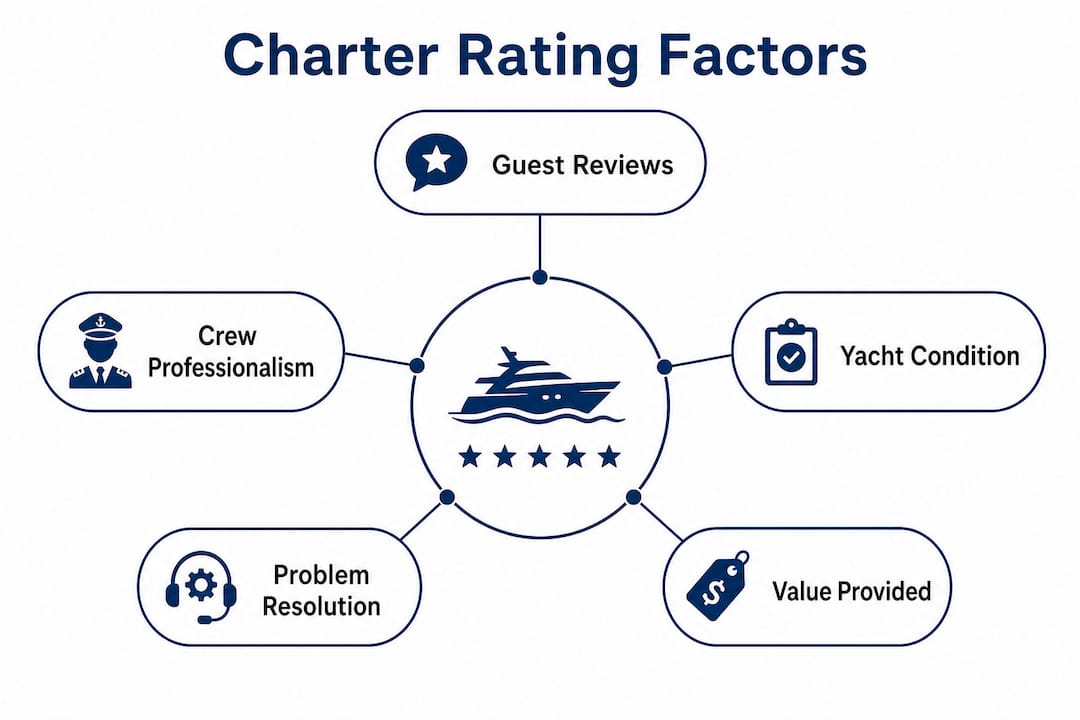
The criteria that feed into a charter rating typically include:
- Crew professionalism: How well the captain and crew anticipated guest needs, communicated safety information, and handled unexpected situations
- Yacht condition: Cleanliness, maintenance quality, and whether the vessel matched its listing photos
- Customer service: Pre-charter communication, booking transparency, and responsiveness to questions
- Transparency in pricing: Whether the final cost matched what was quoted, with no surprise fees
- Problem resolution: How the operator responded when something went wrong
That last point carries more weight than most guests realize. High-rated charter companies excel in problem resolution and transparency, with repeat booking rates often above 40%. A company that recovers gracefully from a mechanical delay earns more loyalty than one that never faces a challenge at all.
One critical distinction: the term "base charter rate" refers to the financial cost of hiring the yacht and crew, not a quality score. The base charter fee covers the yacht and crew only, while the Advance Provisioning Allowance covers running costs like fuel and provisions. Total charter cost typically runs 1.4 to 1.6 times the base fee. Rating and rate are entirely separate concepts, and confusing them leads to poor booking decisions.

Pro Tip: When comparing operators, look for the combination of a 4.2+ star average and a review count above 200. Below that volume, the score is too easily skewed by a few outliers.
How do yacht rating certificates and racing handicaps differ from charter ratings?
The word "rating" appears in several distinct contexts within the yachting world, and each means something completely different. Luxury charter clients need to recognize these differences to avoid misreading what they find during research.
The three main uses of "yacht rating" are:
- Customer satisfaction rating: The hospitality score described above, drawn from guest reviews on platforms like Trustpilot and Google. This is the rating that matters when booking a crewed charter.
- MCA Yacht Rating Certificate: An entry-level crew qualification issued by the Maritime and Coastguard Agency. This certificate is the only MCA-approved credential for people with no prior professional yachting experience, and it is required for crew to serve on the safe manning schedule of a superyacht. It has nothing to do with guest satisfaction.
- Racing yacht rating systems: Handicap formulas used in competitive sailing to level the playing field between vessels of different sizes and designs. These systems calculate a yacht's theoretical speed potential so that race results can be adjusted fairly. They are entirely unrelated to charter quality or hospitality.
A charter client who sees "Yacht Rating Certificate" on a crew member's resume is looking at a professional training credential, not a guest review score. Likewise, a racing handicap number tells you nothing about whether the galley is well-stocked or the captain communicates clearly. Luxury charter clients should focus exclusively on hospitality-based ratings when evaluating operators, and treat the other definitions as background knowledge rather than booking criteria.
How to interpret yacht charter ratings and spot reputable operators
Reading a charter rating with nuance is a skill. A 4.8-star average from 12 reviews tells you far less than a 4.4-star average from 340 reviews. Volume creates credibility. Review platforms become reliable at 200 or more ratings, and isolated complaints should always be read in context of the overall pattern.
Here is a practical framework for evaluating any charter operator's rating:
- Check review volume first. Fewer than 50 reviews means the score is statistically fragile. A single extraordinary trip or a single disaster can swing the average dramatically.
- Read for recurring themes. Phrases like "deposit dispute," "dirty cabin," or "crew was inattentive" appearing across multiple reviews signal a systemic problem, not a one-off incident.
- Examine the refit year, not just the build year. A 1990 yacht refitted in 2022 typically offers more modern amenities than a newer but poorly maintained vessel. The refit year is a stronger indicator of current interior quality than the original construction date.
- Apply the low-price test. A market-average charter for certain models runs roughly EUR 3,800–5,200 per week. Prices well below market almost always signal maintenance or reliability risks, regardless of how the star rating looks.
- Request high-resolution interior photos. Listing photos are often wide-angle shots that make compact spaces look spacious. Ask for photos of the cabins, heads, and galley taken in natural light.
- Ask about repeat booking rates. Operators who see guests return year after year are delivering on their promises. A repeat booking rate above 40% is a stronger quality signal than any star score.
| Signal | What it tells you |
|---|---|
| 4.2+ stars, 200+ reviews | Statistically reliable satisfaction score |
| Refit year within 5 years | Modern interiors and updated systems |
| Repeat booking rate above 40% | Consistent delivery on guest expectations |
| Price well below market average | Likely maintenance or hidden-cost risk |
| Recurring negative themes in reviews | Systemic operator problem, not a fluke |
Pro Tip: Ask your charter broker to share the operator's response rate to negative reviews. Operators who reply professionally and explain their resolution process are far more trustworthy than those who ignore criticism or respond defensively.
What are unified yacht charter rating indexes and why do they matter?
The current rating environment is fragmented. A yacht might have 4.6 stars on one platform, 4.1 on another, and no presence on a third. That inconsistency makes direct comparison difficult and leaves charter clients guessing which score to trust.
Unified rating indexes address this problem by aggregating signals from multiple platforms into a single standardized score. The Boatscribe Index is one example of this approach, consolidating reviews and performance data into a composite quality score where a 5.0 rating signals outstanding performance. That kind of consolidated view helps clients assess both yacht quality and operator reliability without cross-referencing four different platforms manually.
The value of a unified index goes beyond convenience. When ratings are pulled from a single source, they are vulnerable to platform-specific manipulation or review gating. Aggregated indexes are harder to game because they draw from multiple independent data streams simultaneously. As the charter industry matures, standardized rating frameworks are likely to become the norm rather than the exception, giving clients clearer and more comparable information at the point of decision.
For now, the practical approach is to treat any single-platform score as one data point rather than a verdict. Cross-reference Trustpilot with Google, look for patterns across platforms, and use unified indexes where they exist to get the clearest possible picture of an operator's true performance.
Key Takeaways
A yacht charter rating is a hospitality-based quality score, entirely separate from crew certifications or racing handicaps, and it becomes statistically meaningful only above 200 independent reviews.
| Point | Details |
|---|---|
| Rating vs. rate | A charter rating measures service quality; the base charter rate is a financial term for yacht and crew cost. |
| Reliable volume threshold | Scores based on 200 or more reviews carry statistical weight; fewer reviews are easily skewed. |
| Refit year signals quality | A recent refit year predicts current comfort and condition better than the original build year. |
| Low price is a warning | Prices well below market average often indicate maintenance risks, regardless of star score. |
| Unified indexes add clarity | Composite scores like the Boatscribe Index consolidate fragmented platform ratings into one comparable figure. |
What ratings actually reveal about the charter experience
I have spent years working with charter clients across destinations from Alaska to French Polynesia, and the pattern I see most often is this: guests who book on star rating alone are the ones most likely to be disappointed. The number is real, but it is incomplete.
What a rating cannot tell you is whether the crew genuinely loves what they do. A captain who has spent 20 years sailing remote anchorages brings a quality of presence that no review score captures fully. When I look at a charter listing, the refit year and the crew bios hold as much weight for me as the aggregate score. A freshly refitted vessel with a passionate, experienced crew will outperform a higher-rated but stale operation almost every time.
The other thing I have learned is that the best charter operators are the ones who are easiest to reach before you book. If a company takes three days to answer a pre-booking question, that response time tells you exactly how they will handle a problem at sea. Ratings reflect the past. Your direct interaction with the operator reveals the present. Use both, and you will make a far better decision than someone who relies on stars alone. For luxury charter insights that go beyond the numbers, the conversation with a specialist is always worth having.
— Mo
Highly rated luxury charters, curated by people who know the water
Exoticacharters brings together a collection of fully crewed luxury yachts selected for quality, transparency, and the kind of experiences that generate strong ratings for the right reasons. Every vessel in the catalog is assessed not just by star score but by refit year, crew credentials, and the depth of the itinerary options available.

The team at Exoticacharters consists of former captains and water sports professionals who read charter listings the way this article describes: with skepticism, experience, and a focus on what the numbers do not show. Whether you are planning a wildlife expedition in the Galápagos or a sailing adventure through French Polynesia, the luxury yacht collection at Exoticacharters is a strong starting point. Speak with a charter specialist to match your itinerary needs with a vessel that earns its rating.
FAQ
What does a yacht charter rating measure?
A yacht charter rating measures aggregated customer satisfaction across criteria like crew professionalism, yacht condition, pricing transparency, and problem resolution. Reputable operators typically score 4.2 stars or higher based on 200 or more independent reviews.
Is a yacht charter rating the same as the base charter rate?
No. The base charter rate is a financial term covering the cost of the yacht and crew only. A charter rating is a quality score drawn from guest reviews and has no connection to pricing.
What is the MCA Yacht Rating Certificate?
The MCA Yacht Rating Certificate is an entry-level professional training credential for yacht crew with no prior experience. It is required for safe manning on superyachts and is entirely unrelated to customer satisfaction ratings.
How many reviews does a charter rating need to be trustworthy?
A charter rating becomes statistically reliable at 200 or more independent reviews. Below that volume, a single exceptional or negative experience can distort the average significantly.
What is a unified yacht rating index?
A unified yacht rating index, such as the Boatscribe Index, aggregates scores from multiple review platforms into one standardized quality score. This approach reduces the inconsistency that comes from comparing ratings across fragmented sources.