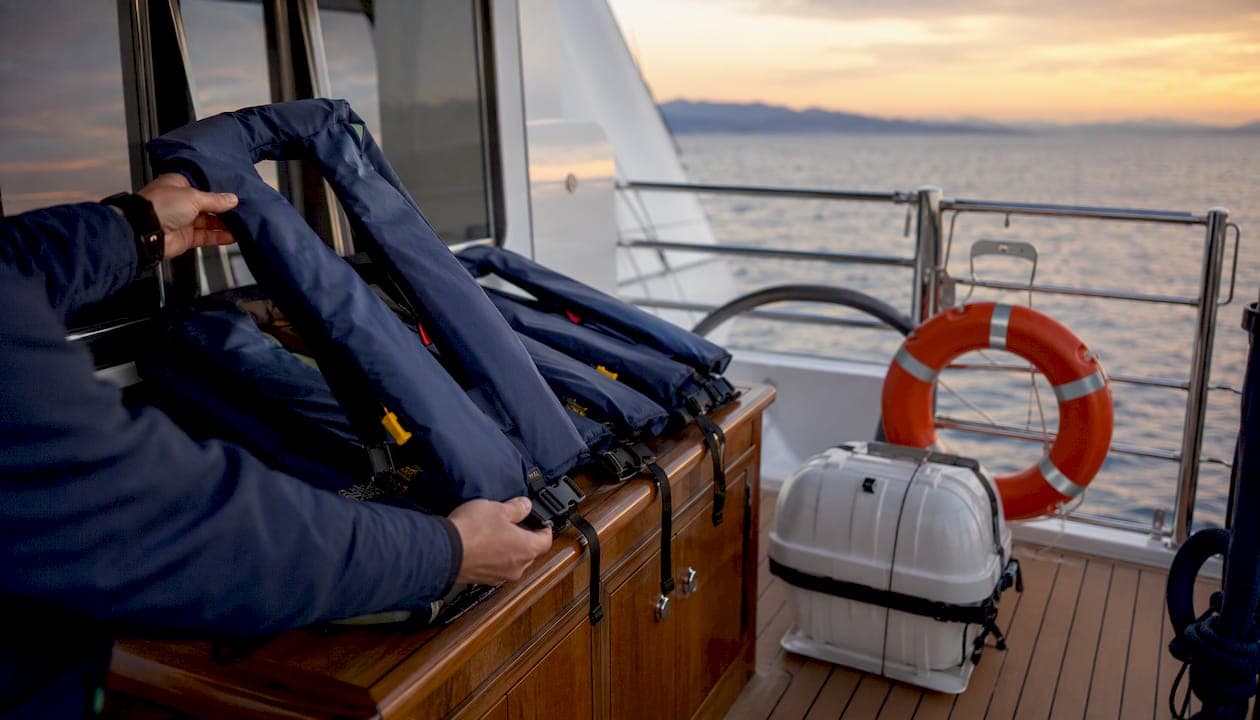
A proper yacht charter safety briefing takes a brief period at step-aboard and delivers three non-negotiable outcomes: every guest knows where the safety gear is, who is in charge, and what to do in the four most likely emergencies. The rest of this guide builds on that foundation.
The absolute must-show items in any briefing:
- PFDs and lifejackets: location, correct fit, and when to wear them
- Man overboard (MOB) response: who shouts, who points, who steers
- VHF radio and Mayday format: channel 16, the exact call sequence
- Fire response: extinguisher location, type, and the two-word rule ("aim low")
Daily refreshers before new activities run 2–3 minutes. A full re-brief after a weather change or new passenger arrival should not exceed 8 minutes.
Key Takeaways
A proper yacht charter safety briefing takes 10–15 minutes at step-aboard, covers demonstrable gear locations and four core emergency procedures, and is backed by pre-boarding paperwork completed before guests arrive.
| Point | Details |
|---|---|
| Briefing timing and length | Step-aboard briefing runs 10–15 minutes; activity-specific add-ons take 3–5 minutes each. |
| Core demonstration items | Show PFDs, MOB ring buoy, VHF Mayday sequence, fire extinguishers, and life raft location before casting off. |
| Role assignment | Name a Second-in-Command and assign specific emergency roles to individuals during the briefing. |
| Safety culture | Frame the briefing as an open conversation; invite questions and state a no-blame reporting policy throughout the charter. |
| Exoticacharters | Every Exoticacharters crewed charter is led by former captains and water-sports professionals who deliver this briefing standard across remote destinations worldwide. |
Table of Contents
- What does a yacht charter safety briefing require before boarding?
- Who runs the briefing, when to do it, and how long each type should take
- The core on-board demonstration checklist
- Emergency procedures and drills every crew member should know
- How to modify the briefing for diving, tenders, and night operations
- How to build a safety culture that lasts beyond the briefing
- A printable checklist and sample script for the step-aboard briefing
- When to brief and how often to repeat key points
- What professional captains actually get right (and what most briefings miss)
- Exoticacharters brings experienced captains and water-sports professionals to every charter
- Sources
What does a yacht charter safety briefing require before boarding?
Smart operators separate pre-boarding paperwork from the onboard demonstration, so the step-aboard briefing stays focused on hands-on gear location rather than form-filling.
The USCG recommends filing a float plan before every departure. On a crewed charter, the captain or operator files this; guests should confirm it has been done. Alongside the float plan, most reputable operators require guests to complete a medical and allergy disclosure form before arrival. This is not optional on a professional charter: undisclosed allergies or cardiac conditions change the first aid kit requirements and the emergency response plan.
| Pre-Boarding Task | Who Completes It | When |
|---|---|---|
| Online safety video or operator briefing | All guests | 24–48 hours before boarding |
| Medical and allergy disclosure form | Each guest | Before arrival at the marina |
| Float plan filed with marina or USCG | Captain/operator | Morning of departure |
| Chart brief and route overview | Captain with guests | At step-aboard or evening before |
| Signed muster acknowledgement | All guests | At step-aboard, before casting off |
The yacht charter manifest is a related document that records every passenger by name, nationality, and emergency contact. Operators like The Moorings and similar crewed-charter companies require guests to watch a pre-departure safety video online precisely so the onboard briefing can skip definitions and move directly to demonstration. If your operator sends a video link, watch it the night before, not on the dock.
Who runs the briefing, when to do it, and how long each type should take
The captain holds legal authority and personal liability for safety onboard. The briefing is the captain's responsibility, full stop. On larger vessels with a mate or lead crew member, that person can deliver specific sections (tender operations, dive gear), but the captain opens and closes every briefing with a clear authority statement.
A structured briefing schedule looks like this:
- Pre-boarding (24–48 hours out): Operator sends online video and paperwork. Guests complete forms independently. No captain time required.
- Step-aboard walkthrough (10–15 minutes): Full demonstrable briefing covering all core safety items. Runs before lines are cast off, never underway.
- Activity-specific pre-brief (3–5 minutes): Delivered before diving, tender use, or night operations. The captain or a designated crew member leads it.
- Daily morning refresher (2–3 minutes): A quick verbal check covering the day's route, weather, and any changed conditions. Especially useful after an overnight passage.
- Night briefing (2 minutes): Covers lights, restricted deck movement, mandatory harness use, and who has the watch.
US Sailing's guidance on safety culture frames the briefing not as a one-time lecture but as the opening moment of an ongoing safety conversation. That framing matters practically: a captain who invites questions at step-aboard will hear about a guest's bad knee or fear of confined spaces before it becomes a problem at sea.
The captain should also name a Second-in-Command for guest communication, typically the most experienced adult guest or a lead crew member. This person relays instructions to the group during an emergency, freeing the captain to manage the vessel.
The core on-board demonstration checklist
Professional operators consistently list the same core items for a structured briefing: lifejackets, harnesses, VHF, flares, man overboard procedure, and first aid. The table below gives you the exact demonstration sequence.
| Item | Location to Show | How to Demonstrate |
|---|---|---|
| PFDs / lifejackets | Cockpit locker or saloon | Pull one out, show correct fit, inflate manually |
| Throwable ring buoy | Stern rail or transom | Point to it; show the throw technique |
| Life raft | Deck canister or transom bracket | Point to it; explain hydrostatic release only |
| EPIRB | Bracket near companionway | Show registration sticker; explain auto-activation |
| Flares | Flare kit in cockpit locker | Open kit; identify red handheld, parachute, smoke |
| Fire extinguishers | Galley, engine room access, cockpit | Show PASS technique: Pull, Aim, Squeeze, Sweep |
| Fire blanket | Galley | Pull tab to release; show smothering motion |
| Seacock locations | Below cabin sole | Point to main seacocks; show closing direction |
| Bilge pump | Cockpit or companionway | Show manual handle; explain when to use it |
| First aid kit | Nav station or saloon | Open it; note contents; mention AED if present |
| Engine kill switch | Helm | Demonstrate lanyard attachment |
| VHF radio | Nav station / helm | Turn on; select channel 16; show Mayday sequence |
VHF and Mayday demonstration. Turn the radio on, confirm channel 16, and read the call template aloud so guests hear the exact words. A laminated Mayday card mounted near the VHF reduces errors under stress. The template: "Mayday, Mayday, Mayday. This is [vessel name], [vessel name], [vessel name]. Mayday [vessel name]. Our position is [GPS coordinates or landmark]. We are [nature of distress]. We have [number] persons on board. We require immediate assistance. Over."
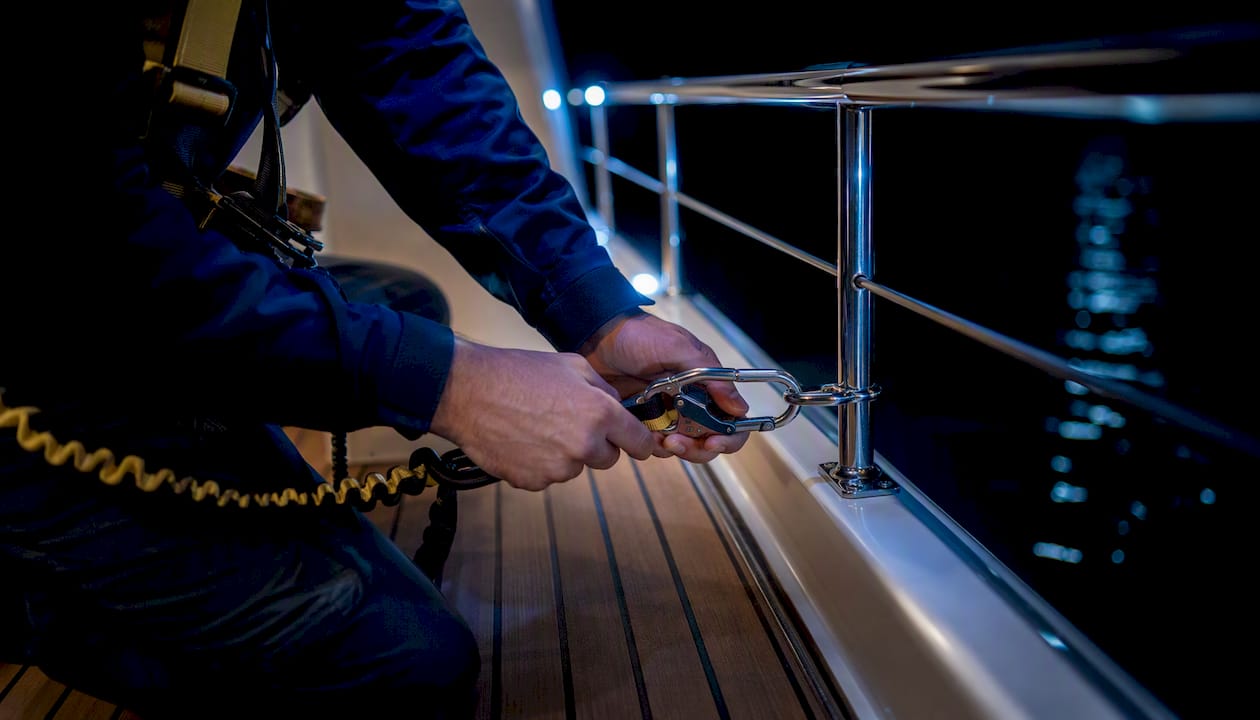
For deck movement safety, swell behavior means a vessel can pitch or roll unexpectedly even in moderate conditions. The rule is simple: one hand for the boat, always. Harnesses and jacklines are mandatory on deck at night or in conditions above 15 knots; they are never worn below decks, where they snag on furniture and create a fall hazard. Guests should also close lockers immediately after use to prevent shifting gear from causing injury.
Pro Tip: Ask one guest to put on a lifejacket in front of the group. This single return-demonstration takes 60 seconds and confirms comprehension far better than any verbal explanation.
Emergency procedures and drills every crew member should know
Drills do not need to be theatrical. A short, calm walkthrough of the sequence is enough to build muscle memory.
Man overboard (MOB)
- Shout "Man overboard, starboard (or port) side!" immediately.
- Assign one person to point continuously at the person in the water. That person does not move or look away.
- Throw the ring buoy toward the person.
- Press the MOB button on the chartplotter to mark the position.
- The captain maneuvers for recovery; all non-essential crew stay seated and out of the way.
- Practice the shout-and-point sequence at the dock before departure. It takes 90 seconds and guests remember it.
Fire response
- Shout "Fire!" and the location.
- Cut engine fuel if the fire is in the engine compartment.
- Assign one person to call Mayday on channel 16 if the fire is not immediately controlled.
- Use the correct extinguisher: CO₂ for electrical fires, dry chemical for galley fires. OSHA's portable extinguisher guidance covers selection and the PASS technique in detail.
- If the fire is not out in 30 seconds, move to abandon-ship.
Flooding and abandon ship
- Locate the source; close the nearest seacock.
- Start the bilge pump.
- If flooding is uncontrolled, activate the EPIRB and prepare the grab bag (flares, water, first aid, ship's papers, handheld VHF).
- Deploy the life raft only when the captain gives the order. Guests step into the raft; they do not jump.
- Stay with the raft. Do not swim for shore unless it is within easy reach.
Mayday call format
The captain or designated crew member makes the call. The sequence: Mayday three times, vessel name three times, position, nature of distress, number of persons aboard, and "Over." Guests who have seen the laminated card and heard it read aloud during the briefing can make this call if the captain is incapacitated.
How to modify the briefing for diving, tenders, and night operations
A general step-aboard briefing covers the vessel. Activity-specific add-ons cover the risks that appear only when guests leave the boat or conditions change.
Diving and snorkeling
Before any dive, the captain or dive guide covers: buddy checks, surface marker buoy (SMB) deployment, air management rules (turn back at 100 bar / 1,500 psi), and the charter's specific dive safety policy. Guests on dive-enabled charters should receive a signed dive briefing acknowledgement for each new site. Snorkelers need the same buddy-check habit and a clear rule about not diving below the surface without a buddy present.
Tender and watersports
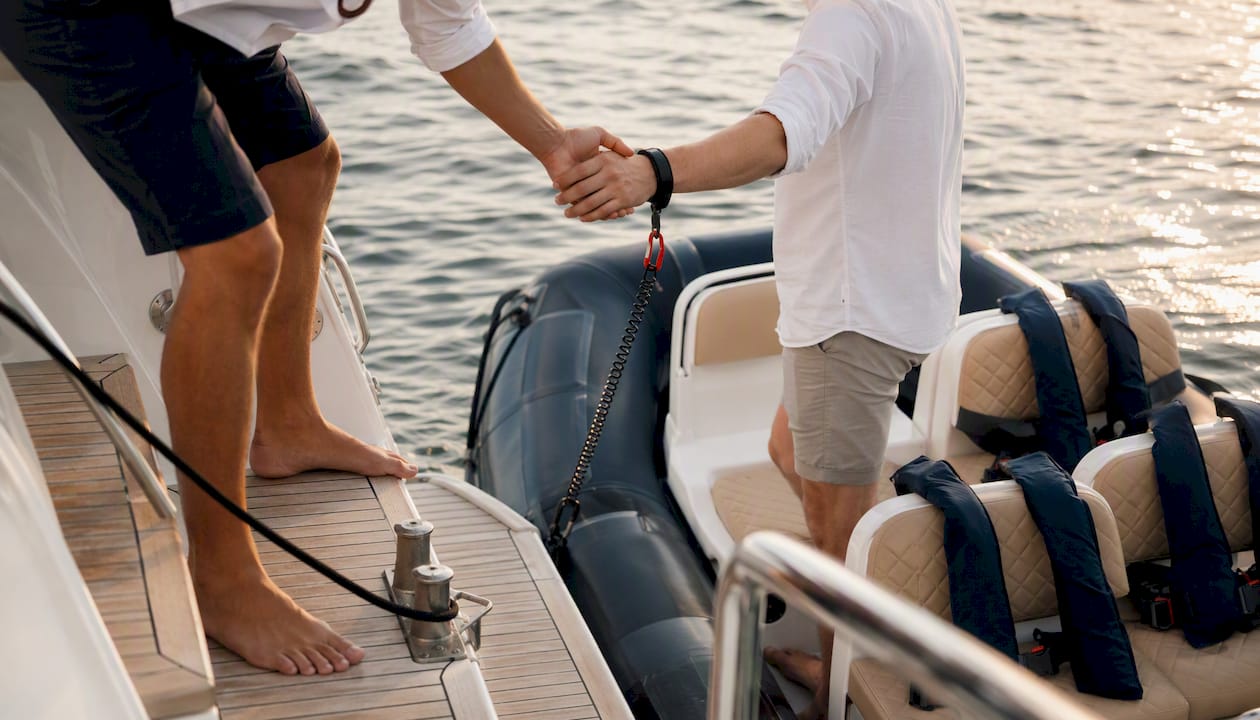
Tender boarding rules: one person boards at a time, engine off until all are seated. The kill-switch lanyard attaches to the driver's wrist before the engine starts. The swimmer recovery plan is stated before anyone enters the water: who drives the tender, where the swimmer signals from, and what the pickup signal is. PFDs are mandatory for all tender passengers.
Night operations
Deck movement is restricted to essential crew after dark. All guests who must come on deck wear a harness clipped to the jackline. Navigation lights are checked at the start of every night watch. The watch officer runs a brief comms check on VHF channel 16 at the start of each watch.
Any activity that materially changes the risk profile, such as open-ocean night passages or technical diving, warrants a signed acknowledgement from each participating guest.
How to build a safety culture that lasts beyond the briefing
The briefing is the opening, not the whole conversation. US Sailing's guidance is direct on this point: a no-blame, open-door reporting environment is what converts a one-time checklist into day-long safe behavior.
Practical ways to keep that culture alive:
- Normalize questions. End the step-aboard briefing with: "If anything feels unclear at any point during the trip, come find me or [Second-in-Command name]. There are no bad questions out here."
- Invite hazard reports. Tell guests that spotting a wet step, a loose line, or a sticking locker door and mentioning it is genuinely helpful, not an interruption.
- Alcohol and fatigue policy. State it plainly at the briefing: no alcohol before or during water activities, and guests who feel fatigued should tell the crew rather than push through.
- Mobility and medical needs. Ask privately before the briefing whether any guest has reduced mobility, a fear of confined spaces, or a medical condition that affects their emergency response. Adjust muster stations and assign a crew buddy accordingly.
- Hydration reminder. Sun, salt air, and physical activity dehydrate guests faster than they expect. A quick reminder at the morning refresher costs nothing.
Pro Tip: Assign one crew member to stay near the most mobility-limited guest during any drill or emergency. State this assignment aloud during the briefing so that guest feels seen, not singled out.
For families with children aboard, the yacht charter family guide offers additional briefing adaptations worth reviewing before departure.
A printable checklist and sample script for the step-aboard briefing
Keep a laminated single-page checklist at the nav station and a duplicate in the cockpit. Mark muster stations on a simple vessel diagram: one circle for the cockpit muster point, one arrow pointing to the life raft. Every guest signs the checklist before departure; the captain retains the signed copy for the duration of the charter.
The sample script below runs approximately 60–90 seconds and can be read verbatim or adapted:
Record guest acknowledgements on the muster sheet with printed names and signatures. File the completed sheet with the ship's papers and hand a copy to the marina or base operator at the end of the charter.
When to brief and how often to repeat key points
A clear timeline prevents gaps and avoids over-briefing guests who are ready to enjoy the water.
24–48 hours before boarding: Operator sends online safety video and pre-boarding forms. Guests complete medical disclosure and watch the video independently.
At step-aboard (before casting off): Full 10–15 minute demonstrable briefing. Muster sheet signed. No exceptions, regardless of how experienced guests claim to be.
Before each new activity: 3–5 minute activity-specific brief. Diving, tender use, and night passages each get their own add-on.
Each morning: 2–3 minute weather and route brief. Mention any changed conditions, new anchorage hazards, or updated activity plan.
Each night watch start: 2-minute lights, harness, and comms check.
Triggers for a full re-brief: new passengers joining mid-charter, a significant weather change (wind above 20 knots or a squall forecast), a near-miss incident, or a complex new activity not covered in the original briefing.
The printed checklist lives at the nav station. The captain signs it after each full briefing; the Second-in-Command countersigns. Organizing these briefings systematically is a skill in itself, and operators who treat it as a repeatable workflow rather than an improvised talk consistently deliver safer, more confident charters.
What professional captains actually get right (and what most briefings miss)
We consider the safety briefing to be one of the clearest signals of a captain's professionalism, and the gap between a good briefing and a great one is almost never about content. It's about delivery.
Three lessons we draw from experienced captains and water-sports professionals:
Keep it short and demonstrable. The briefings that stick are the ones where guests touch the gear. A captain who opens the flare kit, pulls out a lifejacket, and physically shows the MOB ring buoy creates memory. A captain who reads a list creates compliance theater. The industry-standard induction template recommends a short checklist precisely because brevity drives retention.
Assign roles before the emergency. The most common briefing failure we see is a captain who explains what to do but never says who does it. "Someone call Mayday" is not a plan. "If I'm incapacitated, [guest name] calls Mayday on channel 16" is. Naming people during the briefing takes ten seconds and removes the paralysis that costs lives.
Frame it as hospitality, not compliance. Guests on a luxury charter are there to relax. A briefing delivered with warmth and confidence, framed as "here's how we keep this trip extraordinary," lands completely differently than one that feels like a legal disclaimer. The yacht charter insights we've gathered from captains across remote destinations consistently show that guests who feel respected during the briefing are more likely to follow safety guidance throughout the trip.
Exoticacharters brings experienced captains and water-sports professionals to every charter
The safety briefing you've just read through is the standard we hold every Exoticacharters charter to. Our team is built from former captains and water-sports professionals who have delivered these briefings in some of the world's most remote and demanding waters, from the Galápagos to French Polynesia to Alaska.

What that means for you: every crewed charter we plan comes with a captain who knows this material cold, a crew trained in the specific activities on your itinerary, and pre-departure documentation handled before you step aboard. You arrive at the marina ready to sail, not ready to fill out forms. Whether you're drawn to a luxury crewed yacht for a family adventure or a dive-focused expedition in a remote archipelago, the safety infrastructure is already in place. Speak with an Exoticacharters specialist to find the right vessel and destination for your group.
Sources
These are the primary references to consult for formal rules, technical specifications, and regional variations:
- Capt.'s Safety Briefing — Culture of Safety (US Sailing)
- Portable Fire Extinguishers — OSHA
- Uscgboating
- Yacht Safety Briefing: Why Safety Briefs Matter | Halcyon Yachts
Operator pre-boarding policies vary by company and region. Always verify local requirements with your charter base, marina, or the relevant USCG district office for the waters you plan to sail.