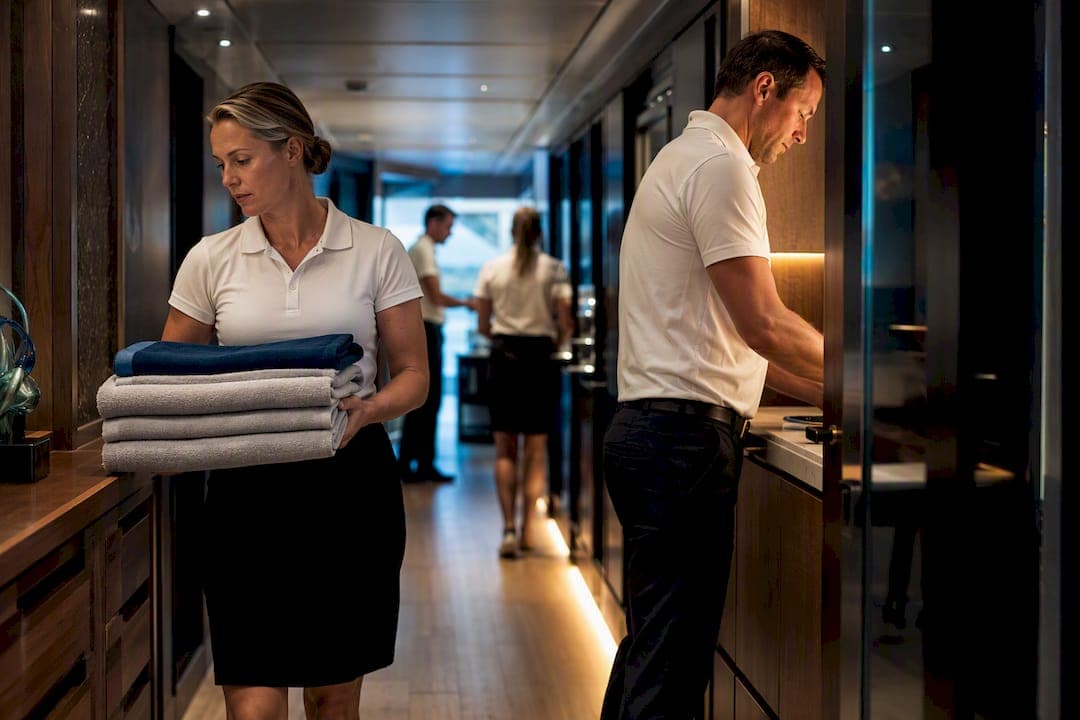
On a fully crewed luxury charter, you'll typically meet a captain, a chef, an interior team led by a chief steward or stewardess, deck crew, and an engineer. Larger yachts add specialists such as dive instructors and spa therapists. Together, this crew handles navigation, cooking, housekeeping, and water activities, so you arrive with nothing to manage but your own itinerary.
TL;DR:
- Smaller yachts have multitasking crew members covering multiple departments, while larger yachts employ specialized staff with clear chains of command.
- The crew roles include the captain for navigation, the interior team for hospitality, deck crew for water activities, and engineers for technical systems; specialists are added on larger vessels.
- Crew experience verification involves requesting CVs, confirming certifications, and ensuring familiarity with the planned itinerary, especially for complex or remote routes.
- A higher crew-to-guest ratio generally offers more attentive service but may reduce privacy, whereas mid-size yachts can provide more intimacy despite fewer staff.
- Understanding each crew member's specific responsibilities helps guests navigate their expectations and recognize the importance of experience when choosing a yacht.
Table of Contents
- What Are the Main Departments on a Crewed Yacht?
- Who Does What on a Luxury Charter?
- How Does Yacht Size Change the Crew You'll Meet?
- How Do You Verify a Crew's Experience Before Booking?
- What Exotica Charters Looks for When Matching Crew
- Ready to Meet Your Crew?
- Sources
- FAQ
What Are the Main Departments on a Crewed Yacht?
Every crewed yacht organizes itself around four departments, and knowing them helps you figure out who to ask for what. The bridge (or navigation) department, led by the captain, owns safety, course planning, and communication with port authorities. The interior department runs hospitality: cabins, dining, laundry, and the kind of concierge touches that make a charter feel effortless. The deck department handles everything outside, from mooring lines to inflating a paddleboard before breakfast. The engineering department keeps the generators, air conditioning, and AV/IT systems humming quietly in the background.
- Bridge/navigation: captain, sometimes a first officer
- Interior/hospitality: chief steward or stewardess, stews
- Deck/watersports: bosun, deckhands
- Engineering/technical: chief engineer, ETO (electro-technical officer)
This structure exists to coordinate timing, privacy, and safety without guests ever seeing the choreography behind it, an insight worth understanding before you step aboard. On a 45-foot catamaran, one person might wear two or three of these hats. On a 150-foot superyacht, each department has its own chain of command. You can learn more about how these command structures scale on larger charter vessels.
Who Does What on a Luxury Charter?
Each role on board has a distinct job, and understanding them changes how you experience the trip, from the moment you step off the tender to the last sundowner on the aft deck.
-
The captain is the highest authority on the yacht, responsible for navigation, safety, itinerary planning, and crew management. A great captain reads the group, not just the weather, adjusting a route to chase calmer water for seasick guests or extending a snorkel stop because the light on the reef is perfect. Expect the captain to greet you at embarkation and check in daily about how the itinerary feels.
-
The first officer or bosun runs the deck and often drives the tender to a beach picnic or a dive site. Deckhands handle mooring, anchoring, and setting up water toys, and on many charters they double as your watersports instructor, teaching a nervous guest to stand up on a paddleboard for the first time, a role detailed further here.
-
The chef and galley team manage provisioning, menu planning, and dietary accommodation, and chef quality is consistently one of the most-cited highlights of a good charter. On expedition-style trips, that means sourcing fish straight from a local dock or adapting a menu around a guest with a shellfish allergy without missing a beat.
-
The interior team, led by the chief steward or stewardess, covers cabin service, table and bar service, laundry, and the concierge details, like remembering you take your coffee black at sunrise, which define the guest experience. Ask "what does a stewardess do" and the honest answer is: nearly everything you experience indoors, from turned-down beds to a perfectly timed cheese board.
-
The engineer or ETO keeps propulsion, generators, HVAC, and AV/IT systems running. Guests rarely interact with this crew member directly, but their work is what keeps the lights and the Wi-Fi on, especially on larger motor yachts and superyachts where technical complexity multiplies.
-
Specialists, including dive instructors, massage therapists, and nannies, appear on larger yachts or for specific charter themes, and their inclusion depends on vessel size and trip objectives. On an expedition charter chasing marine wildlife, a specialist might be the person briefing you each morning on where the whale sharks were last seen.
Pro Tip: If diving, wildlife viewing, or another specialist activity is central to your trip, ask specifically who on board holds the relevant certification. A dive instructor's PADI or SSI card matters as much as the captain's license.
How Does Yacht Size Change the Crew You'll Meet?
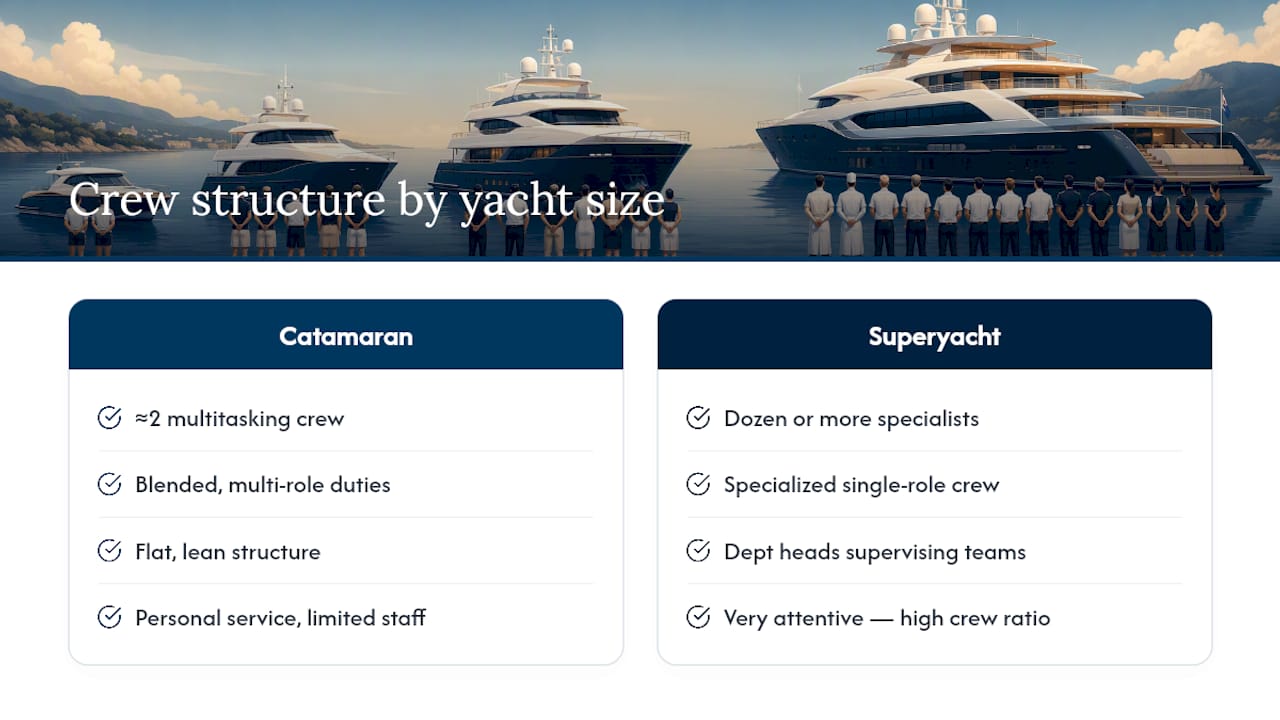
Crew size scales directly with yacht length, and that scaling tells you a lot about what kind of experience to expect. A smaller catamaran runs lean, with roles blending into two multitasking crew members. A large superyacht runs like a small hotel, with a dozen or more specialists reporting up through several department heads.
This size-to-crew relationship holds fairly consistently across the industry. A higher crew-to-guest ratio generally means more attentive, personalized service, but it also means more people quietly working around you. If privacy matters as much as pampering, a mid-size yacht with a tight, cross-trained crew can feel more intimate than a megayacht staffed like a resort.
How Do You Verify a Crew's Experience Before Booking?
A well-matched crew is arguably the single most important variable in how a charter actually feels, and brokers routinely provide captain and chef CVs for any significant booking. Request them, and read them closely.
- Ask for years of charter experience and familiarity with your specific cruising ground, since a captain who knows local currents and hidden anchorages plans a noticeably better itinerary.
- Confirm certifications: RYA Yachtmaster or equivalent for the captain, STCW safety training for the crew, and PADI or SSI credentials for any dive instructor.
- Ask how provisioning works, how dietary restrictions are handled, and exactly what the Advance Provisioning Allowance (APA) covers.
- Clarify tipping customs, crew privacy boundaries, and, on expedition trips, whether the crew carries medical readiness for remote regions.
Pro Tip: On the charter planning call, ask the broker directly: "Has this captain run this specific route before?" A confident, detailed answer, not a vague one, is the strongest signal you've found the right match.
What Exotica Charters Looks for When Matching Crew
Our company is built around former captains and water-sports professionals, and that background shapes how we vet every crew before recommending them for a charter. We review CVs, confirm certifications, and match crew experience to the specific demands of an itinerary, whether that's Galápagos dive currents or Alaskan glacier navigation. For deeper reading on how these decisions play out on real charters, our Yacht Charter Insights collection covers provisioning, safety briefings, and onboard etiquette in more detail.
— Mo
Ready to Meet Your Crew?
Choosing a crewed yacht means choosing the people who will shape every day of your trip, and Exoticacharters exists precisely to get that match right the first time. Where a standard charter broker hands you a boat and a generic itinerary, the team personally vets each crew for the destination, whether that's diving in the Galápagos or wildlife spotting in French Polynesia.
The company is highly rated on Trustpilot, and typically shares captain and chef CVs before clients commit to anything. If you're ready to see who would be on board for your trip, browse our luxury yacht charters or request crew CVs directly through a consultation with our team.
Sources
- Crewed Yacht Charter: What’s Included (2026)
- Yacht Crew Roles Explained: Who’s Who on a Yacht? | AWAY
- The Complete Guide To Yacht Crew Roles & Responsibilities
FAQ
What Does a Stewardess Do on a Yacht?
A stewardess (or steward) handles cabin housekeeping, table and bar service, laundry, and concierge tasks like arranging special requests, making her the crew member you'll interact with most indoors.
Who Is in Charge on a Yacht Charter?
The captain holds ultimate authority over navigation, safety, and crew management, and also serves as your main point of contact for adjusting the itinerary.
Do Guests Need to Help the Crew With Anything?
No. On a fully crewed charter, the crew manages navigation, cooking, housekeeping, and water activities, leaving guests with no operational duties.
How Many Crew Members Are on a Typical Charter Yacht?
Crew count scales with yacht length, ranging from 2 crew on a 45 to 55 foot catamaran up to 15 or more on a 150-plus foot megayacht.
Can I Request Crew CVs Before Booking?
Yes. Brokers commonly provide captain and chef CVs for significant bookings, and clients should always ask about crew qualifications before confirming a charter.