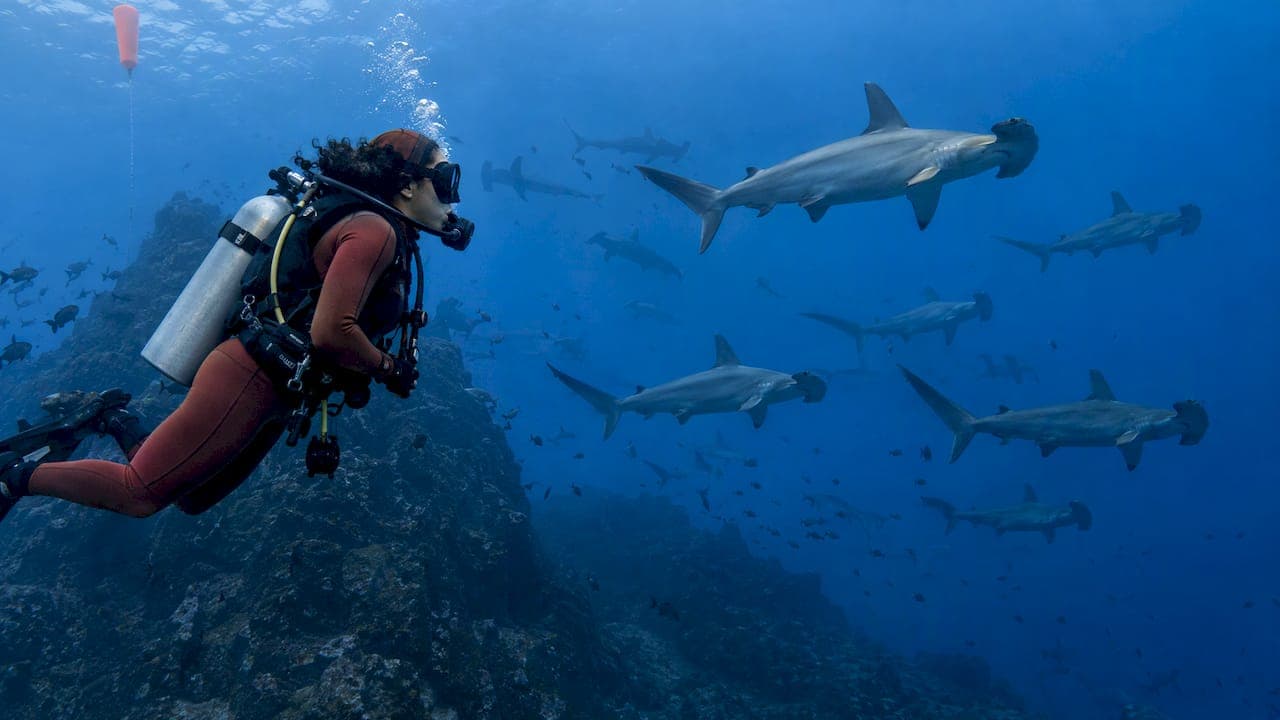
Choose the Galápagos if you want the widest range of life, above and below the surface, and a trip that can include land, families and non-divers. Choose Cocos Island if you are an experienced diver who wants days of focused, big-animal diving from a single base. Both are remote, both are reached by liveaboard at their best, and both reward the traveler who plans early and matches the itinerary to their skills.
We plan crewed charters in places like these, so this comparison is written the way we would talk it through with a client: honestly, specifically, and with the trade-offs laid out so you can decide with confidence.
TL;DR
- Galápagos: the broader experience. Sea lions, marine iguanas, giant tortoises and penguins on land, plus Darwin and Wolf for big-animal diving. It suits mixed groups, families and couples as well as divers.
- Cocos Island: the more concentrated dive trip. An uninhabited national park reached mainly by licensed liveaboard, best for confident divers who want repeated sessions at the same sites.
- Access: Darwin and Wolf are liveaboard-only because they are too far for day boats. Cocos is practically accessible mainly by licensed liveaboard.
- Fees: Galápagos National Park charges US$200 for adult foreign visitors (doubled in August 2024); Cocos park fees are reported at $50 to $70.
- Booking: both fill well ahead. Start planning many months out, then fine-tune the season with a specialist.
Table of Contents
- The two destinations at a glance
- Location and how you get there
- Wildlife and marine life
- Diving conditions and experience required
- Seasons: when to go
- What each trip costs and what is included
- Who should choose which
- Our perspective
- Plan your Pacific expedition with us
- FAQ
- Sources
The two destinations at a glance
The Galápagos and Cocos Island are often mentioned in one breath because they sit in the same eastern Pacific system of cold and warm currents, and both draw schooling hammerheads and other pelagic animals to isolated volcanic rock. Travelers sometimes call Cocos the "poor man's Galápagos" as shorthand for that overlap. We would gently set the nickname aside. Cocos is not a smaller version of anything; it is a different kind of trip, narrower in scope and, for the right diver, deeper in intensity.
| Galápagos (Ecuador) | Cocos Island (Costa Rica) | |
|---|---|---|
| Type of trip | Wildlife expedition with optional world-class diving | Dedicated dive expedition |
| Who it suits | Divers, families, couples, nature enthusiasts, mixed groups | Experienced divers, underwater photographers |
| Land experiences | Extensive, with landings among endemic species | Minimal; the island is uninhabited except for park rangers |
| Best diving access | Darwin and Wolf by liveaboard only | Liveaboard only, in practice |
| Park fee | US$200 per adult foreign visitor | $50 to $70 reported |
| Itinerary feel | Variable islands and anchorages across the archipelago | One island, many dives at the same sites |
Location and how you get there
The Galápagos belong to Ecuador, and a trip begins with a flight from the mainland. The archipelago's islands are spread out, which is why the itinerary matters so much: an island-hopping land trip and a northern dive route are almost two different holidays. Our Galápagos yacht charter page shows how we approach private, crewed expeditions there.
Cocos Island belongs to Costa Rica and lies far offshore in the Pacific. It is uninhabited apart from park rangers, and reaching it practically means joining a licensed liveaboard. That has a consequence worth planning for: the crossing is a real part of the trip, and the open-ocean passage can be lively. If you are prone to seasickness, talk to your doctor before you go and ask us about vessel size and stabilization when we pair you with a yacht.
For travelers from the United States, the practical difference is in the logistics. The Galápagos is a flight-heavy journey with a connection through mainland Ecuador. Cocos is a journey through Costa Rica followed by a longer time at sea. Neither is difficult with good planning, but both reward building in a buffer day before boarding so a delayed flight does not cost you a dive day.

Wildlife and marine life
Galápagos: variety is the signature
What sets the Galápagos apart is range. Within one trip you can snorkel with sea lions, watch marine iguanas on black lava, walk among giant tortoises, and, in the north, dive among schooling hammerheads and other large animals. For families and non-diving partners, the land and snorkel program is as much the point as the scuba. If whale sharks are on your wish list, our guide to 7 to 10 day liveaboards for Galápagos whale sharks explains how to time and route a trip around them.

Cocos: sharks, repeated
Cocos is a dive destination first. The appeal is time: instead of passing through a famous site once, you return to the same pinnacles and walls across several days, which gives you more chances to be in the right place when schools of hammerheads, whitetip reef sharks and other large animals pass. Divers who compare notes after both trips often say that this repetition is what makes Cocos feel distinct. It is a trade, though. You give up the cultural and land variety of the Galápagos in exchange for depth of experience at a single place.
Diving conditions and experience required
Both destinations are for confident, experienced divers if you plan to go to the headline sites. Expect open-water conditions with current, variable visibility and surface chop, plus the discipline that comes with deep, drift-style dives.
In the Galápagos, conditions differ across the archipelago. The central islands offer more sheltered options, while the northern islands of Darwin and Wolf are the demanding ones: they are restricted to liveaboards and known for strong current. Our overview of Galápagos dive sites, from Kicker Rock to Darwin walks through which sites suit which skill level, and our Galápagos dive charters page covers dive-focused yacht options.
Cocos tends to ask for similar competence: strong buoyancy control, comfort in current, and experience with a surface marker buoy. A sensible rule for either trip is to arrive with recent logged dives, to have completed advanced certification, and to be comfortable with nitrox if the vessel offers it. If you are rusty, a refresher dive at home beforehand is time well spent. Your dive operator and certifying agency set the formal requirements; confirm them before booking.
Seasons: when to go
In the Galápagos, the calendar shapes the experience. Water temperature, animal behavior, and the breeding cycle of land species all shift through the year, and the best time for hammerheads is not necessarily the best time for warm, calm snorkeling. We cover this in detail in when to charter a crewed yacht in the Galápagos and in breeding season versus dive season.
For Cocos, liveaboard schedules follow the operators' seasons and the weather, and sea state can affect the crossing. Because itineraries and operating windows change, confirm the current departures with a specialist rather than relying on a fixed calendar printed in a guide.
One principle holds for both: if one particular animal or experience is your priority, choose the itinerary around it first and the dates second.
What each trip costs and what is included
As a brokerage, we do not publish fixed prices for charters, because each yacht, route and group size is priced separately. What we can share are the official fees that sit on top of any trip, and how to think about the rest.
- Galápagos National Park fee: US$200 for adult foreign visitors, after it was doubled from US$100 in August 2024. Access and fees are set by local authorities and can change without notice, so confirm before you travel.
- Cocos Island park fee: reported at $50 to $70 for expeditions.
- Everything else: flights, the vessel, crew, meals, dive equipment and extras vary by yacht and itinerary.
The useful way to compare cost is by experience per day rather than by headline number. A longer Cocos liveaboard concentrates most of the trip into diving. A Galápagos itinerary spreads the days across land visits, snorkeling and dives, which is why many mixed groups find it the better value. For a sense of what drives pricing on an expedition-style charter, see how much an expedition charter costs.
Who should choose which
Choose the Galápagos if:
- You are traveling with family, a non-diving partner, or a mixed-ability group. Our comparison of a crewed catamaran and an expedition ship for Galápagos families helps with the vessel decision.
- You want wildlife encounters on land as well as in the water.
- You want flexibility to shape a private itinerary around specific islands and anchorages.
Choose Cocos Island if:
- You are an experienced diver whose first priority is time with sharks.
- You are happy with a dive-centered routine and a longer sea crossing.
- You prefer a single, wild, uninhabited destination over variety.
Consider both if you dive often. Many divers do the Galápagos first for its breadth, then return to the Pacific for Cocos once they know the conditions they enjoy.
Our perspective
We have spent our careers on boats, as captains and water sports professionals, and the question we hear most is which of these two is better. We never answer with a single name, because the better trip is the one that matches the person.
Where clients want a place that feels like an expedition and still leaves room for a family snorkel, a tortoise walk or a quiet sunset anchorage, we point to the Galápagos and a private, crewed vessel. The crew, the pace and the route are yours to shape, and that is where experienced planning pays off.
Where a diver wants to be underwater as much as safely possible, we talk about Cocos and a dive-focused vessel. In both cases we would suggest settling the season and the boat before the flights, because the best cabins and dates go early.
Mo
Plan your Pacific expedition with us
We plan fully crewed charters in remote destinations, with sailing yachts, motor yachts, catamarans and expedition vessels, around diving, wildlife and adventure. Our team of former captains and water sports professionals can help you weigh the Galápagos against Cocos for your group, your dive experience and your dates. Start with our Galápagos yacht charters or speak to a yacht charter specialist.
If the Galápagos is your pick, read how far ahead to book a crewed charter before you set dates.
FAQ
Is Cocos Island or the Galápagos better for diving?
It depends on what you want from a dive trip. Cocos offers concentrated, repeated shark diving at one island, while the Galápagos adds variety across several sites and, in the north, Darwin and Wolf. Divers who want breadth usually prefer the Galápagos; those who want focus lean toward Cocos.
Can beginners dive at Cocos Island or the Galápagos?
The headline sites in both places suit experienced divers, because of current, depth and open-water conditions. The Galápagos has more sheltered options and a strong snorkeling and land program, so it works better for mixed groups. Confirm certification requirements with the operator before booking.
Do I need a liveaboard to visit Cocos Island?
In practice, yes. The island is uninhabited apart from park rangers, and access is mainly through licensed liveaboards. Darwin and Wolf in the Galápagos are also liveaboard-only.
What is the Galápagos park fee?
The fee is US$200 for adult foreign visitors, doubled from US$100 in August 2024. Because rules can change, confirm the current amount before you travel.
Sources
- Cocos Island National Park: Can You Actually Visit?
- Darwin's Arch | Scuba Diving Guide | Underwater Atlas
- Gordon Rocks | Scuba Diving Guide | Underwater Atlas