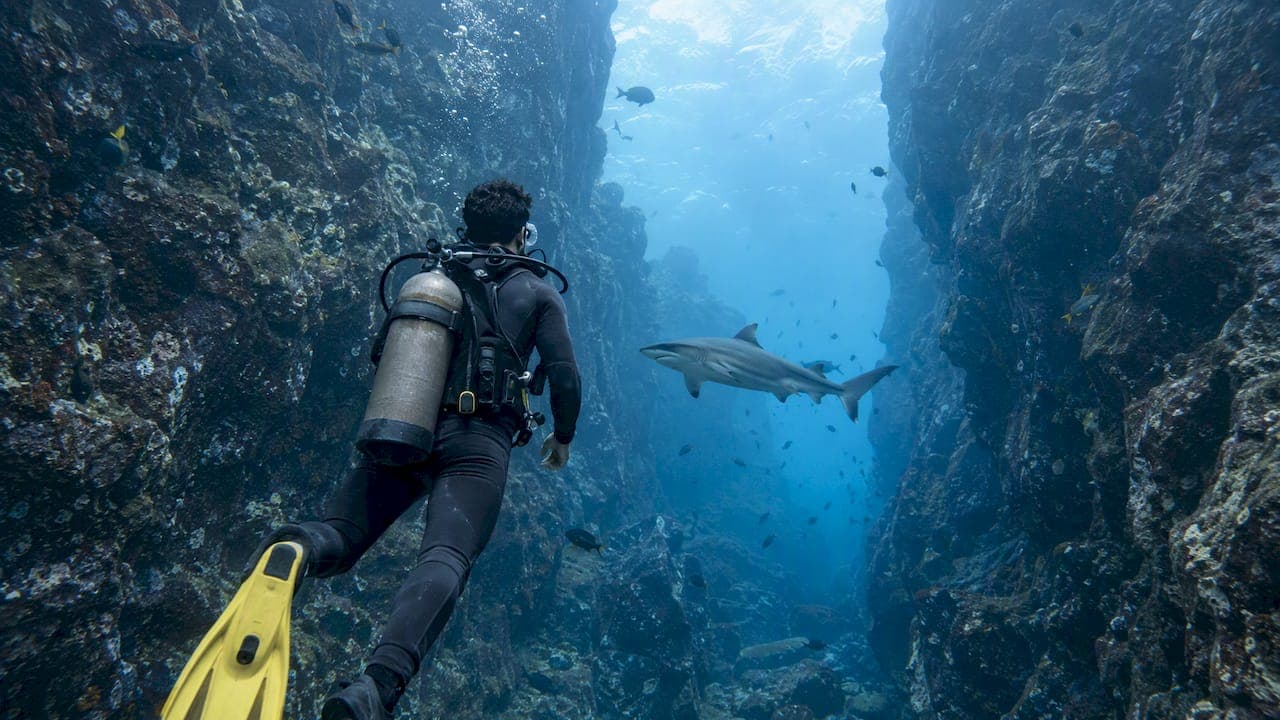
The Galápagos has two kinds of diving. Day sites near Santa Cruz and San Cristóbal, such as Kicker Rock and Gordon Rocks, can be reached from a hotel base. The far northern outposts of Darwin and Wolf are the ones divers dream about, and they are visited from a boat that stays at sea. This guide walks through the main sites by region, what each demands of a diver, and how to decide which circuit suits your experience and your time.
TL;DR
- Central islands (day diving): Kicker Rock and Gordon Rocks offer sharks, turtles and seasonal hammerheads. Gordon Rocks is a demanding, current-swept site, and operators often check your experience before confirming it.
- Darwin and Wolf (far north): the headline destination, where scalloped hammerheads school in the hundreds and whale sharks gather from June to November. Plan on a liveaboard-style trip.
- Western islands: colder, richer water around Isabela and Fernandina, suited to experienced divers who are comfortable with thermoclines and current.
- A crewed dive charter lets you string the best sites together in one itinerary, with a private crew and a captain who knows the anchorages.
- Rules apply everywhere: a licensed naturalist guide is required in protected areas, and you must keep your distance from wildlife.
Table of Contents
- How Galápagos diving is organized
- Central islands: the day-dive sites
- Darwin and Wolf: the northern outposts
- The western islands
- Choosing your circuit: land-based, or boat-based
- Our perspective on diving the Galápagos by yacht
- Rules that shape every dive
- Planning a dive charter with us
- FAQ
- Sources
How Galápagos diving is organized
The islands sit where three powerful ocean currents meet. Undercurrent's Galápagos guide notes that, although the archipelago lies on the equator, this confluence keeps the climate equable. For divers, it means something more specific: cool, nutrient-rich water that feeds an extraordinary density of big animals, and currents that can be strong.
It helps to think of the archipelago in three zones.
| Zone | Typical sites | Style | Experience needed |
|---|---|---|---|
| Central islands | Kicker Rock, Gordon Rocks, North Seymour, Bartolomé | Day trips from Santa Cruz or San Cristóbal, or by boat | Beginner to advanced, depending on the site |
| Far north | Darwin's Arch, Wolf Island | Multi-day trip by boat, after an overnight crossing | Advanced |
| West | Isabela and Fernandina area, including Punta Vicente Roca | Multi-day trip by boat | Advanced |
We describe the zones from the most accessible to the most remote, because that is the order in which most divers build their experience here.
Central islands: the day-dive sites
Day-trip diving is available from Santa Cruz and San Cristóbal, and the central sites that draw most divers are Kicker Rock and Gordon Rocks. Both reward you with Galápagos sharks, turtles and, in season, hammerheads. They differ from the northern circuit in marine biomass density and in the experience they require.
Kicker Rock (León Dormido)
Kicker Rock is a sheer volcanic remnant that rises out of the sea off San Cristóbal, split by a narrow channel. It is the most photographed dive landmark in the central islands, and for good reason: the walls drop away dramatically, and the channel is a natural corridor for sharks, rays and turtles. Conditions vary with the current, so a good guide matters more than the depth gauge.
For divers who have logged a modest number of open-water dives and are comfortable with some current, Kicker Rock is the natural first taste of Galápagos diving. It is also the site many first-time visitors judge everything else against.
Gordon Rocks
Gordon Rocks, off Santa Cruz, is a different proposition. It is an active volcanic caldera where currents funnel and rotate, and it is not a site for divers who lack comfort with deep water and drift-style ascents. Gordon Rocks is noted for challenging current conditions, and operators are selective: many will assess your logbook and experience before they confirm a booking.
The payoff is real. The site is known for sharks, and for the sense of being in an open-water amphitheater. But if you are newer to diving, we would suggest building current experience elsewhere first and coming back to Gordon Rocks on a later trip.
Other central sites worth knowing
The central archipelago also has gentler options that suit newer divers, snorkelers and mixed groups. North Seymour and the channel around it, Bartolomé and the waters near Santa Cruz are commonly used for relaxed dives and snorkeling with sea lions, rays and reef fish. They are less dramatic than the walls of Kicker Rock, but they are a calm way to settle in while your crew reads the conditions.
Darwin and Wolf: the northern outposts
If you have searched for Darwin and Wolf diving, you already know the reputation. These two small islands, far from the main inhabited group, are where scalloped hammerheads school in the hundreds and whale sharks congregate from June to November. The same source describes the contrast with the day sites near Santa Cruz and San Cristóbal, which is the point: this is a different scale of diving.
Darwin's Arch
Darwin's Arch is a rock arch rising from deep water, and the dive is typically done as a blue-water experience along the edge of a current-washed shelf. You hold position, often with a reef hook or by finding a rock to anchor against, and the animals come to you: hammerheads, Galápagos and silky sharks, turtles, dolphins and, in the right months, whale sharks. The pattern is patience rather than exploration, and it suits divers who are calm in current and comfortable hanging in open water.

We should be clear that Darwin is not a place for beginners. The water can be cold, visibility varies, and currents can be strong. Most operators ask for an advanced certification and a minimum number of logged dives.
Wolf Island
Wolf has several sites around its rocky shoreline, and divers often describe it as the more varied of the two. Expect hammerheads, Galápagos sharks, eagle rays and schools of reef fish, with caves and walls as well as open water. A multi-day itinerary usually includes both islands so you can compare them and choose how many dives to spend at each.
When to go
The season matters. Whale sharks gather around the northern islands from June to November, which coincides with the cooler, more current-driven months. The warmer months are typically more comfortable for in-water time. Our own seasonal breakdown, breeding season versus dive season, lays out how to balance wildlife on land against conditions underwater. If whale sharks are your priority, our research-backed guide to 7 to 10 day whale shark itineraries explains how itinerary length affects your chances.
The western islands
The waters around Isabela and Fernandina are among the richest in the archipelago. They are cooler and more nutrient-heavy, and they are where divers hope for marine iguanas feeding underwater, penguins, and, with luck, oceanic sunfish. Punta Vicente Roca, on the northwest of Isabela, is the site most often named for this kind of encounter.

These sites are demanding in a different way from Darwin. Cold thermoclines, surge and current all play a part, so a good wetsuit and a confident skill set are as important as logbook numbers. Because of the distance from the main ports, the western islands are practically a boat-based circuit. If you are weighing how sea state affects comfort, our piece on five sea states that decide snorkel and dive comfort is worth a read before you pick dates.
Choosing your circuit: land-based, or boat-based
There are really two ways to dive the Galápagos, and they suit different divers.
- Land-based day diving. You stay in a hotel on Santa Cruz or San Cristóbal and join daily dive trips. It is flexible, and it works well for mixed groups where some travelers do not dive. The limit is geography: you will reach the central sites, but not Darwin and Wolf.
- Boat-based diving. You live aboard and move between sites. This is the only practical way to reach the far north and the west, because of the distances and the overnight crossings involved.
The second option is where a private crewed charter shines. Instead of sharing a schedule with a large group, you plan the route around the dives you most want, and the crew adjusts to conditions each day.
Who should start where
| Your experience | Where we would suggest starting |
|---|---|
| Newer divers, mixed groups | Central sites, with easy dives and snorkeling on a private itinerary |
| Comfortable with current and deep water | Kicker Rock, then selected western sites |
| Advanced, with strong logbook | Darwin and Wolf, with the western islands added |
| Non-diving family members | A crewed charter that balances dives with land visits and snorkeling |
Our perspective on diving the Galápagos by yacht
We plan these trips with a team of former captains and water sports professionals, and the lesson we return to most is that the dive site is only half the experience. The other half is how you get there and how the day around the dive feels.
On a private crewed yacht, the itinerary is built around your group. If a current is running too hard at one site, the captain can move to another anchorage rather than push on with a fixed schedule. If one person wants to dive and another wants to walk a beach with a naturalist guide, both can have the day they came for. For families, that flexibility is the difference between a trip that works and one that is merely endured; our guide to what wildlife kids can actually see on a Galápagos crewed charter shows how the non-diving days can be just as memorable.
We would also say plainly that not every diver should aim for Darwin and Wolf on a first visit. A well-built itinerary that begins with easier central sites, lets you settle your weights and your buoyancy, and then moves north with confidence is often the better trip. Honest advice about your level is part of what we offer. If you are still deciding between a private charter and a larger vessel, we have laid out the trade-offs in crewed charter versus cruise ship.
— Mo
Rules that shape every dive
The Galápagos is among the most carefully protected marine environments in the world, and the rules affect how you plan.
- A licensed guide is mandatory. All visits to protected areas must be accompanied by a licensed naturalist guide.
- Authorized operators only. The Galápagos National Park Directorate regulates tourism activity, and visitors must use authorized operators and follow its protocols.
- Keep your distance. The park requires a minimum of two meters from animals, and you must not feed or touch wildlife.
The park also has a separate manual covering filming and photography in protected areas. If you plan to bring serious camera gear, or a drone, read it before you pack, and ask your charter team how it applies to your plans.
These rules are not obstacles. They are the reason the hammerheads, sea lions and turtles behave as they do around divers.
Planning a dive charter with us
If you are ready to turn this overview into an itinerary, we can match your group to a yacht and a route. Our Galápagos dive charters are planned around the sites in this guide, and you can browse the vessels on our Galápagos yacht charters page. Two yachts you may want to look at are Galapagos Angel, a 115-foot vessel, and Galapagos Horizon, a 125-foot yacht. Charter pricing is not published, so the best next step is to speak to a yacht charter specialist through our main site with your dates, group size and certification levels.
FAQ
Can beginners dive in the Galápagos?
Yes, at the right sites. The central islands include calmer dives and snorkeling spots, and Kicker Rock suits divers with some current experience. Gordon Rocks and the northern islands are a different matter: Gordon Rocks is noted for challenging currents, so newer divers should build experience first.
Do I need a liveaboard to dive Darwin and Wolf?
In practice, yes. These islands are far from the inhabited central group and are reached by boat after an overnight crossing, so a multi-day boat-based trip is the realistic way to dive them. A private crewed charter is one way to do this, with an itinerary built around your group.
When is the best time to see whale sharks?
Whale sharks gather around the northern islands from June to November. Hammerheads are the headline animal at Darwin and Wolf, and the right month depends on whether you value whale sharks, warmer water or calmer seas. Our seasons guide compares them.
Do I need a guide to dive or snorkel in the Galápagos?
Yes. Licensed naturalist guides must accompany visitors in protected areas, and the park also sets a two-meter minimum distance from animals. A reputable charter arranges this as part of the trip.
What is the difference between a day-trip dive and a charter?
Day trips reach the central sites from Santa Cruz or San Cristóbal and follow the operator's schedule. A charter lives at sea, which opens the northern and western sites and lets you shape the route around conditions and the dives you want.
Sources
- Galápagos Islands Diving, The Complete Guide
- Reglas de Visita, Parque Nacional Galápagos
- Galapagos Islands Diving Guide, Undercurrent
- Shooting, filming and photography in protected areas of Galápagos, regulations manual