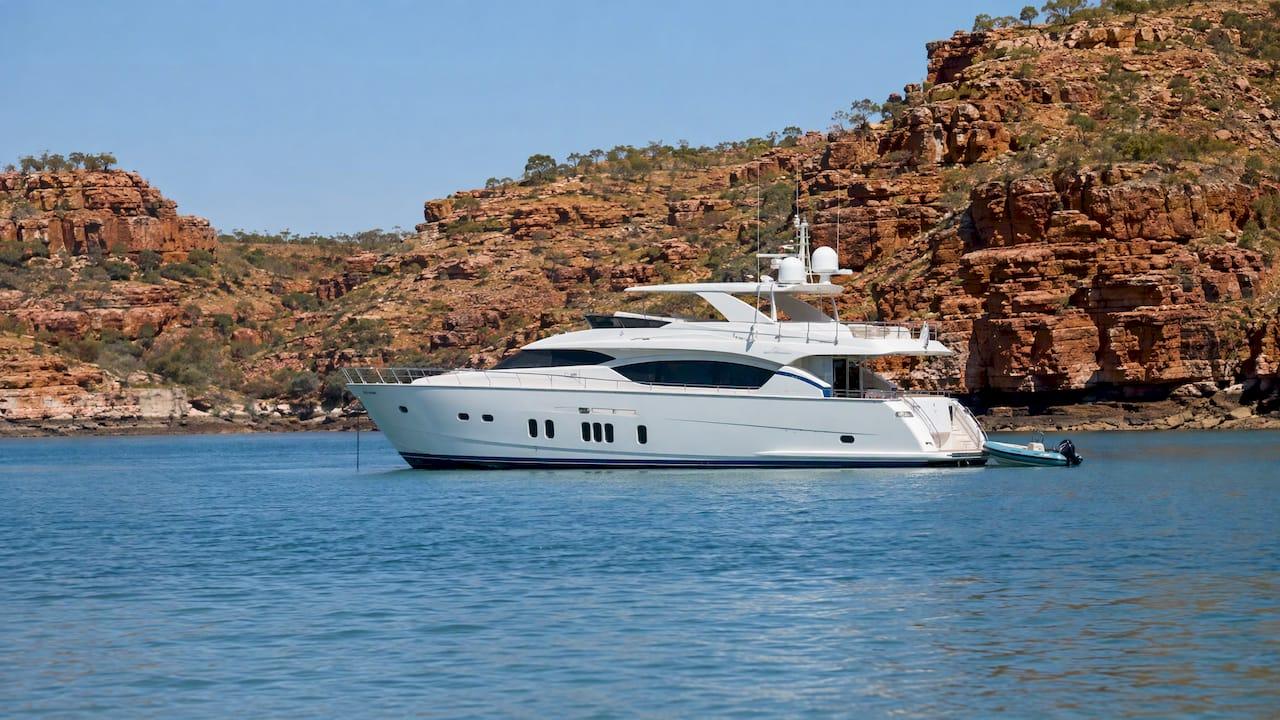
The Kimberley cruising season runs from April to October, the dry months when the coast of northern Western Australia opens to yachts. April and May are generally regarded as the best window, when the waterfalls are still in full force after the wet. Which month suits you depends on what you want to see: thundering falls, calm skies, whales, or quiet anchorages. At Exotica Charters, our team of former captains and water sports professionals plans remote crewed charters, and the Kimberley is one of the places where timing shapes the whole journey.
TL;DR
- The cruising season runs April to October, and Tourism Australia names April and May as generally the best months, with waterfalls at full strength after the wet season.
- The wet season brings thunderstorms and tropical cyclones; the official cyclone season runs 1 November to 30 April, so yachts cruise outside it.
- Tides here are among the largest in the world, so itineraries are built around the moon and the tide tables, not just the calendar.
- Early season favors waterfalls and green scenery; the dry heart of the season brings stable weather and long, easy days on the water.
- Remote anchorages, few refuelling points and long distances make a crewed charter the practical way to see the coast in comfort.
Table of Contents
- When the Kimberley cruising season runs
- Why the wet season closes the coast
- Month by month: what to expect
- The tide is the real calendar
- What you will see, and when
- How long to allow, and how to reach the coast
- Choosing your window
- Which kind of yacht suits the Kimberley
- Plan your Kimberley charter with Exotica Charters
- Our perspective
- FAQ
- Sources
When the Kimberley cruising season runs
The Kimberley coast between Broome and Wyndham is roughly 1,000 miles of rock, mangrove, waterfall and tide with almost no roads or marinas, according to a Western Australian sailing guide. That isolation is the attraction, and it is also why the season matters so much. Once the rains arrive, the region is closed to leisure cruising in all but name.
Tourism Australia describes a cruising season of April to October. Sailing guides for the region describe the same dry-season pattern, in some cases May to October. In practice, the first departures of the year tend to start in April or May and the last wind down in the early southern spring.

For travelers from the United States, one practical point shapes everything: the seasons are reversed. Your northern summer is the Kimberley's dry, mild, winter-like stretch, and your winter holidays fall in the wet. A Kimberley charter is therefore a spring, summer or early autumn trip on your calendar, which suits families working around school vacations.
Why the wet season closes the coast
Almost all of the Kimberley's rain falls between December and March, and June to September is virtually rainless, according to a Western Australian government study of tourism on the Kimberley coast. The same study notes mean daily maximum temperatures of 30°C (86°F) or higher all year.
The wet brings more than rain. At Broome, over 75% of the average annual rainfall from January to March is associated with thunderstorms and tropical lows or cyclones, the Kimberley Ports Authority reports. Its Port of Derby handbook gives the cyclone season as 1 November to 30 April, averaging about five tropical cyclones per season in the Yampi Sound to Exmouth region.
This is why the April start is carefully judged. The first weeks of the season sit right at the tail of the cyclone window, and a good captain watches the forecast closely before committing to remote anchorages.
Month by month: what to expect
The season is seven months long, and each part has its own character. The table below is a planning guide drawn from the official sources cited in this article; the exact feel of any month varies from year to year.
| Part of the season | What stands out | Best for |
|---|---|---|
| April to May | Waterfalls in full flow after the wet season; lush, green landscapes | Waterfall seekers, photographers, first-time visitors |
| June to August | Virtually rainless, warm days; the heart of the dry season | Families, couples, divers, wildlife watching |
| September to October | Late season; fewer travelers as the build-up approaches | Travelers who prefer quiet anchorages |
The government study also observes that operators vary what they promote through the season. Earlier trips are sold on full-flow waterfalls and green vegetation, while later trips lean on other features. The off-season, November to February, gives visited sites a chance to recover.
April and May: waterfalls at their strongest
This is the window Tourism Australia singles out. After months of rain, the falls that spill from the sandstone escarpments are at their most dramatic, and the country around them is green. If you imagine the Kimberley as a place of cascades tumbling into the sea, an early-season charter is the one to aim for.

The trade-off is only that the land is still drying out, and the weather is closer to the tail of the wet. For many guests that is a small price for the scenery.
June to August: the settled middle
These are the stable months. Rain is rare, days are warm and clear, and the logistics of a long charter run most smoothly. Broome's dry season has strong south-easterly winds of 25 to 30 knots in the morning that ease in the afternoon, according to the Kimberley Ports Authority, which also gives July averages of 26.9°C (80.4°F) for the maximum and 12.0°C (53.6°F) for the minimum at Broome.
Those mornings are worth planning around. A well-run itinerary tends to use the calmer afternoons and evenings for longer moves and tender excursions, and the stronger mornings for a relaxed start at anchor.
September and October: the quiet end
The tail of the season suits travelers who value space. The coast is vast in any month, but the later weeks tend to feel the most private. Plan with care around the approach of the build-up to the wet, and book with the end of the season in mind, since the final departures are the first to disappear when a yacht heads away for its next program.
The tide is the real calendar
If there is one fact that sets the Kimberley apart from the Caribbean or the Mediterranean, it is the tide. The Kimberley Marine Research Station describes the region as extremely macro-tidal, with spring tidal ranges up to 11 m and currents up to 10 knots. It says these are the second-largest tides in the world and the largest tidal range experienced by any coral reef system on the planet.
For guests, this means:
- Waterfalls and reefs change by the hour. Montgomery Reef, about 300 square kilometers between Camden Sound and Collier Bay, has tidal changes often over eight meters, according to Tourism Western Australia. The reef drains and floods in front of you, and the timing of your visit decides what you see.
- Passages are timed. Streams of 6 to 10 knots run through some channels, with slack water lasting only minutes, as the sailing guide describes. The Port of Derby handbook records tidal streams of 8 to 10 knots around Sunday Strait.
- Broome and Derby set the rhythm. Broome's tide range can reach 10 meters, and Derby's extreme range is up to 11.8 meters, with a mean spring range of 7.7 meters, according to the Kimberley Ports Authority sources above. Cygnet Bay tide times run 2.75 hours after Broome's, per the research station.
You do not need to learn any of this to enjoy the trip. A crew who know the coast read the tide tables, choose the anchorages and decide when the tender goes out. It is one of the clearest reasons this coast suits a crewed charter rather than a first-time self-skippered trip.
What you will see, and when
The wildlife and landscapes are what most guests come for, and several are tied to the season and the tide.
Montgomery Reef and the humpback whales
Tourism Western Australia calls Montgomery Reef the world's largest inshore reef, home to six species of threatened marine turtles, humpback dolphins, dugongs, saltwater crocodiles and sawfish. It also describes the area as the Southern Hemisphere's most important humpback whale nursery. For nature enthusiasts, this is the centerpiece of a season-long itinerary.

Horizontal Falls and the Buccaneer Archipelago
The same source describes the Buccaneer Archipelago's more than 1,000 islands and the only horizontal waterfalls on Earth, at Talbot Bay. They are created by tidal surges squeezing through narrow gaps in the ranges, so the visit is again a matter of tide timing.
Lake Argyle and the Ord River
Near Kununurra, the Ord River and Lake Argyle system is the largest man-made lake in the southern hemisphere, according to Tourism Western Australia. Its wildlife cruises offer freshwater crocodiles, wallabies and more than 240 bird species, a gentle contrast to the open coast for families.
For divers
A coral system exposed to tides this large is unlike anywhere else, and the research station's point that the macro-tidal regime makes the ecosystems and wildlife unique applies to the water as much as to the land. Our team includes water sports professionals, and we plan dive-focused charters with this in mind: the right tide for the right site is the difference between a good day and an extraordinary one.
How long to allow, and how to reach the coast
Distances here are large. The sailing guide lists Broome to Cape Leveque at 120 miles, timed on the tide, and Cape Leveque to Yampi Sound at 60 miles into the Buccaneer Archipelago. Broome to Darwin is 800 miles, and the guide puts it at two to three weeks with anchorages.
A yacht on a private charter covers the highlights in far less time than that. An itinerary of about a week lets you see the best of the coast between Broome and Talbot Bay; our 8-day Kimberley yacht charter itinerary from Broome to Talbot Bay shows how that route can be shaped. Longer programs give more time at each anchorage and more room for diving, fishing and shore visits.
For getting there, Tourism Western Australia notes that Broome and Kununurra are both served by flights from Perth, taking about 2 hours 30 minutes and 3 hours 10 minutes respectively. From the US, you will connect through a major Australian gateway city first, so plan a night or two on either side of the charter to arrive rested.
There is a practical reason the coast is remote. A Western Australian cruising guide notes there are no marinas and virtually no moorings, and that the few refuelling points need several days' notice. Provisioning, fuel and routing are decisions made before departure, which a charter team handles as part of planning the trip.
Choosing your window
Three questions settle most decisions:
- What do you most want to see? Waterfalls at full strength point to April or May. Settled weather and whale-watching points to the middle of the season.
- Who is traveling? Families often prefer the dry middle months with their warm, clear days, and school vacations in the US line up well with them. Couples after privacy might choose the shoulder weeks at either end.
- How flexible are you? Departures are limited because yacht programs here are short seasons. Booking early gives you the widest choice of boats and dates.
If you enjoy comparing how different coastlines are explored by small boat, these day trip ideas around Bømlo show a cold-water fjord coast that could hardly be more different from the Kimberley.
Which kind of yacht suits the Kimberley
The coast rewards vessels that carry guests comfortably over long distances and carry tenders for shallow creeks and beaches. We offer motor yachts, luxury yachts, sailboats, catamarans and expedition vessels through our listings, and the right choice depends on your group. Motor yachts offer space and range for long coastal runs; catamarans give families stable, open living areas. If you want to understand who looks after you on board, our page on what crew is on an expedition charter explains the roles, and the activities on an expedition charter shows what a day can include.
Plan your Kimberley charter with Exotica Charters
We plan fully crewed yacht charters to remote destinations, and our team is made up of former captains and water sports professionals. For a Kimberley trip, that means we start with what you want to see, then match the season, the tide and the yacht to it. Tell us whether you want waterfalls, whales, diving or simply quiet anchorages, and we will build the route from there.
To begin, speak to a yacht charter specialist at Exotica Charters about your preferred dates and group.
Our perspective
The Kimberley is a place where the calendar and the moon work together, and that is what we love about it. Most destinations ask you to pick a month; here you are also choosing a tide, a morning, a set of anchorages.
We consider the first weeks of the season the most dramatic, when the falls are running hard and the country is green. We would also say the settled middle months are the easiest way to enjoy it with family, with clear days and a steady rhythm.
Because our team came up as captains and water sports professionals, we think about a charter the way the crew will live it: where the anchorage is protected, when the tender can run, and when the diving is at its best. That is the insight we bring to each itinerary, and it is why we believe a crewed charter is the most rewarding way to see this coast.
Mo
FAQ
What is the best month for a Kimberley cruise?
Tourism Australia says April and May are generally regarded as the best times, because the waterfalls are in full force after the wet season. The wider cruising season runs April to October. Your best month depends on whether you favor waterfalls or the most settled weather.
Can you cruise the Kimberley in the wet season?
The wet season runs roughly December to March and brings thunderstorms and tropical lows. The official cyclone season runs 1 November to 30 April, so yacht cruising is planned for the dry months that follow. We plan charters within the season for this reason.
How hot is the Kimberley during the season?
Mean daily maximum temperatures are 30°C (86°F) or higher through the year, according to a Western Australian government study. In the dry season, Broome's July averages are 26.9°C (80.4°F) for the maximum and 12.0°C (53.6°F) for the minimum, so evenings can feel cool. Pack for warm days and light layers at night.
Why do the tides matter so much for a yacht trip?
The Kimberley has some of the largest tides in the world, with spring ranges up to 11 meters and currents up to 10 knots, according to the Kimberley Marine Research Station. They determine when channels can be crossed and when attractions like Montgomery Reef and the Horizontal Falls are at their best. Your crew plans each day around them.
How long should I allow for a Kimberley yacht charter?
An itinerary of about eight days covers the coast from Broome to Talbot Bay, as in our 8-day itinerary. Add a night or two in Broome or Perth at each end, since flights from the US are long. Longer programs give more time for diving and shore visits.
Sources
- Your guide to cruising the Kimberley region, Tourism Australia
- Weather and Tides, Kimberley Ports Authority
- Port of Derby Handbook, Kimberley Ports Authority
- Environment, Kimberley Marine Research Station
- Tourism and the Kimberley Coastal Waterways, Western Australia DBCA
- Kimberley cruising, Tourism Western Australia
- Broome and the Kimberley sailing guide
- Day trip ideas around Bømlo