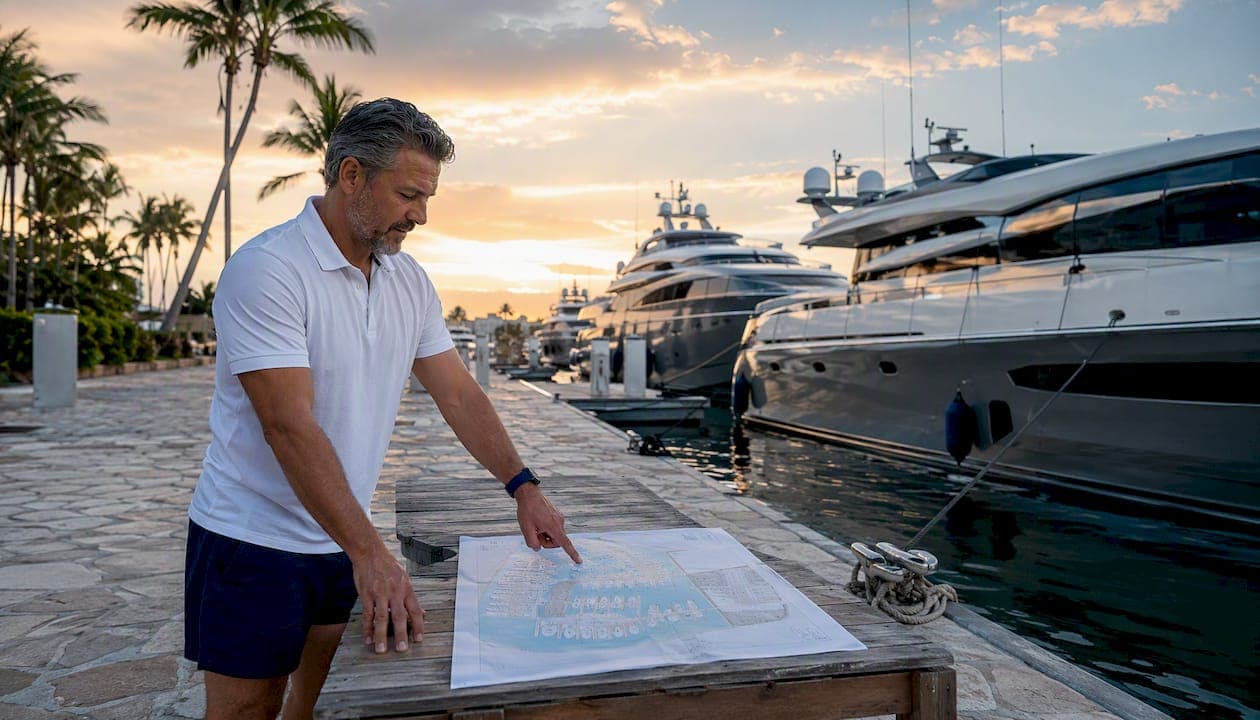
A mega yacht marina is a purpose-built, full-service homeport engineered for vessels 100 feet and longer, combining deep-water berths, high-amperage shore power, in-slip fueling, on-site customs and immigration, and concierge-driven logistics to support fully crewed luxury and expedition charters. For wildlife and adventure itineraries, the marina you choose is as consequential as the yacht itself.
Quick readiness check — five things that matter most:
- Minimum 20 ft draft access and berths scaled to your vessel's length
- Shore power at 400A or higher (three-phase)
- In-slip fueling and duty-free bunkering available
- On-site CIQ (customs and immigration clearance)
- 24-hour concierge and yacht-assist team
Three-point decision test for expedition charters:
- Technical readiness: Does the marina publish verified depth, berth length, and shore power specs?
- Logistics services: Are CIQ, provisioning, and waste disposal handled on-site?
- Destination fit: Can the marina stage your vessel efficiently for the wildlife region you're targeting?
Table of Contents
- What makes a mega yacht marina different from a standard marina?
- What operational services does a true homeport provide?
- How do you choose the right homeport for an expedition charter?
- Where are the best mega-yacht-ready marinas near the United States?
- Arrival and pre-departure checklist for guests and captains
- How do mega yacht marinas approach environmental responsibility?
- Insurance and legal considerations when choosing a mega yacht marina
- Key Takeaways
- What the marina checklist misses
- Exoticacharters handles the homeport details so you don't have to
What makes a mega yacht marina different from a standard marina?
The measurable gap between a standard marina and a true superyacht facility comes down to physical infrastructure. Berth lengths at leading facilities range from 60 ft to 700 ft; Habacoa in South Abaco, Bahamas, for instance, lists 150 berths spanning that full range, with 134 designated superyacht berths and an 880-ft turning circle. Draft access is equally decisive: Habacoa's entry canal reaches 26 ft, while Yacht Haven Grande Miami at Island Gardens offers a 27 ft maximum draft with berths up to 550 ft.
Mooring style shapes the entire arrival experience. Premier superyacht facilities predominantly use stern-to (Mediterranean-style) mooring with bow ground lines, or quay-side alongside berthing for the largest vessels. Stern-to maximizes berth density and keeps gangways accessible; alongside suits very wide-beam expedition yachts that need unobstructed deck access for tenders and equipment.
| Spec | Typical Range at Mega Yacht Marinas |
|---|---|
| Berth length | 100 ft – 700 ft |
| Draft / depth | 20 ft – 27 ft |
| Shore power | 400A – 800A (three-phase) |
| Turning basin | 240 ft – 880 ft |
| In-slip fueling | Standard at premier facilities |
Pro Tip: Before signing a berth contract, request the marina's written technical guarantee covering minimum depth at mean low water, shore power phase and amperage, and turning-basin clearance for your vessel's beam. Verbal assurances are not enough when you're staging for a remote expedition.
What operational services does a true homeport provide?
The difference between a docking point and a genuine homeport is the depth of its integrated logistics. On-site CIQ, duty-free bunkering, and 24-hour concierge are table-stakes for any international expedition charter; without them, clearance delays and fuel logistics can cost a full day of itinerary time, as highlighted by TranspOnyx's luxury yacht and cruise transfer services on the French Riviera.
Yacht-assist and docking teams matter more than guests typically realize. A dedicated dock crew handles line-handling, fender placement, and gangway setup for vessels where a single misjudged approach can cause significant damage. Mobile and in-slip fueling eliminates the need to move the vessel to a fuel dock, which is particularly valuable when you're loading expedition equipment and provisioning simultaneously.
"Top-tier marinas function as homeports rather than transient docks; successful charters rely on marinas that offer comprehensive yacht support plus lifestyle amenities for guests and crew." — PIANC
Crew welfare facilities, often overlooked in the planning phase, include laundry, crew lounges, medical access, and secure storage for expedition gear. Cape Town's V&A Waterfront, for example, offers a crew lounge and Syncrolift dry dock alongside bonded fuel supply — a model that illustrates how a homeport integrates technical and lifestyle support. For wildlife-focused charters, cold-chain provisioning capability and secure stowage for scientific or dive equipment are equally worth confirming.
Superyacht-ready accreditation is a rising industry trust signal that standardizes service levels across shore power protocols, fueling procedures, and yacht-assist availability. Ask any marina you're considering whether it holds or is pursuing this designation.
Pro Tip: For expedition charters departing on a tight wildlife window, confirm that the marina's CIQ office operates on weekends and public holidays — many facilities revert to appointment-only hours that can delay departure by 24 hours or more.
How do you choose the right homeport for an expedition charter?
Prioritize deep-water access, on-site CIQ, in-slip fueling, and 24-hour concierge over aesthetics. A beautiful marina that can't clear your vessel on a Sunday morning is the wrong choice for a Bahamas wildlife run.
Decision checklist (confirm in writing before booking):
- Verified depth at mean low water for your vessel's draft
- Berth length and beam clearance confirmed for your specific yacht
- Shore power phase, amperage, and connector type
- In-slip fueling availability and fuel grade (diesel, gasoline, duty-free status)
- On-site CIQ hours, including weekends and holidays
- Waste disposal: blackwater pump-out, garbage, and recycling
- Provisioning lead times and cold-chain capability
- Nearest dry dock or technical support facility
- 24-hour security and yacht-assist staffing confirmation
- Berth deposit structure and cancellation policy
Cost line items to expect:
- Berthing deposit (typically a percentage of the seasonal or weekly rate)
- Shore power metered charges
- CIQ facilitation fees (where applicable)
- Blackwater and waste pump-out charges
- Security surcharges for extended stays
- Provisioning and fuel delivery fees
Red flags to walk away from:
- No published depth specs or evasive answers about draft clearance
- Turning basin too narrow for your vessel's length
- CIQ only available by advance appointment with no weekend coverage
- Ambiguous fuel sourcing or no duty-free bunkering option
- Single-shift staffing with no overnight security or dock crew
Pro Tip: Ask your broker to request the marina's most recent dredging survey date. Charted depths and actual depths can diverge significantly in high-sedimentation areas, particularly in South Florida and the Bahamas.
Where are the best mega-yacht-ready marinas near the United States?
Seasonality and itinerary shape every homeport decision. Here's how the major U.S. and nearby hubs stack up for expedition and wildlife charters.
South Florida and the Keys anchor the Atlantic corridor. Miami's Yacht Haven Grande at Island Gardens handles vessels up to 550 ft with a 27 ft draft and shore power up to 800A three-phase, making it one of the most technically capable facilities on the East Coast. It's the natural staging point for Caribbean and Bahamas departures, with direct access to international flights and provisioning networks.
The Bahamas offer the most dramatic wildlife access within a short run of Florida. Hurricane Hole Superyacht Marina in Nassau features a 240-ft turning basin, in-slip fueling, 24/7 security and concierge, plus on-site medical and retail. Habacoa in South Abaco, currently under development, is positioned to become North America's largest superyacht marina, with on-site CIQ and an 880-ft turning circle designed for the largest expedition yachts.
"Habacoa reimagines the global marina experience — from essential functionality to ultra-luxury hospitality — creating a global, eco-friendly, superyacht destination at the epicenter of the Atlantic and Caribbean corridor." — Habacoa
New England shines from June through September. Newport, Rhode Island, and Nantucket offer deep-water access and proximity to whale-watching grounds, island-hopping routes, and the dramatic coastline of Maine. Berth lead times in peak summer can stretch to several weeks, so booking 60–90 days out is standard practice.
The West Coast and Pacific Northwest serve as the primary staging ground for Alaska wildlife expeditions. Seattle-area marinas and those in British Columbia provide the provisioning depth and technical support needed for extended passages to remote Alaskan anchorages. Shore power and fueling infrastructure vary more widely here than in Florida, so verifying specs in advance is especially important.
Caribbean and Antigua access round out the picture for longer expedition seasons. Antigua Superyacht Marina offers 25 ft draft access and 400A shore power, with direct positioning for the Eastern Caribbean wildlife circuit.
Pro Tip: For Alaska expedition charters, stage your vessel in Seattle or Vancouver at least two weeks before departure. Spare parts, specialized dive equipment, and naturalist gear take longer to source in the Pacific Northwest than in South Florida.
Arrival and pre-departure checklist for guests and captains
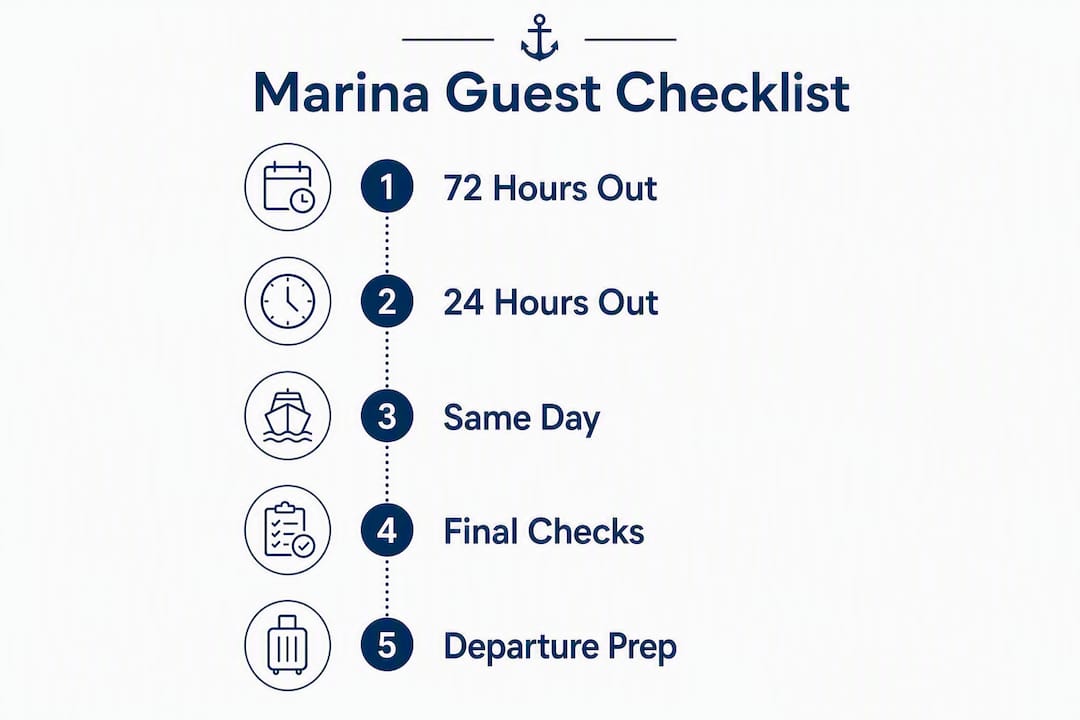
Timing is everything when a wildlife window is fixed. Here's how to structure the final 72 hours before departure.
72+ hours out:
- Confirm berth reservation in writing and request a marina contact for the arrival day
- Submit CIQ pre-arrival notification (vessel documents, crew and guest passports, cargo manifest)
- Place provisioning orders, including cold-chain items and any specialist expedition supplies
- Confirm fuel order volume and delivery timing with the marina's fuel desk
- Arrange naturalist or expedition guide onboarding logistics and equipment stowage plan
48 hours out: 6. Verify shore power connector compatibility with the marina's electrical team 7. Confirm waste pump-out scheduling 8. Arrange guest transfers from airport or hotel to the marina
24 hours out: 9. Final crew welfare check: medical supplies, crew documentation, any required specialist permits for wildlife areas 10. Confirm gangway and tender launch logistics with the dock team
Same day: 11. Complete CIQ clearance on arrival before guests disembark 12. Conduct a final provisioning walkthrough and stow expedition equipment
Integrated logistics at top marinas — on-site CIQ, duty-free fuel, provisioning, and 24-hour concierge — directly reduce downtime and operational friction for international charters, often compressing a two-day clearance process to a matter of hours.
How do mega yacht marinas approach environmental responsibility?
For expedition and wildlife charter guests, a marina's environmental practices are not a secondary concern. They reflect the values of the voyage itself. Leading facilities now invest in shore power infrastructure specifically to reduce vessel idling and diesel emissions while at berth, a practice that directly benefits the marine ecosystems guests travel to experience.
Waste management at premier marinas includes segregated recycling, blackwater pump-out, and gray water treatment. Habacoa, for example, positions eco-technology as a foundational pillar alongside luxury hospitality. Bonded and duty-free fueling systems, when properly managed, also reduce the risk of fuel spills during bunkering operations.
For wildlife-focused charters, ask the marina whether it holds any blue-flag or environmental certification, and whether its bunkering procedures comply with MARPOL standards. These aren't bureaucratic details; they're signals that the facility takes the same care with the ocean that your expedition itinerary demands.
Insurance and legal considerations when choosing a mega yacht marina
Liability at a mega yacht marina flows in multiple directions, and understanding the structure before you arrive protects both guests and the vessel. The marina's own liability policy typically covers damage caused by its dock crew or equipment; it does not cover damage to your yacht caused by weather, neighboring vessels, or your own crew's actions.
Your charter yacht's hull and machinery insurance must be confirmed valid for the specific marina and jurisdiction. Some policies carry geographic exclusions or require prior notification when berthing at a new facility. P&I (Protection and Indemnity) coverage addresses third-party liability, including damage to marina infrastructure, and is standard on fully crewed charter vessels.
Regulatory compliance matters too. U.S. Customs and Border Protection requires advance notice of arrival for vessels entering from international waters; failure to comply can result in fines and delays that derail an entire itinerary. Confirm with your captain or broker that all USCG documentation, EPIRB registration, and crew licensing are current before departure.
This article is general information, not legal or insurance advice. Confirm current requirements with a qualified maritime attorney or insurance broker for your specific vessel and itinerary.
Key Takeaways
A true mega yacht marina combines deep-water berths, on-site CIQ, in-slip fueling, 400A-plus shore power, and 24-hour concierge to function as a full expedition homeport, not just a docking point.
| Point | Details |
|---|---|
| Minimum depth benchmark | Confirm at least 20 ft draft access at mean low water before booking any berth. |
| Shore power standard | Leading facilities offer 400A–800A three-phase; verify connector type for your vessel. |
| CIQ is non-optional | On-site customs and immigration clearance compresses international arrivals from days to hours. |
| Turning basin matters | An 880-ft turning circle (as at Habacoa) accommodates the largest expedition yachts safely. |
| Exoticacharters' role | Exoticacharters coordinates homeport selection, CIQ logistics, and provisioning for fully crewed expedition charters. |
What the marina checklist misses
Most guides stop at the spec sheet. Depth, shore power, berth length — these are necessary, but they're not what separates a forgettable charter from an extraordinary one. The decisive factor for expedition and wildlife itineraries is whether the marina connects you efficiently to the experience you came for.
A facility with a 27-ft draft and 800A shore power is impressive on paper. But if it's positioned two hours from the nearest wildlife corridor, or if its provisioning network can't source the specialist dive equipment your scuba diving charter requires, the technical specs become irrelevant. We've seen charters lose two full days to logistics that a better-positioned homeport would have resolved before guests even stepped aboard.
The other thing most checklists underweight is crew welfare. A well-rested, well-provisioned crew performs at a different level than one that spent the night troubleshooting shore power and sourcing provisions from three different suppliers. The best marinas understand this; they treat the crew as clients, not just vessel operators. Porto Montenegro's model, with its crew facilities and 24-hour yacht assist, reflects exactly this philosophy, and it's the standard we'd apply to any homeport selection for a serious expedition.
Exoticacharters handles the homeport details so you don't have to
Planning a fully crewed expedition charter means choosing the right vessel and the right homeport, coordinating CIQ logistics, staging provisioning, and onboarding naturalists or specialist guides — all before the voyage begins. That's where Exoticacharters brings genuine value.
The Exoticacharters team, built from former captains and water sports professionals, handles homeport selection as part of the full charter planning process. Whether you're staging in South Florida for a Bahamas wildlife run, positioning in the Pacific Northwest for an Alaska expedition, or accessing remote Caribbean anchorages, we match your vessel to a marina that meets every technical and logistical requirement. Exoticacharters is rated highly on Trustpilot by guests who've experienced exactly this level of coordination firsthand.
Browse the full range of luxury yacht charters and speak with a charter specialist to start planning your expedition.