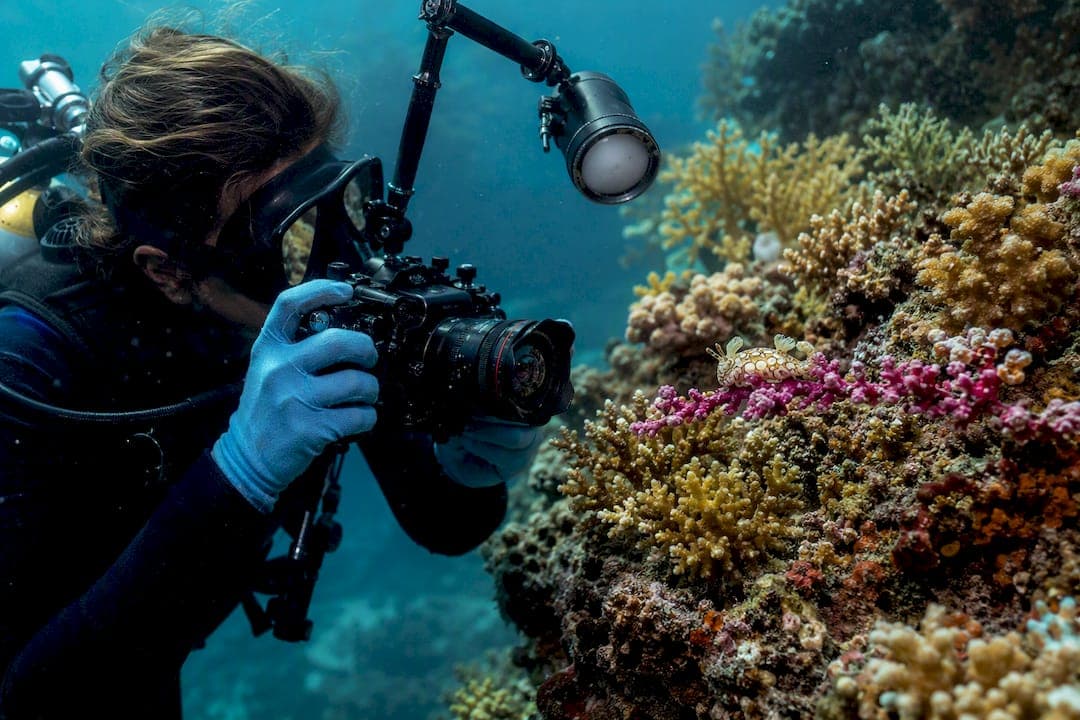
Follow this six-step field checklist to find and document rare marine species safely and reliably: pick a target taxonomic category, choose your dive site and timing around that species' known habits, search slowly and systematically, photograph the animal from multiple angles, log the metadata, and report protected sightings through the proper channel. Each step earns its place. Narrowing your taxonomic target first (fish versus mollusk versus echinoderm) cuts search time dramatically, matching your dive window to tide and season puts you where the animal actually is, and multi-angle photography turns a fleeting glimpse into a record NOAA or a regional database can verify.
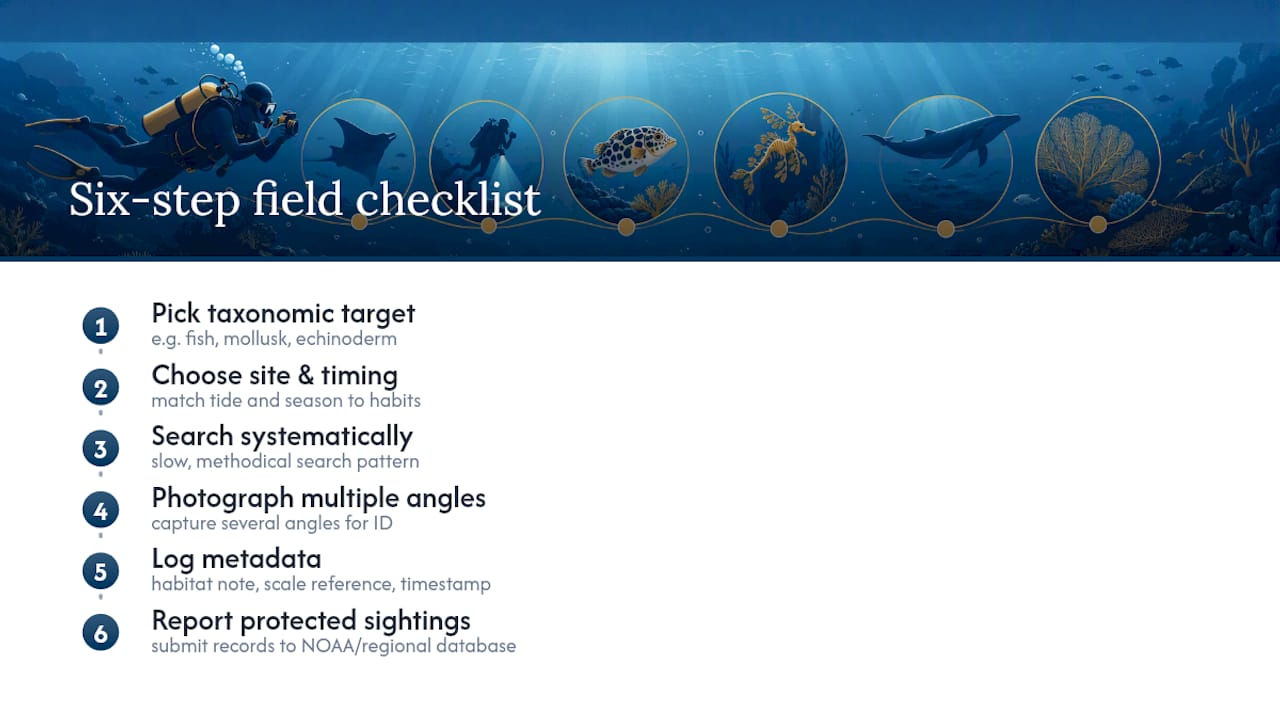
Pro Tip: Treat every sighting as a mini case file. A rare species without a habitat note, a scale reference, and a timestamp is a nice memory, not usable data.
Key Takeaways
A field-ready identification workflow, taxonomic triage, multi-angle documentation, and ethical distance rules, turns a lucky sighting into a verifiable, reportable record.
| Point | Details |
|---|---|
| Start broad, then narrow | Identify the taxonomic category first to cut search time and guide which guidebook or database to consult. |
| Slow down to see more | Cryptic species reveal themselves to still, patient divers, not to divers scanning quickly across the reef. |
| Photograph for ID, not art | Capture multiple angles, a scale reference, and habitat context since color alone often misleads underwater. |
| Respect distance and permits | Never chase, handle, or drone protected species; report sightings through NOAA or your regional authority. |
| Treat eDNA as a complement | eDNA detects presence with high sensitivity but can't confirm exact location, so pair it with visual confirmation. |
Table of Contents
- Which Rare Marine Species Should Divers Look For?
- How Do You Identify an Unknown Marine Species in the Field?
- What Spotting Techniques Reveal Cryptic Marine Life?
- What Makes an Underwater Photo Useful for Identification?
- How Do You Ethically Approach and Report Rare Sightings?
- Can eDNA Help You Find Marine Species You Can't See?
- What Should You Pack Before a Rare-Species Search Trip?
- A Diver's Field Note on Finding What Others Miss
- Ready to Search Remote Reefs for Rare Marine Life?
- Where Can You Verify a Marine Species Sighting?
- Frequently Asked Questions
- Sources
Which Rare Marine Species Should Divers Look For?
Some of the ocean's most prized sightings hide in plain sight; others simply demand the right patch of seafloor at the right hour. Building a mental shortlist before you get wet saves time once you're weightless and distracted by everything else moving around you.
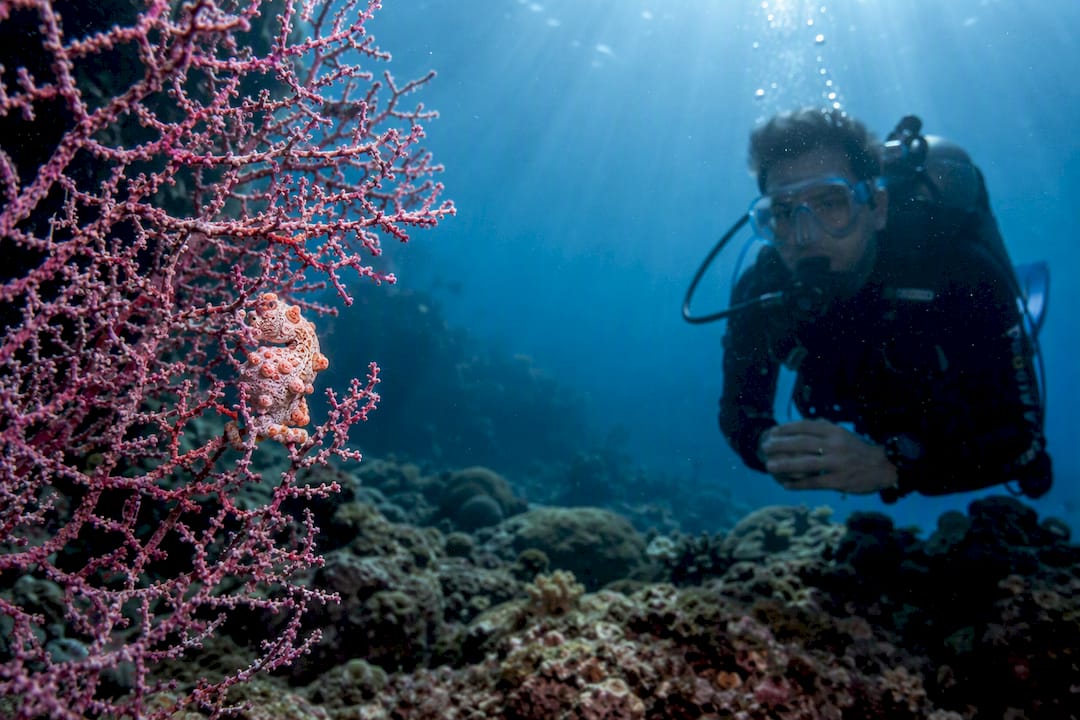
- Pygmy seahorse: Clings to gorgonian fans on reef slopes 10 to 40 meters deep; color-matched to its host, so spotting one usually means spotting the fan first.
- Frogfish: Sits motionless on rubble or sponge, mimicking texture rather than color; more common on muck-diving sites than clean coral reef.
- Nudibranchs (various species): Found on silty slopes and current-swept walls, often most abundant during plankton blooms in cooler months.
- Leafy seadragon: Restricted to temperate kelp and seagrass beds in southern Australian waters; a slow drifter that blends into weed cover.
- Blue whale: Seasonal migratory corridors near continental shelves; look for surface activity rather than the animal itself.
- Ghost pipefish: Hovers vertically near crinoids or seagrass, mimicking the host's shape and color almost perfectly.
- Harlequin shrimp: Found under rubble near sea stars, its only food source, making habitat cues more reliable than random searching.
- Oceanic manta ray: Frequents offshore seamounts and cleaning stations, often tied to lunar cycles and plankton density.
- Wunderpus octopus: Emerges at dusk on sandy muck bottoms, distinguishable from mimic octopus by consistent striping.
Pro Tip: Rarity is often a matter of habitat specificity, not scarcity. Learn the host organism (a sea fan, a sea star, a kelp bed) and you've already cut your search area by 90 percent.
How Do You Identify an Unknown Marine Species in the Field?
Start broad. Before worrying about a common name, place the animal in a taxonomic category, fish, mollusk, crustacean, echinoderm, or tunicate, since this single step greatly reduces search time and improves ID accuracy compared to flipping randomly through a guidebook.
- Triage underwater. Note the obvious body plan, fins versus shell versus arms, within seconds of the sighting.
- Shoot targeted angles before the animal moves or you run low on time.
- Record habitat, depth, and behavior in a slate or dive computer log immediately after the encounter.
- Consult a regional guide or database once topside, cross-checking against known ranges.
- Crowdsource to specialists through platforms like iNaturalist or regional dive Facebook groups when the ID still feels uncertain.
- Verify against WoRMS or FishBase for the accepted scientific name and distribution records.
A useful field checklist to jot down mid-dive:
- Approximate size relative to a known object (your hand, a dive light)
- Fin count and shape, or shell texture for mollusks
- Gill structure or rhinophore shape on nudibranchs
- Any burrow, midden, or den evidence nearby
What Spotting Techniques Reveal Cryptic Marine Life?
Most rare species aren't hiding from you; they're simply invisible to a diver scanning too fast. Guides and underwater naturalists consistently recommend slowing down and training your eye to catch small, involuntary movements, like an antenna flick or a fin twitch, rather than sweeping your gaze across the reef.
- Try the "Five-Minute Freeze": hold still near a healthy coral head or ledge and let shy animals resume normal behavior.
- Watch how small fish react. A sudden scatter often signals a predator or cryptic visitor before you ever see it directly.
- Look for middens, piles of discarded shell, near rock crevices as telltale signs of an active octopus den.
- Check sea state before committing to a search dive; anything above a light chop scrambles visibility and scares off skittish species.
- For boat-based spotting of larger animals, scan for blows, slicks, or concentrated bird activity rather than the animal itself.
Pro Tip: Cryptic species reward stillness. Roving divers see reef structure; still divers see reef life.
What Makes an Underwater Photo Useful for Identification?
A photograph only qualifies as identification-grade when it combines multiple angles with habitat context, since color alone is frequently misleading underwater due to light absorption at depth and regional color variation within the same species.
- Capture a side profile first, then a top-down shot, and an underside angle only if it's safe to approach that closely.
- Get one tight close-up of the diagnostic feature, a rhinophore, a fin ray count, a shell pattern, and one wider context shot showing substrate and scale.
- Shoot in burst mode with a shutter speed around 1/250 to 1/1000 for moving subjects, a technique photo-ID researchers rely on for matchable records.
- Favor strobes over continuous lighting for true color rendition, and set white balance manually below 10 meters.
- Log GPS, depth, and timestamp immediately, then upload to iNaturalist or a regional reporting line without baiting or touching the subject.
How Do You Ethically Approach and Report Rare Sightings?
Keep your distance, never chase or handle a protected species, and skip the drone entirely unless you hold a specific permit for that airspace. Minimizing time around any animal, especially one that's stressed or feeding, protects both the species and your legal standing.
- Maintain the safe-distance recommendations published in NOAA's regional protected species identification guides.
- Check permit requirements before photographing marine mammals or nesting sea turtles in protected zones.
- Never feed, corner, or redirect an animal's path to get a better shot.
To report a sighting:
- Photograph the animal without approaching closer than the recommended distance.
- Record GPS coordinates, depth, date, and time immediately.
- Contact your regional NOAA stranding or protected-species line, or the equivalent authority for your country.
- Submit observer details so researchers can follow up if needed.
Can eDNA Help You Find Marine Species You Can't See?
Environmental DNA sampling detects genetic traces a species leaves behind in seawater, and it's remarkably sensitive for confirming presence without ever spotting the animal. The trade-off: eDNA struggles to pinpoint exact location, and lingering genetic material can suggest an animal is present when it has already moved on or died.
- Use eDNA for pre-survey screening or research collaborations, not as a stand-alone confirmation method.
- Pair it with visual confirmation or confirmatory sampling before reporting a species as present in a given area.
- Treat it as one tool among several; molecular techniques increasingly complement, rather than replace, traditional morphological identification.
Roughly one in every handful of marine surveys now incorporates eDNA screening alongside diver observation, a shift researchers describe as improving detection of species too rare or cryptic for visual surveys alone.
What Should You Pack Before a Rare-Species Search Trip?
Gear needs shift depending on whether you're snorkeling a shallow flat, diving a reef wall, or scanning open water from a boat deck. Pack for all three if your itinerary covers mixed terrain.
- Snorkel gear for shallow seagrass and flat searches; full scuba kit with a dive light for wall and cave habitat.
- Backup camera batteries and extra storage cards, since a dead battery mid-encounter is the most common regret divers report.
- A waterproof slate or a phone app for logging metadata the moment you surface.
- A regional species checklist and current permit requirements for the area you're visiting.
- Consider a PADI fish identification course or a local naturalist workshop before a major trip.
- For remote reef systems and open-ocean megafauna corridors, chartering a yacht with onboard scuba support solves the access problem that keeps most rare-species habitat out of reach for shore-based divers.
- Review a marine insurance primer like this guide to liveaboard coverage before committing to extended offshore trips.
A Diver's Field Note on Finding What Others Miss
One of the most memorable pygmy seahorse sightings I've heard described from experienced dive guides came not from covering more reef, but less. The diver held position beside a single gorgonian fan for nearly ten minutes, waiting for a color mismatch to reveal itself against the polyps. That patience, not distance covered, is what separates a rare sighting from a missed one.
Log what you find, report what's protected, and if the search calls for a remote reef system beyond shore access, a naturalist-led charter closes that gap.
Ready to Search Remote Reefs for Rare Marine Life?
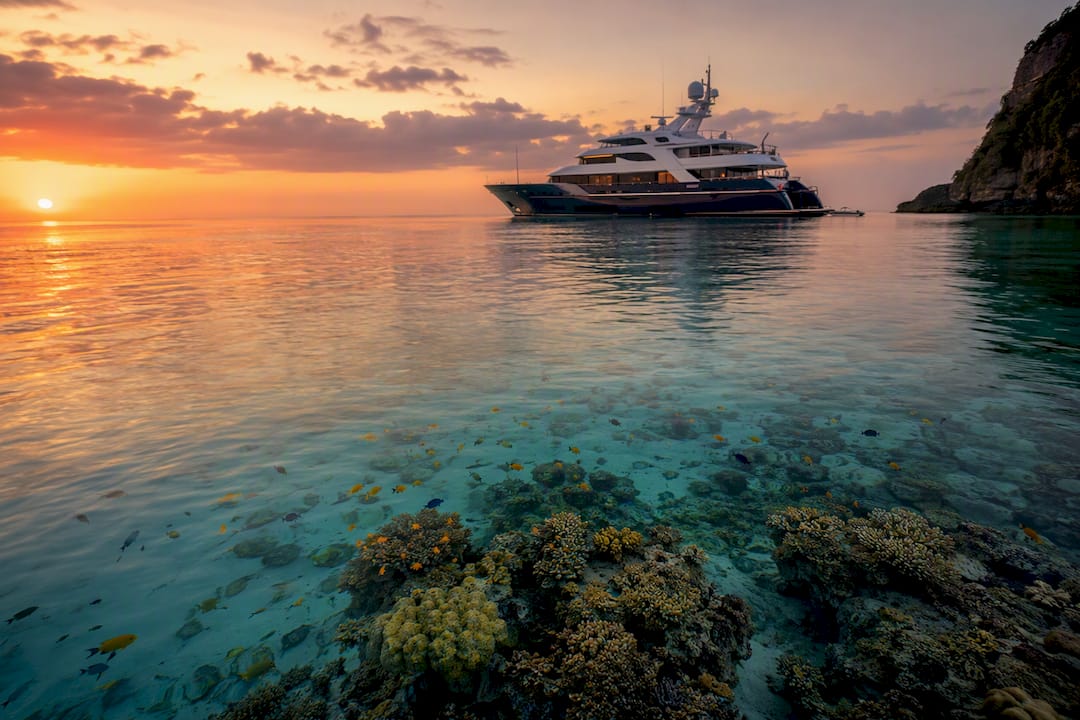
Some of the species on your list, oceanic mantas, leafy seadragons, deep reef-slope pygmy seahorses, simply don't live within range of a shore dive. Exoticacharters builds fully crewed itineraries around exactly that problem, pairing former captains and water sports professionals with clients who want to dive remote habitat rather than crowded reef access points. Browse luxury yacht charters built around wildlife-focused itineraries, or explore charter yachts with scuba diving onboard if your search depends on reaching sites no dive boat schedule can get you to on its own.
Where Can You Verify a Marine Species Sighting?
- NOAA Protected Marine Species Identification Guide: best for confirming protected status and safe-distance rules by region.
- World Register of Marine Species (WoRMS): the reference point for accepted scientific names.
- FishBase: useful for distribution records and species-level fish data.
- iNaturalist: crowdsourced confirmation from naturalists and taxonomists worldwide.
- A peer-reviewed eDNA methodology overview: background on molecular detection techniques and their limits.
Frequently Asked Questions
What's the fastest way to narrow down an unknown marine species sighting? Identify the broad taxonomic category first, fish, mollusk, crustacean, echinoderm, or tunicate, before consulting any field guide. This single step eliminates most irrelevant search results immediately.
Do I need a permit to photograph protected marine species? Permit rules vary by species and location. Check NOAA's regional protected species guidance or your local marine authority before photographing marine mammals or nesting sea turtles at close range.
Can eDNA replace visual identification entirely? No. eDNA detects genetic traces with high sensitivity but struggles to pinpoint an animal's exact location and can register DNA from transient or deceased material, so confirmatory visual sighting still matters.
What's the single most useful camera setting for rare-species photo IDs? Burst mode paired with a shutter speed between 1/250 and 1/1000 for moving subjects gives you the best odds of capturing a diagnostic, matchable frame before the animal moves.
Where should I report a rare or protected species sighting? In U.S. waters, contact NOAA's regional protected-species line with your photos, GPS coordinates, date, time, and observer details. Other countries maintain equivalent stranding or reporting networks.
Sources
- Marine Species Identification: So, What Did You Just Photograph? | MarineBio Conservation Society
- Protected Marine Species Identification Guide Southeast United States
- A tool for finding rare marine species
- Pro Tips for Finding Marine Life While Scuba Diving | Scuba Diving