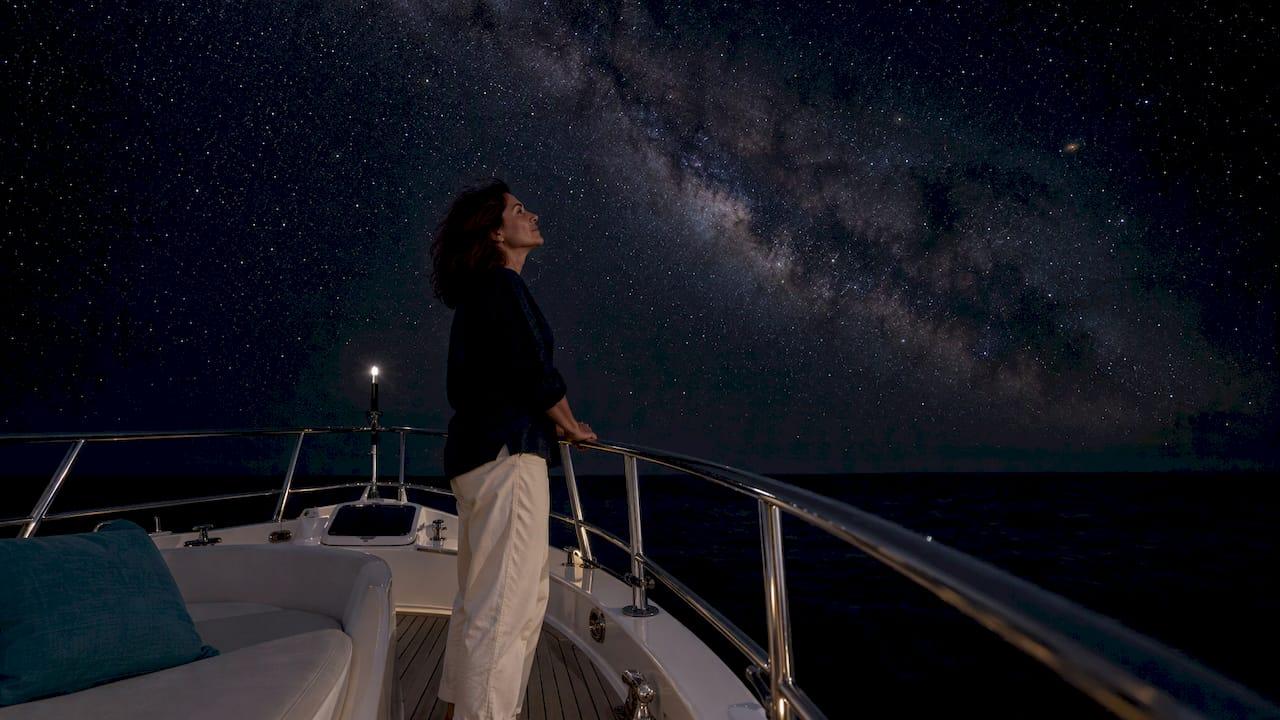
The best sky you will ever see is usually at anchor, a long way from any town, with the engines off and the deck lights low. A yacht can take you there. Plan around the new moon, sail well offshore or to a remote anchorage, dim everything that glows, and give your eyes time to adjust. This guide covers each step, from choosing the water to choosing the vessel, so your first night under the Milky Way is as good as it can be.
TL;DR
- Head far from land and plan around the new moon. Light pollution fades offshore, and a moonless night shows the faintest stars.
- Choose a dry-season window for your region, then confirm the forecast on the day for clear skies and calm water.
- Dim the deck. Switch off what you can, keep red light for moving around, and always show the white anchor light the rules require.
- Take binoculars rather than a telescope. A moving boat defeats high magnification.
- Match the vessel to the sky you want: a catamaran, a sailing yacht or an expedition-style boat each offers something different.
Table of Contents
- Why a yacht gives you a better night sky
- Where and when to see the clearest skies
- Choosing the right yacht for a night under the stars
- Perspective
- Setting up the deck: lights, eyes and comfort
- Gear that works on a moving boat
- Finding your way around the sky
- Safety on deck at night
- Planning a stargazing charter with us
- FAQ
- Sources
Why a yacht gives you a better night sky
On land, even a quiet beach town throws a dome of light into the sky. On the water, once you leave the coast behind, that dome shrinks and then disappears. Open ocean has dark skies where light pollution does not hide dimmer stars, according to Cruise Critic. In those conditions you can pick out the Milky Way, meteors, satellites and the faint smudge of the Andromeda Galaxy, some 2 million light-years away.
A private yacht adds three advantages that no shore-based stay or large ship can match.
You choose the anchorage. A crewed charter lets you move to wherever the sky is darkest rather than wherever the itinerary stops. If a bay is lit by a resort across the water, the captain can reposition.
You control the lights. On a private charter, the deck lighting, the music and the salon glow are all yours to set. That matters more than most people expect, because glare and glass reflections can wash out a view that the sky itself would have delivered.
You control the timing. There is no scheduled departure and no shared deck. If the cloud breaks at 2 a.m., you can be on the foredeck in a blanket five minutes later.
Where and when to see the clearest skies
The two variables that matter most are distance from land and the phase of the moon.
Distance from shore
An itinerary that takes you more than a couple of dozen miles offshore may offer good viewing. For a smaller boat, Discover Boating advises traveling at least a few miles offshore or to the center of a lake, cutting the engines, turning off unnecessary lights and dropping anchor.
Remote island groups work in a different way. They sit so far from industrial coastlines that the nearest bright lights may be hundreds of miles away. This is one reason we plan so many of our trips around remote regions, from the South Pacific to Belize, the Red Sea and the Arctic.
The moon
Time your trip for the new moon. It is the darkest part of the lunar cycle and the best for viewing celestial objects, because the moon crosses the sky in daylight with the sun. A full moon is beautiful on the water, but it drowns out the Milky Way. If your dates are fixed, plan your stargazing for the nights either side of the new moon and keep the bright-moon evenings for swimming, dinner on deck and tender rides.
The season
Pick the dry season for your region. Cruise Critic cites December through April in the Caribbean and May through September in the Mediterranean as optimal windows. Other regions follow their own patterns, so ask your charter specialist for the dry months where you plan to sail, and check the forecast again when you are there. Clear skies are essential, and calm water makes for better viewing.
Keeping it close to home
You do not need a passport to try this. Several US waters are accessible by private vessel and known for dark skies. DarkSky International reports that Cape Lookout National Seashore in North Carolina became an International Dark Sky Park in 2021, with conditions ideal for viewing the Milky Way with the unaided eye; the islands can be reached by ferry or private vessel. Off Florida, Dry Tortugas National Park, about 70 miles west of Key West, is reachable only by ferry, seaplane or private boat, and its offshore position means very little light pollution.
If you want to compare the experience with a dark sky on land, the Dutch island of Ameland is known for it, and a guide to stargazing on Ameland shows how a good dark-sky site is organized.

Choosing the right yacht for a night under the stars
Any boat can carry you under the sky; some are simply better at it. When we talk through a stargazing charter with a guest, we think about space, quiet and how easily the lighting can be controlled.
| Vessel type | What it offers for stargazing | Best for |
|---|---|---|
| Catamarans | Wide trampolines and open foredecks where you can lie flat and look straight up | Families and couples who want room to spread out |
| Sailing yachts | Quiet at anchor and under sail, close to the elements | Couples and nature lovers |
| Motor yachts | Large sundecks and flybridges, comfortable seating, more range to reach remote anchorages | Groups wanting comfort and distance |
| Luxury yachts | Multiple deck levels, so one can stay dark while another stays social | Larger parties |
| Expedition-style vessels | Built for remote waters, with itineraries that go where few boats do | Divers and wildlife enthusiasts |
A few design points are worth raising with your specialist before you book:
- A dark upper deck. An open sundeck or flybridge with controllable lighting is ideal. A deck that is bright at night, from fixed lighting you cannot switch off, works against the sky.
- Glass and reflections. Large salon windows can reflect interior light back at you. A dim salon, or an exterior seating area away from the glass, solves it.
- Quiet systems. Generators and music carry across still water. Agree with the crew when to switch off what you can for your viewing hour.
- A flat place to lie down. Craning your neck for an hour spoils the experience. Loungers, a trampoline or a foredeck cushion matter more than any gadget.
For a deeper look at remote vessels, our guide to what makes a yacht suitable for expedition waters explains the build qualities involved.
Perspective
We have spent our careers on the water, as captains and water sports professionals, and the nights guests talk about most are rarely the ones with the grandest dinner. They are the quiet ones: anchor down in a remote bay, the generator off, a blanket around the shoulders and the Milky Way running from one horizon to the other.
That is why we plan stargazing into the itinerary rather than adding it as an afterthought. We look at where the anchorages sit relative to the nearest lights, which night of the lunar cycle you will be there, and how the crew can set the boat up so the deck is dark and comfortable.
Remote destinations make the difference. Far from marinas and coastal towns, the sky behaves in a way most people have never seen. We would suggest building two or three unhurried evenings into a week at sea, so that one cloudy night never decides the trip.
Mo
Setting up the deck: lights, eyes and comfort
The sky is not hard to see. Keeping it visible is the work.
Let your eyes adjust
Give yourself time for the eye adjustment. Discover Boating lists allowing time for eye adjustment among its night-boating tips, and recommends red lights for visibility. Red light protects your night vision where white light undoes it, so keep red torches on deck and ask the crew to switch the cockpit and deck lights to dim or off for the viewing hour. Put phones on night mode as well.

Keep the legally required lights on
Dark does not mean unlit. A boat at anchor at night must show a white anchor light, as Discover Boating notes. More broadly, US recreational vessels must display navigation lights between sunset and sunrise and in restricted visibility, under the federal boating requirements published by the US Coast Guard's Boating Safety Division. On federally controlled waters, the Arkansas Game and Fish Commission adds that decorative LED strips, under-glow and bright floodlights can mask the standard navigation lights while underway, so leave them off. Your captain handles these requirements as a matter of routine; the point for you is that you dim everything else, not the lights that keep the boat visible and safe.
Pick your spot
The cruise-ship advice transfers neatly. Cruise Critic quotes a resident astronomer recommending a viewing area forward of the funnel, since the area ahead of the bridge is kept dark at sea while positions aft are brighter and may have smoke in the way. On a yacht the same logic applies: the foredeck is usually the darkest, least obstructed place, away from the galley glow and the exhaust.
Stay warm
Temperatures drop significantly on the water at night. Discover Boating suggests warm, waterproof clothing, blankets, a thermos of hot drinks and simple snacks. On a charter, tell the crew in the afternoon and they will have hot chocolate, cushions and throws waiting on deck.
Gear that works on a moving boat
The instinct is to bring a telescope. On a boat, binoculars are more practical because the motion makes a telescope hard to hold on a target.
Choose the magnification with care. REI's experts say 10x42 or 10x50 binoculars are options for stargazing, but magnification above 10 makes steady viewing difficult on a boat or other moving platform. For boats, they suggest 8x or less. At anchor in calm water, 8x or 10x binoculars will show star clusters, the moons of Jupiter on a good night and far more stars in the Milky Way than your eye alone.
If you want to go further, image-stabilized binoculars are built for this problem. One 2026 review rates the Fujinon Techno-Stabi TS-X 14x40 as best for boats, with plus or minus 6 degrees of correction to tame a rocking hull.
A short kit list:
- Binoculars, 8x to 10x, with a neck strap
- Red-light torches, one per person
- A reclining lounger, cushion or yoga mat
- Blankets and a hot drink
- A phone or tablet with a stargazing app, set to night mode
- A printed star chart as a battery-free backup
Finding your way around the sky
You do not need to know the constellations before you go. Apps do the work. SkySafari 8 Pro lets you hold your device to the sky to identify stars, constellations, planets and satellites, and includes a Night Vision Mode that helps preserve dark-adapted vision, plus an Events Finder for upcoming astronomical events visible from your location. SkyView uses your camera to identify the same objects, including the ISS and Hubble, offers red or green night filters, and works without WiFi, data signal or GPS, which suits a boat far from the coast.
Before you leave, download what you need and check the offline functions. A quick look at the Events Finder for meteor showers on your dates can turn an ordinary evening into one you plan around.
Safety on deck at night
Stargazing means sitting in the dark on a moving platform, so a few habits matter. Discover Boating's night-boating guidance covers life jackets for everyone, a check of the navigation lights, a float plan shared with someone ashore, charged phones and a VHF radio, reduced speed, a dedicated lookout and red lights for visibility.
On a crewed charter, the captain and crew handle most of this: watch-keeping, radios, navigation and anchoring. Your part is simple:
- Ask the crew where it is safe to sit and where to avoid, especially on foredecks and open sides.
- Keep a red torch with you rather than switching on white light to find your way.
- Wear a life jacket if the crew advises it, and follow the briefing on night movement around the boat.
- Children should stay close to an adult on deck after dark.
Planning a stargazing charter with us
We are a team of former captains and water sports professionals, and we plan fully crewed charters in remote regions around the world, with a focus on diving, wildlife and adventure on the water. Stargazing fits naturally into that: a day of diving or wildlife watching, an anchorage far from any town, and a night on deck. Our guests have rated us highly on Trustpilot.
Tell us the kind of night you want, whether that is a romantic evening for two, a family on a catamaran trampoline or a diving group in a remote atoll, and we will suggest regions, seasons and vessels to match, including South America and the Indian Ocean and Southeast Asia. Ask us to build your dates around the new moon.
If you are ready to start, speak to a yacht charter specialist and tell us when and where you would like to be under the stars. For a sense of what a remote voyage involves, read about the activities on an expedition charter and the crew on board.
FAQ
Can you stargaze on a cruise ship?
Yes, and many people do. The best spot is forward of the funnel, where the area ahead of the bridge is kept dark at sea, according to Cruise Critic. A private yacht gives you more control, because you can choose the anchorage and dim the lights yourself.
What is the best time of month for stargazing on a yacht?
Around the new moon, the darkest part of the lunar cycle. Combine it with your region's dry season and a forecast of clear skies. Ask your charter specialist to line up your dates with the moon phase when you plan the trip.
Do you need a telescope?
No. Binoculars are the more practical choice on a boat, and REI's experts say magnification above 10 makes steady viewing difficult on a moving platform. A stargazing app on your phone will help you identify what you see.
Can you spend the night on a yacht at anchor?
Yes. That is what a charter is built around: you anchor in a sheltered bay and sleep aboard. While at anchor at night, the white anchor light must stay on, so the boat remains visible to other vessels.
Sources
- 10 Tips for Shipboard Stargazing on a Cruise, Cruise Critic
- Stargazing on a Boat: 8 Tips for a Night Cruise, Discover Boating
- Cape Lookout National Seashore, DarkSky International
- Dry Tortugas National Park: Best Time and Trip Guide, Kit Authority
- A Boater's Guide to the Federal Requirements for Recreational Boats, USCG Boating Safety Division
- Nighttime Safety Tips for Arkansas Boaters, Arkansas Game and Fish Commission
- How to Choose Binoculars, REI Expert Advice
- Best Image-Stabilized Binoculars 2026, Smart Home Explorer
- SkySafari 8 Pro, App Store
- SkyView, App Store
- Sterren kijken op Ameland: de complete gids, Breeze Ameland