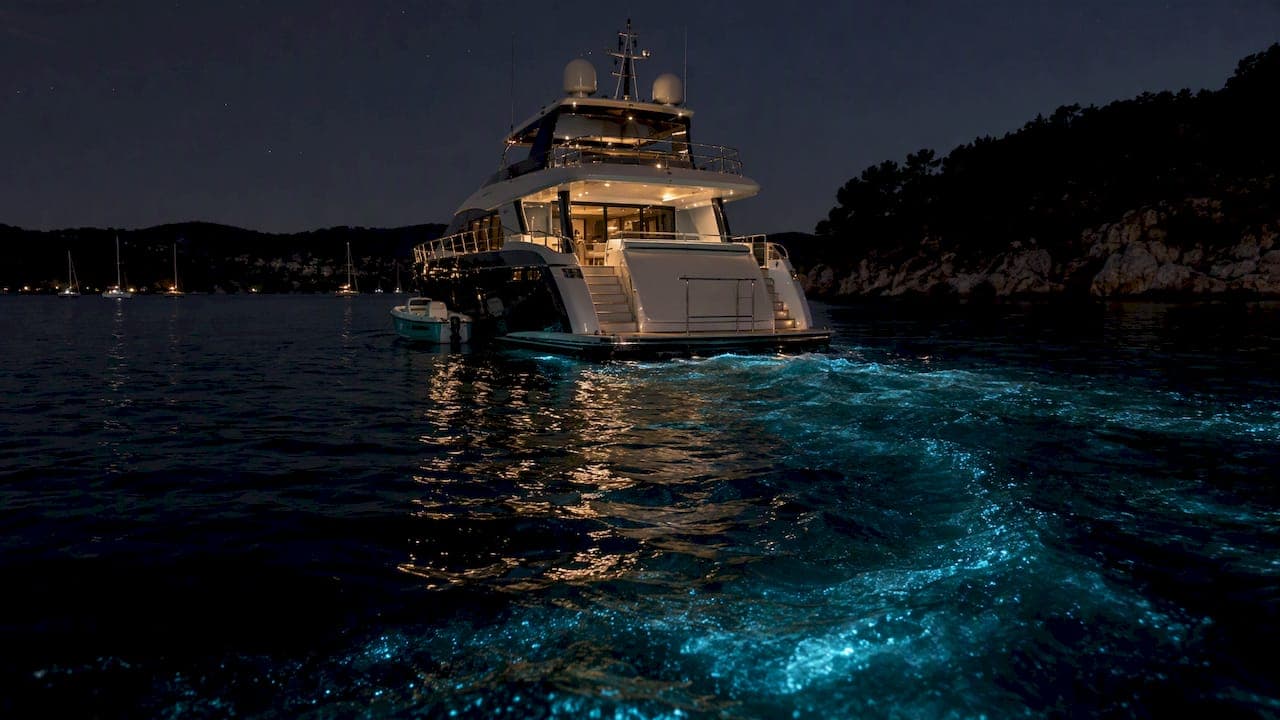
The best way to see bioluminescence is from a quiet boat, far from shore lights, on a dark night when the sea is calm. A private crewed yacht gives you all three: you choose the anchorage, the crew switches off deck lighting, and the itinerary can follow the moon rather than a tour schedule. The glow itself is a natural event that no operator controls, so the skill lies in planning around the conditions that make it likely. This guide covers what makes the water light up, where and when to look in the United States, how night and drift diving fit into a charter, and how we build an itinerary around a glowing sea.
TL;DR
- Marine bioluminescence is living light, most often from single-celled dinoflagellates that flash when the water around them is disturbed, such as by a hull, an oar or a swimmer.
- Plan around a new moon or a night before moonrise, calm wind and warm late-summer water; strong wind can mix the plankton away and end a display.
- In the US, Florida's Space Coast and Southern California are well-documented areas, and the season matters more than the exact date.
- Night dives and drift dives from a yacht need a clear plan, proper lights and a crew that briefs the exit and the current; certification and local conditions decide what suits you.
- A private charter lets you build a trip around moon phase, anchorage and diving, with a specialist who has run boats and water sports before.
Table of Contents
- What makes the sea glow
- Why a yacht is the right platform
- Where to see bioluminescence from a boat in the United States
- When conditions line up
- What to expect on deck, in the tender and in the water
- Night diving from a yacht
- Drift diving from a yacht
- Combining night and drift diving
- Cold-water diving charters
- Our perspective
- Choosing the right yacht for a night on the water
- Plan your glowing-sea charter with us
- FAQ
- Sources
What makes the sea glow
Bioluminescence is light produced by a living organism, generated by chemical reactions that take place inside the creature or are released by it, as NOAA's National Ocean Service describes it. On the water, the version most sailors meet is caused by dinoflagellates, single-cell algae that almost always account for the glow seen from ships, lit up when a hull or a moving animal excites them mechanically.
That explains why the display follows you. Your wake becomes a streak of light, a dropped fender sends a flare through the water, and a hand trailed over the swim platform draws sparks. Researchers at UC Santa Barbara note that these organisms flash when disturbed, so boat wakes, splashes and swimming all produce visible trails.
The color is not a matter of taste. Marine bioluminescence is usually blue-green, because those wavelengths travel farthest through seawater. Woods Hole Oceanographic Institution also explains that some animals carry a dedicated light organ called a photophore, and that the light can help attract prey, avoid predators or communicate. Once you leave the surface and start diving at night, those animals become part of the story.

Why a yacht is the right platform
Shore-based glow tours share a few limits: fixed departure times, shared boats, nearby lights and a set route. A private yacht removes most of those.
- Darkness on demand. The crew can dim or switch off exterior lights, and the captain can anchor well away from town glow.
- Timing that follows the moon. UCSB advises choosing a night when the moon is new or has not yet risen, because moonlight reduces contrast. On a charter you set the dates; you are not choosing from a published tour calendar.
- Flexibility on the day. Wind and water movement decide whether a display holds. A captain with options can move the boat to a sheltered bay when conditions shift.
- A comfortable base. You return to a warm cabin, a hot shower and a late supper rather than a long drive back from a launch ramp.
The sections below cover what you can reasonably expect, because the glow is a natural phenomenon and we will not promise a light show on a given night.
Where to see bioluminescence from a boat in the United States
Florida's Space Coast and Mosquito Lagoon
Florida's Department of Environmental Protection lists Haulover Canal in Merritt Island National Wildlife Refuge as a known spot for people seeking bioluminescent plankton and comb jellies. The University of Central Florida also uses Mosquito Lagoon near Titusville for nighttime viewing of dinoflagellates and, occasionally, bioluminescent jellyfish.
Visit Florida reports that the strongest season in Central Florida runs from May through November, peaking from June through October, with July and August the prime months. It names Cocoa Beach, Titusville, Port Canaveral and Cape Canaveral among the Space Coast locations. Much of this area is shallow lagoon, so it suits paddling and small-boat exploration; for a larger yacht, the practical approach is to base the charter on the coast and use the tender for the shallows.
Southern California
California offers a vessel-based experience of its own. The Ocean Institute's research vessel runs summer bioluminescence night cruises off Dana Point, using a deep meter net and onboard lighting to look at drifting luminous organisms. The institute also states that these cruises are offered only in summer and that natural forces determine how much bioluminescence there is.
Farther up the coast, The Sacramento Bee reports that dinoflagellates off San Luis Obispo County are commonly seen in late summer and early fall, are easier to spot on dark nights such as a new moon, and are often clearer around high tide. The same report notes that wind shifts can clear a bloom within days, which is why a flexible schedule helps.
Beyond US waters
If you want to build an entire trip around dark skies and warm water, a yacht can take you well past the US coastline. We plan crewed charters in regions such as Belize, the South Pacific, the Indian Ocean and Southeast Asia and the Red Sea. Tell our team that a glowing sea is a priority and we will line up moon phase, anchorages and crew briefings with your dates.
When conditions line up
Two variables matter most, according to UCSB's marine-science resource: how concentrated the organisms are, and how the water moves. Nutrients help blooms build, while calm conditions let the plankton stay near the surface where you can see it. Strong winds can mix surface dinoflagellates down and end a display.
In practice, build your plan on these points:
| Factor | What to aim for | Why it matters |
|---|---|---|
| Season | Late summer and fall in many US waters; May through November in Central Florida | Blooms often follow nutrient input and calm seas |
| Moon | New moon, or the hours before moonrise | Moonlight lowers contrast |
| Wind | Light and steady | Strong wind mixes plankton away |
| Light pollution | Anchor well away from towns and marinas | Darker water shows fainter flashes |
| Flexibility | Three or four possible nights, more than one anchorage | Displays can come and go within days |
The lesson is to book a window, not a single night. A week-long charter spanning a new moon gives you several chances, and a crew that knows the area will tell you where the water was glowing last night.
What to expect on deck, in the tender and in the water
The typical evening on a yacht looks like this. After dinner, the crew dims the lights and you wait ten to fifteen minutes for your eyes to adjust. Then you look at the wake from the stern, or take the tender out and run a hand through the water. Many guests are surprised that the glow is faint at first and grows sharper as their night vision builds, so give it time.
Also consider the safety of swimming. KQED's science desk notes that most bioluminescent dinoflagellates are not dangerous to humans, but murky brown water during a red tide may contain toxin-producing organisms, and it is best to stay out of the water then. The safe approach is simple: ask the captain to check local advisories for the area, and if the water looks brown or discolored in daylight, enjoy the glow from the deck and the tender instead. A swim at night should always be supervised, from a lit platform with a crew member watching.
Night diving from a yacht
For certified divers, the glow is only the beginning. Night diving shows a different reef: the animals that hide by day come out, and the beam of a dive light reveals color the blue water filters away at depth. A yacht makes this practical, because you dive from the boat you sleep on, with no long transit in the dark.

The Divers Alert Network, in its guidance on night diving, recommends primary and backup dive lights, surface signaling devices and a clear dive plan. For boat dives it suggests that you identify the boat as your exit with a light, mark the anchor line with chemlights, place a strobe at the ladder, and understand the crew's backup plan. It also advises checking local tide charts, planning around slack tide, and carrying a reliable underwater compass, preferably with glow-in-the-dark markers.
A good crew briefing covers each of those points before anyone enters the water. On our side, we look for yachts whose crew and dive staff will brief the entry, the lit exit and the emergency plan in detail, and we match the vessel to your certification level and experience.
Keeping a night dive simple
DAN's published case summary of a diver who developed decompression sickness after a deep wreck night dive involving task loading and unfamiliar buddies is a useful reminder of how stacked demands compound. A sound approach for a charter:
- Choose a shallow, familiar site for your first night dive on a trip.
- Dive with a buddy you know, and agree on signals before you descend.
- Carry two lights and test both on deck.
- Keep the plan conservative and let the dive leader set the turn pressure and time.
- Save deeper or more complex sites for daylight.
If your plans include warm-water Gulf waters as well, a guide to deep diving in Dubai covers eligibility and planning for that destination, and our team can arrange crewed charters in the United Arab Emirates for divers who want to combine the two.
Drift diving from a yacht
Drift diving means moving with the current rather than against it, while staying aware of your surroundings and your fellow divers. PADI describes it as learning to move efficiently with the current, which is a skill in its own right, not just a ride. It suits a yacht well, because the boat follows your bubbles and collects you at the end, so you do not have to swim back to a fixed mooring.
Five Sisters on Lanai is one example of how local features help: coastal rock formations guide divers to the correct drop area. The principle applies everywhere: a good dive leader reads landmarks, timing and current direction before you enter.
What to ask before a drift dive from a charter yacht:
- Who is the surface support, and does the tender follow the group?
- Does everyone carry a surface signaling device, such as an inflatable marker?
- What is the plan if the group separates?
- At what point in the tide cycle does the dive take place?
- Is the current mild enough for your experience?
Combining night and drift diving
Some charters are designed to do both: a daytime drift dive on a current-swept reef, a rest on deck, and a calm night dive at an anchored site, with the night's glow from the deck as the finale. We would suggest keeping the two separate in difficulty. A current dive at night adds navigation, lights and moving water all at once, which is a step up that suits experienced divers with an operator they trust.
Before you commit to an itinerary, verify:
- Site conditions: typical current strength, visibility and water temperature at the time of year.
- Crew support: dive guides on board, tender coverage and oxygen on the vessel.
- Your certification: whether the sites match your training and your recent dive log.
- Permissions: whether the area needs permits or has protected-zone rules, which your charter manager can confirm.
Cold-water diving charters
Cold water changes the equipment and the planning, not the appeal. Water that is cold enough to need a drysuit calls for specific training, and your dive leader should ask about your experience in similar conditions before booking you on any site. Ask your charter specialist which exposure protection the yacht supplies and which you should bring, and whether a cold-water orientation dive is part of the schedule. For expedition-style trips, our guide to what makes a yacht suitable for polar or expedition waters explains what to look for in the vessel, and our Arctic and Antarctica pages show where we plan these voyages.
Our perspective
We have worked on boats and in water sports, and the same lesson comes back every season: the best nights on the water are planned by someone who has stood on that deck before. A glowing wake is not a product that can be guaranteed, so the work is in the preparation. We look at moon phase, anchorage, wind exposure and the crew's local knowledge, and we build a window of nights rather than a single date.
A private charter also lets us shape the trip to the people on board. A couple may want a quiet anchorage and a late tender ride; a family may want a gentle swim from the platform in clear, safe water; a diver may want a night dive followed by a drift dive at first light. The yacht, whether a motor yacht, sailboat, catamaran or expedition vessel, is chosen to suit that plan, not the other way around.
We would suggest booking early, being open on dates, and telling us what matters most. We will tell you honestly what the area offers in the season you choose.
Mo
Choosing the right yacht for a night on the water
The vessel shapes the evening more than most guests expect. Our range includes motor yachts, sailboats, catamarans, luxury yachts and expedition vessels, and each suits a different version of the night.
- Sailboats and catamarans: quiet under sail, with little engine noise and a low stern close to the water, so the wake and the glow are right beside you. Catamarans add stable, wide deck space for stargazing.
- Motor yachts: a swim platform, a tender and often dive equipment on board, which suits night diving and tender excursions.
- Expedition vessels: built for remote and cold waters, with the crew and tenders for landings and dives. Our page on activities on an expedition charter shows what a typical program includes, and the crew on an expedition charter page explains who is on board.
Prices vary widely by vessel and region, so we do not publish a single figure here; our page on how much an expedition charter costs is the place to start for expedition budgets.
Plan your glowing-sea charter with us
We plan fully crewed yacht charters around the experiences that make a trip memorable: night dives, drift dives, wildlife and long, quiet evenings at anchor. If you want a trip timed to the new moon, tell us the region, the month and whether you dive, and a specialist who has run boats and water sports will help you shape the itinerary.

Speak to a yacht charter specialist about your dates, or browse our luxury yachts to see the kind of vessel that could host your night on the water.
FAQ
Can you see bioluminescence from a yacht at any time of year?
Not reliably. Displays depend on the plankton being present and the sea being calm, and many US areas see them most in late summer and fall. Central Florida's season runs from May through November, according to Visit Florida. Ask your charter specialist what the area is likely to offer in your month.
Is it safe to swim in bioluminescent water?
Most bioluminescent dinoflagellates are not dangerous to humans, but murky brown water during a red tide may contain toxin-producing organisms, and it is best to stay out. Have the captain check local advisories, swim only from a lit platform with a crew member watching, and watch the glow from the deck if the water looks discolored by day.
What moon phase is best for seeing the glow?
Choose a night when the moon is new or has not yet risen, because moonlight reduces contrast. On a charter you can set your dates around the new moon and keep two or three nights in reserve, since wind can end a display within days.
Do I need special certification for night or drift diving from a yacht?
Operators generally want to see your certification level and recent dive experience, and many offer a night or drift specialty course or an orientation dive. Tell your charter specialist about your training in advance so the yacht's dive team can match the sites to you.
Sources
- What is bioluminescence? NOAA National Ocean Service
- The Bioluminescence Web Page, UC Santa Barbara
- BL Web: Bioluminescent Red Tide, UC Santa Barbara
- How does bioluminescence work? Woods Hole Oceanographic Institution
- Brevard County, Florida Department of Environmental Protection
- Bioluminescent Night Paddle, University of Central Florida
- Bioluminescent Kayaking in Florida, Visit Florida
- Cruises and Sails, Ocean Institute
- Bioluminescence Night Cruise, Ocean Institute
- What's causing glowing blue waves in California? The Sacramento Bee
- Bioluminescence in Bay Area: Where to See the Glow, KQED
- Night Diving, Divers Alert Network
- DCS After a Deep, Wreck and Night Dive, Divers Alert Network
- What Are PADI Adventure Dives?
- Five Sisters dive site, PADI