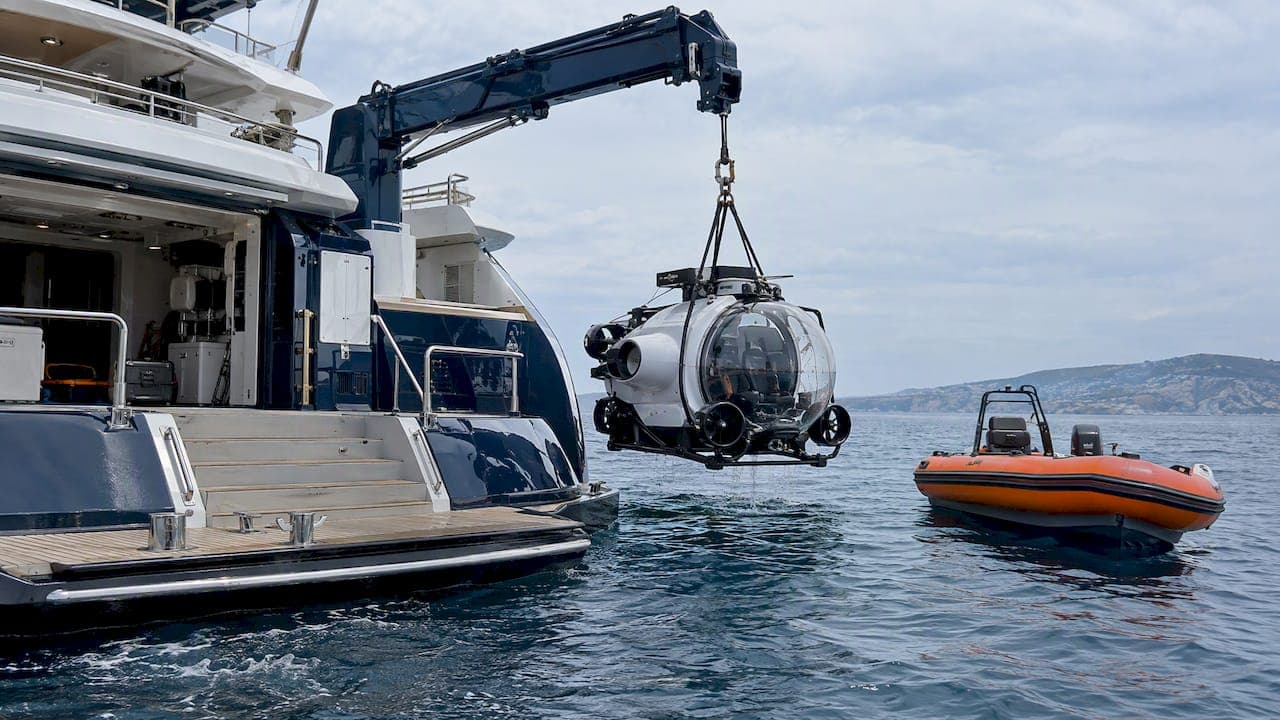
A submersible on a yacht charter is a small crewed vessel, launched from the yacht's deck, that takes you and a pilot below the surface in dry comfort. It is not a submarine: it cannot leave port on its own and depends on the yacht above it. It is also rarer than the glossy photographs suggest, because it only makes sense aboard a very large yacht, with a trained pilot and a support crew. Below, we explain how it works, which kinds of yachts carry one, how deep you can go, what the safety picture looks like, what it adds to the cost, and what to do if a sub is not the right fit for your trip.
TL;DR
- A submersible needs a mother ship. It is launched and recovered by crane from a large yacht, with a tender standing by on the surface throughout the dive.
- Yachts that carry one are typically 120 feet or more, and often explorer-style vessels built for remote cruising. Many large yachts without a sub can still add one through a leasing arrangement.
- Typical working depths run from about 100 to 1,000 meters, depending on the model. Most guest dives are far shallower, where the light and the life are.
- Rules for submersibles are less uniform than for other vessels, so ask about class certification, inspection records, pilot qualifications and the support crew before you commit.
- If a sub is out of reach, diving from a crewed yacht can put you in front of much of the same marine life. We can help you weigh the two.
Table of Contents
- Submersible or submarine: why the difference matters
- How a submersible dive from a yacht works
- Which yachts carry a submersible
- How deep can you go, and how many can come
- Safety and regulation: what to ask before you go
- What a submersible adds to the cost
- Where a submersible makes sense
- When a sub is not the right answer
- Our perspective
- Plan your charter with us
- FAQ
- Sources
Submersible or submarine: why the difference matters
The two words get used interchangeably in brochures, and the distinction is more than pedantic. A submarine has enough power to leave a port and return on its own. A submersible has much more limited power and needs a mother ship to launch from and return to. On a yacht charter, you are almost always dealing with the second: a compact, battery-powered craft that works in the water around your yacht, within sight of the surface team.
That dependency is the heart of how the experience is organized. The yacht is not simply carrying a toy; it is the base for launch, communication, recovery, charging and maintenance. When a listing says "yacht with submarine," read it as "yacht with a submersible and a crew trained to run it." Then ask who that crew is, because the quality of the dive depends on them as much as on the hardware.
How a submersible dive from a yacht works
The sequence is more choreographed than most guests expect, and that is reassuring. According to a SuperyachtNews account of onboard operations, the crane lifts the craft into the water, the pilot enters from a tender, guests are brought aboard, and the tender then acts as a surface safety boat, keeping in communication with the sub for the whole dive.

The same piece describes the ideal set-up as a hangar or garage for storage and maintenance, plus a crane to lift the sub into the water. An A-frame, it adds, allows launch and recovery in higher seas. In practical terms, that means a yacht designed around the sub will usually give you more operating days than one improvising with deck space.
What a typical dive day looks like
Every yacht and itinerary differs, but the rhythm tends to follow a pattern:
- Briefing. The pilot explains the dive plan, the communication system and what to do if anything feels wrong.
- Launch. The sub goes into the water and guests board from the tender.
- Descent and exploration. A pilot and a small number of guests drift along a reef wall, over a wreck or through a kelp forest, with the surface team following.
- Recovery. The craft is brought back to the yacht, rinsed, checked and, if needed, recharged before the next group.
Because only a few people fit in each dive, the schedule often spreads across a day or more. Plan on rotating guests, and use the waiting time for snorkeling, kayaking or time ashore.
Why guests choose a sub over scuba
Captain Les Annan, quoted by SuperyachtNews, says submersibles are more comfortable than scuba diving: passengers stay dry, keep communication with the surface, and enjoy an enhanced peripheral view. That matters for guests who are not certified divers, for anyone with ears or sinuses that dislike pressure changes, and for travelers who simply want to see the deep reef in street clothes. It also means a family with a mix of ages and abilities can share one experience.
Which yachts carry a submersible
Submersibles are a feature of the largest end of the market. The New York Times, reporting in August 2023, described yacht-carried submersibles as generally requiring very large vessels, at least 120 feet in the example it cited, and often a crane, a boarding tender or speedboat, guides and mapping services. A small catamaran or sailing yacht, however lovely, will not host one.
Among yachts known to have carried submersibles, Boat International lists Octopus, Limerence, Five Oceans, Hodor and La Datcha. Several are privately used or have changed hands, so treat any list as a map of what the market has built, not a guarantee of what is available to charter this season. The sensible approach is to start with your destination and dates, then ask which yachts that can serve you currently have a sub aboard.
Explorer yachts are the natural home
The yachts most likely to carry a sub are expedition-style vessels: long range, strong hulls, deck space for equipment and enough crew to run a technical program. That matches how we think about remote charters, where the route and the experience matter more than a marina. If you are browsing, our pages for luxury yachts, high-end yachts and yachts over 200 feet are the places to see the size range where this kind of equipment becomes realistic.
Leasing a sub for a week or a season
Not every yacht with a sub owns it. Rob Report has covered a wet lease program from a submersible manufacturer for yacht owners and charter superyachts, letting a yacht rent a sub for as little as a week or as long as a season. Models include two-, three-, five- and seven-person vehicles that can descend at least to 330 feet, and the arrangement includes a pilot on demand, plus maintenance and operational support. For charter guests, the takeaway is practical: a yacht that does not carry a sub year-round may still be able to arrange one for your dates, with advance notice.
How deep can you go, and how many can come
Working depths vary widely. DNV, the classification society, notes that diving depths usually range from 100 to 1,000 meters and in some cases deeper. The vehicles in the leasing program above begin at around 330 feet, or about 100 meters, which is already well beyond recreational scuba limits.
For most guests, depth is not the point. Light, color and wildlife concentrate in the upper water column, and a sub that cruises at a modest depth along a reef edge or over a wreck gives a richer experience than a long descent into blue darkness. Ask your charter specialist what the sub will actually do at your destination, and what depth the pilot plans to work at for guests.
Capacity is small. Many models carry a pilot and two or three passengers, with larger ones taking more, so a family of six or eight should expect several dives. Confirm the number of seats, the pilot's role and whether children are permitted, since operators set their own age and size limits.
Safety and regulation: what to ask before you go
The 2025 Titan report has made guests more careful, and rightly so. The honest picture is that submersible oversight is less uniform than for ordinary passenger vessels. One summary notes that a submersible is not as regulated as other water vessels, especially in international waters. The U.S. Coast Guard Marine Board of Investigation, in its 2025 Titan report, recommended expanding federal and international requirements to all submersibles conducting scientific or commercial dives, and requiring Coast Guard documentation for all U.S. submersibles.
For context, the Coast Guard's Marine Safety Center Hull Division reviews submersible designs for compliance with safety standards on structure, stability and structural fire protection. A certified, class-reviewed craft is a very different proposition from an uncertified one.
The questions that matter
DNV describes a safety approach built on class-society review, rigorous testing of the hull and systems, life-support designed for a minimum of 96 hours, and support from a surface vessel. It also says it conducts annual inspections of essential safety systems and comprehensive inspections every five years for certified submersibles. Use that as your checklist. Before you book a charter that includes a dive, ask:
- Is the submersible certified by a recognized classification society, and can you see the certificate?
- When was its last annual and five-year inspection?
- How many hours of life support does it carry, and what is the emergency plan?
- Who is the pilot, what training do they hold, and how many dives have they logged in this model?
- Is there a tender on the surface, in constant communication, for every dive?
- What are the weather and sea-state limits, and what happens to the dive if conditions change?
A good operator answers these quickly and in writing. If answers are vague, that is your answer. We would rather lose a booking than send a family on an uncertified dive.
What a submersible adds to the cost
The economics explain why so few yachts carry a sub. The New York Times reported that submersibles typically cost $2 million to $7 million, not including the crane or speedboat, and that mapping and guide services can run about $15,000 per day. Those are figures from the purchase side, but they show why a charter with a sub sits at the top of the market. The yacht must be large, the crew larger, and the support equipment substantial.
We do not publish a fixed price for sub-equipped charters, because every yacht, route and season is priced separately, and the sub itself may be an add-on or a leased feature. What we can do is show you the cost structure plainly: the yacht's weekly rate, the crew's expenses, fuel, and any charge for the sub, its pilot and the support team. Ask for these as separate lines so you can see what you are paying for.

Where a submersible makes sense
A sub is only as good as the water it dives in. The destinations that reward it share a few traits: clear water, dramatic topography, and wildlife or history that is hard to reach another way. Think volcanic island walls, deep reef drop-offs, kelp forests, wrecks and polar fjords. Some of our regions lend themselves naturally to the style of charter where a sub is plausible, such as Antarctica, South America, the Red Sea and Indian Ocean and Southeast Asia. Whether a sub is available there for your dates depends on the yacht, so treat the region as a starting point for a conversation rather than a promise.
Two practical points apply everywhere. First, visibility and sea state decide whether a launch happens, so build slack into the itinerary rather than hanging the whole trip on one dive. Second, local permits can matter in protected areas, and a specialist who knows the destination will tell you early if a sub program needs approval.
When a sub is not the right answer
A submersible is a showpiece, not the only way to see the underwater world. If your budget, party size or destination does not fit, there are strong alternatives, and we would rather you choose the one that suits you.
- Diving from the yacht. A crewed yacht with a dive program and qualified instructors puts you in the water at the best sites. Our page on charter yachts with scuba diving onboard shows what is available, and the version for selected locations narrows it by region.
- Introductory dives. If you or your guests are not certified, a guided first dive is a gentle step. For a sense of how this works on a reef, see these cruises with intro dives on the Great Barrier Reef.
- Snorkeling and water toys. Many large yachts carry underwater scooters and snorkeling gear that bring you close to shallow reefs without any dive training.
The point is the same in every case: choose the yacht and itinerary first, then the equipment. A well-run charter in the right place will deliver a memorable underwater day with or without a sub.
Our perspective
We are former captains and water sports professionals, so we look at a sub the way an operator does. The craft itself is rarely the question. The questions are who is flying it, who is on the tender, how the yacht handles the sea when the crane swings, and what happens if the weather turns. A calm, well-rehearsed crew makes the dive feel effortless; an improvised one makes it stressful, whatever the hardware.
We also think guests are better served by honesty about availability. Subs are scarce, schedules are tight, and the best yachts are often booked well ahead. If a sub is central to your trip, tell us early, and we will work from the yacht backwards: crew, certification, route, season and a realistic plan B. If it is not central, we will say so, and point you to a charter where diving, wildlife and comfort are the strengths.
In short, we would suggest treating a submersible as one memorable day in a well-planned expedition, not as the reason to choose a vessel that does not otherwise suit you.
— Mo
Plan your charter with us
If you would like a yacht with a submersible, or a crewed charter built around diving and wildlife, we can start from your destination, dates and party and tell you what is realistic. Our specialists handle the questions above on your behalf, including certification and crew details, and can compare options across motor yachts, catamarans and larger vessels. Speak to a yacht charter specialist to begin.
FAQ
Is there a superyacht that has a submarine?
Yes. Boat International names Octopus, Limerence, Five Oceans, Hodor and La Datcha among superyachts equipped with their own submersibles. Availability for charter varies, and some are privately used, so ask a specialist which yachts currently carry a sub for your route and dates.
How big does a yacht need to be to carry a submersible?
Very large. The New York Times cited at least 120 feet in its example, and a crane plus a tender or speedboat are usually needed for launch and recovery. Smaller sailing yachts and catamarans cannot host one, though they may be excellent for diving and snorkeling.
How deep do yacht submersibles go?
DNV says working depths usually range from 100 to 1,000 meters, and some go deeper. Guest dives on a yacht charter are normally much shallower, because the best light and marine life are closer to the surface.
Is it safe to dive in a yacht submersible?
It can be, when the craft is certified, inspected and operated by a trained pilot with a surface support vessel. Regulation is less uniform than for other vessels, so ask to see the class certificate, inspection dates, life-support specifications and the pilot's qualifications before you book.
Can I charter a yacht with a submarine if I do not scuba dive?
Yes. A submersible keeps you dry and requires no dive certification, which is why it suits families and mixed groups. Age and size limits are set by each operator, so confirm them in advance.
Sources
- Boat International: 10 superyachts equipped with their own submarines
- Green Matters: What's the difference between a submersible and a submarine?
- SuperyachtNews: Operating submersibles on board
- DNV: Exploring the deep blue with submersibles
- U.S. Coast Guard Marine Safety Center, Hull Division
- U.S. Coast Guard: Marine Board of Investigation report on the Titan submersible
- The New York Times: The latest trend on yachts? Submersibles
- Robb Report: Submersible wet lease program
- Aussie Loop: Outer Reef cruises with intro dives