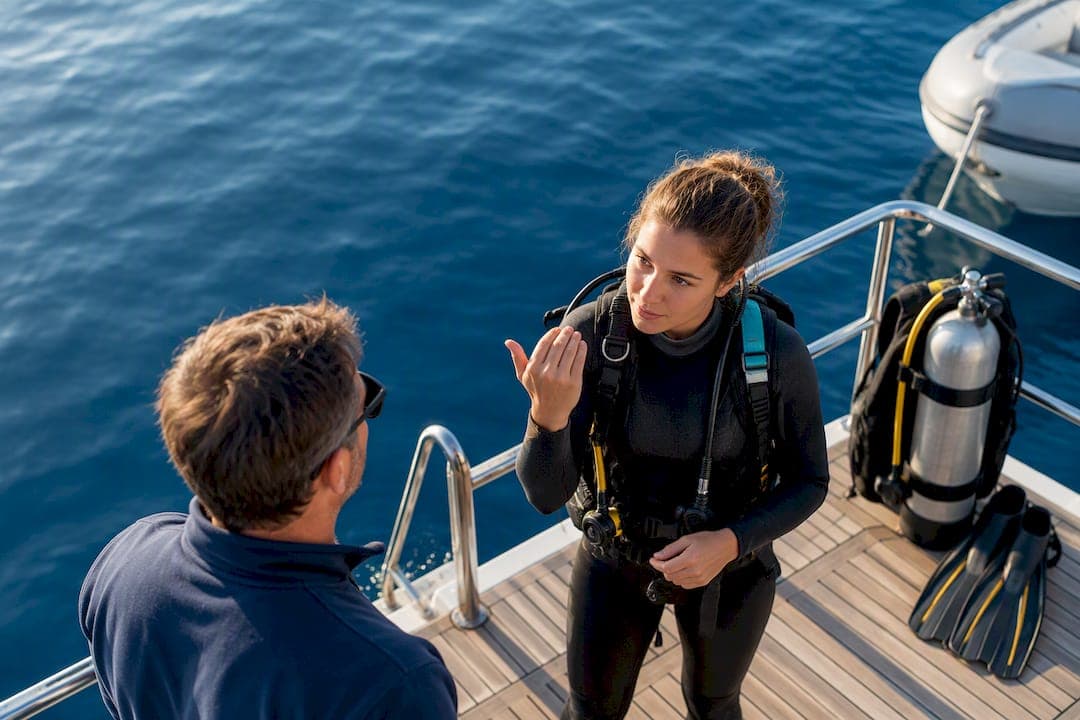
Yes: private, fully crewed yacht charters can include a certified onboard dive instructor or divemaster who runs guided dives, refresher training, and surface support throughout your trip. Requested at booking, this service delivers a tailored dive itinerary, close supervision for mixed-ability groups, and hands-on briefings before every entry, with a crew member standing ready on the surface the moment you descend.
TL;DR:
- Chartering a private yacht with a dive instructor requires early request and verification of the instructor's certifications, experience, and liability coverage.
- Medical screening through a diver questionnaire and a documented emergency action plan, including nearby hyperbaric chambers, are essential for safety.
- The typical dive schedule adapts to the itinerary, allowing for two to three dives daily, with night dives scheduled after sufficient surface intervals based on the dive profile.
- Costs vary depending on staff fees, gas fills, equipment rental, fuel, and permits, so request an itemized breakdown tailored to your route.
- Smaller dive groups of two to six divers benefit from personalized instruction and skill level adjustments, with operational roles clearly coordinated for safety and efficiency.
Table of Contents
- What an onboard dive instructor does: duties, certifications, and team roles
- How to request and book an onboard dive instructor through your broker
- Safety, medical readiness, and emergency planning you must verify
- Logistics and typical costs: equipment, nitrox, crew roles, and time planning
- Pre-charter checklist for divers and accompanying guests
- Group sizes and skill levels for onboard dive instruction
- Timing dive sessions across your charter
- Certifications and insurance for dive instructors on yachts
- Communication between the dive instructor and yacht crew
- Mo's perspective: why a dedicated onboard dive instructor elevates a luxury dive charter
- How Exotica Charters arranges dive-focused yacht charters and how to request one
- Sources
- FAQ
What an onboard dive instructor does: duties, certifications, and team roles
A dedicated dive instructor aboard a private charter wears several hats across a single day. Beyond leading the dive itself, they assess each guest's comfort level, pair buddies sensibly, and adjust the plan when currents or visibility change.
- Instruction and refreshers: Teaching or refreshing skills for guests who haven't dived in a while, often before the first real dive of the trip.
- Guided dives: Leading small groups through reef systems, walls, or wreck sites suited to the group's certification level.
- Equipment checks: Verifying tanks, regulators, and buoyancy devices before every entry.
- Buddy pairing: Matching divers by experience and comfort so no one is out of their depth, literally.
- Emergency response: Managing in-water incidents and coordinating with the crew for surface recovery.
When you're vetting a charter, ask whether the professional aboard holds a divemaster or instructor rating, since the two carry different scopes of responsibility: a divemaster typically guides certified divers, while an instructor can also teach and certify. High-volume liveaboard experience matters here too. Professionals who have spent seasons on liveaboards are used to running several dives a day and supporting experienced divers while carrying their own spare parts, a habit worth asking about directly.
On a well-run charter, the instructor doesn't operate alone. Tender operators handle pickups and drop-offs, a topside crew member tracks bottom time and stays alert for recall signals, and oxygen and an AED are kept within reach of the dive deck at all times.
How to request and book an onboard dive instructor through your broker
Booking dive staff on a private charter is a conversation, not a checkbox, and the earlier you raise it, the more the itinerary can flex around it.
- Request onboard dive staff explicitly when you first discuss your itinerary, rather than assuming it's included by default.
- Ask for the instructor's CV and certifications, including agency (PADI, SSI, or equivalent) and years of liveaboard-specific experience.
- Confirm what's included versus billed as an extra, such as nitrox fills, equipment rental, and the instructor's own liability coverage.
- Clarify the diver-to-instructor ratio you'll have for guided dives, since smaller ratios generally mean more attention per diver.
- Ask about daily dive cadence, so you know whether two or three dives a day is realistic given transit time between sites.
- Request the yacht's emergency action plan (EAP) and the name of the nearest hyperbaric facility to your planned route.
Pro Tip: Get the instructor's certifications and the vessel's emergency action plan in writing before you pay a deposit, not after you board.
Contract terms should spell out the instructor's daily or per-dive rate, what happens to that fee if weather cancels diving days, and the exact scope of duties so nobody's expecting a private lesson when only guided dives were arranged.
Safety, medical readiness, and emergency planning you must verify
Diving from a private yacht in a remote anchorage is a different proposition than diving from a dive shop with a hospital down the road, and the paperwork should reflect that.
Start with medical screening. Reputable operations require every diver to complete a PADI Diver Medical Participant Questionnaire, which flags conditions that need physician clearance before diving and states plainly that pregnant guests should not dive. If any answer triggers a flag, get that clearance before you fly to the departure port, not after.
Next, ask for the vessel's written emergency plan.
- Confirm the yacht carries a documented emergency action plan (EAP) covering evacuation routes and communication protocols.
- Request a named list of nearby hyperbaric chambers along your specific route, since remote itineraries can put real distance between you and treatment.
- Verify topside oxygen and AED availability, standards that mirror what NOAA's diving operations guidance expects of any organized dive operation with assigned personnel roles.
A well-prepared charter treats flying-after-diving limits as a fixed constraint on your travel dates. DAN's flying-after-diving guidelines recommend a minimum 12-hour surface interval after a single no-decompression dive, 18 hours after multi-day repetitive diving, and longer still after decompression or mixed-gas dives. An intensive schedule of multiple dives each day over several days pushes you toward that 18-hour threshold, so build it into your return flight before you book it, not the night before you fly.
Logistics and typical costs: equipment, nitrox, crew roles, and time planning
Most fully crewed charters supply core dive gear: tanks, weights, and often BCDs and regulators sized to the group; for maintenance between dive operations, see UK hull cleaning steps and timing. Guests who prefer their own mask, fins, or wetsuit typically bring them, and it's worth asking in advance rather than assuming everything fits every body type.
- Spares and redundancy: Confirm the boat carries spare masks, fin straps, and at least one backup regulator, since liveaboard professionals often supply their own spare parts for exactly this reason.
- Nitrox availability: Ask whether the vessel has an onboard compressor capable of nitrox fills and whether that's included or billed per fill.
- Certification for nitrox use: Confirm the instructor can verify nitrox certification for any guest requesting enriched-air dives.
Cost drivers on a dive-focused charter tend to cluster around a few line items: the instructor's staffing fee, gas fills (air versus nitrox), equipment rental for guests without their own gear, extra fuel for longer repositioning between dive sites, and any port or permit charges specific to marine parks along the route. None of these figures are fixed industry-wide, so ask your broker for an itemized breakdown tied to your specific itinerary rather than a single bundled number.
Pre-charter checklist for divers and accompanying guests
A little preparation before you board turns a good dive charter into an effortless one.
- Complete the medical questionnaire early and secure physician clearance if any answer flags a condition, following PADI's medical screening guidance.
- Book a refresher course if you haven't dived in the past year, especially before diving unfamiliar currents or wrecks.
- Match your logged experience to the planned dive types, since drift dives, strong currents, and night dives all demand different comfort levels.
- Confirm your flight timing against DAN's surface-interval guidance so your departure doesn't cut it close after the trip's final dive.
- Label your personal equipment and share emergency contacts and travel insurance details with the crew before departure.
DAN's own travel guidance echoes this approach, recommending that divers research conditions at their destination and prepare an emergency plan suited to how remote the evacuation route actually is. A private charter chasing pristine reefs in a far-flung archipelago is exactly the kind of trip that guidance was written for. Guests planning a dive-heavy itinerary can also work through a one-page charter checklist that covers certification, medical readiness, and packing in one pass.
Group sizes and skill levels for onboard dive instruction
Onboard dive instruction on a private charter almost always means smaller groups than a typical day-boat operation, since the guest list is fixed by the charter itself rather than filled by walk-ins. A single instructor commonly guides anywhere from two to six divers per outing, small enough to keep every diver within sight and within reach if conditions shift.

Mixed skill levels are the norm rather than the exception on a family or friend-group charter. A capable instructor will split a larger party into sub-groups, sending confident, well-logged divers to a deeper wall or a current-swept channel while keeping newer certifications closer to a gentle slope with better visibility and less current. This is where requesting an instructor's CV pays off. Someone experienced with liveaboard-style groups will already expect to run two dive plans at once rather than forcing everyone into a single pace.
Non-diving guests aren't left out either. Snorkeling alongside the dive group, paired with a crew member on the surface, keeps families together without putting anyone in water beyond their training.
Timing dive sessions across your charter
Dive instruction sessions on a private charter follow the rhythm of the itinerary rather than a fixed shop schedule, which is one of the real advantages of chartering over booking day trips. A typical dive day might open with a morning briefing over coffee, a first dive shortly after, a surface interval built around brunch or a site transit, and a second dive in the early afternoon, leaving the rest of the day for exploring ashore or simply relaxing on deck.
Two dives a day is common on itineraries balancing diving with wildlife viewing or shore excursions; three becomes realistic when diving is the trip's central focus and sites are close together. Night dives, when requested, are usually scheduled after a full surface interval from the day's last dive, both for nitrogen loading and so the group isn't diving on fatigue.
Because everything runs on your schedule rather than a shop's fixed departure times, weather delays or a guest wanting an extra rest day simply shift the plan rather than costing you a missed slot. That flexibility is worth naming explicitly when you're comparing a private charter against a land-based dive resort with fixed boat times.

Certifications and insurance for dive instructors on yachts
The instructor's own paperwork matters as much as the yacht's. At minimum, ask for proof of an active divemaster or instructor certification from a recognized agency such as PADI or SSI, along with any specialty ratings relevant to your planned dives, deep diving, nitrox, or wreck penetration among them.
Liability coverage is the piece guests most often forget to ask about. Confirm whether the instructor carries their own professional liability insurance or operates under the yacht's policy, and get that answer in writing before the deposit is paid. NOAA's own diving standards illustrate how seriously organized operations treat this distinction: their diving safety manual sets minimum training and equipment standards precisely because roles and responsibilities need to be clear before anyone enters the water.
If your itinerary includes any dives framed as scientific or expedition-style rather than purely recreational, ask directly whether those dives fall under a different regulatory standard, since staffing and documentation requirements can shift accordingly.
Communication between the dive instructor and yacht crew
The best dive instructor in the world is only as effective as the crew coordination around them. Before the first dive, the instructor and captain should agree on a recall signal, a plan for tender positioning during entries and exits, and who's responsible for topside oxygen if it's ever needed in a hurry.
Pre-dive briefings should cover more than the site itself. Expect the instructor to flag site-specific hazards like current strength or surge, walk through the yacht's reboarding procedure, and confirm the buddy pairings before anyone suits up. NOAA's pre- and post-dive checklist framework reflects this same discipline, requiring documented team readiness and recall procedures before any dive is logged as complete.
Post-dive, a short debrief closes the loop: what was seen, what conditions were like, and whether tomorrow's plan needs adjusting. On a well-run charter, this handoff between instructor and crew happens so smoothly that guests barely notice it, which is exactly the point.
Mo's perspective: why a dedicated onboard dive instructor elevates a luxury dive charter
A charter with a genuine dive focus feels different from one where diving is an afterthought squeezed between cocktail hours. Crews built around former captains and water sports professionals tend to read conditions faster, adjust a day's plan before guests even notice a swell picking up, and know which anchorage holds a better wall dive than the one on the original itinerary.
The real value shows up in the pacing. A mixed group of confident divers and first-timers doesn't need to dive the same plan, and an experienced instructor knows how to keep both halves of that group genuinely happy rather than compromising for everyone. Established emergency action plans and a crew that has rehearsed them matter more than any brochure claim once you're three days from the nearest port.
— Mo
How Exotica Charters arranges dive-focused yacht charters and how to request one
Booking a dive-focused itinerary through Exotica Charters starts with a conversation, not a fixed package. Tell your specialist your destinations of interest, the skill mix of your group, and that you want an onboard instructor or divemaster with specific certifications and liveaboard experience, and the team builds the itinerary and staffing around that brief rather than fitting you into a template.
Every element, the instructor, the equipment, the daily dive cadence, is arranged case by case, since a family of mixed-ability divers heading to a shallow reef system needs a different setup than a group of advanced divers chasing current-swept walls. You can explore yachts equipped for onboard scuba diving to see how a certified dive guide fits into the broader charter experience, or browse luxury yacht options if you're still deciding on a vessel class. When you're ready, start your inquiry with Exotica Charters and describe the diving experience you have in mind.
Sources
- Guidelines for Flying After Diving – Divers Alert Network (DAN)
- PADI Diver Medical Participant Questionnaire (2026)
- Travelers Medical Guide – Divers Alert Network (DAN)
- NOAA Dive Operations Plan (DOP) form
FAQ
Do private yacht charters really include a dive instructor?
Many fully crewed luxury charters can include a certified onboard dive instructor or divemaster, but it's typically arranged on request rather than included automatically. Raise it when you first plan your itinerary so staffing and equipment can be built around your group's skill level.
What medical clearance do I need before diving on a charter?
Most operations require a diver medical questionnaire covering conditions that need physician evaluation before diving. If any answer flags a concern, get that clearance well before departure rather than at the dock.
How soon can I fly home after diving?
DAN recommends a minimum surface interval of 12 hours after a single no-decompression dive and 18 hours after multi-day repetitive diving, with longer intervals for decompression dives. Build that window into your return flight rather than treating it as flexible.
What should I ask about before booking an onboard instructor?
Ask for the instructor's certification level and liveaboard experience, confirm the diver-to-instructor ratio, and request the yacht's emergency action plan and nearest hyperbaric facility. Also clarify what's included in the rate versus billed separately, such as nitrox fills or equipment rental.
Does Exotica Charters arrange dive instructors on its yachts?
Dive-focused itineraries with onboard dive staff are arranged on a case-by-case basis, matched to the destination and the group's skill mix. Requests, including instructor experience and certification level, are handled directly through the inquiry process.