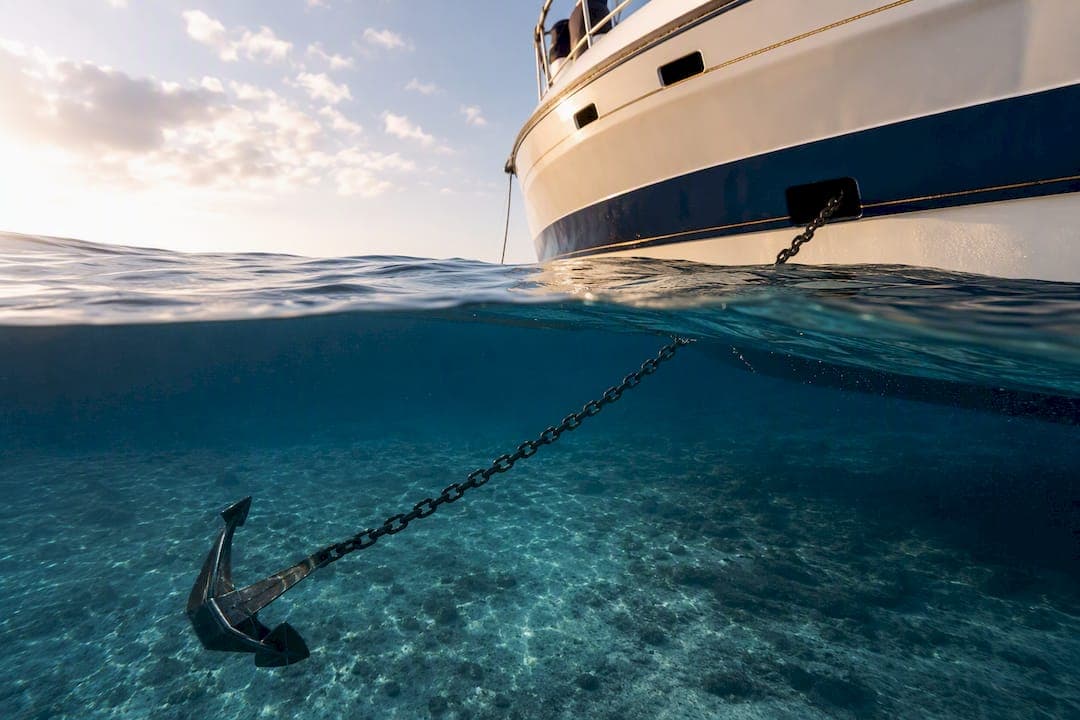
Anchoring means dropping a weighted device to the seabed to hold your boat in open water, using nothing but your own ground tackle and judgment. A marina is a built shore facility, with slips, docks, and services, where you tie up and plug in. The quick verdict: anchor when you want flexibility, scenery, and privacy on a short, fair-weather stay; choose a marina when you need power, provisions, guest access, or shelter from a system rolling in.
- Anchoring = self-sufficient, free (mostly), scenic, but requires active monitoring
- Marina = paid, serviced, secure, but structured and less private
- Mooring = the middle ground, using a fixed seabed anchor point maintained by someone else
Key Takeaways
Anchoring gives boaters autonomy and scenery at the cost of active monitoring, while marinas trade privacy for power, water, and shelter that matter most on longer stays or in rough weather.
| Point | Details |
|---|---|
| Anchoring defined | Dropping a weighted device tied to a rode into the seabed to hold position without shore infrastructure. |
| Marina defined | A shore-based facility with slips, power, water, and pump-out built for pleasure craft, not cargo ships. |
| Mooring is the middle ground | A fixed buoy tethered to the seabed, maintained by others, offering more security than anchoring alone. |
| Scope decides anchor security | Use roughly 5:1 chain or 7:1 rope scope calculated against high tide depth, not current depth. |
| Marinas restrict swimming | Shore power current and boat traffic make swimming near docks a real safety hazard. |
| Choice depends on trip length | Short, fair-weather stays favor anchoring; longer stays or bad weather favor a marina slip. |
Table of Contents
- What Does Anchor vs Marina Mean in Practice?
- The Case for Anchoring: Freedom With a Price
- Weighing Marina Life: Convenience Has a Cost
- Anchoring and Marina Safety: The Technique That Matters
- How to Choose Between Anchoring, Mooring, and a Marina
- How Exotica Charters Weighs Anchor vs Marina for Guests
- What Novice Boaters Get Wrong About This Choice
- Sources
What Does Anchor vs Marina Mean in Practice?
An anchor is, in the plainest terms, a heavy object attached to your boat by rope or chain that keeps it from drifting once dropped, according to the Cambridge Dictionary. The chain and rope connecting anchor to boat is called the rode, and the anchor's grip depends entirely on the "holding ground," the seabed material it digs into.
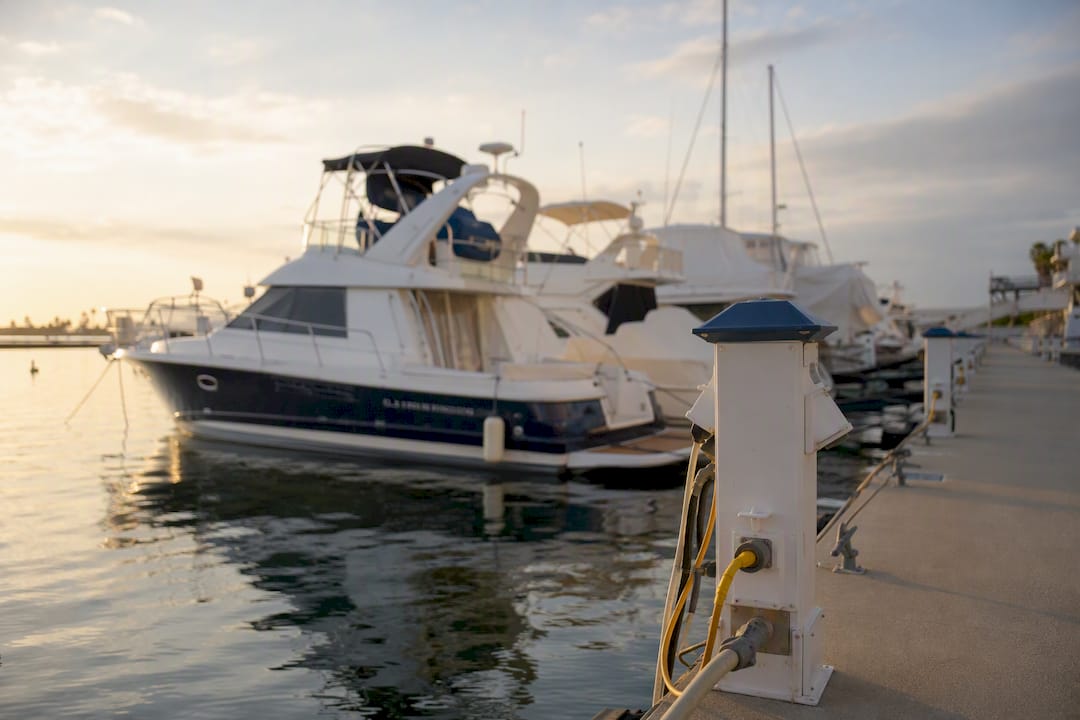
A marina is a dock or basin built specifically to provide moorings and services for pleasure boats, distinct from a commercial port because it never handles cargo ships or ferries, per Wikipedia's definition. Boats tie up at pontoons or fixed slips, often with walk-on access straight from the dock to your deck, no dinghy required.
Mooring sits between the two. A mooring ball is a permanent buoy tethered to a heavy block on the seabed, maintained by a marina, yacht club, or harbor authority rather than by you, notes A.M. Nautical. You still need a tender to reach shore, but you skip the guesswork of setting your own anchor.
- Anchoring: you supply and set the ground tackle yourself
- Docking: a marina slip with direct shore access, usually with shore power and water hookups
- Mooring: a fixed buoy system you rent, offering more security than anchoring without full marina infrastructure
Merriam-Webster's entry for marina reinforces the same idea: a small harbor built for pleasure craft, not a working port.
The Case for Anchoring: Freedom With a Price
Anchoring rewards boaters who value solitude over convenience. You can drop the hook in a quiet cove nobody else has claimed, wake up to a view a marina slip could never offer, and pay nothing for the privilege in most public anchorages. Experienced cruisers often describe anchoring out as priceless for the scenery and privacy it delivers, a trade-off Technomadia captures well from years of liveaboard life.
That freedom comes with responsibility. Anchoring is not like parking a car; a hold that feels secure at 6 p.m. can drag by midnight if the wind shifts or the tide drops the water column, a point Yachting Monthly stresses for anyone new to setting ground tackle.
- Check your swing radius against nearby boats, rocks, and shallows before you settle in for the night.
- Match your rode length to depth and seabed type, not just how the anchor looks on the bottom.
- Set a riding light and check position periodically, especially overnight or when weather is forecast to shift.
- Never assume a set anchor stays set through a change in wind direction or a dropping tide.
The most common mistake is under scoping the rode, letting out too little chain and rope for the depth, which flattens the pulling angle and lets the anchor pop loose.
Pro Tip: Set your anchor, then back down on it gently in reverse to confirm it's dug in before you relax below deck.
Weighing Marina Life: Convenience Has a Cost
A marina slip hands you shore power, fresh water, pump-out stations, fuel docks, and often a laundry room and grocery run within walking distance. For a family trip or a stay with guests unused to boat life, that infrastructure changes everything.
- Shore power keeps batteries topped and air conditioning running without burning diesel on a generator
- Pump-out and fresh water simplify longer stays without rationing
- Security and staffed docks offer peace of mind overnight
- Easy provisioning since most marinas sit near towns, restaurants, or marine supply stores
The downsides are real. Dockage isn't free, and prices swing widely, from modest municipal marinas to resort-style facilities that require booking weeks ahead, according to The Clever Boater. Privacy disappears when your neighbor's cockpit sits ten feet away, and docking itself can be stressful in tight fairways or crosswinds.
Swimming is commonly restricted or banned outright inside marinas, and that's not marina staff being overly cautious. Shore power cables run current through the water in ways that can create electric shock drowning hazards, and constant boat traffic in tight fairways makes swimmers hard to see, a safety concern A.M. Nautical flags directly.
Anchoring and Marina Safety: The Technique That Matters
The single rule every anchoring guide agrees on is scope, the ratio of rode length to water depth. A widely used starting point is 5:1 for chain rode and 7:1 for mostly rope rode, calculated against high tide depth rather than the depth you see when you drop anchor, since a boat set at low tide can find itself dangerously under scoped hours later.
- Sand and mud generally offer the best holding for most anchor designs
- Weed and grass can prevent an anchor from digging in at all, no matter how much rode you pay out
- Rock may hold a well-placed anchor brilliantly or reject it entirely, with little middle ground
Seasoned cruisers routinely stress calculating rode for the worst-case tide, not the water in front of you right now, a habit that separates confident anchoring from a 2 a.m. scramble when the boat starts sliding toward the rocks.
Swing radius matters just as much in a crowded anchorage or mooring field as scope does at a single boat's bow. Mooring fields often publish maximum vessel lengths and required pennant lengths, and ignoring those published limits has caused real collisions when boats swing into each other's space during a wind shift.
Pro Tip: Before settling in a busy anchorage, watch how neighboring boats are lying to wind and current, then anchor with matching scope so everyone swings the same direction.
- Keep an anchor watch app or alarm running overnight
- Reassess conditions before bed and again before a forecasted front arrives
- Move to a marina or protected mooring field if wind or swell exceeds your comfort level
For a deeper walkthrough of monitoring an anchored vessel overnight, our yacht charter safety briefing guide covers the checks crews run before turning in.
How to Choose Between Anchoring, Mooring, and a Marina
Run through a short set of questions before you commit to a spot for the night:
- How long are you staying? A single night favors anchoring or a mooring ball; a week or more tilts toward a marina for power and provisioning.
- Do you need shore access for guests or supplies? Marinas win here without much competition.
- What's the weather forecast? Anything approaching gale force sends most sensible boaters toward a slip.
- How confident is your crew in ground tackle? Novice crews often sleep better on a mooring ball or in a marina until anchoring technique feels second nature.
- Is there a mooring field available? It often splits the difference nicely, cheaper than a slip, more secure than a bare anchorage.
Book marina slips ahead during peak season, confirm mooring field rules and pennant length before you pick up a ball, and always check that your dinghy and outboard are ready before you commit to anchoring out for the night.
How Exotica Charters Weighs Anchor vs Marina for Guests
Our crews, many of them former captains, choose protected anchorages whenever the itinerary and weather allow it, saving marina stops for embarkation, disembarkation, and provisioning runs. Tender logistics and guest comfort drive that call as much as scenery does.
A quiet anchorage off a reef in the Galápagos gives guests an experience no marina berth can match, but a stable pier still matters for loading gear, restocking the galley, and setting expectations before a dive-focused day begins.
That balance, paired with strong Trustpilot ratings from guests who've experienced both sides of it, shapes how we plan every boat tour in Croatia and yacht charter itinerary.
What Novice Boaters Get Wrong About This Choice
Most guides treat anchoring and marina life as a binary, pick one philosophy and stick with it. That's backward. The boaters who cruise happiest treat anchoring, mooring, and marinas as three tools for three different jobs, switching between them based on forecast and crew mood rather than loyalty to a lifestyle label.
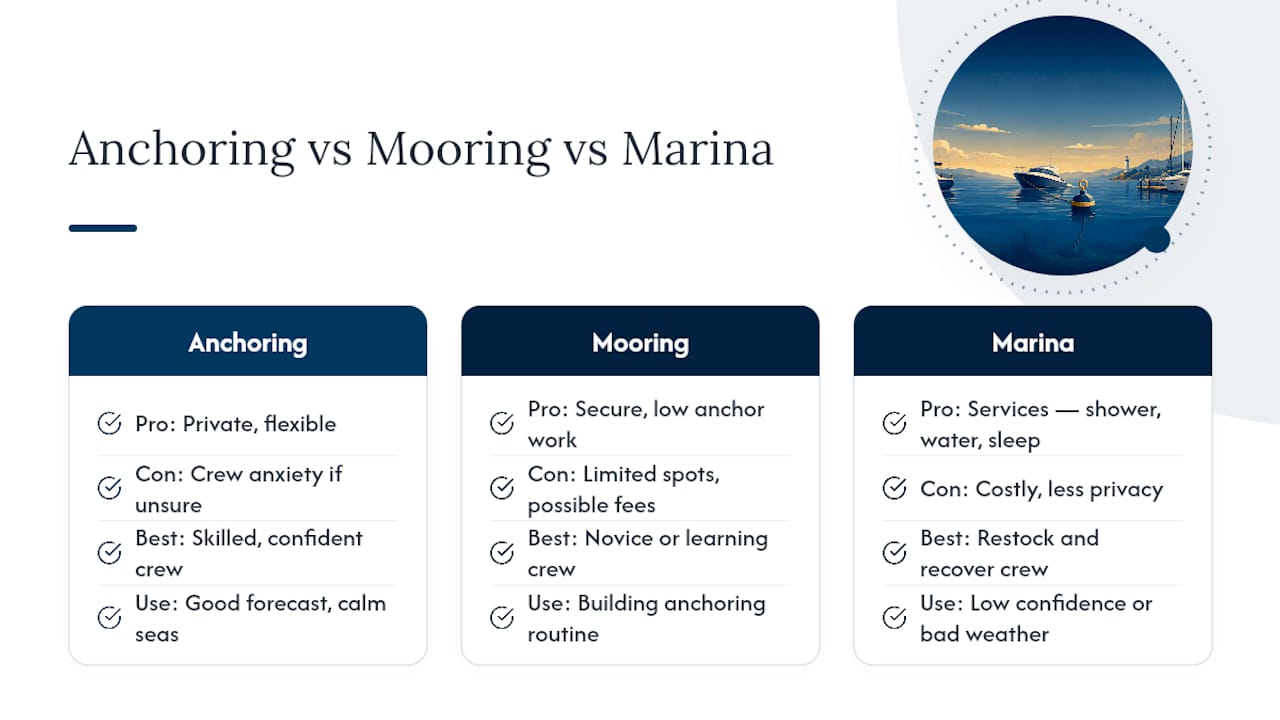
The overlooked variable isn't cost or convenience, it's crew confidence. A perfectly holding anchorage can still ruin a trip if someone aboard lies awake all night worried about dragging. Novice sailors would do better prioritizing a mooring field or marina until anchoring technique feels routine, then expanding into open anchorages as skill and comfort grow.
Conventional advice oversells anchoring as the "real" boater's choice and undersells how much a good marina night, hot shower, full water tank, solid sleep, sets up a better next day on the water. Prioritize matching the choice to conditions and crew, not to which option sounds more adventurous on paper.
— Mo
Sources
- All about anchoring, mooring and docking | A.M. Nautical
- How much anchor chain do I need? | Yachting Monthly
- Marina — Wikipedia
- Anchoring vs Marinas: Which is Better? | Technomadia