A sailing itinerary for kids is a day-by-day route designed around short sailing legs, long midday activity stops, and sheltered overnight anchorages so children stay safe, rested, and genuinely excited about the next day. The goal is not miles covered but memories made. Three principles shape every successful plan:
- Keep sailing legs short. Caribbean sailing guides consistently recommend Active sailing per day for families should be limited to a few hours; for toddlers and preschoolers, experienced skippers suggest very short legs that maximize beach and exploring time.
- Lead with activity, not distance. Each day should have one anchor experience — a snorkel, a beach, a tide pool — not a destination reached by endurance.
- Anchor before dark in protected water. Calm, sheltered bays mean better sleep for everyone and a safer environment for children on deck at dusk.
RYA guidance adds a fourth layer: involve children as crew from day one. Supervised, age-appropriate tasks like steering or knot-tying increase engagement and reduce the restless behavior that makes parents anxious underway.
Key Takeaways
A well-designed sailing itinerary for kids keeps daily sailing legs under three hours, centers each day on a major activity stop, and anchors in protected water before dark so children stay safe, rested, and eager for the next day.
| Point | Details |
|---|---|
| Keep legs short | Limit daily sailing to 1–3 hours; for children under five, cap passages at 60–90 minutes. |
| Activity-first planning | Identify one major midday activity (snorkel, beach, kayak) before finalizing each day's route. |
| Sheltered overnights | Always anchor in a protected bay before dark; calm water means better sleep and safer evenings on deck. |
| Involve kids as crew | Age-appropriate tasks like steering or lookout duty increase engagement and reduce risky behavior, per RYA guidance. |
| Exoticacharters for families | Exoticacharters designs fully crewed family itineraries with former captains and water-sports professionals handling navigation, meals, and safety. |
Table of Contents
- What does a sailing itinerary for kids actually look like?
- How do you choose destinations and daily pacing that work for children?
- What safety rules and activities keep kids safe and engaged?
- What should you pack and provision for kids on a sailing trip?
- What ages are ready for what tasks on board?
- How do you build your own kid-friendly sailing itinerary from scratch?
- Why does a crewed charter often work best for families?
- What we recommend for a stress-free family sailing week
- Exoticacharters makes family sailing genuinely turnkey
- Sources
What does a sailing itinerary for kids actually look like?
Three worked examples follow: a 3-day weekend, a 7-day family loop, and a 10–14 day gentle hop. Each shows daily sail times, the main activity, a safety note, and a provisioning idea. Adapt freely; the rhythm matters more than the specific geography.
3-day weekend itinerary
A short weekend sail is the ideal first test. Two nights on the water, two short passages, and one full beach day in the middle.
| Day | Sail time | Main activity | Safety note | Meal idea |
|---|---|---|---|---|
| Friday PM | 60–90 min | Settle in, explore the marina | Lifejacket drill at dock | Easy pasta, familiar food |
| Saturday | 90 min AM | Snorkel stop, beach play all afternoon | Anchor by 3 PM in sheltered bay | Packed lunch, BBQ on deck |
| Sunday | 60 min | Morning swim, sail home by noon | Depart before wind builds | Fruit, sandwiches underway |
The Friday evening passage is intentionally short: children arrive at the boat excited, not exhausted, and the first night in a calm anchorage sets the tone. Saturday is the heart of the trip. Sail in the morning while the sea is glassy, anchor by midday, and let the afternoon disappear into the water. Sunday's return leg should be brief enough that nobody is counting the minutes.
Pro Tip: Swap Saturday's afternoon sail entirely for shore exploration. The kids will remember the cave they found, not the extra nautical mile.
7-day family loop
A week gives you room for one rest day, one provisioning stop, and a genuine sense of expedition without pushing anyone past their limit.
Day 4 is the secret weapon. A full rest day mid-week resets everyone's energy, gives parents a chance to reprovision, and lets children feel like the boat is genuinely their home for the week. Practical family planning resources consistently flag the sea-day versus land-day balance as one of the most important decisions in a longer itinerary.
10–14 day gentle hop
Longer trips work best when you build in "home base" stops: two or three nights in one anchorage so children can return to a familiar spot, make friends on the beach, and decompress between passages.
| Days | Sail time | Structure | Activity focus |
|---|---|---|---|
| 1–2 | 90 min each | Transit to first base | Settle in, short snorkel |
| 3–5 | Home base | Zero sailing | Beach, kayaking, fishing |
| 6–7 | 2 hrs each | Hop to second base | Island exploration, wildlife |
| 8–10 | Home base | Zero sailing | Snorkeling, local market visit |
| 11–12 | 2 hrs each | Hop toward return point | Rock pools, sunset swims |
| 13–14 | 90 min each | Return passage | Final swim stop, pack down |
For families with children under six, keep every sailing leg under two hours and treat the home base days as the main event. Older kids (10+) can handle a 2.5-hour passage without complaint if they know a great snorkel spot is waiting at the other end. Experienced charter skippers working with young families recommend designing the itinerary so the sailing is almost incidental to the discoveries it unlocks.
How do you choose destinations and daily pacing that work for children?
Geography is the first filter. Island chains with short inter-island distances and protected channels — the British Virgin Islands, the Whitsundays, the Greek Cyclades, the Exumas in the Bahamas — are structurally suited to family sailing because the hops are short and the anchorages are plentiful. Open-ocean routes with long exposed passages are a different category entirely and rarely appropriate for a first family sail.
Once you have a region, apply these pacing rules:
- Limit daily sailing to 1–3 hours; for children under five, aim for 60–90 minutes maximum.
- Plan one major midday activity stop every single day, not as a reward but as the centerpiece.
- Always identify a protected overnight anchorage before you leave the dock each morning.
- Build at least one contingency port into every two-day stretch in case weather or a tired child changes the plan.
A well-paced family day looks like this: a 60–90 minute morning sail while the sea is calm and children are fresh, a long midday stop for swimming, snorkeling, or beach play, a short afternoon reposition of 30–45 minutes if needed, and the anchor down well before sunset. That rhythm leaves parents relaxed and children genuinely tired in the best possible way.
When vetting a proposed route, run it through this checklist:
- Are all sailing legs under three hours in normal conditions?
- Does each day have at least one sheltered anchorage with good holding?
- Are there provisioning points every two to three days?
- Is there an alternative harbor within 30 minutes of each planned stop?
- Are the anchorages suitable for children swimming off the stern?
For family-friendly destination ideas organized by region, Exoticacharters maintains a curated list worth consulting before you commit to a charter area.
What safety rules and activities keep kids safe and engaged?
Safety on a family boat works best when the rules feel like routines rather than restrictions. Children who understand why a rule exists — and who have a role in enforcing it — comply far more consistently than those who are simply told no.
Core onboard rules, framed as family habits:
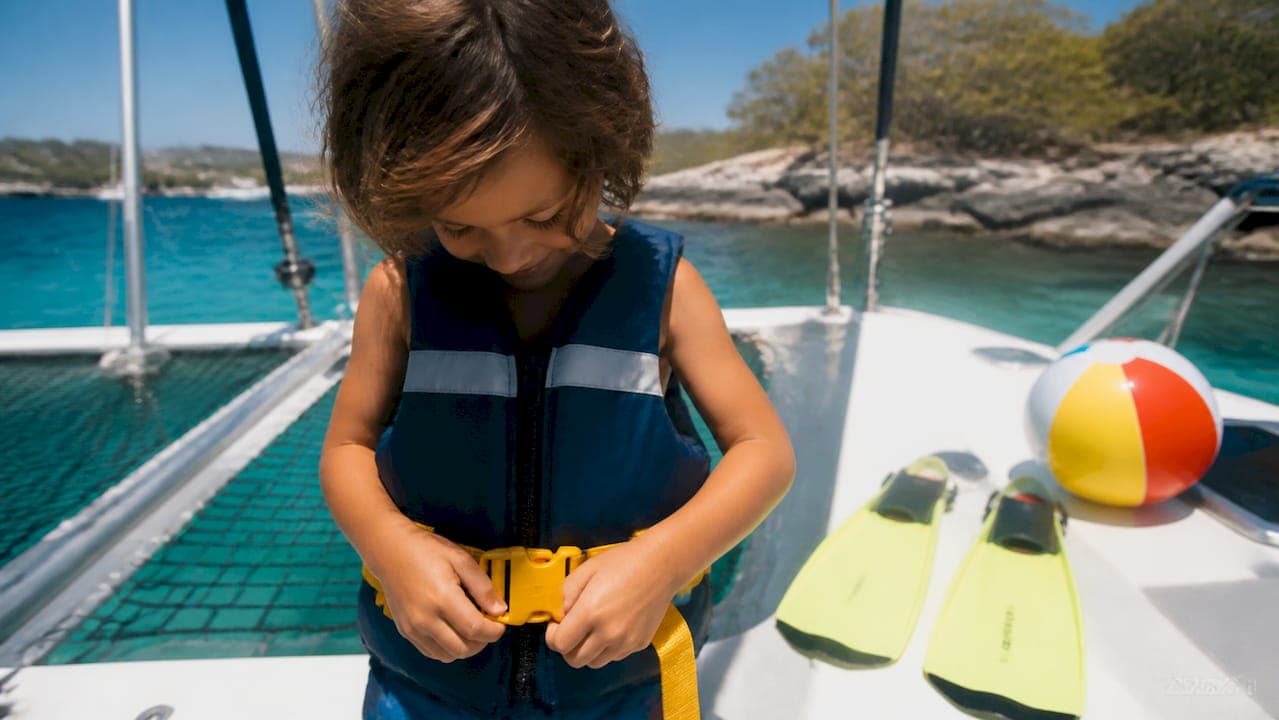
- Lifejackets go on before leaving the cockpit, every time, no exceptions. Make it automatic from day one.
- The buddy system applies on deck: no child moves forward of the cockpit alone.
- No going below alone at night; a parent or crew member accompanies children after dark.
- Anchor watch is a shared responsibility: older kids can be "anchor monitors" with a simple compass bearing to check.
The Royal Yachting Association supports giving children supervised, age-appropriate tasks as a direct way to build competence and reduce risky behavior. Steering under adult supervision, helping hoist the mainsail, tying a bowline, calling out landmarks from the bow — these are not just fun. They shift a child's identity from passenger to crew, and that shift changes behavior.
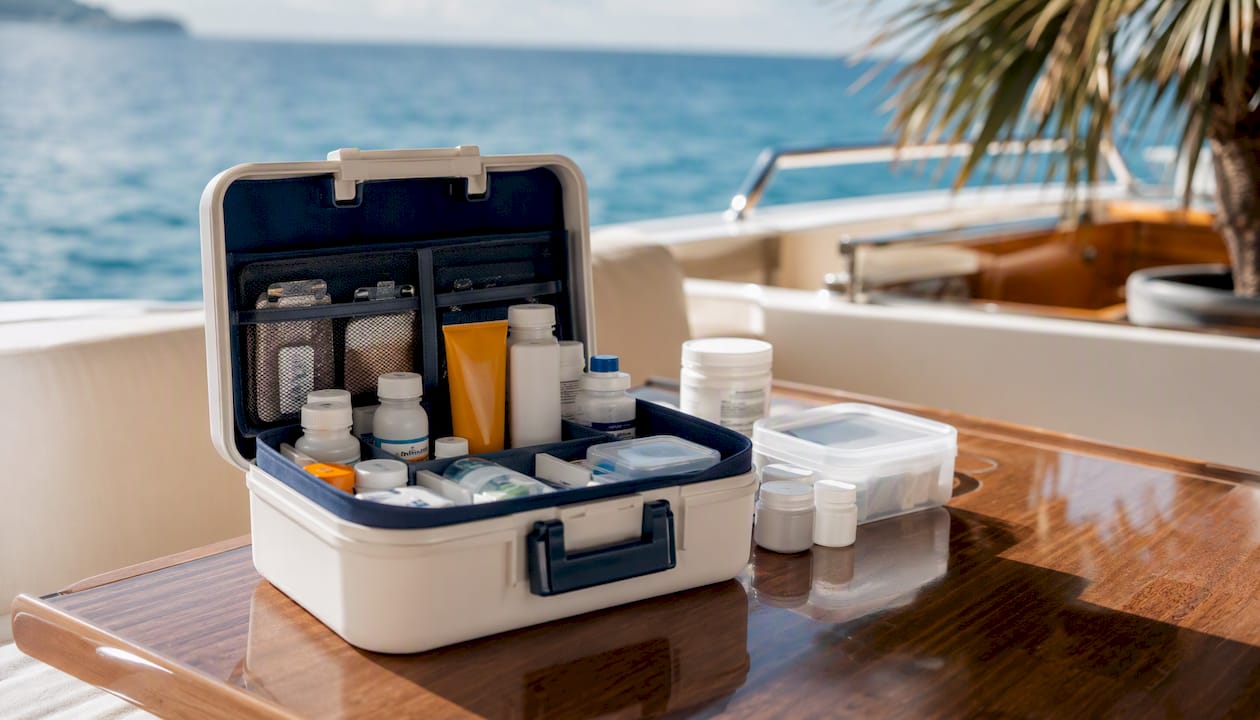
For emergency preparedness, carry a dedicated children's first-aid kit stocked with seasickness medication appropriate for your children's ages (consult your pediatrician before departure), children's sunscreen SPF 50+, antihistamine, rehydration sachets, and any prescription medications in clearly labeled, waterproof containers. Run a brief, calm safety briefing with the children before departure each morning: where the life rings are, what the horn signal means, and what to do if someone goes overboard. Keep it short and matter-of-fact.
Pro Tip: Turn the morning safety briefing into a "crew check" ritual — each child reports one safety item (lifejacket clipped, sunscreen applied, water bottle full) before the anchor comes up. It takes two minutes and builds the habit without a single argument.
Structured activity programs on day excursions show how well themed programming works: short supervised outings with onboard workshops, games, and a small reward like a diploma keep children engaged and give parents breathing room. The same principle scales to a multi-day trip: a small "crew log" where children record the day's wildlife sightings, a fishing competition, a nightly star-identification challenge.
What should you pack and provision for kids on a sailing trip?
Provisioning for children on a boat requires more planning than a land vacation because resupply is intermittent and storage is limited. The goal is variety without waste, and comfort without overloading the lockers.
Clothing and sun protection:
- Rash guards and UV-protective swimwear for every child; re-apply SPF 50+ sunscreen every two hours on the water.
- Wide-brim hats that tie under the chin (they stay on in wind).
- One warm layer per child for early mornings and cooler evenings underway.
- Non-slip deck shoes or water sandals with heel straps.
Medication and seasickness kit:
- Seasickness remedies suited to your children's ages; patches, bands, and oral medications each work differently, so discuss options with your pediatrician before the trip.
- Store all medications in a labeled, waterproof pouch in a consistent location so any adult on board can find them quickly.
- Children's pain reliever, antihistamine, rehydration sachets, and a basic wound kit.
- Any prescription medications with a copy of the prescription.
Provisioning for picky eaters:
Familiar foods matter more on a boat than at home. A child who refuses dinner at anchor is a child who wakes up hungry at 3 AM. Stock a week's worth of reliable favorites alongside more adventurous options. A simple framework:
- Breakfast: oatmeal, cereal, or eggs — something warm and filling before a morning sail.
- Lunch: sandwiches, wraps, or leftovers eaten at anchor; easy to prepare, easy to eat.
- Dinner: one-pot meals (pasta, rice dishes, stews) that work in a small galley and reheat well.
- Snacks: crackers, fruit, cheese, and nut bars in a dedicated "snack basket" children can access themselves.
Kid-friendly boat tour planning guides emphasize keeping snacks accessible and predictable as one of the most effective ways to manage energy levels and moods underway.
Entertainment that works on a boat:
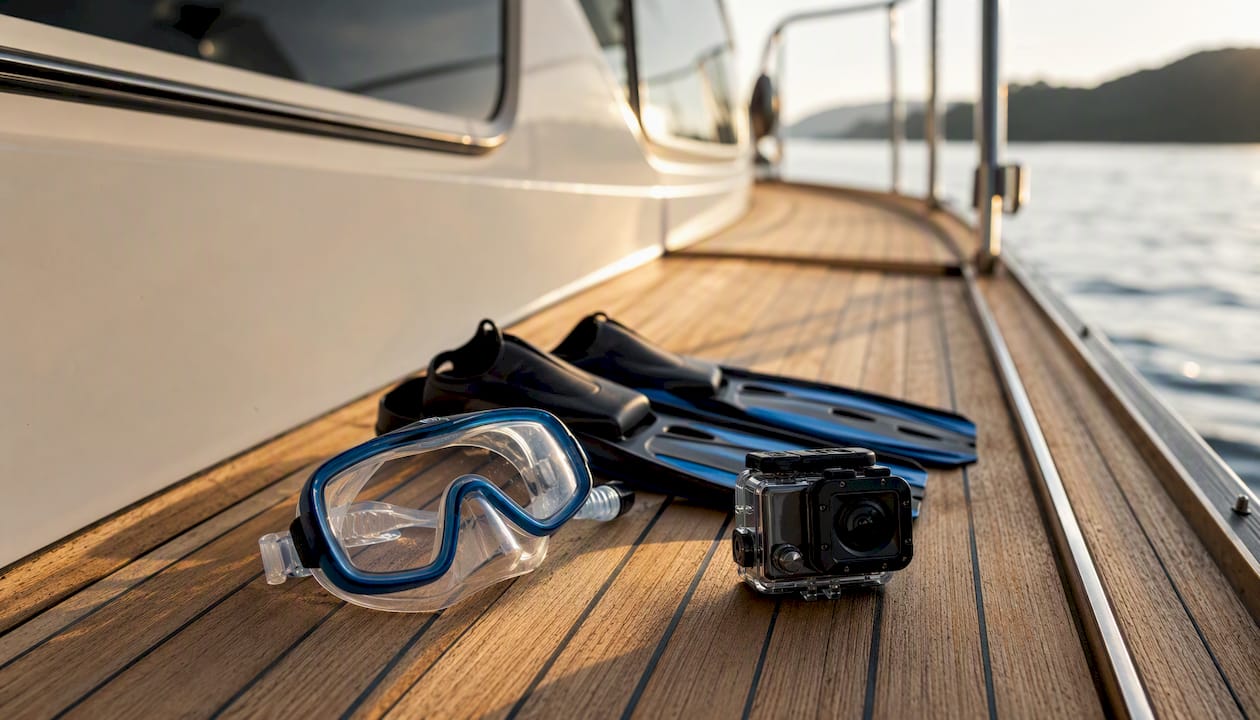
Screen time has its place on long passages, but the best entertainment is the environment itself. Snorkel gear, a small fishing rod, a waterproof camera, a field guide to local fish or birds, and a simple activity kit (watercolor paints, a journal, card games) cover most situations. Limit screens to passages only; once the anchor is down, the water is the entertainment.
What ages are ready for what tasks on board?
Children do not need formal sailing skills to contribute meaningfully to a family voyage. What they need is a role that matches their developmental stage, and a parent or crew member who takes that role seriously.
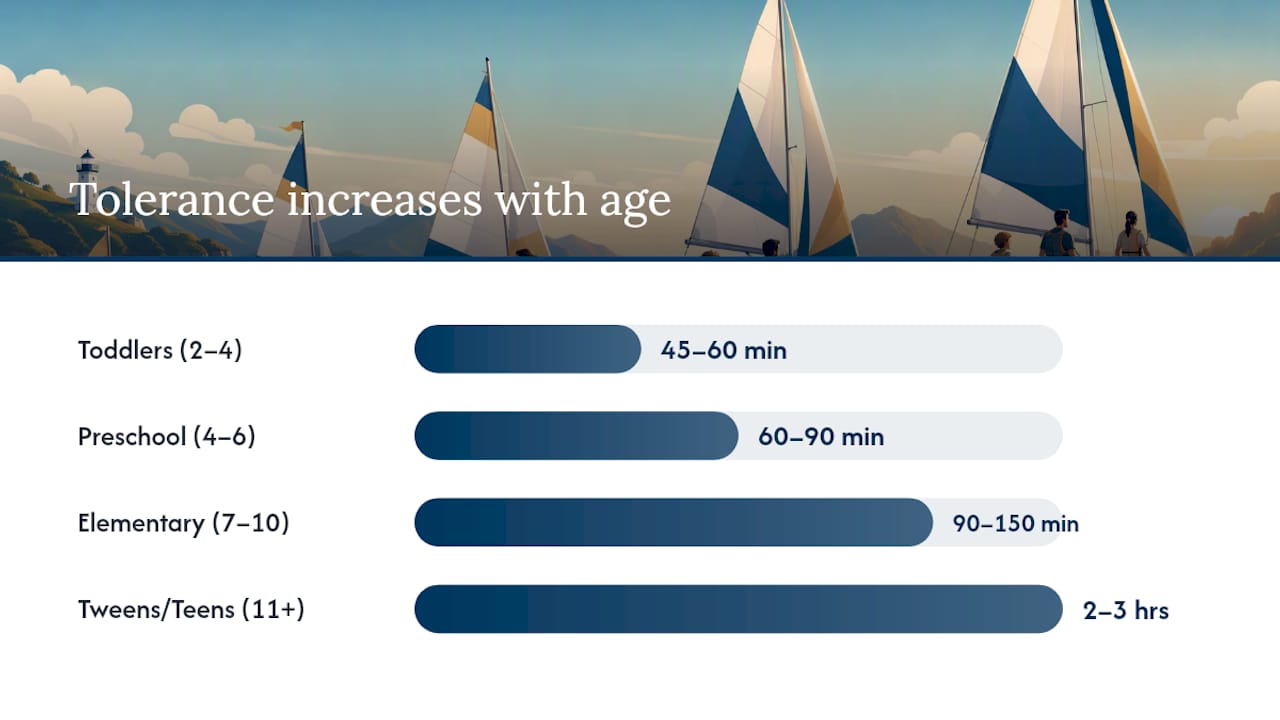
| Age group | Sailing tolerance | Best activities | Supervised tasks | Supervision level |
|---|---|---|---|---|
| Toddlers (2–4) | 45–60 min max | Water play at anchor, watching wildlife | Towel monitor, snack helper | Constant adult contact |
| Preschool (4–6) | 60–90 min | Beach play, simple fishing, paddleboard with adult | Snack distribution, flag raising | Within arm's reach at all times |
| Elementary (7–10) | 90–150 min | Snorkeling, kayaking, knot-tying | Steering under supervision, lookout duty, knot practice | Close supervision; can be 2–3 meters away on deck |
| Tweens/Teens (11+) | 2–3 hrs | Snorkeling, paddleboarding, fishing, navigation | Navigation spotter, sail trimming, anchor watch | Supervised responsibility; can take short independent tasks |
Family sailing trips with crew instruction demonstrate that children of varied ages can safely help with sails, steering, and simple tasks when the instruction is structured and the expectations are clear. The key is matching the complexity of the task to the child's attention span, not just their physical ability.
For toddlers, constant adult contact is non-negotiable. A tether or harness is appropriate whenever a toddler is on deck underway. For tweens and teens, supervised responsibility is both safe and motivating: a 13-year-old who has taken a compass bearing and confirmed the anchorage is the right one has had a genuinely formative experience.
How do you build your own kid-friendly sailing itinerary from scratch?
Seven steps, in order. Work through them before you book anything.
-
Choose your region. Select an island chain or coastal area with short inter-island distances (under 15 nautical miles between stops), protected channels, and multiple anchorage options. The BVI, Whitsundays, Greek islands, and Exumas are proven starting points for families.
-
Set your maximum daily sail time. Decide on a hard ceiling before you look at charts: 90 minutes for families with children under six, up to three hours for older children. Write it down and do not negotiate it away when planning.
-
Pick anchorages with safe access. For each overnight stop, confirm the anchorage is protected from the prevailing swell, has good holding, and allows children to swim safely off the boat. Avoid anchorages with strong tidal currents or heavy boat traffic.
-
Plan one major midday activity per day. Before you finalize any day's route, identify the activity that makes that day worth doing: a specific reef, a beach, a sea cave, a local market. The activity comes first; the sailing connects the dots.
-
Add contingency ports. For every two days of sailing, identify one alternative harbor or anchorage you can reach within 30 minutes if weather changes or a child needs a rest day. Mark it on the chart before you leave.
-
Provision and pack. Use the checklist in the previous section. Provision for one extra day beyond your planned trip length; boats run late, weather holds you in a beautiful anchorage, and running out of crackers is a genuine crisis with a four-year-old.
-
Run a family safety briefing. Before departure, gather everyone on deck and walk through the four essentials: where lifejackets are stored, what the man-overboard signal is, where the first-aid kit lives, and what the plan is if the weather changes. Keep it under five minutes and make it a ritual, not a lecture.
Balancing sea days and land days and building contingency stops are the two planning decisions that most consistently separate enjoyable family sails from stressful ones. Get those right and most other problems solve themselves.
Why does a crewed charter often work best for families?
The practical case for a crewed yacht comes down to one shift: parents stop managing the trip and start experiencing it. Navigation, provisioning, safety watches, and galley work all transfer to the crew. What remains is the sailing, the swimming, and the time together.
A professional crew brings local knowledge that no chart or cruising guide fully replicates: which anchorage has the best snorkeling for children, where the sea turtles feed at dawn, which passage is glassy in the morning and choppy by afternoon. For families with young children especially, that knowledge is worth more than any piece of equipment.
Exoticacharters' team includes former captains and water-sports professionals who design itineraries around the family's specific ages, interests, and comfort levels. The Trustpilot ratings reflect what that personalized approach produces in practice: families who arrive as passengers and leave feeling like sailors.
Crewed charters for families offer a level of safety coverage and activity programming that bareboat charters simply cannot match when young children are involved. The crew handles the watch schedule, monitors weather, and manages the boat at anchor overnight. Parents sleep.
When is a crewed charter the right call? We would suggest it for any family with children under ten, any group where the adults are not experienced sailors, and any itinerary that includes remote anchorages or open-water passages. A bareboat with a hired skipper is a reasonable middle ground for sailing-confident parents with older children on well-charted routes. For everyone else, a fully crewed vessel is the safer and more enjoyable choice.
Pro Tip: Ask your charter specialist about onboard naturalist guides when booking a family trip. A guide who can name the fish your child just spotted turns a snorkel into a science lesson — and children remember that kind of detail for years.
What we recommend for a stress-free family sailing week
The families who have the best first sailing trips share one characteristic: they planned for less sailing than they thought they needed. Every experienced family sailor we know says the same thing. You will not regret anchoring early. You will regret pushing through a lumpy afternoon passage with a seasick six-year-old.
For first-time family sailors, we recommend a crewed catamaran in a sheltered island chain, a maximum of two hours of sailing per day, and at least two full rest days built into a seven-day trip. Catamarans offer more deck space, more stability, and more cabin separation than monohulls of comparable length, which matters enormously when you are sharing a boat with children for a week.
Hire a captain at minimum if you are sailing with children under eight and you are not a confident sailor yourself. A full crew makes more sense for groups with toddlers, multigenerational families, or anyone who wants the trip to feel like a vacation rather than a project.
One thing we have observed consistently: the families who build unstructured afternoon time into the itinerary — no plan, just the boat, the water, and whatever the children decide to do — report the highest satisfaction. Structure the mornings; leave the afternoons open.
Exoticacharters makes family sailing genuinely turnkey
Planning a family sailing trip from scratch takes real expertise: choosing the right region, vetting anchorages for child safety, calibrating daily distances, and sourcing a crew that knows how to work with young passengers. Exoticacharters handles all of it.

The team at Exoticacharters consists of former captains and water-sports professionals who build each family itinerary around the specific ages and interests of the children on board. Crew handles navigation, galley, and safety so parents can focus entirely on the experience. Optional onboard activities include snorkeling instruction, wildlife spotting with naturalist guides, and age-appropriate crew tasks that make children feel like genuine participants.
To get started, browse luxury crewed yachts and have your dates, the number of children and their ages, and any dietary or accessibility notes ready when you reach out to a charter specialist. The conversation takes fifteen minutes; the planning takes care of itself from there.
Sources
The sources below informed this guide and offer practical depth for specific planning questions.
- Caribbean Sailing with Kids — 7 Smart Family Planning Tips
- Bahamas sailing adventure | Family cruising the Abacos
- Royal Yachting Association (RYA)
- Planning a first big sailing trip with Kids
- Special children's catamaran outing | Pirate games St-Raphaël - Expérience Côte d'Azur