The right yacht crew ratio depends on length and service ambition, not guesswork: under 24 meters typically calls for a small crew, 40 to 60 meters runs a moderate crew size, and full hotel-style charter service often approaches one crew member per guest. The Safe Manning Document and MLC 2006 set the legal floor beneath all of this, and charter operations need meaningfully more staff than private cruising ever does.
TL;DR:
- Charter yachts over 40 meters typically require a crew-to-guest ratio close to 1:1, with actual numbers rising for expedition or dive-focused itineraries.
- The Safe Manning Document provides a legal minimum that often underestimates staffing needs, which should be increased based on operational complexity and safety regulations.
- Guest-facing roles scale with service ambition, meaning interior staff are generally heavier on charter yachts, especially for hotel-style guest experiences.
- Estimated crew costs for a 40-meter yacht can exceed $1 million annually when including benefits, tips, and operational expenses, representing a significant portion of the total budget.
- Owners should evaluate their specific charter type, itinerary, and service standards when determining crew numbers, and always plan above legal minimums for safety and quality.
Table of Contents
- What Is the Right Crew-to-Guest Ratio by Yacht Size?
- How Do Safety Rules Set the Minimum Crew Level?
- How Do Deck, Engineering, Interior, and Galley Roles Break Down?
- Should You Staff for 1:1 Service or a Leaner Ratio?
- What Does Adding Crew Actually Cost Owners?
- What Should You Ask Before Finalizing Crew Numbers?
- A Captain's View on Getting the Ratio Right
- Sources
- FAQ
What Is the Right Crew-to-Guest Ratio by Yacht Size?
We've watched owners underestimate this repeatedly: crew count is not a luxury add-on, it is the mechanism that makes a charter feel effortless. The math scales predictably with length, and once you know the bands, sizing a program becomes far less mysterious.
Common industry guidance breaks down as follows. Charter yachts consistently run heavier complements than private equivalents of the same length, because turnaround days and back-to-back charter weeks add workload that private owners never generate.
| LOA band | Typical crew count | Typical guest capacity | Approximate ratio |
|---|---|---|---|
| Under 24m | 2 to 4 | 6 to 10 | 1:2 to 1:3 |
| 24 to 40m | 6 to 10 | 8 to 10 | 1:1 |
| 40 to 60m | 10 | 10 to 13 | Close to 1:1 |
| Over 60m | 20 to 30+ | 12 to 20 | Often 1:1 or better |
A few exceptions matter here:
- Day-charter boats skip overnight watches entirely, so they run leaner than the table suggests.
- Expedition and dive-focused itineraries add specialist crew regardless of length, pushing smaller yachts toward richer ratios.
- Rotation policies (two or three months on, one off) effectively double the contracted headcount for budgeting purposes, even though only half the roster is aboard at any time.
How Do Safety Rules Set the Minimum Crew Level?
The Minimum Safe Manning Document is a compliance floor, not a service target. It states the smallest legal crew a flag state will allow for that vessel's tonnage and trading area. Well-run charter operations staff above it deliberately, because a document built around bare-minimum safety was never meant to deliver five-star hospitality.
Two regulatory forces push actual staffing higher:
- Gross tonnage and certification. Yachts crossing roughly 200 GT or engaging in commercial charter trigger stricter manning rules tied to SOLAS, STCW, and MARPOL compliance.
- MLC rest-hour rules. Mandated rest periods mean one officer cannot legally cover a full day's bridge watch.
Statistic Callout: Continuous overnight bridge coverage typically requires at least three qualified deck officers, independent of how many guests are aboard. That number holds whether you're carrying six guests or sixteen, which is why length and watchkeeping needs often drive headcount more than passenger count does.
Flag state and vessel classification adjust the specifics, but the pattern is universal: plan crew numbers above the legal minimum whenever you intend to run a genuine charter program.
How Do Deck, Engineering, Interior, and Galley Roles Break Down?
Crew requirements split cleanly into two categories: roles that keep the vessel safe and legal, and roles that shape the guest's actual experience. Confusing the two is where owners misjudge their staffing needs.
Safety and operations roles include captain, chief engineer, and deck officers, sized by the watchkeeping math above rather than by guest count. Guest-facing roles include chief stewardess, stewards, and the chef, and these scale directly with service ambition. Charter yachts typically carry more interior staff than private yachts of the same length precisely because guests expect turndown service, varied menus, and attentive presence at every meal.
- Deck: captain, first officer, deckhands (safety and tender operations)
- Engineering: chief engineer, second engineer on larger vessels (systems and compliance)
- Interior: chief stew, stewardesses (guest service, cabins, laundry)
- Galley: head chef, sous chef on larger complements (meals and provisioning)
Smaller yachts lean on cross-training. A 20 meter charter boat might have a deckhand who also tends bar and a stew who doubles as a masseuse. Expedition-style charters add specialist roles entirely, such as a dive instructor or naturalist guide, which raises the effective ratio without adding a single traditional department slot.
Pro Tip: Ask any crew proposal to separate "safety complement" from "service complement." If a broker can't make that distinction clearly, they likely haven't thought through your itinerary's real staffing needs.
For a deeper look at how these positions interact day to day, see Yacht Crew Roles for Luxury Charters, written from the perspective of former captains who've staffed both sides of that line.
Should You Staff for 1:1 Service or a Leaner Ratio?
Private use and commercial charter demand different math entirely. A private owner cruising with family might run comfortably at 1:2 or 1:3, since there's no turnover pressure and guests already know the boat's rhythms. Charter guests paying premium weekly rates expect something closer to hotel service, and that pushes toward 1:1 on yachts over 40 meters.
A few situations where each approach makes sense:
- 1:1 or better fits back-to-back charter weeks, multi-generational groups with varying needs, or itineraries built around diving and water sports that require dedicated safety staff in the water.
- 1:2 remains acceptable for shorter coastal trips, repeat charter guests who prefer a relaxed atmosphere, or smaller yachts under 24 meters where space limits crew cabins anyway.
- Contract language should specify service level explicitly, since "fully crewed" means wildly different things at 1:3 versus 1:1.
Setting expectations early avoids the awkward mid-charter conversation where guests assumed hotel-level attention and got something closer to a well-run sailing club.
What Does Adding Crew Actually Cost Owners?
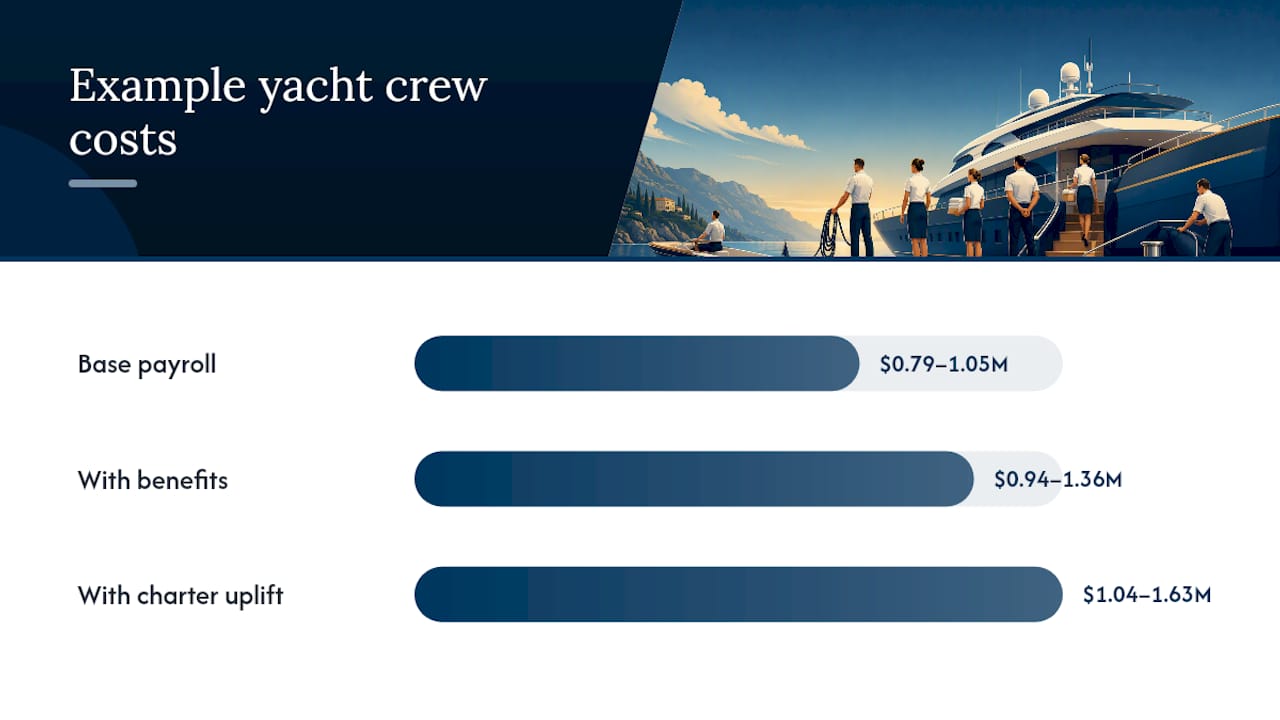
Crew payroll follows a rough shorthand that's useful for a first pass, though never a substitute for a real budget. Industry planning tools price crew at roughly $6,000 to $8,000 per foot per year, with benefits adding another 20 to 30 percent on top of base salary.
Here's how that arithmetic plays out for a 40 meter (about 131 foot) charter yacht:
- Base payroll: 131 feet times $6,000 to $8,000 equals roughly $786,000 to $1,048,000 annually.
- Add benefits at 20 to 30 percent: pushes the range to roughly $943,000 to $1,362,000.
- Charter uplift and guest tips typically add another 10 to 20 percent on top when the vessel runs an active charter program.
Statistic Callout: Crew payroll commonly represents 30 to 40 percent of a yacht's total annual operating cost, making it the single largest line item most owners underestimate at purchase.
Hidden costs pile on beyond the base number: rotation flights for crew changeovers, additional liability insurance, and mandatory training certifications. Treat the per-foot figure as a sanity check, not a final budget, since regional pay rates and department mix shift the real number considerably.
What Should You Ask Before Finalizing Crew Numbers?
Before signing off on a crew proposal, work through this sequence with your captain or management company:
- Define the charter program type: full commercial charter, occasional guest use, or purely private.
- Clarify guest service expectations in writing, including meal frequency and water sports support.
- Map the itinerary: offshore passages and remote anchorages need more watchkeeping capacity than coastal hops.
- Confirm the rotation plan and how it affects year-round budget, not just the crew aboard today.
- Set a budget envelope before requesting proposals, so bids get compared on the same terms.
Ask directly whether a proposal reflects the Safe Manning Document minimum or a recommended complement built for your actual program. A vendor unable to explain that gap, or one who quotes a number suspiciously close to the bare legal floor for a full charter season, is a red flag worth pressing on.
A Captain's View on Getting the Ratio Right
The planning team is built from former captains and water sports professionals who've staffed these programs from the wheelhouse, not just the spreadsheet, ensuring they understand the UK hull cleaning steps and timing necessary to keep vessel maintenance seamless amid operational demands. That perspective matters most on expedition-style charters, where a dive-heavy itinerary in a remote destination can call for two extra water sports specialists beyond what a standard length-based table would ever suggest.
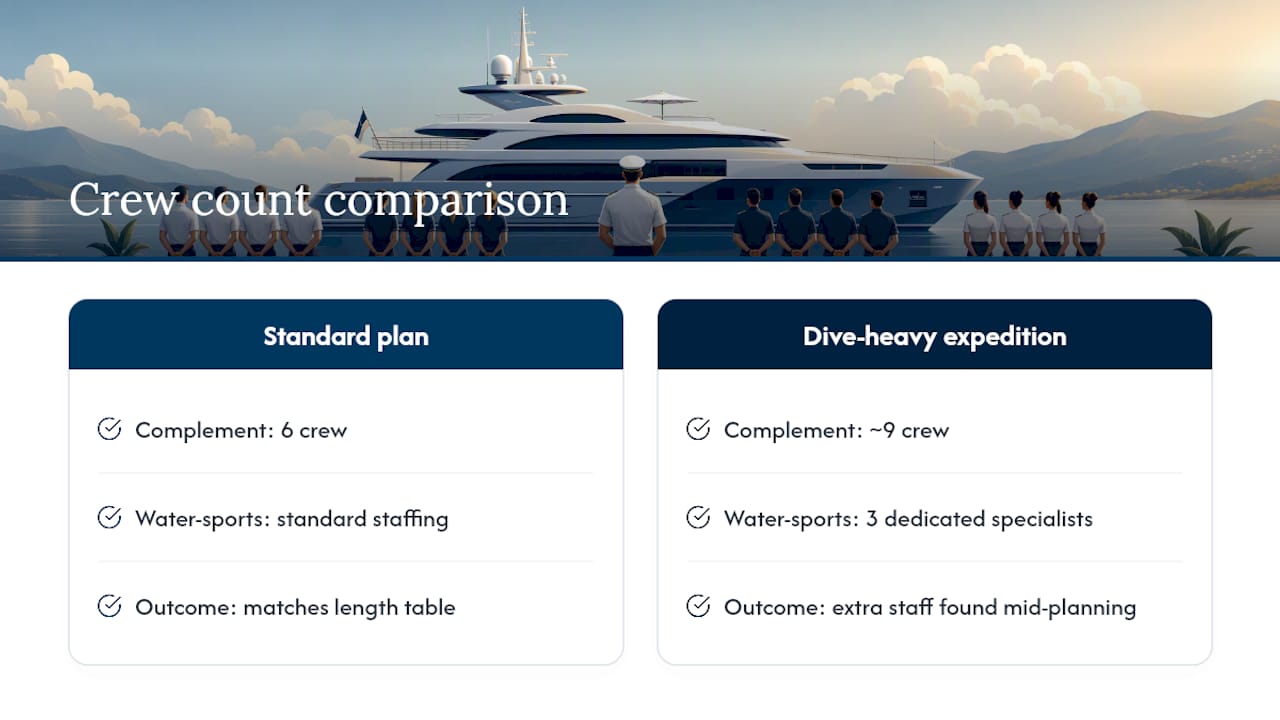
We've seen owners plan a 30 meter expedition yacht around a lean six-person complement, only to discover mid-planning that daily dive support alone needed three dedicated crew, pushing the real number closer to nine. Getting that math right before departure, not during it, is the entire point of this guide.
For related reading, see Yacht Charter Guest Capacity Explained and Yacht Crew Roles for Luxury Charters. If you're ready to talk through staffing for a specific itinerary, Exotica Charters can walk through options across motor yachts and luxury yachts built for exactly this kind of trip.
— Mo
Sources
- What size yacht requires crew? — Dockwalk
- Yacht Crew Management: Hiring, Training & Retention Guide — Yachtpedia
- Yacht Crew Cost Calculator — Annual Payroll by Yacht Size (2026)
FAQ
What Is a Typical Yacht Crew Ratio for Charters?
Charter yachts over 40 meters often approach a 1:1 crew-to-guest ratio for hotel-style service, while smaller yachts under 24 meters commonly run 1:2 or 1:3. Private yachts typically staff leaner than charter equivalents of the same length.
How Many Crew Does a 30 Meter Yacht Need?
A 30 meter yacht generally falls in the 24 to 40 meter band, needing roughly six to ten crew depending on charter activity and guest count. Expedition itineraries with diving or water sports often push that number higher regardless of length.
Is the Safe Manning Document the Same as Recommended Crew Levels?
No. The Safe Manning Document sets a legal minimum for safety compliance, while a recommended complement accounts for guest service, rotation, and fatigue avoidance. Charter operators typically staff well above the legal floor.
Why Do Charter Yachts Need More Crew Than Private Yachts of the Same Size?
Charter operations face constant guest turnover, back-to-back weeks, and hotel-level service expectations that private cruising doesn't generate. Interior staffing in particular runs heavier on charter yachts to keep cabins, meals, and guest attention consistent across a full season.
How Much Does Adding One Crew Member Cost Annually?
Using the $6,000 to $8,000 per foot shorthand as a rough per-crew estimate, plus 20 to 30 percent benefits, a single additional crew member typically adds well into six figures annually on a mid-size yacht. Rotation, training, and travel costs add further expense beyond base salary.