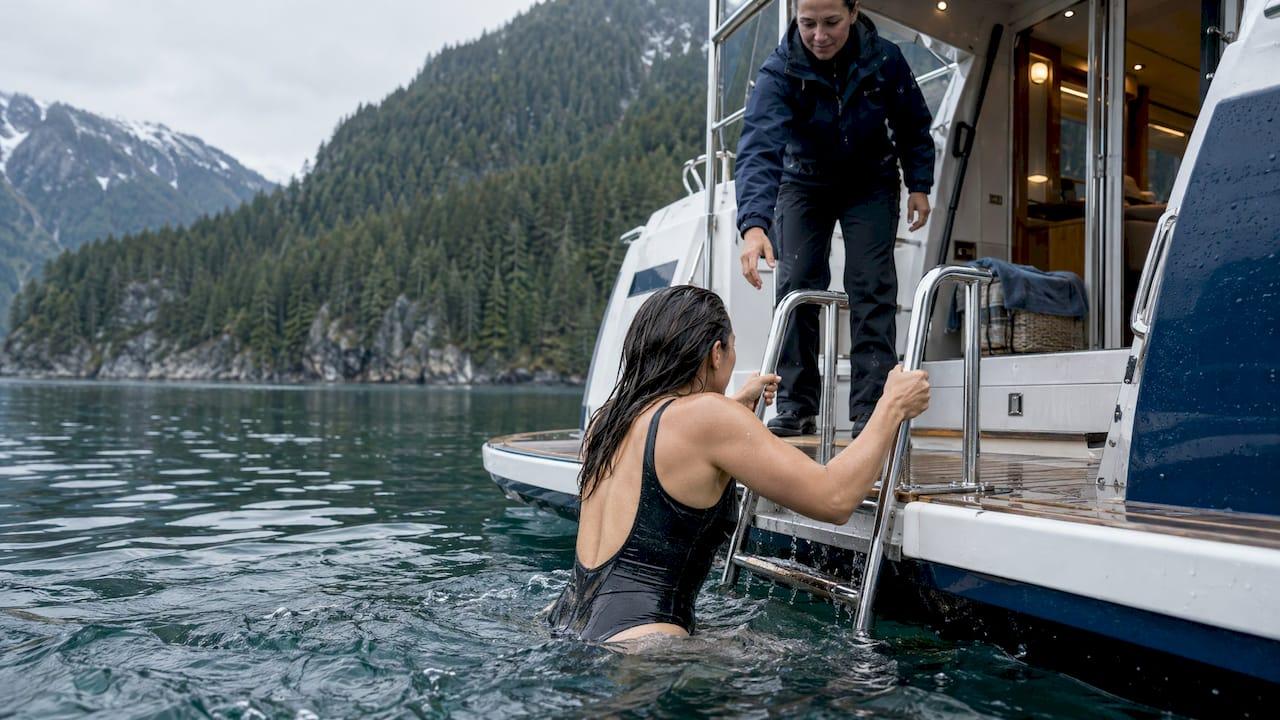
A polar plunge from a yacht is a deliberate, controlled jump into near-freezing water, usually lasting well under a minute, followed by a fast exit and a long, careful warm-up. On a private crewed yacht it can be done on your schedule, from the swim platform or a tender, with the crew watching conditions and a plan in place before anyone steps to the edge. The experience is thrilling, but it is also a real physiological event, and the people who enjoy it most are the ones who prepare for it. Our team of former captains and water sports professionals plans custom itineraries in remote waters, from Alaska to Antarctica, and this guide covers what you need to know before you go.
TL;DR
- Polar water can sit near freezing: Antarctic water can be as low as 28°F (-2°C), and the plunge itself is measured in seconds, not minutes.
- The main danger is cold shock in the first minute, not the cold itself, which is why a gentle, controlled entry matters more than swimming skill.
- Heart conditions, high blood pressure, diabetes, pregnancy and age over 60 or under 14 are all reasons to speak with a licensed medical professional first.
- The warm-up matters as much as the jump: your coolest body temperature arrives 30 to 50 minutes later.
- Cold-water diving and glacier hiking pair naturally with a plunge, but each needs its own gear, training and guides.
Table of Contents
- Why a yacht is a good platform for a plunge
- How cold is a polar plunge, and how long do you stay in?
- What happens to your body in the first minute
- Who should skip it, and who should ask a doctor first
- A sensible plunge routine, step by step
- Warming up properly afterward
- Cold-water diving from a yacht
- Glacier hiking from a yacht
- Where to plunge: matching the waters to the trip
- Our perspective
- Plan your polar voyage with us
- FAQ
- Sources
Why a yacht is a good platform for a plunge
A plunge is easiest to control from a vessel. You enter the water from a fixed, stable point, the exit is a ladder or platform a few steps away, and the warm interior of the boat is moments behind you. Compare that with a shore entry over slippery rocks and shellfish, where numb feet and uneven footing turn a ten-second thrill into a hazard.
On a private charter the whole rhythm is yours. There is no queue of other passengers and no fixed slot in a group schedule. You and your party choose the anchorage, the morning light and the moment, and the captain decides whether the conditions are right. In a fjord with glacier ice drifting past the bow, or a quiet bay under dark mountains, the jump becomes part of the landscape rather than a stunt added to it.
That flexibility is also why planning matters. The right vessel, the right crew and the right waters make the difference between a plunge that is a highlight and one that is merely cold. If you are weighing vessel types for high-latitude waters, our overview of what makes a yacht suitable for polar or expedition waters is a good place to start.

How cold is a polar plunge, and how long do you stay in?
The water is cold enough to take your breath away, and that is meant literally. Antarctic water can fall to 28°F (-2°C), and glacial waters in Alaska and the Arctic in summer are cold enough to be unmistakable the instant you enter. Seawater stays liquid below 32°F because of its salt content, which is why you can plunge into water that is technically below freezing.
For context, a typical backyard cold-plunge tub is a much milder experience. One hospital guide suggests keeping sessions to roughly five to ten minutes in water no colder than 50°F. A polar plunge is colder than that and far shorter by design.
How long should you stay in? Less than you think. A University of Ottawa extreme-environments researcher told Smithsonian Magazine that in ice water two to three minutes is all you need, and that pushing for longer is neither advisable nor beneficial. For a yacht plunge, a jump, a few seconds and a calm climb out is the right shape. Treat the cold as the point, not the clock.
What happens to your body in the first minute
Understanding the first sixty seconds is the single most useful thing a first-timer can do.
When cold water hits your skin, the body responds with cold shock: a sudden surge in breathing rate, heart rate and blood pressure. According to the U.S. Model Aquatic Health Code guidance, citing the American Heart Association, this response occurs within the first minute and can be fatal, because an involuntary gasp while your head is under the surface can lead to drowning within seconds. Smithsonian Magazine reports that cold shock peaks in about 30 seconds and can last three to five minutes, and that even confident swimmers can be caught out by a panic-induced inhalation.
A cardiologist at Houston Methodist adds that the shock makes the heart work harder, which is why the heart conditions discussed below deserve respect.
What this means in practice:
- Enter feet first and controlled. Do not dive. Keep your head above water on entry.
- Focus on slow exhalation. Breathe out deliberately as the gasp reflex passes; it settles within a minute or so.
- Stay at the ladder. Your job in the first minute is simply to get your breathing under control, not to swim.
- Get out when the urge to gasp has eased and your limbs begin to feel clumsy. Hands numb quickly, and a ladder is much harder to climb once they do.
Who should skip it, and who should ask a doctor first
This is the part of the planning not to rush. The MAHC cold-water guidance recommends that people with heart conditions, high blood pressure, poor circulation, diabetes, respiratory conditions such as asthma, or compromised immune systems, as well as anyone who is pregnant, over 60 or under 14, avoid cold-water venues or consult a licensed medical professional first. Houston Methodist's list is similar and also names peripheral neuropathy and circulation problems such as Raynaud's, and recommends checking with a healthcare provider before any cold plunge.
If anything on that list applies to you or someone in your family, speak to your own doctor before the trip, not on the swim platform. Families with teenagers should have that conversation in advance too, and a plunge is always optional: plenty of guests are happiest watching from the deck with a camera and a warm drink, and the trip is no less rewarding for it.
A sensible plunge routine, step by step
There is no single official protocol for private yachts, but the principles below follow the medical guidance above and are the ones we would apply to any cold-water entry.
- Clear it with your doctor. Do this at home, well before departure, if any of the conditions above apply.
- Let the captain choose the moment. Wind, swell, drifting ice and wildlife all affect whether a plunge is sensible. Wait for a calm anchorage rather than forcing a schedule.
- Go one at a time, or two at most. Everyone else stays warm and dressed, with towels, robes and hot drinks ready.
- Use a controlled entry. A swim platform with a ladder, or a lowered tender with a secure line and a crew member close by, beats a leap from height. Take off watches, rings and loose jewelry first.
- Breathe out, then count to a few seconds. Keep the visit short and exit by the ladder as soon as you are ready.
- Get dry and dressed at once. Everything after the water is about rewarming, covered next.
Warming up properly afterward
Most people think the danger ends when they climb out. It does not. Smithsonian Magazine notes that your coolest deep body temperature occurs 30 to 50 minutes after getting in the water, a phenomenon often called afterdrop. The cold-water safety expert quoted there recommends drying off quickly, getting out of the wind and cold, and light exercise. She does not recommend a warm bath, because it stops the shivering without addressing deep body temperature.
A good post-plunge plan therefore looks like this:
- Towel off immediately and change into dry, layered clothing, with a hat and dry socks.
- Move indoors, out of the wind, and keep gently active.
- Sip a warm, non-alcoholic drink. Hot cocoa is a classic for a reason.
- Wait until you feel properly warm before a warm (not hot) shower.
- Stay in company for the following hour, so someone notices if you are shivering hard or feeling confused.
If you are curious about how staff-supported towels, hot drinks and recovery work in a cold-plunge setting, the cold plunge recovery basics are a helpful companion read. On a yacht, the advantage is simple: the heated saloon, the cabin showers and a crew who know the routine are all within a few steps of the ladder.
Cold-water diving from a yacht
If you are a certified diver, a plunge is only the start. Cold-water diving from a yacht lets you reach sites that day boats never see, from kelp-filled bays to the edges of glaciers. It is also a different discipline from tropical diving.
The Divers Alert Network advises testing all gear as it will be used and dialing in your weighting before entering freezing water, using environmentally sealed first stages, and carrying backup regulators when diving under any overhead ice. If a drysuit or gloves flood, the advice is to end the dive, remove wet undergarments and warm up gradually. Air temperatures in ice-diving conditions can range from -15°F to 30°F, so the surface interval deserves as much planning as the dive itself.
What this means for a yacht charter is that a drysuit certification and some practice with your own drysuit before you travel will transform the experience. Tell us your certification level and cold-water experience early, and we can shape the itinerary around dive sites that suit it. For a closer look at the diving and wildlife side of expedition travel, see what activities there are on an expedition charter.
Glacier hiking from a yacht
Glacier hiking is the natural partner to a plunge in Alaska, where a yacht can anchor within reach of the ice and guests step ashore for a day on the glacier. Our page on Alaska yacht charters covers the region, and our comparison of the Inside Passage and Glacier Bay helps you choose where to base the trip.
Two safety points are worth knowing before you go. First, the glacier face itself is no place to linger: Alaska's tourism authority warns visitors to stay well back from melting glacier faces, where one-ton chunks of ice can fall, and notes that walking on a glacier surface requires expert assistance and technical gear such as crampons, ice axes and ropes, because hidden crevasses and moulins can be fatal. Second, expect the weather to change: the same guide describes a 10-to-20-degree temperature drop from the wind coming off a glacier toe.
The University of Alaska's remote travel guidance adds a rule that applies to anyone moving across frozen surfaces: if the ice sounds hollow or cracks, find another route. In practice, that means hiring a qualified local glacier guide for the walk itself, while the yacht provides the base, the warm meals and the hot shower waiting at the end of the day.

Where to plunge: matching the waters to the trip
Not every destination suits every traveler, and this is where planning pays off.
| Region | What the plunge feels like | Best suited to |
|---|---|---|
| Alaska | Glacial, cold, scenic; ice often within sight | Families, couples, nature lovers who also want glacier hikes and wildlife |
| Antarctica | Near-freezing, dramatic and remote | Experienced travelers and divers seeking a once-in-a-lifetime voyage |
| Norway and the Arctic | Cold, with long summer light | Couples and travelers who want fjords and the midnight sun |
If you are deciding between regions, our guide to Alaska versus Norway for a crewed expedition charter and the overview of five epic expedition destinations set out the differences in scenery, season and style. For the far south, see how a private yacht differs from an expedition cruise in Antarctica.
Our perspective
We have spent our careers on the water, and we will say plainly what we think makes a good plunge: it is the one that was planned.
The jump itself takes seconds. Everything around it, the vessel, the anchorage, the crew, the dry clothes laid out, the warm saloon, is what decides whether it is a memory you treasure or one you would rather forget. That is why our team of former captains and water sports professionals builds each itinerary around you, your party and the waters you want to reach, rather than around a fixed schedule.
On a private crewed yacht the day can bend to the weather and the wildlife. If a pod of whales appears, we would suggest staying with them. If the light is perfect over a glacier, we would suggest waiting for it. The plunge becomes one chapter in a voyage, and it is far more memorable for it.
If you want to see how a polar voyage is shaped from start to finish, our private polar yacht charter guide is the best place to begin.
Mo
Plan your polar voyage with us
If the idea of anchoring beside a glacier, diving in clear cold water and ending the day with a plunge and a hot drink on deck appeals to you, we would love to hear from you. We plan fully crewed yacht charters in some of the world's most remote destinations, including motor yachts, sailing yachts, catamarans and expedition vessels, with itineraries focused on diving, wildlife and adventure.

Speak to a yacht charter specialist about your dates, your party and the waters you have in mind through our remote luxury yacht charters page. For a sense of what is involved before you inquire, see how much an expedition charter costs.
FAQ
How cold is a polar plunge?
Polar surface water can reach 28°F (-2°C) in places such as Antarctica, and glacial and Arctic water in summer is only a little warmer. The plunge is therefore kept to a few seconds, with an immediate climb out and a proper warm-up.
Do I need to be a strong swimmer?
Swimming skill matters less than controlling your breathing, because the first minute is dominated by cold shock. Experts note that even confident swimmers can inhale water in a panic. A controlled, feet-first entry at a ladder keeps the exit within arm's reach.
Who should not do a polar plunge?
People with heart conditions, high blood pressure, poor circulation, diabetes, asthma or other respiratory conditions, or a compromised immune system, as well as anyone pregnant, over 60 or under 14, should consult a licensed medical professional first. Taking part is always optional.
Can I combine a plunge with diving or glacier hiking on the same charter?
Yes, many itineraries pair them, particularly in Alaska, where glaciers sit close to sheltered anchorages. Divers should arrive with drysuit experience, and glacier walks should always be led by qualified guides with technical gear. Tell our team what you want to do and we will shape the route around it.
Sources
- Smithsonian Magazine: polar plunges and what happens to your body
- MAHC Cold-Water Venue Guidance
- Houston Methodist: cold plunge health benefits and risks
- Divers Alert Network: ice diving
- Alaska.org glacier viewing guide
- University of Alaska remote travel plan guide