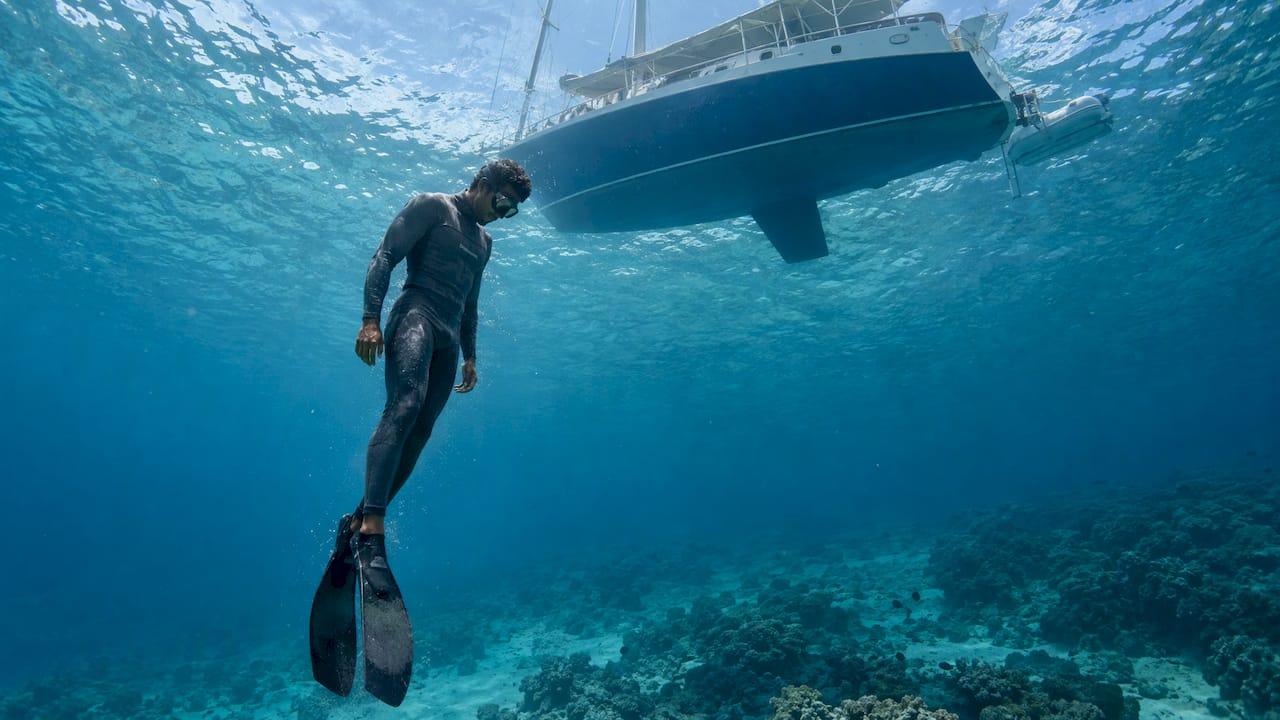
Freediving from a crewed yacht is the quietest way to see the ocean: you anchor over a reef, a wall or a kelp forest, slip in with a mask, fins and one breath, and the boat becomes your private base camp. It works best when the yacht, the crew and the itinerary are chosen around breath-hold diving from the start, not added on as an afterthought. This guide explains what a freediving day looks like, what training you need, where the water suits it, which rules protect the places you will swim, and what to settle with your charter specialist before you sail.
TL;DR
- A yacht gives freedivers what shore access cannot: remote sites, unhurried time in the water, a captain who reads conditions, and a comfortable place to rest between sessions.
- Training matters more than gear. DAN recommends professional instruction, never diving alone, avoiding hyperventilation and watching each other closely after every surfacing.
- Tell your broker early if the group is freediving rather than scuba: it changes the vessel, the crew briefing, the tender and the itinerary.
- Protected areas, such as national marine sanctuaries and marine protected areas, allow diving but often forbid taking anything, so plan around the rules.
- Our brokers are former captains and water sports professionals, and we plan these trips around the water, not the brochure.
Table of Contents
- What freediving from a yacht charter actually involves
- A typical freediving day on board
- Training and experience: what you need before you go
- Safety practices that matter on a yacht
- Where to go: sea conditions and destinations
- Wildlife and protected areas: dive well, leave nothing
- What to confirm before you book
- Which yacht suits a freediving group?
- Our perspective
- Plan your freediving charter with us
- FAQ
- Sources
What freediving from a yacht charter actually involves
Freediving means diving on a single breath, with no tank. On a charter, that usually looks less like a competition and more like a slow, absorbed form of snorkeling taken a few meters deeper: long relaxed breath-ups at the surface, a quiet descent, a pause to watch a ray or a school of fish, and a calm return.
The yacht changes the experience in three ways.

Access. A crewed yacht can reach anchorages that day boats rarely visit, and it can stay there. You are not racing a return schedule, so you can wait for the current to ease, the visibility to clear or the light to reach the reef.
Pacing. Freediving is built on rest. A session in the water is followed by a long recovery, and a yacht gives you shade, fresh water, a meal and a deck to lie on between sessions. That rhythm is hard to match on a crowded day boat.
Support. Your captain chooses the anchorage and sets the anchor. The crew can brief the plan before each entry, run the tender, watch the surface and help with gear coming aboard. On a well-run boat, someone is always looking at the water.
One point of difference is worth understanding. Many dedicated US freediving boats run freediving-only days and carry no scuba gear at all. A luxury charter is more flexible: some of our yachts carry scuba equipment and instructors, so a mixed party of freedivers, scuba divers and non-divers can share one boat. If that is your group, our guide to charter yachts with scuba diving onboard shows what is available.
A typical freediving day on board
Every itinerary is different, but a well-planned day tends to follow a pattern like this:
- Morning briefing. Over breakfast the captain and dive lead go through conditions, the chosen site, entry and exit points, who is buddied with whom, and the signals for surface support.
- Positioning. The yacht moves to the anchorage while you prepare. The captain sets the anchor and confirms the swim area is clear of traffic.
- First session. Buddies enter together, warm up with easy dives and stay within their own limits. A crew member watches from deck or tender.
- Lunch and rest. A proper break matters. Eat lightly, hydrate, and let your body recover before going back in.
- Second session. Often deeper into the site, or a different site, once the group has settled into the water.
- Evening anchorage. Gear is rinsed, stories are traded, and the next day is planned around what you saw.
As a reference for how organized freediving days run in the US, one dedicated boat operation describes a day with a briefing at anchor, two long in-water sessions and a lunch between them, with some days given over to hunting in open zones and others to camera-only runs through kelp where taking nothing is the rule. On a private yacht you set your own version of that rhythm, which is the real luxury.
Training and experience: what you need before you go
Be honest about experience when you enquire. Freediving is a skill, and the safe way to enjoy it is to match the plan to the least experienced person in the water.
Certification
Some dedicated freedive operators ask for a specific freediving certification level and will not accept scuba cards in its place. One US charter outfit, for example, requires proof of a minimum Level 1 freedive certification for its split charters, citing insurance and safety. A private yacht is not bound by that rule, but it is a useful benchmark: if you have never taken a freediving course, take one before the trip. A short course teaches breathing technique, equalization, rescue skills and how to know your limits, and it will make every dive on the charter better.
Recent practice
Some operators also ask that you have dived recently. One US dive charter, for instance, asks guests to have dived within the past 12 months or complete a reactivation. If your last open-water session was years ago, spend a few pool or shallow sessions with an instructor before you fly.
Fitness and health
You do not need to be an athlete, but you do need to be comfortable in open water and able to equalize easily. If you have a heart, lung or ear condition, or take medication, ask a physician familiar with diving medicine before you book.
Safety practices that matter on a yacht
The most important thing to know about freediving is that the main risk, loss of consciousness from low oxygen, can strike without warning and usually near the surface. DAN's guidance on breath-hold hypoxia says shallow-water blackout is most likely on the final ascent or just after reaching the surface. That is why the practices below are non-negotiable.
- Never dive alone. Every diver has a trained buddy. The common method is one up, one down: one person dives while the other stays at the surface, watching and ready to help. DAN notes this can offer some protection during simple shallow activity.
- Observe after surfacing. The buddy keeps eyes on the diver and watches for at least 30 seconds after the diver reaches the surface.
- Do not hyperventilate. Rapid, forced breathing before a dive is a recognized hazard. Use slow, relaxed breathing instead, as you would be taught in a course.
- Keep depth and time conservative. On holiday, do not chase personal bests. The aim is to enjoy the place.
- Separate freediving from scuba on the same day. If your group includes scuba divers, ask your instructor how to sequence activities and surface intervals, and follow their advice.
- Brief the crew. A crew who knows what freediving looks like will not mistake a still diver at the surface for a casual swimmer.
Our own safety briefing guide for charterers covers what every guest should hear on arrival, and our captain-vetted safety guide for diving yachts explains what to ask about equipment and procedures before you commit.
Where to go: sea conditions and destinations
The right destination depends on your experience, your comfort with cold water, and what you want to see. Here is how the options stack up for a freediving-led charter.
| Region | Typical appeal | Water and season notes |
|---|---|---|
| California Channel Islands | Kelp forests, sea lions, rocky reefs | PADI notes California is warmest from June to August |
| Pacific Northwest | Cold-water life, dramatic scenery | Per PADI, about 45–53°F in December and January and around 64°F in June and July |
| Hawaii | Clear water, reefs, lava-tube caves | Warm, clear conditions suited to line diving |
| Florida and the Keys | Reefs, caves, springs | Varied sites from offshore reefs to inland springs |
| Remote tropics (Galápagos, French Polynesia) | Big marine life, clear water | Some of the most sought-after destinations for a long yacht itinerary |
The US rows above come from PADI's overview of freediving in the USA. Abroad, the remote tropics are where a yacht earns its keep. The Galápagos and French Polynesia are two of the places we plan most often for guests who want wildlife, drama and space, and both reward patient, relaxed breath-hold diving. Conditions, permits and the rules on guides differ by country and by park, so we check them for your dates before we recommend a route.
Choosing by conditions, not by name
- Visibility and current. Calm anchorages with gentle current suit newer freedivers. Drift dives and open-ocean blue water suit experienced groups with proper surface support.
- Water temperature. Cold water changes your wetsuit, your weights and your endurance. Ask us what thickness the season calls for.
- Entry and exit. A swim platform or a tender with a low boarding point makes a real difference after a long session.
- Shelter. A good captain keeps a lee option in mind for every site.
Wildlife and protected areas: dive well, leave nothing
Some of the finest freediving in the US is in protected water. NOAA's sanctuary diving guidance describes swimming through giant kelp forests, spotting nurse sharks near coral ledges and visiting shipwrecks, and it asks divers to watch wildlife from a safe distance, avoid harassment and leave underwater souvenirs where they are.

The law backs this up. NOAA Fisheries states that it is illegal to harass, feed, capture or injure marine species, and it advises watching from a respectful, legal distance.
Marine protected areas add another layer. At Anacapa Island in California, the park's own signage says diving, surfing, swimming and boating are allowed in its MPAs, while fishing is restricted. The reserve prohibits taking any living, geologic or cultural resource, and the conservation area has specific exceptions for lobster and pelagic finfish.
What this means for your trip:
- Decide up front whether anyone intends to spearfish. Fishing rules, licenses and no-take zones vary by site, and they decide where the yacht anchors.
- Plan photography days. In no-take areas, a camera is the best souvenir, and a good photo run is a full day's pleasure.
- Keep your distance. Give sea lions, turtles, sharks and rays room, and never chase or touch them.
- Let the captain check the rules. Regulations change, so your captain and broker should confirm the current status of each site before you arrive.
What to confirm before you book
A freediving charter is only as good as its preparation. These are the questions we go through with every freediving party.
The vessel
- Is there a swim platform, a low-freeboard tender or a ladder that is easy to use with fins?
- Is there deck space to rinse and store long-fin gear, wetsuits and weight belts?
- How many guests can be in the water at once with proper surface cover? Some dedicated freediving boats limit in-water numbers, with one US spearfishing charter allowing up to four divers in the water on a six-passenger trip, and the same logic of small groups applies on a private yacht.
The crew
- Does anyone aboard have freediving or water-safety training, and is a rescue plan agreed?
- Will the crew brief each session and help with gear on and off the boat?
- Can the captain adjust the schedule around weather and tides without pressure?
The equipment
- What do you bring and what does the yacht carry? Most serious freedivers bring their own mask, fins and suit; the yacht supplies the platform and support.
- Are surface marker buoys and lines available if your plan calls for them? Some dive operators require guests to carry a marker buoy and finger spool on every dive.
- Does the yacht carry first aid and emergency oxygen, and does the crew know how to use them?
The paperwork
- Share certification cards and recent dive history early.
- Check your travel and medical insurance, and ask whether it covers breath-hold diving.
- Confirm any permits or guide requirements for national parks and reserves on your route.
Our article on booking a yacht dive instructor walks through the steps a broker takes when you need qualified instruction on board, and our piece on dive-focused itineraries explains why planning the route around the water pays off.
Which yacht suits a freediving group?
There is no single best boat; the right one depends on your group, your route and your style.
- Catamarans offer wide, stable decks and generous swim platforms, which many freedivers appreciate for easy entries and exits. Browse catamarans or power catamarans for steady, spacious platforms.
- Sailing yachts suit guests who enjoy the passage as much as the destination and are happy with a slower pace between sites. See our sailboats.
- Motor yachts cover distance quickly, which matters when the best sites are far apart. Explore motor yachts.
- Larger luxury yachts bring more cabins, more crew and space for families and mixed groups; see luxury yachts. If you are traveling with several couples or a larger family, a 6-cabin yacht or a 4-cabin yacht may fit the group.
If your itinerary includes scuba as well, our selection of charter yachts with scuba diving onboard in selected locations is a good place to start.
Our perspective
Most people who ask us about freediving have already done the hard part: they have fallen for the idea of being in the water with nothing but a mask and a breath. What they need from us is the rest of the picture.
We were captains and water sports professionals before we were brokers, so we think about a freediving charter the way a skipper does. Where will the swell be? Which anchorage has the clear water at ten in the morning? How does a guest climb back aboard after an hour of diving? Those details decide whether a day feels effortless or stressful, and they are the details we plan around.
We would suggest choosing the destination for the conditions and the wildlife, then the yacht for the platform, the crew and the pace. A remote itinerary with a crew who understands breath-hold diving gives you something no day boat can: time. Time to wait for the light, to repeat a dive you loved, to rest, to go again.
Tell us your experience honestly, including who is a seasoned freediver and who is a first-timer. We will shape the plan so that everyone aboard has a wonderful week.
Mo
Plan your freediving charter with us
We plan fully crewed charters, from sailing yachts and catamarans to motor yachts and expedition vessels, around remote destinations and immersive time on the water, with diving and wildlife at the center. Tell us where you want to dive, who is coming and how much experience the group has, and we will match you with yachts and crews that fit.
Start with our full range of luxury yacht charters and speak to a yacht charter specialist about a freediving itinerary.
FAQ
Do I need a freediving certification to freedive from a charter yacht?
Requirements depend on the operator and the destination. Some dedicated freediving boats ask for a minimum certification level and proof of it, and scuba cards may not count. On a private charter we recommend at least an introductory freediving course, because the safety skills it teaches, such as buddy rescue, apply to every dive.
Can freedivers and scuba divers share the same yacht?
Yes, many yachts suit a mixed group. Some of our charter yachts carry scuba equipment and instructors, while freedivers use the same anchorages with their own buddy system. Ask your broker how sessions will be sequenced so everyone has safe surface support.
What is the safest way to freedive from a boat?
Never dive alone, use a trained buddy, avoid hyperventilation and watch the diver closely after every surfacing. DAN advises close observation for at least 30 seconds after the diver reaches the surface. A crew member watching from the deck or tender adds a second layer of cover.
Can I spearfish on a yacht charter?
Only where local rules allow it. Marine protected areas and sanctuaries may forbid taking any marine life, and licenses and species limits differ by site. Tell us in advance, and your captain will plan anchorages around the regulations.
Sources
- Hypoxia in Breath-Hold Diving, Divers Alert Network
- Freediving in the USA: Everything You Need to Know, PADI
- Diving into your National Marine Sanctuaries, NOAA
- Watching Wildlife: How to Share the Shore and Sea with Marine Animals, NOAA Fisheries
- Anacapa Marine Protected Areas, National Park Service